How to blend your individual progress with the coaching resources (virtual and in person) available to you. How can I do each part better, not how can I do more.
Timestamps
When you do not have a coach with you all the time you will be self-coaching or doing peer-to-peer coaching. Key is not how to do more but to have a pathway (not just this pathway). The training program shows what to do today; the pathway shows you what comes next so you see your own progress.
Masters are all on an individual pathway. You need to know where you are on the journey and what comes next. Your training program is part of a training block of 2-5 months during which you have a specific end goal which may be a race. Base training is happening now with fitness, endurance and robust technique to set you up for 2027. This involves low rate endurance and so you have plenty of time each stroke to think and check that your technique is having the effect you want each stroke. Athletes who tend to zone out - this doesn't serve you well. You will slip off the rowing pattern you should be working to improve. The Faster Masters Rowing training program has notes below each workout which are detailed and explicit. In there are goals to set yourself for your skill, strength and capability. How to gauge your progress - our program structure includes repeated workouts - so you can learn the workout and note your progress from the previous time you did it. They may include a technical focus, a drill or skill with a reference video you can watch that shows you how to do it correctly and points you to things which may be going wrong that you hadn't noticed. This is the advantage of working with an experienced coach.
Ask your coach what is my one thing I need to learn or achieve for this training block? A singular focus allows you to sharpen your mind. On the website is the rowing skills ladder with beginner, intermediate and advanced skills for you to self-assess.
Find what you need to learn next.
Find what you need and locate the gaps. Always be ready to go back to the beginning of the stroke cycle and re-learn each part over again.
Why the rowers, crews and clubs that cope best are not the ones where nothing goes wrong. They are the ones that can change direction when the plan falls apart. Resilience isn't powering through with brute force, it's the ability to adapt to try a different approach and let go of what's not working (in the boat, the crew, the club). Same question every time - What's our next move from here?
Timestamps
The perfect picture of life when the obstacles are bigger and the path isn't straight. In rowing we get situations where a pivot is needed. Ross was right you do need to have the ability to pivot.
In technique you find the coaching approach isn't working - trying harder may just create tension, stress and no improvement. The pivot is to change the approach not the effort. Have a different cue (aural not verbal) or body position which is a different way to achieve the change. Try video, try it on the erg, in the single, slower / faster. All these approaches enable you to make a change by thinking about a pivot to a different way to do it.
You want to get a group together to do something - it often doesn't work. It can be hard to break into a group which appears to be already sorted. Don't wait for the "perfect" lineup - think about changing the approach instead. Row with the crew you've got - cut an eight into a four, have a regular list of alternates/substitutes who can come at late notice. We often suggest building your own crew rather than trying to break into an existing crew. Ask new joiners to try rowing a quad on a Wednesday. Look at the Learn to Row graduates and pick out a few who might be able to join you. "super stars" may get invited to join the fast crowd but most of us don't get selected like that. Be available to be the regular substitutes when the fast crowd crew needs an extra person. This can lead to the two crews blending and helping each other out - it builds trust.
Things break - often just before an important regatta. Or the club has no money to do what you want to do. Your pivot could be to start with what you have. Can you borrow or share a boat? Could you run a club repair day and invite the local boat builder to show you how to do repairs on site? Ask if someone has tools who could lead a working bee to fix up the club house - simple things that don't require a lot of expertise.
Other fundraising ideas can come from other sports - would a group watch party for a coaching video be fun? Sell food at the same time. when things don't go to plan, shouting Pivot louder is not a solution. Keep asking the same question "what is our next move from here?". Listen to the quiet people - the introverts - they often have good ideas and get shouted down by the loud folks.
These things compound and that can become the "new normal" for your club.
Hip extension is dominated by the three muscle groups - hamstrings, glutes and paraspinals. Get the timing right, your back becomes the connector between them.
Timestamps
The legs, back and arms deliver the power and part way through, the back changes its job. Triple extension means three joints opening together. Starts with pushing onto the feet and quads work to straighten your knees. The hip extension uses hamstrings and glutes to activate and throughout the paraspinal muscles keep your trunk firm.
The hip hinges twice each stroke - once on the power phase and once on the recovery. When you hinge on the recovery the spine is neutral - it's not actively working the muscles. But on the drive phase the same hinge action opens up the back angle. In the drive phase there is a 'hand off' between the legs and back muscles.
Classic rowing technique suggests using the back swing after the legs are 50% used up. This is when the back changes its job. As the legs start the drive your back is holding its leaning forward angle as part of the kinetic chain linkage. The back starts to be part of the hip hinge activation at this point. Your glutes are the hinge joining back to legs and learning how to activate the glutes is difficult. You need to learn this.
One way to do this is to clench your butt muscles. The back's job is to continue the acceleration through the water that the legs have begun.
If you take the catch by partially using your arms, that muscle is not available to use at the end of the stroke in the arm draw. Similarly, if you use your back to place the oar in the water at the catch, you have less back to use later in the power phase, because you've used it up already. This limits the potential of your stroke.
The back movement is not the same in big, faster boats. The boat moves faster through the water and so your leg drive finishes sooner and the timing of the back swing starting is also earlier. Feel the difference by experimenting with your back timing - watch your puddles to see the effect. To learn this - increase the load while you row so you can feel the muscles working against the increased gearing.
Train your back to do this movement by isolating the back swing - train it on its own. Tighten your glutes as you rock forward, start the stroke and move your back more dynamically. The drills compendium has a drill to teach this and a video explainer. As you add in more body parts (arms, legs) the oar must continue to accelerate through the water. Keep the back swing active and dynamic as you add in more body parts.
Bruce Ware spoke to the Coach Mastermind Group
Is your diet really enough to support the training you're asking of your body? Or are you spending money on supplements that do more for the marketing department than for your rowing?
In this episode you'll discover why the official dietary guidelines are a floor for survival rather than a target for masters athletes, and how much protein an active older rower actually needs to recover and build strength.
Our guest Bruce, a 68-year-old sculler and former bodybuilder with a career in statistics and experimental design, walks us through the short list of supplements he believes are worth the money, the ones he's quietly dropped, and what a real week of eating looks like when you're lifting heavy two to three times a week and rowing on the other days.
You'll also hear practical tips from the Q&A on snacking, pre-bed protein, eating before early sessions, and why "know your own body" is the best rule of all.
Eat well, then close the gaps. Food comes first, and supplements fill the shortfall between what your diet supplies and what your training demands. Bruce's two non-negotiables are protein and creatine monohydrate.
Protein needs are higher than the guidelines suggest. The standard recommendation of 0.8 g per kg of body weight is a minimum. Bruce works to around 1.6 g per kg and spreads it across four or five meals or snacks, because older bodies make better use of protein in regular smaller doses than in one big meal.
Creatine is the best-researched supplement there is. Most of us get only a gram or two a day from food. Bruce takes 5 g of creatine monohydrate daily in his morning coffee, and talks about the emerging (and still early) research into creatine and brain health.
Be sceptical of the next big thing. Magnesium helps Bruce sleep but hasn't touched his cramps. Collagen may or may not help his joints, but it adds 18 g of protein to his day, so it stays.
Recovery is where masters rowers win or lose. You don't get stronger in the gym, you get stronger recovering from it, and sleep is where most of that repair happens.
00:00 Welcome, and what supplementation is actually aiming at
01:45 Bruce's story: a holiday photo, a "dad bod" and a move into bodybuilding, then rowing
05:15 What a masters athlete needs: nutrition, strength, power, endurance, recovery and sleep
07:30 Why early strength gains come from the nervous system before the muscles grow
08:00 Training versus practice, and rowing as a hybrid endurance and power sport
10:15 Recovery, age-related decline and protecting yourself from injury
12:30 The official dietary guidelines and why they're bare minimums
15:00 Protein: how much, where to get it, plant proteins and amino acids
19:00 Why spreading protein across the day matters for older athletes
19:30 Creatine monohydrate: dose, saturation and the different forms
23:30 Creatine and the brain
24:45 Research versus marketing: magnesium and collagen
27:45 Bruce's own numbers: calories, protein, carbs and fat
29:45 What he eats on lifting days and rowing days
33:00 Q&A: snacks, nuts, a protein shake before bed and peanut butter before early outings
35:15 Tracking workouts and concurrent strength and conditioning
37:15 Power strokes in steady state sessions, and the UT versus category naming muddle
40:30 Why don't the guidelines differ by age or sex?
42:00 Science versus art: should your arms bend at the catch?
44:00 Know your own body, and wrap-up
Resources mentioned
Bruce's slides: below
Nutrition Intensive with sports dietitian Elizabeth Avery
Polar Flow (workout and heart rate tracking app)
Join a future Coach Mastermind session.
This episode is for general education only and isn't medical advice. Check with your doctor or a registered dietitian before starting any supplement, particularly if you have a health condition or take medication.
A guest article by Karen Jewell
It was a long time in the making, but several years ago the marriage of rowing and SUP finally happened, at least in my neck of the watery woods.
At the time, I was involved with both sports, and had a strong affection for each individually. Having connections with fellow athletes on all sides, I was saddened to learn that, at that point, they did not seem to get along very well.
There were some reasons that were understandable, I suppose, like the fact that each sport thought they owned the particular river that they were sharing. Granted, the rowers had been there first, and when the SUP crew claimed a spot and set up shop just a few doors down from the established boathouse, they were not too pleased, to say the least. Do you remember the old tale of the Hatfields and McCoys? Well, it was something similar to that.
As time went on, and the summer season was in full swing, it was clear that the prestigious rowing club wanted nothing to do with the newcomer SUPers. Steeped in tradition, the rowing club had more of a feel like the respectable tea parties in London, and they liked the formality of that. When it came to the SUP crew, they were a bit more like the fraternity at the local university, with a much more casual air about them. (Nothing negative about either, by the way. Just totally different personalities.)
Unfortunately, as you can imagine, the two did not mix well. You know the science project of mixing oil and water? Yeah, that’s it.
Well, just as you might expect, the perception of the river seemed to get smaller and smaller each day, until it appeared that it was just not going to be big enough for the two of them. Something had to give, and neither side was ready to surrender their stake. I will spare you the messy details, but suffice it to say that on one particular day there was a bit of a clash - literally (no injuries, thankfully). Neither side was necessarily at fault, but at the same time, neither side was necessarily not at fault.
But then something amazing happened.
Little by little, the rowers started to open up to their new neighbors. Instead of keeping their heads forward and focused when rowing, here and there the staff on the SUP dock would receive a subtle nod or even a slight smile from one of the crew members passing by.
Then, during mid-day hours when the rowing club was typically quiet between the early morning and late afternoon training sessions, a few of the rowers would start to come and try out the paddle boards. Incognito, of course.
Hoping to keep that ball rolling, some of the SUP staff decided that they would like to try their hand at crew, so they signed up for a few of the introductory beginner lessons at the reputable rowing club.
Well, guess what? It turns out that the tea party group actually likes to kick their shoes off and loosen their ties every now and then, and the fraternity members apparently like to add a little class to their daily routines every once in a while.
The road was a bit rocky there for a bit, but suffice it to say, they ultimately came to terms and the marriage is now official.
And can I just say what a relief that is for yours truly? It really was getting challenging sneaking under the fence between the Hatfield property and the McCoy estate.
Karen Jewell is a freelance writer currently living in Fairfield County, CT. Karen has received three Certificates of Merit for Outstanding Submissions in the Sailing Columns Category for the John Southam Awards, one in 2005 and two in 2006.
How long it actually takes for a training program to feel like it's working.
I've had some version of this conversation more times than I can count.
A rower gets in touch, keen and ready to go. They've decided this is the year they get serious about their training. They want a program, and they want it now. Understandable. But almost every time, the first thing I have to do is talk them out of starting the way they want to start.
Here's what they usually want: three volume-heavy sessions a week, a big jump in intensity, and results within a month. Here's what actually works: building the base slowly, tolerating a few weeks of feeling like you're going backwards, and trusting that the technical work you're doing now is what makes the fitness work later.
I've been coaching masters rowers for 25 years, and one pattern shows up again and again. The rowers who rush the early weeks, who skip the basics, the drills, the stroke sequence because they'd rather just row fast, who push volume before their technique can hold up under fatigue, are the ones who plateau or get hurt.
The rowers who commit to a slower start are, almost without exception, still rowing a year later, still improving, and enjoying it more.
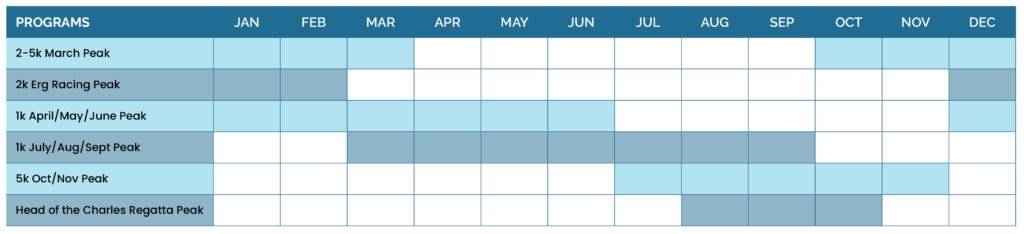
Take a look at what our base training months look like on a Faster Masters Rowing Program.
There are several programs available simultaneously - you pick the one best suited for the date of your next race.
When you start a proper, periodised training programme, the first few weeks are mostly invisible work. You're grooving technique, getting into the rhythm of training and managing your recovery. You're building the aerobic base that everything else sits on. None of that shows up as a faster split or a better feeling on the water, not yet.
This is the phase people are most tempted to cut short. They want to feel like they're training hard, and slow technical work doesn't feel hard in the way a big erg session does. So they add volume too soon, or drop the skill drills, in an effort to feel like they're making progress.
It usually backfires. Technique that hasn't been embedded falls apart exactly when you need it most, under fatigue, in a race, in rough water. And an aerobic base that's been rushed doesn't hold up either. You end up training in the "grey middle" where the easy rows are too hard and the hard rows are too easy.
Using our 1k April May June peak program as an example - this begins in December. Like all our programs you need to do at least 3 workouts a week. The priority ones are marked with an asterisk * in the download.
December base preparation (weeks 1-4) has three Cat 6/ UT2 sessions, one Cat 5/ UT1 intervals and up to two strength or additional Cat 6 / UT2 sessions.
January base preparation (weeks 5-8) first fitness gains become noticeable as we repeat workouts you will see improved splits and faster recovery between workouts. The session profiles are similar but the top stroke rate is now up to 26. An additional 300 hard strokes builds on the December base.
February specific preparation one (weeks 9 - 12) has two Cat 5 / UT1 sessions and one Cat 4 / AT working over the 1k race distance at sub-race stroke rates. Additionally one of the base workouts is now at UT3 (low Cat 6) to build base fitness and improve technique at low rates.
By March specific preparation two - the stroke rates are up to 30 for big boats and 28 for small boats with more 1k race distance workouts are in the program - including a race trial on the last Saturday of the month. The repetitions are there so you can monitor your progress when doing the same workout several times.
April specific preparation two is the first month where 1k peak races are happening. You may do a trial race or this may be your big event. More Cat 4 / AT workouts over measured distances (500, and 1k) to build familiarity and pacing expertise.
May and June, continue the build up to race events with elements of race strategy included in the training including racing starts, power starts, sprint finishes and stepping up and down in rate.
It's not a fast process. But it's a lot faster, and a lot more durable, than the stop-start version most people default to: train hard for six weeks, stall or get injured, take time off, start again from scratch.
I still tell rowers the truth about how long it takes. Some of them go elsewhere, looking for something quicker. Most of them, once they understand why the early weeks matter, settle in and do the work.
The ones who do are, almost without exception, the ones still improving a year from now. They buy an annual training program from Faster Masters Rowing and take breaks between their big events because they know we have got their training planned in a manageable build-up over the full masters rowing calendar.
Ask us anything. Support is here when you need it
If you want to trial a program, buy it. You can cancel at any time. The full suite of programs and pricing is here.
See you on the water!
We received an enquiry from a Faster Masters Newsletter reader.
I'm a Masters rower who has just been diagnosed with osteoporosis. The general advice is that rowing/strength training etc are good if done correctly but I wondered if you had any rowing-specific advice or guidance around this? I'm thinking about all the other things that we do around rowing (boat lifting/carrying in particular), as well as the relative risks of sweep rowing versus sculling. Do you know of any guidelines?
Thanks for any help or pointers you can provide.
Josh replied saying - this advice is very generic, I’m an orthopaedic surgeon.
First answer, it depends…
1. How was diagnosis made (i.e. proactive GP or after fracture)
2. How bad is the osteoporosis.
3. How old? Ie where on the curve of loss/maintenance.
4. Gender
Etc
But in general;
1. If their back’s ok, lifts and everything are fine.
2. Sculling is generally kinder on body, but just alternate sweep positions (port to starbourd) if you’re enjoying it.
3. Weight bearing exercises are key to bone maintenance and muscle mass, so add this to your program.
4. Good shoes on ramps etc to avoid falls
5. Use your club mates. Ask for help with lifts etc if people are around, it’s the fun part of clubs.
6. Talk to your specialist/GP.
7. Work on technique and boat setup to protect your back.
8. Talk to your team mates & coach, there will be others.
Very generalised I know, but hard to give specifics, osteoporosis has a wide spectrum of impacts.
Follow one hand through one stroke in sweep rowing. Your outside hand is a second oarlock - controlling the handle when the blade is under the water.
Timestamps
Visualise your outside hand tracking through one stroke. It's setting the height for the oar. It goes through the longest arc. You get control for catch and finish timing from the outside hand, force on the face of the spoon and rhythm.
When the oar goes into the water, it doesn't move much during the power phase. But the boat is being levered past the oar tip. The pivot point from the end of the spoon is your handle and this is the 'second oarlock concept'. the outside hand times the catch placement and manages the oar depth.
Placement is proactive to make the handle move before your slide stops at the change of direction. Your outside hand moves a greater distance - moves further - than your seat moves. Placing with the inside hand won't give you the same finesse and control compared with the outside hand. This is because it's closer to the pivot point at the oarlock.
Your outside hand knuckles should point forwards towards your feet / the stern. This helps to keep your wrist flat. It also connects the handle through the kinetic chain to your feet.
Look at photos of rowers whose hands are not wrapped around the handle - they are likely using their inside hand to control the handle. The clue is their fingers extended and thumb dropping down not touching the handle.
From 90 degrees square off in the power phase your outside hand loses leverage and your inside hand takes over. Try not to let your elbow point out the side of the boat - let it go along your side ribs and point it to the person behind you.
From this point to the finish you can add power with your inside hand (pull hard).
This controls how the blade comes out of the water and sets the rhythm for the recovery. Use the movement of timing the extraction - sit still while extending the outside hand and arm only to take the oar out of the water and start moving to the stern on the recovery.
Speed of the handle into the body is approximately equal to speed out from the body.
Only move the shoulders after the arm is straight. This makes the rhythm for the recovery. On the recovery the blade shaft should be parallel to the water surface and approximately the same as all the other blades on your side of the boat.
Four jobs for your outside hand
How gripping tighter makes you slower.
In this episode you’ll discover why the tightest grip on the handle is often the slowest stroke, and what to do about it instead. The idea comes from Tai Chi, not the boathouse, but it applies directly to your hands, wrists and shoulders on the water. Here is the reframe. Softness is not the absence of power. It is how power actually travels through the body. Tension blocks it. Softness lets it flow. Soft hands, hard drive. Let's go.
Timestamps
You might think that if you grip harder, you'll row faster but if your thumb is tight, your whole hand is tight. Tension is like a virus - it spreads. A tight thumb leads to tight fingers, wrists, shoulders. Fear of losing your grip or catching a crab when under pressure makes you clamp down instinctively.
How should you hold a blade handle? Imagine you're holding a kitten or a puppy - or like it's a banana - if you squeeze too tight the skin splits and you have squashed banana on your hands.
When you have a tight hand or thumb it locks your wrist and forearm and travels up the kinetic chain of your body. Control and power are two different problems. A tight hand is just stiff and loses strength rapidly. Relaxing while keeping your fingers hooked around the handle gives you control and security.
When trying harder (like when rowing firm pressure) your instinct is to grip harder. This stiffens the kinetic chain and slows the transfer of power from your legs and body to the blade.
Soften your hand grip starting with your thumbs, then move to your fingers and you'll find this also loosens your forearm and try to row with a long neck (drop your shoulders).
A muscle which is already tight finds it harder to activate when you are calling for that muscle to work during the power phase of the stroke. A relaxed muscle is easier to engage and activate to move the boat.
Let your focus come down to the mass of your body and your leg drive doing the work rather than your hands being the driver of effort. Keeping your hands soft allows the mass/weight of your body to make the power.
A mental re-frame - soft hands, hard drive.
Softness isn't weakness it's how explosive power propels the water. Tai Chi says tightness is life running out of a stroke, softness is life flowing through it. Hand tension blocks power and gives you a slower catch, a slower grip on the water. Let this flow into soft shoulders which will enable you to get your body weight behind pushing the blade through the water.
How little energy you burn in one race - about one banana. The real skill is racing more than once in a day - what to eat and drink.
Timestamps
If you have more than one race in a single day you need to fuel appropriately. A single race barely touches your "fuel tank". The key is timing your meals and recovery between races.
A race is not a big calorie burn - about 150 - 200 calories for 1k. Your body stores thousands of calories of glycogen. When you put out a lot of effort you assume the intensity means you are burning a lot of fuel. Separate habit from what you need to fuel on race day.
If you race once in a day - fuel is not your limiter. Your hydration and glycogen are where they need to be if you've had a good meal the night before and on the morning of the regatta. Your job is to feel good on the day. You cannot empty your tank in one sprint race.
Racing more than once in a day the goal is about recovery in the gaps between your races. You have to replace fluid, nudge glycogen up a little but still keep your gut feeling comfortable.
After the first race don't eat a big meal - go small, frequent and easy to digest.
3 levers
Different people find this different - practice and notice what happens to you on race day. Time when you ate and how you feel at the second race. How your tummy feels may affect your nerves and affect digestion rates. Never trial a new food on race day - it's not worth the risk.
I'm not replacing calories, I'm staying ready. - Know you're not depleted removes the panic eating - Fuel for one race by how you feel - Fuel for many races by planning the gaps between races.
Use a race day plan / timetable - add fueling into the timetable and checklist. Here's an article which may help you.
Join our community and get our exclusive Faster Masters Rowing Magazine, packed with tips, techniques, and inspiring stories. Includes four new articles monthly.