With Kim Degutis (Riverside Boat Club, Cambridge MA) and Heather Franklin (Orlando Rowing, East Arm Rowing, NY).
02:30 Coxing a four compared to an eight. Heather - coxing a four (front loader) you can't see behind you. My bow seat is an extra pair of eyes stroke telling me if a boat is coming up behind and stroke seat communicates with other crews. It's great for picking a point beware knowing how wide your oars are because you can't see.
Kim - the eight has a bigger engine and you can see your rowers and help them with technique calls. The pivot point for an eight is like pin a tail on the donkey - it turns differently from a four because it has more mass to get around the corner. Setting up a turn in an eight is easier for visual acuity.
06:30 Bow loaded four gives a different vantage point. The rowers partially obscure an eight's coxswains view. The eight is the "dump truck" or "freight train" of rowing boats. In a four you have to trust the rowers behind you - you need better boat feel to cox it skilfully.
Filling the time can be scary. At the start focus on the rhythm in the boat and steering "inside the gunwales" and to get a good start. The middle section of HOCR is setting yourself up well for bridges and making moves between crews. Overtaking comes later and when the crew gets tired I focus on good technique, rowing smarter not harder and ending with the sprint to the finish line.
I can hear the wheels really loud I know they are digging into their seats and the crew isn't floating up the slide. I freeform some motivational calls for rowers specific to them to prevent them zoning out. Or do a silent 5 or 10 where I listen to the finishes - that makes the rowers realise I'm silent and they need to focus.
13:30 Kim uses landmarks to structure the race. She brings to the focus onto splits, or a technical point to get the crew out of their heads and to feel the flow. She focuses on little bits on the race course. 15:00 Help the rowers to not focus on their pain. We work on this in practice you are a psychology coach.
16:00 Working on 2 modalities - prepare them for what's coming up and at the same time get them to stay in the present to make this a good stroke. The cox is part pilot, part jockey. In a head race pilot is a good start. Heather moves between these two modalities but it depends what's happening around you.
Lean into what you hear at practice from your coach. Those things being worked on will be useful in a race. You can't do power 10s all the time. Get more tools in your toolbox with things the crew has practiced. Also know your race packet (joining instructions) so your crew don't have to think. Kim's advice is to re-learn key words the coach uses - don't beat the crew with endless power 10s. Know the major landmarks and have a plan for the technical calls around the landmarks. Look up under the bridges as you may get into a photograph!
21:30 Tips for motivating
Heather reminds her crew that there is 100 years of experience in the five of us. We have done the work. We are no less qualified for the race than the Olympians in front of us. Marlene believes that training year round takes a crew to a whole other level. Kim's motivational calls for the main is team-specific and situational. It depends on the crew's culture and needs. No two crews are the same. A good cox dials in to their crew which is the difference between coxes who only steer the boat.
Get our ebook on the Ultimate Guide to Head Racing
25:00 Communicating to the crew how to mentally prepare them to row the distance.
Heather says the training has to be there first. We do time trials on our local water and a "ghost race" the crews we are racing against. I pretend we are at the race, I do all the bridges. I practice doing crazy turns and passing crews. I make it as realistic as possible.
Kim says imagine your arch rival crew in front of you. The cox on land tries to find videos of the race and learn the landmarks from the race map so you're prepared to give the crew an additional kick on the chin if needed. If you need to be the "bully on the river" if you aren't rubbing then you aren't racing. I like to make them hurt if they want to pass us. Have the discussion on land first. I sometimes tell them 'the beer is getting cold on the finish line' and 'there's an ambulance waiting for you'. Anything can happen, people will not yield but whatever happens, I will talk to you as we go down the course so you are aware.
Marlene says practicing screwing up and coming back from it.
Join coxswain Kim Degutis, (Riverside Rowing Club, Cambridge, MA USA) as we talk head racing and tips for coxing masters crews. Dive deep as we talk - what's different about coxing masters - how to get a group who want to row eights - advice to anyone wanting to start coxing masters
01:00 Rowing genealogy from our past. Marlene's ancestors were in the first families of Newfoundland, Canada. Alfred Royle was at Ottawa Rowing Club pre WW2. Rebecca's Great Grandfather, WD Caroe Rowed for the First Trinity BC in 1880s. They won the Ladies Plate coxed fours event at St Neots Amateur Regatta winning a solid silver medal, which Rebecca now owns.
05:00 When Marlene started rowing in 1977 Westside RC, Buffalo was the only club in town compared to 1900 when there were 11 rowing clubs.
08:00 Kim Degutis working with the mens masters sweep group of 19 athletes. How Kim got back into rowing - "I saw a single oar with a broken collar and picked it up and returned it to the club and met the crew."
10:30 My first stroke taught me how to cox. I had a great relationship it was sometimes non-verbal.
11:30 what is it like coxing masters? Depends on their age. It can be very intimidating. Be confident and own that seat - they should be respectful. You have to earn the rest by proving yourself. Masters appreciate a cox who is clear and runs a good practice. Know what you are doing. Appreciate that it's not a rower coxing.
13:45 At races coxswains get passed around to other teams. I had to jump out of the boat very quickly for a short turn-around between races. I'm 5' 3" and got very wet. I shoved off the dock too hard and went head over heels into the lake. When we got to the start the referee asked "Did you guys have a pool party?" I now have a reputation of flipping at the start in Canada at the Burnaby Lake Race.
16:30 A serious incident that happened helped me to learn a lesson. On the River Charles, Elliot Bridge is the most dangerous going upstream. Boats coming down stream swerve wide and are hard to see. We 'traded paint' with another crew.
20:00 Advice to anyone thinking of coxing masters.
Take a fun, encouraging approach. You can be more serious if a crew is more competitive. Intonation determines how to speak to them. Word choice matters. Vocabulary matters - explain the technique you are aiming for. Time on the water teaches you a lot. Working with coaches - use the intonation they use and fold this into what you say.
22:30 A competitive crew wants you to be demanding. If you want to go fast you need this.
23:00 How to organise a masters sweep group. We try to make the 8 and he go out together with the 4 being a faster lineup so they can be similar speeds. Kim is an eights specialist. A bow-loader four is very different - it feels different, more intimate, finesse is needed. An 8 is a dump truck - just GO.
25: 00 Working with a new crew - tips. They can have different flexibility and movement patterns and different technique. How do you get them together?
Pause drills work well for timing. Watch them row for 500 meters - see what's happening and look out for technical deficiencies. We do a lot of eyes closed rowing.
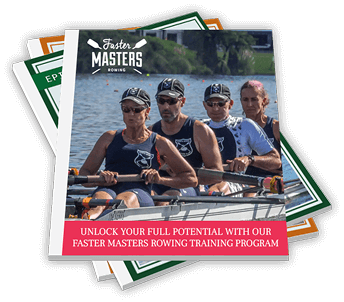
Join our community and get our exclusive Faster Masters Rowing Magazine, packed with tips, techniques, and inspiring stories. Includes four new articles monthly.