Quick Answer
The best training programme for masters rowers over 50 includes: 4-5 sessions per week (not 6-7), polarised intensity distribution (80% easy, 20% hard), mandatory strength training 2x/week, 72+ hour recovery between hard sessions, and clear periodisation with base/build/peak/taper phases. Volume should be 30-40% less than younger athletes, with strategic intensity and recovery prioritised.
Core Principles of Effective Masters programming
1. Appropriate Training Volume
Weekly structure that works:
- 4-5 rowing sessions (not 6-7)
- 2 strength training sessions (45 minutes)
- 2 complete rest days (not "active recovery" that's actually training)
- Total weekly training: 6-8 hours maximum
Why less is more: Your body's recovery capacity has decreased. More volume without adequate recovery creates cumulative fatigue that appears as "plateau" or declining performance. Four high quality sessions beat seven mediocre ones.
Common mistake: Trying to match the volume you did at 30, or the volume younger athletes do. This leads to chronic overtraining and under-recovery.
2. Polarised Intensity Distribution
The split that works:
- 80% easy/aerobic: Conversational pace, building base, recovering actively
- 20% hard/threshold: Race pace minus 2-3 seconds, lactate tolerance work
- 0% moderate: The "junk mile" zone should barely exist
Why polarisation matters: The moderate zone, too hard to recover from, too easy to drive adaptation, is where most masters athletes waste their limited training time. You're accumulating fatigue without getting faster or better.
Weekly application:
- 2-3 easy aerobic sessions (45-90 minutes)
- 1-2 hard threshold/race pace sessions
- Zero sessions in the moderate "no man's land"

3. Mandatory Strength Training
Non-negotiable requirement: 2 sessions per week, 45 minutes minimum
Why it's essential: After 40, you lose 3-5% of muscle mass per decade without resistance training. That's power output disappearing. Rowing alone doesn't prevent this.
What to include:
- Squats (goblet, front, or back)
- Deadlifts (conventional or Romanian)
- Rows (bent-over, cable, or inverted)
- Overhead press / bicep curl
- Core work (anti-rotation, stability)
Progression: Start with bodyweight/light weight, add load gradually. Focus on movement quality over "ego" lifting.
4. Strategic Recovery Windows
Hard session spacing: Minimum 72 hours between high-intensity rowing sessions
Example schedule:
- Monday: Easy aerobic (45-60 minutes)
- Tuesday: Strength training
- Wednesday: OFF or very easy technique (30 min)
- Thursday: Hard threshold intervals
- Friday: Strength training
- Saturday: Long steady state (75-90 min easy)
- Sunday: OFF or race simulation (if competition phase)
Why 72 hours: Complete glycogen restoration, muscle repair, and nervous system recovery all take longer after 40. Training hard before you have achieved full recovery makes you slower, not faster.
5. Periodisation Structure
Annual plan framework:
Base Phase (8-12 weeks):
- Build aerobic foundation
- Establish strength base
- Refine technique
- Volume: Moderate, Intensity: Low
Build Phase (6-8 weeks):
- Add threshold work
- Increase strength training load
- Maintain aerobic work
- Volume: Moderate-High, Intensity: Moderate-High
Peak Phase (4-6 weeks):
- Race-specific intensity
- Maintain strength
- Reduce volume slightly
- Volume: Moderate, Intensity: High
Taper Phase (1-3 weeks):
- Volume drops 40-60%
- Intensity maintained
- Full recovery prioritised
- Race readiness
Recovery Phase (2-4 weeks):
- Active recovery
- Cross-training
- Mental break
- Prepare for next cycle
Sample Week-by-Week programme
Base Phase Example (Week 4 of 12)
Monday: 45-60 min steady state (rate 18-20, conversational) Tuesday: Strength - Squats 3x8, Rows 3x10, Core circuit Wednesday: OFF Thursday: 45 min easy technique (rate 18, focus drills) Friday: Strength - Deadlifts 3x6, Press 3x8, Stability work Saturday: 90 min long aerobic (rate 18-20, steady) Sunday: OFF
Key features: High aerobic volume, building strength, minimal intensity
Build Phase Example (Week 6 of 8)
Monday: 60 min steady state (rate 20) Tuesday: Strength - Squats 3x6 (heavier), Rows 3x8, Core Wednesday: OFF Thursday: Threshold intervals - 4x6 min at race pace -2 sec, 3 min rest Friday: Strength - Deadlifts 3x5 (heavier), Press 3x6 Saturday: 75 min aerobic + 3x5 min at threshold (embedded intervals) Sunday: OFF
Key features: Adding intensity, maintaining volume, progressive strength loading
Peak Phase Example (Week 3 of 6)
Monday: 45 min easy (rate 20) Tuesday: Strength - Squats 3x5, Rows 3x8, Power work Wednesday: OFF Thursday: Race pace work - 3x3 min at race pace, 4 min rest Friday: Strength - Deadlifts 2x5, Press 2x6 (maintenance) Saturday: Time trial or race simulation (1K test repeats) Sunday: OFF
Key features: Race-specific intensity, reduced volume, strength maintenance
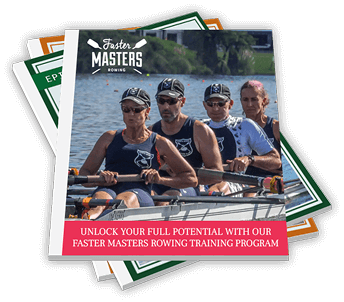
Sample Faster Masters Rowing Training Program
Training Session Types Explained
Easy Aerobic Sessions
Purpose: Build aerobic base, promote recovery, increase training volume safely Intensity: 60-70% max HR, conversational pace Duration: 60-90 minutes Rate: 18-20 spm Feel: Could sustain for hours if needed
Threshold Intervals
Purpose: Improve lactate threshold, build race-specific endurance Intensity: Race pace minus 2-3 seconds, ~80-85% max HR Structure: 4-6 x 5-7 min with 2-3 min rest Rate: 20-22 spm Feel: Sustainable discomfort, heavy breathing but controlled
Race Pace Work
Purpose: Practice race intensity, build lactate tolerance Intensity: Actual 1K race pace, ~90% max HR Structure: 4-8 x 2-3 min with equal rest Rate: 22-24 spm Feel: Uncomfortable, "can I actually sustain this?"
Long Steady State
Purpose: Build aerobic capacity, mental endurance Intensity: 65-75% max HR Duration: 45-120 minutes Rate: 18-20 spm Feel: Comfortable but purposeful
What to Avoid
Red Flag #1: Too Much Moderate Intensity
If most sessions are in the "sort of hard" zone (75-80% max HR), you're in trouble. This intensity is too hard to recover from but too easy to drive adaptation. Polarise your training.
Red Flag #2: Hard Sessions Too Close Together
Thursday hard intervals → Saturday hard steady state → Tuesday more intervals = recipe for overtraining. You need 72+ hours between high-intensity work.
Red Flag #3: No Strength Training
If you're only rowing, you're losing muscle mass and power every year. This isn't optional,it's foundational, particularly for post-menopausal women.
Red Flag #4: No Clear Periodisation
Training the same way year-round with no structure, no build phases, no recovery weeks. Your body needs variation and planned recovery to adapt.
Red Flag #5: Insufficient Recovery
Only 1 rest day per week, "active recovery" that's actually moderate training, sleeping <7 hours. Recovery is when adaptation happens.
How to Choose or Modify a programme
Questions to Ask:
1. Does it account for age-specific recovery?
- Look for: 72+ hour spacing between hard sessions, 2 full rest days
- Red flag: Daily training, hard work 3-4x per week
2. Is intensity properly distributed?
- Look for: Clear easy/hard distinction, polarised approach
- Red flag: Everything is moderate intensity, no structure
3. Does it include strength training?
- Look for: 2x per week dedicated resistance work
- Red flag: "Optional" strength work, or none at all
4. Is there clear periodisation?
- Look for: Base/build/peak/taper phases, planned recovery weeks
- Red flag: Same training year-round, no variation
5. Can it be sustained long-term?
- Look for: Reasonable time commitment (6-8 hours/week total)
- Red flag: 10+ hours weekly, unsustainable in real life
Related Questions
- Do masters rowers need different training than younger rowers?
- How much can I actually improve my 1k time at age 50?
- Should I hire a rowing coach as a masters athlete?
- Is it worth doing strength training for rowing at age 50+?
Get Age-Optimised programming
Our Masters Performance programme is designed specifically for competitive athletes 40-65+:
- Monthly periodised plan with clear phases
- Proper recovery spacing for masters physiology
- Integrated strength training protocols
- Technical progressions and video library of drills
- Pacing strategies for 1K and 5k racing
No more guessing if your training matches your age. Get programming that actually works for your body.
Join our newsletter for free weekly training insights specifically designed for masters rowers.