Quick Answer
You're likely experiencing one or more of these issues:
- training with inappropriate volume for your age
- insufficient recovery between sessions
- declining muscle mass without compensatory strength training
- using training methods designed for younger athletes that no longer match your physiology
The Core Problem
If you're over 40 and training as hard or harder than ever but seeing your splits slow down, you're not alone, and you're not doing anything obviously wrong. The problem is that "training hard" means something fundamentally different after 40 than it did at 25.
Why "Traditional" Training Fails Masters Athletes
Volume doesn't equal results anymore. Your body's ability to absorb and recover from training volume decreases significantly after 40. What used to work (high volume, frequent sessions, minimal rest) now leads to chronic fatigue and declining performance. You're not undertrained; you're likely overtrained relative to your current recovery capacity.
Your VO2 max ceiling has dropped. Even well-trained masters athletes see roughly 10% decline in VO2 max per decade after age 30. By 50, you're working with 70-80% of your previous peak aerobic capacity. No amount of volume training changes this, it's physiology. Masters athletes who stay competitive move their training focus from volume to strategic intensity.
Recovery timelines have doubled. Where you once needed 24-48 hours between hard sessions, you now may need 72+ hours for full recovery. If you're doing high-intensity work more than twice per week, you're accumulating fatigue faster than you're recovering. Every "hard" session you do while incompletely recovered makes you slower, not faster over the long term.
The Three Hidden Culprits
1. Muscle Loss (Sarcopenia)
After 40, you lose 3-5% of muscle mass per decade without intervention. That's not just aesthetic, it's power output. If you've lost 15% of your muscle mass over the past decade, you've lost 15% of your potential power per stroke. No amount of cardiovascular training compensates for this.
The solution isn't more rowing, it's resistance training. Two 45-minute strength sessions per week, focusing on compound movements (squats, deadlifts, seated rows), can maintain 95% of your muscle mass through your 50s and 60s.
2. Wrong Training Intensity Distribution
Most masters athletes train in the "moderate" zone too much. This is neither easy enough for true base fitness building, and not hard enough for physiological adaptation. This middle-ground training (often called "junk miles") accumulates fatigue without driving improvement.
Your training should be polarised: 80% easy/aerobic base work, 20% legitimately hard threshold and race-pace work. The middle zone barely exists in your training programme.
3. Inadequate Protein and Nutrition
Masters athletes need MORE protein than younger athletes (1.2-1.6g per kg of bodyweight daily) to maintain muscle mass and support recovery. If you're eating like you did at 25, you're almost certainly underfueling your recovery.
What Actually Works
1. Reduce Volume, Increase Quality
Instead of: 6-7 sessions per week of moderate intensity
Try: 4-5 sessions per week with clear purpose. 2 easy, 2 hard, 1 technical
Your body adapts during recovery, not during training. Less volume with better recovery often produces faster results.
2. Add Strategic Strength Training
Minimum effective dose: 2x per week, 45 minutes, compound movements
Focus: Squats, deadlifts, rows, overhead press, core work
Goal: Maintain muscle mass and power output as you age
This isn't optional for competitive masters athletes, it's foundational.
3. Optimise Your Recovery
- Sleep: 7-9 hours minimum, non-negotiable
- Nutrition: Hit protein targets (1.2-1.6g/kg bodyweight), adequate carbs around training
- Active recovery: Easy movement on rest days, not "moderate" training
- Monitor: Track resting heart rate and HRV to catch incomplete recovery early
4. Shift to Threshold-Heavy Training
Since VO2 max becomes less trainable with age, focus on what remains highly adaptable: your lactate threshold. Threshold work (sustained efforts at race pace minus 2-3 seconds) remains trainable and drives competitive performance.
Effective threshold sessions:
- 4-6 x 5 minutes at threshold pace, 2-3 min rest
- 2 x 12 minutes at threshold pace, 5 min rest
- 20-minute steady state at threshold
Related Questions Masters Athletes Ask
- Do masters rowers need different training than younger rowers?
- Why does it take me so long to recover from hard rowing workouts?
- How much can I actually improve my 1k time at age 50?
- Is it worth doing strength training for rowing at age 50+?
Professional Rowing Training Support
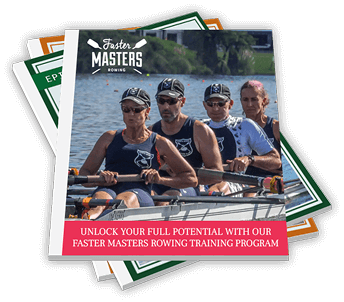
If you're serious about getting faster instead of slower, structured programming makes a massive difference. Our Masters Training Program provides year-long age-optimised periodisation, proper intensity distribution, and integrated strength protocols designed specifically for competitive masters athletes. This self-guided programme is built on testing so that your training zones are correct for YOU at your current age, fitness and rowing experience.
Want weekly masters training insights? Join our newsletter for evidence-based training tips, recovery protocols, and performance strategies delivered to your inbox.