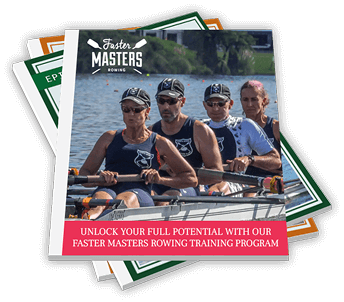
The risks of abrupt changes of your training and surprising outcomes from practice lineups, rigging, and winter to summer transitions with guest Marlene Royle.
Timestamps
00:45 The effect of abrupt changes
Marlene sees these as a red flag for masters rowers. Her experience as a coach when racing season comes around was a trend from mid-summer on where their season got derailed. All were caused by quick changes, unfamiliar boats and doing a training session from another coach on top of their normal training. These are all avoidable.
04:00 Transition from winter to summer
Let your muscles and tendons adapt to different stresses like moving from an indoor rower to a boat. The difference between a sculling erg and a sweep boat is clear in movement patterns. All these abrupt changes resulted in injury to tendons or muscle strain. Rule of thumb for moving onto the water is to start at 50% volume in week one and build up to full training in the new mode over 4 weeks. You won't get as fit on the water initially as you did on the rowing machine so use this time for technique.
07:00 Three injury scenarios
- An athlete with mild tennis elbow changed the grips on her scull handles. The new grips were a different size and it flared her tendonitis. Be aware of any pain (it may be a very small thing).
- Another had a glute / sacrum tendon tenderness and while somewhat fatigued did a practice with another club member and the following day was in a quad doing a race simulation. The boat was rigged high for her and she rowed the quad two days in a row doing another race simulation. This pushed the ligament strain and stopped her rowing for a month.
- Two athletes visited another club for a quad outing and found the rigging/boat changes led to a hamstring strain and the consequent race was "cautious" and not full power. A soft tissue injury takes 6-8 weeks to heal, at best, with physical therapy.
19:00 When in an wobbly boat
The temptation is to stop rowing your normal pattern and instead to "flex" and go with what you feel in the boat. This is an abrupt change in technique and not conducive to protecting your body. If you have a sensitive low back, then an unstable boat can cause a flare up. Common sense - think before you do. Common sense is not very common. For equipment make gradual changes.
Listen to podcast
Further resources
- Transitioning out of winter - podcast [45 minutes]
- Seasonal training plans - winter to summer - podcast [25 minutes]
- Review our training programs - one will suit your needs
Want easy live streams like this? Instant broadcasts to Facebook, YouTube, LinkedIn. Faster Masters uses StreamYard: https://streamyard.com/pal/d/5694205242376192