Supplements for Masters Rowers: Eat Well, Then Close the Gaps
Is your diet really enough to support the training you're asking of your body? Or are you spending money on supplements that do more for the marketing department than for your rowing?
In this episode you'll discover why the official dietary guidelines are a floor for survival rather than a target for masters athletes, and how much protein an active older rower actually needs to recover and build strength.
Our guest Bruce, a 68-year-old sculler and former bodybuilder with a career in statistics and experimental design, walks us through the short list of supplements he believes are worth the money, the ones he's quietly dropped, and what a real week of eating looks like when you're lifting heavy two to three times a week and rowing on the other days.
You'll also hear practical tips from the Q&A on snacking, pre-bed protein, eating before early sessions, and why "know your own body" is the best rule of all.
Key takeaways
Eat well, then close the gaps. Food comes first, and supplements fill the shortfall between what your diet supplies and what your training demands. Bruce's two non-negotiables are protein and creatine monohydrate.
Protein needs are higher than the guidelines suggest. The standard recommendation of 0.8 g per kg of body weight is a minimum. Bruce works to around 1.6 g per kg and spreads it across four or five meals or snacks, because older bodies make better use of protein in regular smaller doses than in one big meal.
Creatine is the best-researched supplement there is. Most of us get only a gram or two a day from food. Bruce takes 5 g of creatine monohydrate daily in his morning coffee, and talks about the emerging (and still early) research into creatine and brain health.
Be sceptical of the next big thing. Magnesium helps Bruce sleep but hasn't touched his cramps. Collagen may or may not help his joints, but it adds 18 g of protein to his day, so it stays.
Recovery is where masters rowers win or lose. You don't get stronger in the gym, you get stronger recovering from it, and sleep is where most of that repair happens.
Episode timeline
00:00 Welcome, and what supplementation is actually aiming at 01:45 Bruce's story: a holiday photo, a "dad bod" and a move into bodybuilding, then rowing 05:15 What a masters athlete needs: nutrition, strength, power, endurance, recovery and sleep 07:30 Why early strength gains come from the nervous system before the muscles grow 08:00 Training versus practice, and rowing as a hybrid endurance and power sport 10:15 Recovery, age-related decline and protecting yourself from injury 12:30 The official dietary guidelines and why they're bare minimums 15:00 Protein: how much, where to get it, plant proteins and amino acids 19:00 Why spreading protein across the day matters for older athletes 19:30 Creatine monohydrate: dose, saturation and the different forms 23:30 Creatine and the brain 24:45 Research versus marketing: magnesium and collagen 27:45 Bruce's own numbers: calories, protein, carbs and fat 29:45 What he eats on lifting days and rowing days 33:00 Q&A: snacks, nuts, a protein shake before bed and peanut butter before early outings 35:15 Tracking workouts and concurrent strength and conditioning 37:15 Power strokes in steady state sessions, and the UT versus category naming muddle 40:30 Why don't the guidelines differ by age or sex? 42:00 Science versus art: should your arms bend at the catch? 44:00 Know your own body, and wrap-up
Resources mentioned
Bruce's slides: below Nutrition Intensive with sports dietitian Elizabeth Avery Polar Flow (workout and heart rate tracking app) Join a future Coach Mastermind session.
This episode is for general education only and isn't medical advice. Check with your doctor or a registered dietitian before starting any supplement, particularly if you have a health condition or take medication.
Returning rowers should start with 3 core water sessions a week at around 50% of normal programmed volume, hold that for two weeks, then add roughly 500m per outing only as recovery allows. Wear a heart rate monitor to catch early fatigue, track daily recovery using a simple HRV app or a subjective wellness score, and do land based strength and mobility work on non water days. The single biggest mistake returning rowers make is comparing current performance to their fitness from decades earlier, rather than building a new baseline for how their body responds to training now.
Why Returning Rowers Need a Different Approach
If you rowed competitively years or decades ago, the instinct is to pick up roughly where you left off. Almost every returning rower we work with underestimates how long real recovery takes after 40, and overestimates how much training volume they're actually managing once running, Pilates, or other cross training is added into the week.
One member who came back to rowing after years away put it well in a note to her coach: she'd built up steady mileage on the water but felt weak and dispirited when she tried faster sessions, and found her splits didn't match what she expected given how long she'd been rowing. That gap between expectation and current capacity is the normal experience of returning to the sport, not a sign that something's gone wrong.
Image Credit: David Sogan mens 2- at catch
How Much Training Should a Returning Rower Do?
Start with 3 core sessions on the water a week. These are the sessions to prioritise if time or energy is limited, everything else is supplementary.
Water volume: Begin at roughly 50% of your target session distance
Duration at reduced volume: Hold this for 2 full weeks before increasing
Progression: Add approximately 500m per outing once recovery markers confirm you're coping well
It's fine to hold steady: If you're not ready to add distance, staying at your current volume is a normal and appropriate response, not a setback
Tracking Recovery, Not Just Effort
Two simple tools make the biggest difference for returning rowers.
A heart rate monitor worn on the water. A rising heart rate for the same effort is one of the clearest early signs of accumulating fatigue, and it's easier to catch in the boat than to notice subjectively. A sports watch will usually have a heart rate monitor but its accuracy may not be as good as a chest strap monitor.
A daily recovery check. A morning heart rate variability reading, using an app such as HRV4Training, or a simple written wellness score, tells you whether you're recovered enough to progress or whether you should hold your current volume. Track this alongside a short training diary: how energised you felt beforehand, what you did, and how tired you felt afterwards on a simple numeric scale.
Building Strength and Flexibility Alongside Rowing
Use non water days for land based strength and mobility work rather than treating them purely as rest. For returning rowers, especially those with a history of back issues or old injuries, this is where a lot of the groundwork for safe progression on the water actually happens.
If you don't have consistent erg access, or you find the erg aggravates an old issue, water and erg sessions can generally be used interchangeably. Row on the water when conditions allow and use the erg as a substitute on days they don't, rather than forcing erg sessions that cause discomfort.
Common Mistakes Returning Rowers Make
Benchmarking against your younger self. Your training age has reset even if your rowing experience hasn't. Comparing current splits to decades-old times, or to rowers with a shorter history but more recent consistent training, sets an unfair and discouraging bar.
Undercounting total weekly training load. Running, Pilates, mat classes, and other cross training all add to cumulative fatigue even when they don't feel like "real" training. Add these into your weekly total before deciding how much rowing volume you can handle.
Ignoring early fatigue signals. A rising heart rate for the same pace, or a low HRV reading, is a signal to hold or reduce volume, not push through.
Skipping land based strength work. Especially relevant for rowers with a history of back problems or old injuries, since strength and mobility work supports the joints under load on the water.
Overestimating actual training frequency. It's common to believe you're training more often than you are. A written log removes the guesswork.
Sample First Four Weeks
Week
Water sessions
Volume
Focus
1 to 2
3 core sessions
~50% of target distance
Technique, establishing HRV/recovery baseline
3
3 core sessions
+500m per outing if recovery supports it
Gradual build, land based strength 2x
4
3 core sessions
+500m per outing, or hold steady if tired
Continue tracking, reassess at week 4
Key Takeaways
Start at 3 core water sessions a week, roughly 50% volume, for the first 2 weeks
Progress by approximately 500m per outing, guided by recovery data rather than a fixed schedule
Track daily recovery with HRV or a simple wellness score, and keep a written training diary
Do land based strength and mobility work on non water days
Count all training, including running, Pilates, and other cross training, toward your weekly total
Be patient. Rebuilding a training base after a multi-year gap takes longer than it did the first time round
FAQ
How long does it take to get back to previous fitness after a break from rowing? This varies widely and depends on age, the length of the break, and training history, but a gradual 4 to 8 week rebuilding phase before returning to full training volume is a reasonable starting expectation for most masters rowers. It will take you a couple of years to build your base fitness again.
Do I need a heart rate monitor to return to rowing safely? It isn't mandatory, but it's one of the simplest ways to catch early fatigue before it becomes a bigger setback, particularly useful for returning rowers who are still learning what their current fitness can handle.
What if I can't get on the water regularly because of weather or access? Use the erg as a substitute when water sessions aren't possible, and treat the two as interchangeable rather than trying to make up missed water sessions later.
Should I compare my current pace to my times from years ago? No. Use your current fitness as your baseline for progress and treat old personal bests as history rather than a benchmark to chase immediately.
Faster Masters Rowing provides training programmes and coaching built specifically for masters rowers aged 40 and up, co-founded by Rebecca Caroe and coach Marlene Royle. We offer age-appropriate periodised plans, strength integration, and technical coaching designed around the physiology of masters athletes rather than adapted from younger rowers' programmes.
We recommend getting medical clearance before resuming structured training for returners with pre-existing conditions such as old injuries or respiratory conditions.
UT2, Threshold and VO2max Explained
Quick Answer
UT2 is easy, conversational-pace rowing (60-70% max heart rate) that builds your aerobic base and should make up roughly 80% of a masters rower's weekly volume.
Threshold is the "comfortably uncomfortable" zone (80-85% max heart rate) just below the pace you could sustain in a 5-6K race, used to raise your lactate threshold.
VO2max work is short, hard intervals at or above race pace (90%+ max heart rate) that build your aerobic ceiling but should be used sparingly by rowers over 40 due to the longer recovery they demand.
Understanding these three zones — and training mostly in the first, occasionally in the second, and rarely in the third — is the foundation of every programme on this site.
Why These Terms Matter
If you've read our guide to the best training programme for masters rowers over 50, you'll have seen terms like "polarised training," "threshold intervals" and "UT2" used throughout. This page exists as the single reference point for what those terms actually mean, so every article in this cluster can link back here instead of re-explaining the basics each time.
These aren't arbitrary labels. They map to physiological training zones that determine how your body adapts. And for masters athletes, getting the zones (and the balance between them) right matters more than it did in your twenties, because recovery capacity is more limited and poorly-targeted training is more likely to produce fatigue than fitness.
The Core Training Zones
UT3 or Category 6 (Utilisation Training 2) — the easiest of the rowing training zones, sitting below UT2 in intensity
Intensity: roughly 50-60% max heart rate (some models put it at 50-55%, just below where UT2 begins)
Feel: very light, fully conversational, barely feels like exercise
Purpose: promotes fat metabolism and active recovery it's associated with easy aerobic work and fat burning rather than building the aerobic base the way UT2 does Fitclub
Typical use: warm-ups, cool-downs, recovery days, or extended low-intensity days for athletes doing very high volume
In practice, most masters programmes (including ours) don't distinguish UT3 from UT2 very often, since the practical coaching advice, "go easy, stay conversational," covers both. UT3 tends to show up more in elite or high-volume training systems where there's a meaningful physiological reason to separate "recovery-pace easy" from "base-building easy."
UT2 or Category 5 (Utilisation Training 2) — Easy Aerobic
Intensity: 60-70% max heart rate
Rate: 18-20 strokes per minute
Feel: Fully conversational. You should be able to hold a conversation in full sentences.
Purpose: Builds the aerobic "engine" of mitochondrial density, capillary networks, fat-burning efficiency and promotes recovery between harder sessions.
Typical duration: 45-90 minutes
This is the zone some masters rowers under-use. It feels "too easy" to count as real training, but it's where the majority of your weekly volume should sit.
UT1 or Category 4 (Utilisation Training 1) — Moderate Aerobic
Intensity: 70-75% max heart rate
Rate: 20-22 strokes per minute
Feel: Sustainable but purposeful; conversation becomes broken.
Purpose: A step up from UT2, still aerobic but with slightly more physiological stress.
This zone is used more sparingly in a polarised approach see the "moderate intensity trap" below.
Threshold or Category 3 (AT / Anaerobic Threshold)
Intensity: 80-85% max heart rate
Rate: 20-22 strokes per minute
Feel: Sustainable discomfort — heavy breathing, controlled effort, roughly the pace you could hold for 20-30 minutes at maximum.
Purpose: Raises the intensity at which lactate starts to accumulate faster than your body can clear it, which extends the pace you can sustain before fatigue sets in.
Typical structure: 4-6 x 5-7 minutes, with 2-3 minutes' rest
VO2max or Category 2 (Race Pace / Above-Threshold)
Intensity: 90%+ max heart rate
Rate: 22-24+ strokes per minute
Feel: Uncomfortable; "can I actually sustain this?"
Purpose: Raises your aerobic ceiling and builds tolerance to high lactate levels. This is genuine race-pace or faster work.
Typical structure: 4-8 x 2-3 minutes, with equal rest
Miguel Carvalho 1x by the bank
The Moderate Intensity Trap
The single most common mistake masters rowers make is spending too much time in the "grey zone" between UT1 and threshold which is roughly 75-80% max heart rate. It's a trap because:
It's too hard to provide the recovery benefit of UT2
It's too easy to drive the adaptations threshold or VO2max work provides
It accumulates fatigue without a proportional fitness return
This is why polarised training where the majority of sessions easy, a smaller portion genuinely hard, with almost nothing in between consistently outperforms "medium effort every day" approaches for time-limited masters athletes.
Treating UT1 as UT2. Most watches and erg displays don't distinguish these well — if in doubt, go easier, not harder.
Doing threshold work too often. Once or twice a week is usually enough; more than that without adequate recovery leads to the moderate-intensity trap by another route.
Estimating max heart rate from age-based formulas alone. These are a reasonable starting point but can be inaccurate for masters athletes — a lab test or a recent all-out effort gives a more reliable number.
Ignoring stroke rate as a secondary check. Heart rate lags effort, especially in short intervals — rate is a useful real-time cross-check on whether you're in the right zone.
Key Takeaways
UT2 = easy, conversational, most of your volume
Threshold = comfortably uncomfortable, race pace minus a few seconds
VO2max = genuinely hard, race pace or faster, used sparingly
The "moderate" zone in between UT1 and threshold is where training time is most often wasted
Polarised distribution — mostly easy, a little genuinely hard — beats "medium effort" training for masters rowers
FAQ
What's the difference between UT2 and "easy rowing"? They're the same thing. UT2 is simply the technical name for the easy, conversational-pace zone that should form the bulk of your training.
Do I need a heart rate monitor to train by these zones? It helps, but isn't mandatory. Stroke rate and perceived effort (can you hold a full conversation, or not?) are reasonable proxies if you don't have one. Our Testing Protocols (part of the Faster Five Fitness Assessment) which you get included with any Faster Masters subscription training program helps you set your zones.
Why is VO2max work used so sparingly for masters rowers? It's the most physiologically demanding zone and requires the longest recovery. Overusing it is one of the fastest routes to overtraining in athletes over 40.
Is threshold the same as "race pace"? Close but not identical — threshold is typically race pace minus 2-3 seconds per 500m, sustained for longer intervals than you'd hold in an actual race.
Faster Masters Rowing provides training programmes and coaching built specifically for masters rowers aged 40 and up, co-founded by coach Rebecca Caroe with coach Marlene Royle. We offer age-appropriate periodised plans, strength integration, and technical coaching designed around the physiology of masters athletes rather than adapted from younger rowers' programmes.
[Consider adding: professional guidance disclaimer — recommend consultation with a physician before beginning new high-intensity training, particularly for readers new to structured threshold/VO2max work.]
David Finniff is a former middle distance runner, who was trained by Lydiard, now a masters rower.
Endurance training in rowing is often discussed in terms of heart rates, watts, and lactate, but the principles that matter most were established long before any of those tools existed.
This article grew out of a conversation with Rebecca Caroe, when I mentioned that I was coached for six years beginning in 1971 by the legendary Auckland-based track coach Arthur Lydiard. Rebecca asked three simple but important questions: What did Lydiard teach? Why was it innovative? And where do we see parallels in rowing today?
Who Was Arthur Lydiard?
Arthur Lydiard was a relatively unknown running coach until the 1960 Rome Olympics, where athletes he coached delivered extraordinary results. Peter Snell won gold in the 800 meters, Murray Halberg won gold in the 5,000 meters, and Barry Magee earned bronze in the marathon. Four years later, at the 1964 Tokyo Olympics, Snell won gold in both the 800 and 1,500 meters, while another Lydiard athlete, John Davies, captured bronze in the 1,500.
These performances sparked global interest in Lydiard’s training philosophy. He published Run to the Top in 1961, outlining the program behind those Olympic medals. After 1964, Lydiard worked widely with coaches and athletes. I first met him during his U.S. lecture tour in 1970, after which he coached me primarily through correspondence, with occasional inperson meetings during later tours.
The Core Objectives of The Lydiard System
Lydiard’s training system was built around two primary goals: developing sufficient endurance to maintain race-winning speed over the full distance and structuring training so that peak fitness is reached at precisely the right time for a major championship or Olympic race.
To achieve this, he developed a periodized system based on a deliberate balance between aerobic and anaerobic work. His approach consisted of three clearly defined phases: Marathon Conditioning, Hill Training, and Race Conditioning guided by his enduring motto: “Train, Don’t Strain”.
Arthur Lydiard. Image credit: Wikipedia
Marathon Conditioning: Building The Aerobic Base
Through years of self-experimentation, Lydiard concluded that running approximately 100 miles per week for ten weeks, plus any supplementary mileage, was ideal for developing cardiac efficiency and improving oxygen intake, transport, and utilization. This work followed a hard/easy structure, with three long runs and four medium runs per week.
A hallmark of this phase was the extra-long Sunday run, famously conducted on the 22 mile Waiatarua circuit near Auckland. These runs were performed at a brisk but conversational pace, a level we now recognize as Zone 2 or UT2 training.
What follows is the marathon-conditioning program Lydiard prescribed to Halberg, Snell, and Magee in the build-up to the 1960 Rome Olympics:
Monday: 10 miles at ½ effort over hills
Tuesday: 15 miles at ¼ effort over undulating terrain
Wednesday: 12 miles easy fartlek
Thursday: 18 miles at ¼ effort
Friday: 10 miles fast at ¾ effort, but not race pace
Saturday: 15 miles at ¼ effort
Sunday: 22 miles at ¼ effort
Athletes new to the program began at a modest mileages and increased volume over time. Some adapted quickly, others required years, and some never reached the 100-mile weeks. Lydiard coached them with equal care, whether they became Olympic champions or lifelong club runners, working to help each runner reach their own potential.
Another major innovation in Lydiard’s system addressed how athletes controlled training intensity. Without heart-rate monitors, he defined training intensity by perceived effort and breathing patterns. These effort levels align closely with modern rowing training zones:
Best effort: Anaerobic—very deep, rapid breathing; nearly impossible to talk
¾ effort: Anaerobic threshold—rapid breathing; hard to talk
½ effort: UT1—heavier breathing; talking becomes difficult
¼ effort: UT2—conversational pace sustainable for long durations
Athletes were encouraged to listen closely to their bodies and adjust distances, repetitions, or effort levels as needed. Breathing served and still serves as a reliable proxy for training intensity.
Lydiard third from right with his athletes at the Rome Olympics
Hill Training: Strength Without Weights
Lydiard did not believe in traditional weight training. Instead, he used hill running to develop leg strength, ankle flexibility, and efficient running mechanics. In rowing terms, this phase is comparable to power strokes, technical drills, and workouts using multiple stroke rates. While modern rowing programs frequently include weight training to improve leg strength and maximal power, Lydiard achieved similar adaptations through terrain-based resistance.
His hill circuit consisted of a steep half-mile climb with a flat quarter-mile section at both the top and bottom. After a two-mile warmup, athletes sprinted uphill with exaggerated knee lift and powerful toe push-off. At the top, they jogged for recovery, then ran downhill fast but relaxed and under control. At the bottom, the half-mile flat was used for short, sharp sprints such as alternating 50- and 220-yard efforts.
Originally, the workout session consisted of four repeats of the hill loop. Monday through Saturday, followed by the 22mile Waiatarua run on Sunday, for a total of six weeks. In later years, Lydiard reduced the number of hill sessions to three per week. For the other three days, he introduced a new workout which he called the leg speed workout.
Race Conditioning: Speed, Stamina, and Timing
The final phase, Race Conditioning, was divided into two five-week blocks. The first emphasized repetition work, sprint training, and steady runs. The second replaced repetitions with sharpening sprints and time trials. The goal was to progressively blend speed and endurance while sharpening race-specific skills and timing. Together, these two blocks were designed to progressively blend speed and endurance while sharpening race‑specific skills and timing.
To make sense of the race‑conditioning schedules, it helps to understand how Lydiard defined the key workouts used during this phase.
Key workout concepts included:
Sprint training: Short runs building to top speed while remaining relaxed, with long recoveries. On the erg, this translates to high-quality short sprints (e.g., 8 × 100 m) with full recovery to maintain technical precision.
Starting practice: Repeated short accelerations focusing on rapid engagement and smooth transition into race pace, directly applicable to erg and on water start sequences.
Fifty-yard dashes: Alternating sprint and floating segments to train changes of pace and the ability to tolerate high oxygen debt. Rowing equivalents include cadence pyramids or 30/30 interval sessions.
Time trials: Even-paced efforts at roughly ¾ effort, used to assess fitness, refine pacing, and simulate race demands. In rowing, time trials establish training baselines, support training zone calculation, and provide valuable mental conditioning.
Fartlek: Unstructured “speed play” combining steady work with spontaneous surges. On the erg, stroke-based power pyramids serve a similar function.
Leg speed: Run down a slightly sloping area 10-120 yards long moving the legs as fast as possible without straining as in sprinting. Run ten efforts with a 3 minute very slow and easy jog between each interval.
The schedule below illustrates how this phase was structured:
First Five Weeks:
Second Five Weeks:
Monday
2 miles
3 miles of fifty-yard dashes
Tuesday
Twenty 220s at ¾ effort
Fartlek 1 hour
Wednesday
Sprint training and race 100/200 yards
Time trial ½ race distance
Thursday
Three miles at ½ effort
Sprint training
Friday
Sprint training and starting practice
Leg speed workout
Saturday
Twenty 440s at ¼ effort
Time trial or development Race
Sunday
2 hours easy
1 hour easy
Taken together, Lydiard’s ideas predate heartrate monitors, power meters, and lactate testing, yet they map remarkably well onto how we now understand endurance training in rowing. His system explains why high-volume aerobic work matters, when strength and speed should be added, and how to peak without burning out, problems that masters’ rowers wrestle with constantly.
More than six decades later, the principles behind Lydiard’s success, patience, aerobic mastery, and precise timing, remain deeply relevant to rowing performance at every level.
David Finniff
Footnote
I wrote to David to ask what the Fartlek sessions he mentioned entailed.
The fartlek sessions were not structured. Here is some background. Major high school, college and the AAU cross country races in Pittsburgh were run on trails in a very hilly city park called Schenley Park. There were 3 major courses: a 2 mile. a 3 mile and a 6 mile course. In the late 70's the courses were converted to metric distances: 3K, 5K and 10K. My understanding now is the city in the last 15 years or so has made major changes the park and the courses I ran on have been re-routed within the park. I probably would not recognize the park today as I have been living in Colorado for almost 30 years now and have gone back to Pittsburgh only about 4 times.
For my fartlek sessions I ran 2 laps of the 6 mile or 10K courses. I would run the first 2 miles for warmup. My standard warmup procedure whether on the track or the cross country course was to start out at a jog ( about 8 min/mile) and gradually build the pace so that at the end of the 2 miles I was running sub-five minute per mile pace. As for the fartlek sessions. I would randomly run parts of the trail at different speeds for different durations and then run at a comparable zone 2 or UT2 pace until I recovered. Some of the hills I would sprint hard up them and recover on others. It was the same for the downhills and the flat stretches. Running the shorter hills was comparable to Sam's 30 sec max intervals while the downhill sprints were comparable to the 60 sec max intensity intervals. Longer intervals were similar to TR pace intervals.
I hope this helps clarify the fartlek sessions. Let me know if there are any other training methods that might need further explanation.
Tapering is reducing volume while maintaining intensity. Deloading is drop volume and intensity. Remember form = fitness minus fatigue.
Timestamps
00:45 How fit are you to race and train?
Three ideas for your race preparation
taper compared to deloading;
the form formula explained;
a practical taper blueprint.
When you ease off training do you feel flat and slow in the boat? A taper is pre-competition where you reduce volume but increase the intensity of your workouts. The conclusion is to arrive at the race feeling fresh and you haven't lost your sharpness. A deload is a recovery strategy where you reduce both volume and intensity. This lets your body get more rest during a hard training block. They feel similar but the effect is different.
03:45 What is rowing form?
Fitness rises lowly and fades slowly - notice this if you have time off. You can come back to the level of fitness you had before the break quickly.
Fatigue is the acute training load which is on top of your fitness.
Form is what's left when we clear out the fatigue - the fitness available to you on race day.
As masters our fatigue can be amplified as it takes us longer to recover. A taper keeps your fitness steady and rapidly drops your fatigue - think of your fitness as a glass of water and the fatigue is a layer of mud sitting on the top surface of the water. Clear away the mud and you can access your fitness reserves.
06:00 Taper blueprint
All Faster Masters Rowing training programs include tapers for the major masters rowing races and months of the year. Most masters only peak with a taper twice a year - a long distance race and a sprint 1k race. In the taper we cut volume by 40-50% across the taper period. Shorter sessions but nearly every session has elements at or above race pace e.g. racing starts practice.
Do not add in anything new in a taper week - no new equipment, drills or nutrition changes. The urge to train more during the taper because you feel flat during the mid-taper. This urge is nearly always wrong and you'll feel flat in days 2-4 as your fatigue is clearing. Remember you aren't losing fitness.
For multi-day regattas start the taper one week before your first race. Review your race week training and plan how you are going to manage your fatigue. Your taper is a way on collecting on what you've already earned in your training.
Review our racing programs
Quick Answer
Absolutely yes,strength training is non-negotiable for competitive masters rowers. After 40, you lose 3-5% muscle mass per decade without resistance training. That's literal power disappearing from your stroke. Two 45-minute sessions weekly can maintain 95% of muscle mass, prevent injury, and improve boat speed. The ROI is higher than adding more rowing volume.
Why Strength Training Becomes Essential After 50
The Sarcopenia Problem
What happens: Age-related muscle loss (sarcopenia) accelerates after 40.
The numbers:
Ages 40-50: Lose ~3% muscle mass per decade (if sedentary)
Ages 50-60: Lose ~4-5% muscle mass per decade
Ages 60+: Can lose 8-10% per decade
Impact on rowing: Every percent of muscle loss is roughly equivalent percent of power loss. Lose 15% muscle mass = lose 15% power output.
The critical point: Rowing alone does NOT prevent muscle loss. You MUST add resistance training.
The reason: Rowing is primarily aerobic/endurance work. While it uses muscles, it doesn't provide sufficient overload stimulus to prevent age-related muscle loss.
What you need: Progressive resistance training with adequate load to signal your body to maintain/build muscle tissue.
The Performance Benefits
1. Increased Power Output
Direct benefit: More muscle mass = more power per stroke
Measurable improvements:
5-10% increase in peak power
10-15 watts increase in sustained power
Better acceleration out of start
Stronger finishes in races
Timeline: Noticeable in 8-12 weeks of consistent training
2. Injury Prevention
How it works: Strength training builds resilient connective tissue, supports joint stability, and prevents compensatory movement patterns.
Common injuries prevented:
Lower back pain (strong core and posterior chain)
Rib stress fractures (thoracic and core stability)
Shoulder issues (rotator cuff and scapular stability)
The data: Masters athletes who strength train have 30-40% lower injury rates than those who don't.
3. Better Technique Under Fatigue
The connection: Stronger athletes maintain better positions when fatigued.
What this means:
Catch positions stay solid in final 250m
Less technical breakdown late in pieces
More consistent stroke-to-stroke
Better race execution when it matters
4. Bone Density Maintenance
Why it matters: Bone density decreases with age, especially post-menopause for women.
Strength training benefit: Load-bearing resistance training is the most effective intervention for maintaining bone density.
Rowing alone: Provides minimal bone density benefit (non-weight bearing activity).
The Minimal Effective Dose
What You Actually Need
Frequency: 2 sessions per week (not 5, not daily) Duration: 45 minutes per session Focus: Compound movements with progressive overload
Total weekly time investment: 90 minutes
ROI: Massive performance and injury prevention benefits for <10% of your weekly training time.
The Essential Exercises
Lower Body:
Squats (goblet, front, or back): 3 sets x 6-10 reps
Deadlifts (conventional or Romanian): 3 sets x 6-8 reps
Lunges or step-ups: 3 sets x 8-10 reps each leg
Upper Body/Core:
Rows (bent-over, cable, or inverted): 3 sets x 8-12 reps
Overhead press: 3 sets x 6-10 reps
Core work (planks, dead bugs, anti-rotation): 3 sets x 20-45 seconds
Power Development (optional but beneficial):
Box jumps or broad jumps: 3 sets x 5 reps
Medicine ball throws: 3 sets x 8 reps
Progressive Overload
The principle: Gradually increase demands over time
How to progress:
Add weight (5-10 lbs when you can complete all sets with good form)
Add reps (work from 6 to 10 reps before adding weight)
Improve form quality
Reduce rest periods slightly
Timeline: Expect to progress every 2-4 weeks initially, then slower as you advance.
Sample Weekly Integration
Example Training Week
Monday: Easy rowing (60 min) Tuesday: Strength - Lower body focus + core Wednesday: OFF Thursday: Hard rowing intervals Friday: Strength - Upper body focus + power Saturday: Long steady state rowing (75-90 min) Sunday: OFF
Key points:
Strength sessions on easy rowing days or rest days
Never strength train day before hard rowing
24+ hours between strength and intensity rowing
Common Concerns Addressed
"I Don't Want to Get Bulky"
Reality: You won't. Masters athletes building excessive muscle is nearly impossible without dedicated bodybuilding training and nutrition.
What actually happens: You'll maintain/slightly build functional muscle mass that improves rowing performance.
The goal: Power-to-weight optimisation, not bodybuilding.
"I Don't Have Time"
Reality check: 90 minutes per week prevents injury that forces weeks/months off.
Time math:
90 min/week strength training = prevents 2-4 weeks injury time off
ROI: Massive
Solution: Prioritise. Cut a 90-minute easy row to 60 minutes. Make time for what matters.
"I'm Too Old to Start Lifting"
Truth: You're never too old. Studies show 70-80 year olds gain strength and muscle from resistance training.
Starting approach:
Begin with bodyweight or light weights
Focus on movement quality
Progress slowly
Consider working with trainer initially
Reality: You're not too old,you're the exact age where this becomes most critical.
"I'll Get Too Sore to Row"
If this happens: You're doing too much volume or intensity
Solution:
Start with 2 sets per exercise (not 3-4)
Use lighter weights initially
Build up slowly over 4-6 weeks
Soreness should be manageable, not debilitating
Proper programming: Strength training should enhance rowing, not impair it.
Equipment Options
Minimal Home Setup ($200-400)
Adjustable dumbbells (5-50 lbs)
Resistance bands
Pull-up bar
Mat for core work
Sufficient for: All essential exercises
Full Home Gym ($800-1500)
Power rack or squat stand
Barbell and plates
Adjustable bench
Pull-up/dip station
Benefit: Maximum progression potential
Gym Membership ($30-100/month)
Pros: Full equipment access, potential for coaching Cons: Monthly cost, travel time
Best for: Those who need equipment variety or coaching
The Reality
You can get 80% of benefits with minimal equipment. Perfect is the enemy of good, start with what you have access to.
Yes, stop immediately if you have sharp, localised pain that worsens during rowing or persists 24+ hours after. Pain is your body signalling tissue damage. "Rowing through it" risks turning a minor issue into major injuries requiring months off.
Stop, assess, fix the root cause, then return gradually with medical clearance. Ideally find a medic who understands rowing.
Types of Pain: When to Stop vs. Continue
STOP IMMEDIATELY If You Have:
Sharp, Localised Pain:
Specific point tenderness on ribs, spine, or joints
Pain that makes you wince or gasp
Pain that gets progressively worse during session
Shooting or stabbing sensations
Pain That Persists:
Still hurts 24+ hours after rowing
Wakes you up at night
Hurts with normal daily activities (breathing deeply, laughing, bending)
Mechanical Pain:
Joint "catching" or "locking"
Instability or giving way
Significant swelling
Loss of range of motion
Warning: Continuing to row with these symptoms risks turning a 2-week issue into a 2-3 month forced layoff.
You Can Likely Continue (With Modifications) If:
General Muscle Soreness:
Diffuse achiness (not sharp or localised)
Resolves within 24-48 hours
Improves with warm-up
Doesn't worsen during a workout session
Post-Hard-Session Fatigue:
"Good tired" feeling
Evenly distributed muscle fatigue
Expected after intense training
Gone within 48 hours
Mild Technical Discomfort:
First few sessions with technique changes
Unfamiliar muscle activation
Not sharp pain, just different recruitment patterns
What to Do When Pain Strikes
Immediate Actions (First 24-48 Hours)
1. Stop the activity causing pain
No rowing until you have been medically assessed
No "testing" if it still hurts
No "just one light session"
2. RICE Protocol
Rest: Complete rest from aggravating activity
Ice: 15-20 minutes every 2-3 hours (if swelling/inflammation)
Compression: Gentle compression if swelling
Elevation: If applicable (limb injuries)
3. Document your symptoms
When does it hurt? (specific movements)
Quality of pain (sharp, dull, aching, burning)
Intensity (1-10 scale)
What makes it better/worse?
4. Consider anti-inflammatories
NSAIDs (ibuprofen, naproxen) for acute inflammation
Follow dosing instructions
Not as routine prevention, only for an actual injury
Next Steps (48-72 Hours)
If improving:
Continue rest for another 3-5 days
Gentle mobility work (pain-free only)
Address the root cause before returning
Consider video analysis of technique and consult your coach
If not improving or worsening:
See sports medicine doctor, osteopath or PT
Get proper diagnosis (imaging if needed)
Follow professional treatment plan
Don't self-diagnose serious injuries
Common Injury Scenarios
Lower Back Pain
Likely causes:
Lumbar flexion loading at catch (rounded spine)
Early back opening (poor sequencing)
Weak deep core stabilisers needed to balance your lumbar loading
What to do:
Stop rowing 1-2 weeks minimum
See PT if not improving quickly
Address technique faults before returning
Add core stability work daily (this really is the long term fix)
Return protocol:
Start with erging, light technique work
Gradually progress volume over 4-6 weeks
Maintain neutral spine vigilance
Full guide: Why does my lower back hurt after rowing?
Rib Pain
Likely causes:
Aggressive catch technique
Excessive trunk rotation
Rapid volume increase
Previous rib injury history
What to do:
STOP immediately (rib stress fractures worsen with continued loading)
See sports medicine doctor
Get imaging (X-ray may miss early fracture; MRI or bone scan if suspected)
Expect 6-12 weeks recovery if diagnosed
Return protocol:
Medical clearance required
Very gradual return (start 50% previous volume)
Address technique faults that caused injury
Consider prevention strategies permanently
Full guide: How to prevent rib stress fractures
Knee Pain
Likely causes:
Over-compression at catch
Foot stretcher position wrong
Weak supporting musculature
Excessive training load
What to do:
Reduce volume by 50% initially
Adjust foot stretcher (try moving closer to flywheel)
Reduce compression by 2-3cm
Add quad/glute strengthening
See PT if persisting >2 weeks
Return protocol:
Gradual volume build (10% per week max)
Maintain modified compression
Monitor for pain recurrence
The Psychological Trap
"I'll Just Row Through It"
The logic: "I don't want to lose fitness" or "It's not that bad"
The reality: Minor injuries become major with continued loading. You'll lose more fitness from forced 2-3 month layoffs than from 2-week strategic rest.
Maths:
2 weeks rest now = 2 weeks fitness loss
Row through injury = 8-12 weeks forced rest later = 3 months fitness loss
Smart choice: Take the 2 weeks now.
"It Only Hurts A Little"
The trap: Normalising pain that shouldn't be there
The truth: Pain is your body's warning system. "A little" often becomes "a lot" with a single bad stroke or hard session.
Guidelines:
Pain level 1-2/10 that goes away quickly = probably okay
Pain level 3+/10 or persisting = not okay
Any sharp pain = stop immediately
"I Have a Race Coming Up"
The trap: Rowing injured to make a race, making injury worse, missing even more races
Smart approach:
Miss one race to heal properly
Race healthy later in the season
Better to DNS one race than DNF multiple or row injured poorly
Reality check: You will NOT race well injured. You'll race poorly AND make the injury worse.
Return to Rowing Protocol
Gradual Return Framework
Week 1-2 post-injury:
Light erging only if pain-free
50% previous volume maximum
Zero intensity
Monitor for pain recurrence
Week 3-4:
Add water work if still pain-free
Build to 75% previous volume
Still low intensity
Technical focus
Week 5-6:
Approach normal volume
Add moderate intensity
Strength training if cleared
Continue monitoring
Week 7+:
Resume normal training
Gradually add race-intensity work
Remain vigilant for recurrence
Don't rush this progression. Recurrence rates are high if return too quickly.
Prevention Strategies
Address Root Causes
Technical faults:
Get video analysis
Fix mechanics before returning to volume
Work with a coach if available
Master drills that correct the fault
Training errors:
Review volume progression (was increase too fast?)
Check intensity distribution (too much moderate work?)
Proper catch positions that protect your back and ribs
Sequencing drills for safe power application
Progressive volume guidelines
Technical fault identification and correction
Train smart, stay healthy, race consistently.
Join our newsletter for injury prevention strategies and technique insights.
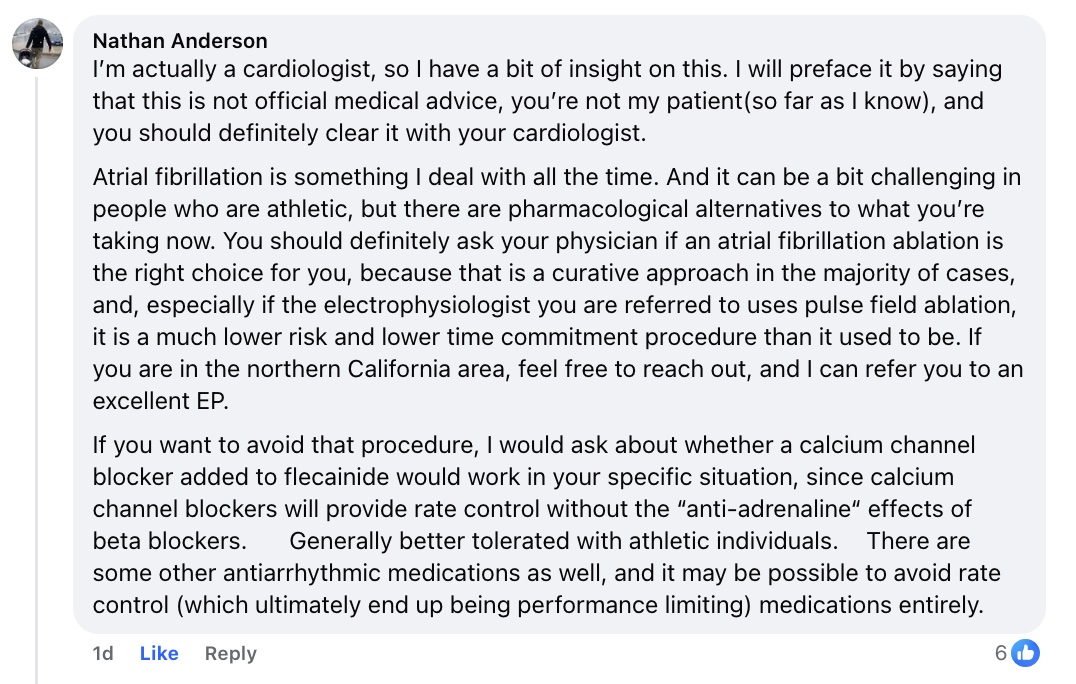
A discussion from the Masters Rowing International Facebook Group - very useful insights from people with similar health situations, medical experts and the rest of us who are following and bookmarking the discussion in the hope that we won't need to refer to it for ourselves in future.
[Note you have to join the group to read the discussion. Please fill in all the questions to avoid being mistaken as a bot.]
I had an episode of atrial fibrillation a week last Sunday. As a bloke in his early 60s that's not too surprising; apparently rowers have 8x the chance, and I'm in the peak age bracket too. Looking back I have a suspicion that those times over the past year when my heart rate monitor was acting a bit weird, it's because my heart was acting a bit weird, and the HRM was probably fine. I'm waiting for a followup with the cardiologist, but have discovered that the beta blockers I'm currently on until then make ergs and weights completely impossible - serious "head feels like it will explode" side effects. The erg was especially exciting. And not in the good way. Clearly won't be on the water for the next couple of weeks.
Does anyone have any advice for training/rowing with AFib, assuming I get put on a gentler treatment plan? I realise everyone is different and it may not be relevant to me, but it would be nice to know it isn't 100% certain my rowing days are over. I'm not quite ready to just swan around at regattas in my blazer telling people how good I wasn't. (Although that is the backup plan.)
Further resources
And some webinars from our archive which may be useful. Both are free to view.
Recovery takes 2-3x longer after age 40 due to reduced mitochondrial function, slower protein synthesis, decreased glycogen resynthesis rate, and reduced ability to clear metabolic waste. Whereas a 25-year-old recovers in 24-48 hours, masters athletes need 72+ hours between hard sessions. This isn't being "out of shape", it's cellular biology.
The Physiology of Slower Recovery
What's Changed in Your Body
Mitochondrial Function Decline: Your mitochondria (cellular "power plants") become less efficient at 40+. They're slower at producing ATP and clearing metabolic byproducts, which directly impacts recovery speed.
Protein Synthesis Slowdown: Muscle repair depends on protein synthesis. After 40, this process slows significantly. Your muscles need more time to repair the micro-damage from hard training.
Glycogen Restoration: Your muscles store less glycogen after 40, and the resynthesis rate is slower. Complete restoration after hard interval training can take 72+ hours vs. 24-36 hours when younger.
Hormonal Changes: Growth hormone, testosterone, and IGF-1 all decline with age. These hormones are critical for recovery, adaptation, and muscle repair.
The Cumulative Fatigue Problem
What happens: When you do hard sessions too frequently, you accumulate fatigue faster than you clear it. This appears as:
Declining splits despite consistent training
Elevated resting heart rate
Persistent muscle soreness
Poor sleep quality
Mood disruption
Increased injury susceptibility
The mistake: Interpreting this as "I need to train harder" when the solution is "I need to recover more."
Between high-intensity rowing sessions: Minimum 72 hours elapsed
Example schedule:
Monday: Easy aerobic (60 min)
Tuesday: Strength training
Wednesday: OFF or very easy technique
Thursday: Hard threshold intervals
Friday: Strength training
Saturday: Long steady state (easy)
Sunday: OFF
Key point: Only Thursday is high-intensity rowing. Everything else is recovery, technique, or strength work.
2. Sleep Is Non-Negotiable
Target: 7-9 hours per night, consistently, and go to bed at the same time.
Why it matters: Growth hormone is released primarily during deep sleep. Inadequate sleep directly impairs muscle repair and adaptation.
Sleep optimisation:
Consistent bed/wake times (even weekends)
Cool, dark room (65-68°F)
No screens 60 minutes before bed
Consider magnesium supplementation (400mg before bed)
Reality check: You cannot out-train poor sleep. Ever. Watch the sleep webinar to find out if your sleep patterns are normal, how to adjust sleeping and training demands as you age.
3. Nutrition for Recovery
Protein Requirements:
1.2-1.6 g/kg bodyweight daily
Distributed across meals (not all at dinner)
20-40g within 60 minutes post-workout
Carbohydrate Timing:
Adequate carbs around hard sessions (before and after)
Other medical issues requiring professional evaluation
The Overtraining Diagnosis
Symptoms:
Declining performance despite maintaining/increasing training
Persistent fatigue
Elevated resting heart rate
Frequent illness
Depression or mood changes
Loss of motivation
Sleep disturbances
Treatment:
2-4 weeks complete rest (not just "easy")
Medical evaluation to rule out other causes
Gradual return following recovery
Training volume permanently reduced
Prevention: Easier than cure. Respect recovery from the start.
Recovery Enhancement Strategies
Evidence-Based Approaches
Cold Water Immersion:
10-15 minutes at 50-59°F after hard sessions
Reduces inflammation and perceived soreness
Don't use before strength training (may blunt adaptation)
Compression Garments:
Some evidence for reduced soreness
Wear 2-4 hours post-workout
More helpful for recovery between hard days
Massage/Foam Rolling:
Helps with perceived recovery and soreness
10-15 minutes daily on major muscle groups
Not a replacement for actual rest
Contrast Therapy:
Alternating hot/cold (3 min hot, 1 min cold, repeat 3-4x)
May help with recovery perception
Not a magic bullet
Probably Not Worth It
Expensive supplements: Most recovery supplements are marketing, not science Excessive stretching: More isn't better; quality over quantity Fancy gadgets: Most offer minimal benefit over basics (sleep, nutrition, rest)
The truth: Nothing replaces actual rest, quality sleep, and proper nutrition.
Train smarter, not harder. Recover better, race faster.
Join our newsletter for recovery strategies and training insights designed specifically for masters athletes.
You know the thought - that devastating idea that staying in bed is much, much nicer than heading out for a row when the air temperature hovers near zero degrees centigrade.
And you also know that once you're out on the water and have warmed up, the feeling of rowing and the boat hull gliding while nature wakes up around you is unmissable.
How to transition out of bed
Tips that may help you overcome the inertia of a warm bed.
Firstly, you know that it'll be cold outside, and you're tempted to put on lots of clothes so that you're warm when you first sit in the boat. Don't.
Exercise physiologists have shown that while you are exercising, your body produces a lot of heat so that you feel between 5 - 11 degrees WARMER than the ambient air temperature. The proof? If you feel cozy warm when you sit in the boat, you'll be overheated and stripping off layers of clothing after you've rowed 1-2km and you're warmed up.
A friend's advice: You should feel slightly cold when you step into the boat - That's a sign that you are dressed for a workout, not a walk round the block.
Photo credit: David Miege mix quad in snow
Creative hacks from the 6 am rowing club
All rowers have braved early morning outings. Here are some hacks which you may like to try.
Warm your clothes in the drier before stepping out of the door. A small burst of heat to see you through the first chilly minutes of exercise - this is a runners' trick - but I'm sure we can make this work for rowing too.
If it's windy and cold the skin on your face and cheeks can physically hurt - coat your cheeks with a thin layer of vaseline to provide a barrier of protection from the wind.
Drinkable hand warmer - put some hot water in your drink bottle and use this to warm your hands while half the crew is warming up and you're sitting idle in the boat. By the time you become thirsty, it'll have cooled down and be drinkable.
Have a small hot (caffeinated) drink before leaving home. Not only do we feel less thirsty in cold temperatures, and risk dehydration, this boost of caffeine keeps your brain sharp and the heat encourages your body to regulate its internal temperature.
Join our community and get our exclusive Faster Masters Rowing Magazine, packed with tips, techniques, and inspiring stories. Includes four new articles monthly.
PLUS get the Rowing Fundamentals bundle (US$279 value).