There are four types of recovery responses to be familiar with:
Acute overload is the recovery that takes place on a daily basis, session to session. Proper diet and sleep are the main factors for long term recovery. However, immediate recovery interventions should start as a session concludes to signal the body to start repair. This can include a 10-minute cool down row with focused deep breathing, changing to some slow music after listening to upbeat music, a protein snack within 30 minutes ending a session, wearing compression garments, and light massage.
Functional overreaching is the gold target. It is the result of good management of the daily training load. It will show improvement in the performance of the rowers from week to week. As they repeat weekly sessions they get better. Repeating the same weekly sequence of workouts for a few weeks is an effective approach for masters. Making small changes or increases to achieve slow steady gains are preferable.
Non-functional overreaching is when athletes are not seeing performance improvements, they are feeling stale, and the usual number of recovery days is not enough for them to gain energy back. The prescription is then to recommend taking three or four days off perhaps a week. Often the athlete will then feel better and be able to return to their previous level of performance. Usually non-functional overreaching happens because the increase in the training load was too fast.

An example of recovering from non-functional overreaching:
R.C.’s normal heart rate variability measurement is between 7.2 to 8.3. She had a moderate training session on Wednesday, rowed a hard session on Thursday, and then trained easy on Friday.
On Saturday her HRV was high 9.5 but she went to train but had to abandon her session due to fatigue.; She rested on Sunday but HRV was still high at 9.3. On Monday it was 8.7 so she took an additional rest day. Tuesday her HRV was 8.5, still slightly above normal, but she was able to resume training on Wednesday when her HRV was received to her normal range.
All in all she required three days rest to recover but was able to resume training at her previous level.
Fortunately, true overreaching is rare. This is when the athlete cannot recover for weeks and can take months to get back to their baseline performance level. Overreaching can be avoided with attention to the balance of work and rest on a daily, weekly, and seasonal basis.
Researching masters physiology - aging from 50 to 70 affects your rowing.
01:00 Guests from Athlone, Ireland Lorcan Daly and Paul Gallen
Lorcan is a sport science researcher starting with his grandfather, Richard Morgan who was an erg champion. Uniquely he was sedentary for most of his life, was a smoker and at 73 took up indoor rowing. He was tested aged 92 and some of the tests were on a par with a 30 year old. Three world champion indoor rowers were his next test subjects - described as a "game changer" by Irish Rowing.
Paul Gallen Dennis and Ken were recruited after winning their divisions at the 2024 World Rowing Indoor Championships. The tests were done over 2 visits - diet, lung and muscle function and sporting history.
06:00 Paul Gallen rejoined masters rowing
He took 30 years out of the sport and his first event back was the Head of the Charles Regatta. Learned to scull aged 60 and indoor rowing competitions. His 8s crew includes school friends. For the winter season he does a 10 week lead in to the Irish Indoor Rowing Championships. The three age gaps gave a good framing for the study.
Lorcan found that their muscle oxygen take-up was similar to an Olympic champion. The deterioration over life is much flatter than non-trained people.
Paul has 10 years of his splits at the indoor champs 6:59 - 7.14 times over ten year drop off. Paul does daily Yoga for rowers - 12 moves a day. Off season 2 weights; mix of high intensity and longer rowers. At least one high intensity per week.
13:00 General advice on aging well
The principles for healthy aging - keep your full body system going is a mix of resistance exercise and the mix of aerobic exercise is key. The two together is the winning formula.
15:00 Returning rowers
Paul the big thing about people coming back to rowing - it depends on how busy your life is. Start at recreational level and not commit fully to being in competition. Build up if your life gets less busy.
Lorcan's paper is called Toward the Limits of Human Ageing Physiology: Characteristics of the 50+, 60+ & 70+ Male Indoor Rowing Champions
Want easy live streams like this? Instant broadcasts to Facebook, YouTube, LinkedIn. Faster Masters uses StreamYard: https://streamyard.com/pal/d/5694205242376192
What is normal for you? What to expect when you track your normal waking heart rate.
Resource: Daily Diary - simple templated record keeping for your training diary
00:50 This is important as we age. It's a free way to track your physical wellbeing. I found out about it from Harry Mahon, the New Zealand rowing coach. Resting heart rate is important for masters because we are too good at "keeping going". Knowing how well you are is key to how you approach training and to give you confidence.
In the longer term it's an indicator of your fitness. The lower your resting heart rate the fitter you are. Heart rates are very individual - what's normal for you is not the same as mine.
It's also useful to determine your readiness to train today. Waking heart rates when tracked regularly show you what number is normal for you. After one week you will see your numbers and what's normal.
The resting heart rate can show if you are incubating an illness - viral or bacterial. It shows up in your resting heart rate before you see symptoms. Before you get symptoms your heart is already responding to the illness. This could also be stress, poor sleep or dehydration - it's not always illness. The heart rate jumps up 10 beats per minute when suffering an illness.
07:00 After being sick and wanting to go rowing again, I have gone out when I still have symptoms but find doing a medium intensity workout helps to clear the final symptoms of the virus. The normal pulse precedes this.
There are two easy places - the side of your neck or the wrist - find your pulse on the thumb side about 2 cm from the wrist joint - use two fingers to locate it (not your thumb because there's a pulse in your thumb).
Take a one minute reading or 30 seconds and double the score. When you start counting, make the first pulse zero and then one, two, three etc. Keep a daily record - use this free daily training diary from our website - to record your training, overnight health and hydration state.
Want easy live streams like this? Instant broadcasts to Facebook, YouTube, LinkedIn. Faster Masters uses StreamYard: https://streamyard.com/pal/d/5694205242376192
When you recognise that you need more rest by tracking the stressors in your life having a lighter training week is good athlete self-management.You can use a daily diary [free download] to help you track your pattern of recovery. This tool is very useful in the context of adapting your training to suit your recovery needs.
When following the full Faster Masters Rowing program, Monday is your only day off in the week, incorporating a degree of unloading will help your progress. Unloading is when you choose lighter workouts.
A typical mesocycle periodized training program follows a weekly progression of light - medium - hard - light workout loading.
If you consistently train five or six days a week that is the threshold for possibly needing more rest during a month. Whereas if you do three or four sessions a week there is plenty of recovery time between workouts and you may not need this. Tracking your recovery using a daily diary or HRV monitoring will give you the answer.
As a general principle, here are some ways you can get more recovery while still following the program. For example if after 3 weeks of full training you feel you need a couple of lighter sessions, choose one of the options below.
Remember, the program should be challenging - strike a balance between your rest needs and a robust workout.

What's the difference between a taper and a rest day? When should you taper before a regatta and how does it affect your readiness to race? A rest day gives your body time to recovery and feel more energetic. After the rest day you continue training in the normal way.
A taper is when training volume is vastly reduced before a race - this helps your body get deep rest, allows for travelling and will leave you bouncing with energy come race day. Usually a taper starts around 7 days before the big event.
Tapering incorporates elements of intensity and recovery. So you may be doing race pace workouts still and also getting shorter practice as well as days when you do not train at all.
A good way to think about your physical wellbeing is to use the formula Form = Fitness minus Fatigue.
Fatigue masks your potential true performance. Shedding the fatigue unveils the fitness you've built in training. During the taper you will maintain fitness - you won't improve your fitness.
The design of Faster Masters programs is such that we do not recommend tapering before a test like a 5k that’s just part of your training. We’ve been doing race distance workouts at weekends throughout the 1k and 5k training program.
But resting in order to feel ready to do a test helps you feel prepared for the test. Take a rest day beforehand - either 3 days before or 1 day before, not both.
In Faster Masters programs the “training load” is designed to stress your body and race distance test rows are programmed into the workouts as part of this process. You want your best performance to be on race day, not necessarily on the test day.
To be effective, tapers have to be preceded by strong periods of regular workouts. Most athletes only taper for 2 or 3 events per year. When there are only a few weeks left before your race event (and you've got a test planned in the program) doing a taper at this time will lower your training stress at a time when the program is designed to be bringing it gradually up. This compromises your ultimate peak if you’ve not followed the program.
Pre-race nerves diary week 5 Casey McKenna
Head race taper versus rest article
Travel, tapering and using borrowed boats podcast
Do you have a split to aim for during workouts? What to do if you don't hit your rowing 500m split and does this matter?
Resource: Make winter ergs fun again - 5 tips
3 Value Bombs
01:00 Psychology of chasing 500m splits on the erg and on the water? Is it beneficial for masters rowing training.
03:45 Before rowing electronics the best way to find out your boat speed was to work on a measured marked distance on your river or lake. Repeating the distance and comparing boat speeds helped to work out your improvements.
The advent of splits enabled comparability between workouts and also use on the indoor rowing machine. Concept2 erg splits are comparable to heavyweight men 4- times on water.
05:30 Splits as a comparable tool but your split does NOT equal your training zone.
The physiology of how coaches write programs to achieve key athlete outcomes. Training each physiological system helps you improve. As we age our base fitness is generally more sustained (we don't lose it fast).
Our absolute strength declines with age and our ability to rate high and train our anaerobic system can be more challenging.
Doing testing allows you to set up training zones aligned to your physiology. The same training program can't be applied to men and women of different ages e.g. 40 to 65 years old. They cannot do the same workouts - not physically capable.
Know your own training zones so you can adapt the program to suit you. In a club with diverse members, you may find that the program is too hard or too easy for you. You may find recovery is insufficient. These symptoms are caused by a one-size-fits-all training program for masters rowing.
Come to Faster Masters Rowing and use our program where you can interpret the program and adapt it to suit you.
Re-testing yourself regularly allows you to measure progress and then adjust your training zones to match your new physical fitness.
Use tools mindfully.
It's fun to look at a number and to try to beat it - this is motivating.
But moving into an adjacent training zone as a result of beating the number will negatively impact your future performance.
10:30 You can choose to focus on a split that is attuned to your body or not.
The program you are following was written with a goal in mind. You aren't supporting your coaches' goals if you do not follow the program. Following the wrong split is a good example of not doing the program.
Staying hydrated for training and racing can give you hidden benefits. It's very easy to become dehydrated and not realise. Performance improvements and recovery gains from hydration.
Resource: Home Made Sport Drink Recipe (below in notes).
Timestamps
What you are drinking and how to get fluids into your body. It's more than just drinking while training, off the water drinking matters too.
Start with a glass of water when you wake up in the morning. Every time you have a meal or snack, have another glass of water. Snacks might be mid-morning or mid-afternoon. Get into the habit of 2 litres of fluid a day - this includes any hot drink, shake or smoothie count too. Keep a record of your hydration - cricket notation makes it easy to see each 5 glasses of water you have.
02:30 Before during and after training sessions hydration is needed as well.
Drinks need carbohydrate and electrolytes in them. This is part of your recovery from exercise. Carbohydrates help you maximise energy levels to maintain intensity through to the end of a workout. Training works to provoke adaptations. Electrolytes are minerals which get lost through sweat. The air temperature during exercise affects your feeling of thirst. Do not rely on your sensation of thirst - anticipate your hydration needs before you feel thirsty.
06:00 Caffeine drinks - these are worthy of your consideration because caffeine is a stimulant. I drank a half and half Red Bull and water at a regatta when I had a lot of races. I'd learned that Dame Kelly Holmes used this for her race day hydration.
Use sports drink only on regatta days. Use either caffeinated drinks or tablets (noDoze or Pro Plus). Have caffeine every 2-3 hours while racing - half a can of drink 30-40 minutes before your first race or half a caffeine tablet.
From Nancy Clark's Sport Nutrition Guidebook affiliate link to buy.
Flavoured with orange juice and lemon juice or cranberry/lemonade.
Want easy live streams like this? Instant broadcasts to Facebook, YouTube, LinkedIn. Faster Masters uses StreamYard: https://streamyard.com/pal/d/5694205242376192
Resource Rowing Blisters And Skin Injuries ebook
Hand cream may be insufficient to keep your hands soft and supple enough to prevent blisters forming. By wearing rowing gloves - padded palm and finger protection. The Crew Stop gloves are specialist - light and flexible gloves designed by rowers, for rowing and paddling.
Recommendations for treatment - because I've done all of these and they work.
rec.sport.rowing discussions about blisters.
Methylated spirits are NOT a good solution - avoid as it kills living skin tissue.
Want easy live streams like this? Instant broadcasts to Facebook, YouTube, LinkedIn. Faster Masters uses StreamYard: https://streamyard.com/pal/d/5694205242376192
Knowing how ready your body is for the day’s training can be challenging. Some days you just know you feel rough, maybe you have a virus or you are short on sleep or there are life stresses occupying your mind. Other days you feel fine, but when you start your workout you find that your performance is lacklustre.
Why is this?
Many times it’s because your body is too tired, too stressed or starting a virus. There’s an easy way to find out how “prepared” for training you are each day – Heart Rate Variability or HRV.
HRV is the measure of the variation in time between heartbeats, measured in milliseconds. For example, sometimes your heart might beat every 1.2 seconds; other times, it might beat at 0.8 seconds.
The human body continuously adjusts to maintain a state of balance, homeostasis. Our heart rate, blood pressure, glucose level and hormones all react to stress and the autonomic nervous system works to keep everything in balance.
Heart rhythm (and therefore HRV) at rest is regulated by the parasympathetic branch of the autonomic nervous system, the one in charge of rest and recovery. Measuring HRV is an effective way to capture your current response to stress.
Researchers have found that tiny differences between heart beats give a strong indication of your state of readiness for training. Until recently these measurements required specialist equipment, but now modern smartphones can take your heart rate using the camera app.
A daily 1-2 minute heart rate measurement is all you need to get started with HRV. During the measurement, sit still and breathe normally. Your HRV measurement is a number, mine is between 7.1 and 8.2 most days. Outside this range indicates excess stress and that an adjustment to your training may be warranted.
Enter the HRV4Training app. HRV can also be measured with an Apple watch, Garmin watch and other personal health apps.
Your personal range scores are established after a week of daily measurements. A lower than normal score indicates stress. I’ve found this useful for making small adjustments to my training once I know my daily state of HRV readiness.
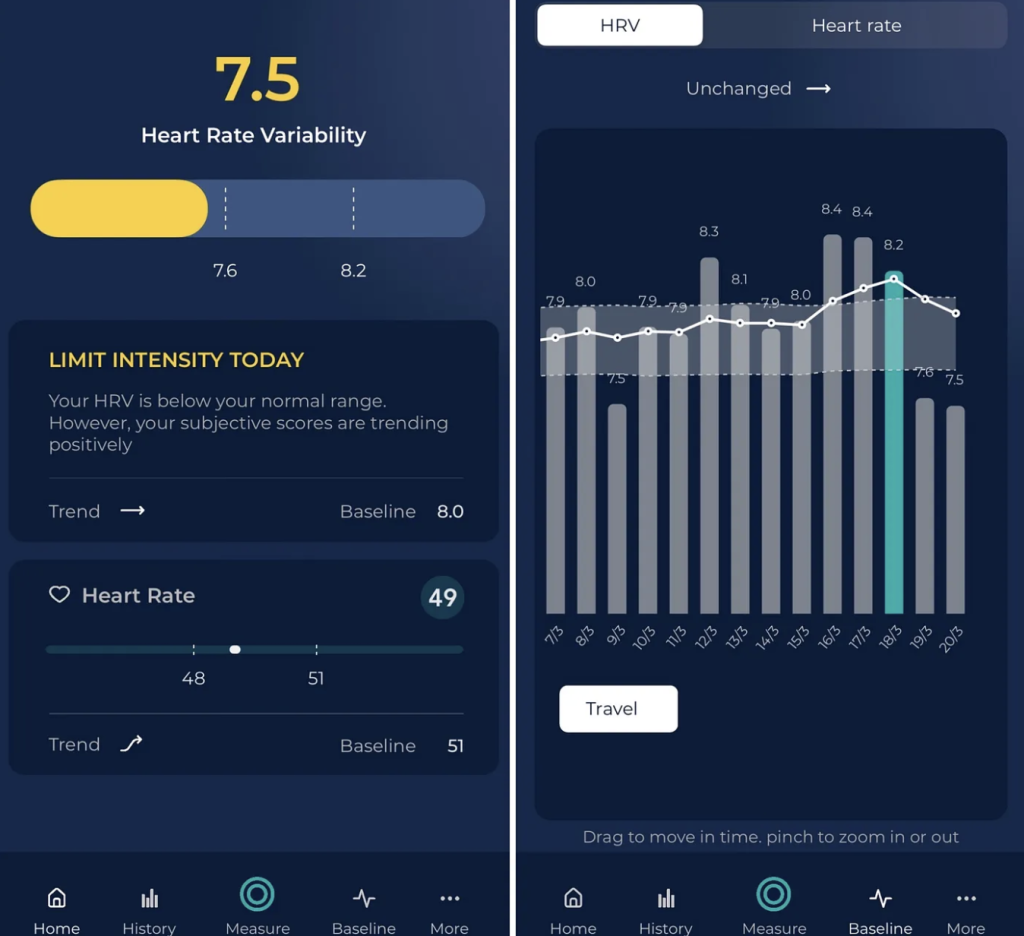
HRV App output showing a day where the athlete suffers stress. Image credit: Marco Altini
Marco Altini is the rowing world’s HRV expert and Rebecca did a podcast episode with him to find out more about how HRV works and the ways rowers can use it.
Marco Altini explains HRV for rowers
Try it out for yourself and see if you can get improved training outcomes by applying a tiny but more science to your workouts.
If you dread your indoor rower workouts, listen in. We have 5 things for you to try out which could make your ergs more enjoyable.
00:30 In our training programme this month - 3 training plans to suit your racing, force curve video, how your body mass affects boat speed. We had a winner at the Virtual Head of the Hooch and personal best times of 3 seconds and 6 seconds from participants - the programs do work!
Long endurance workouts can be daunting.
1 - Follow a programme
Making up your workout on the day means you have no goal. Keep a record of your training so you can measure your gains and progress.
2 - Train with a group
There is nothing worse than having to train alone. Even if you have to train in your garage, start the workout at the same time as your crew mates - it's an incentive to show up. And showing up is half the battle in forming an exercise habit.
3 - Reward yourself
Feel good about what you have done. Choose something which you enjoy as a reward.
4 - Set short horizons
While doing the workout choose a destination in the near future (5 minutes) so you can focus on one thing for that time. I choose technique items that will keep my form consistent. One minute is the lowest horizon.
5 - Distract yourself
Listen to music while training - challenge not to look at the screen until the song is over. Shut your eyes and focus on the feel of the movement instead of looking. Listen to the flywheel - does it get louder as you move to the finish of the stroke? Have a visual cue for your catch - use tape or a straw marker. Change the units to watts from 500m splits. Use this to train yourself to row with consistent pressure. Use your force curve in the same way to train consistency.
Training Camp with US Rowing in Chula Vista 1-4 April. Newsletter recipients will get information about it. I was incorrect that food and accommodation. These aren't included. My bad.
Breathing is something that we do every day and most of us don’t even think about when and how we breathe. The breathing process moves air in and out of the lungs to allow diffusion of oxygen and carbon dioxide. We as human beings require oxygen at cellular level for our body to function. The respiratory center in our brains (Medulla) is responsible for control of ventilation as breathing is often called. Regulation of pH levels in our body is also done through breathing.
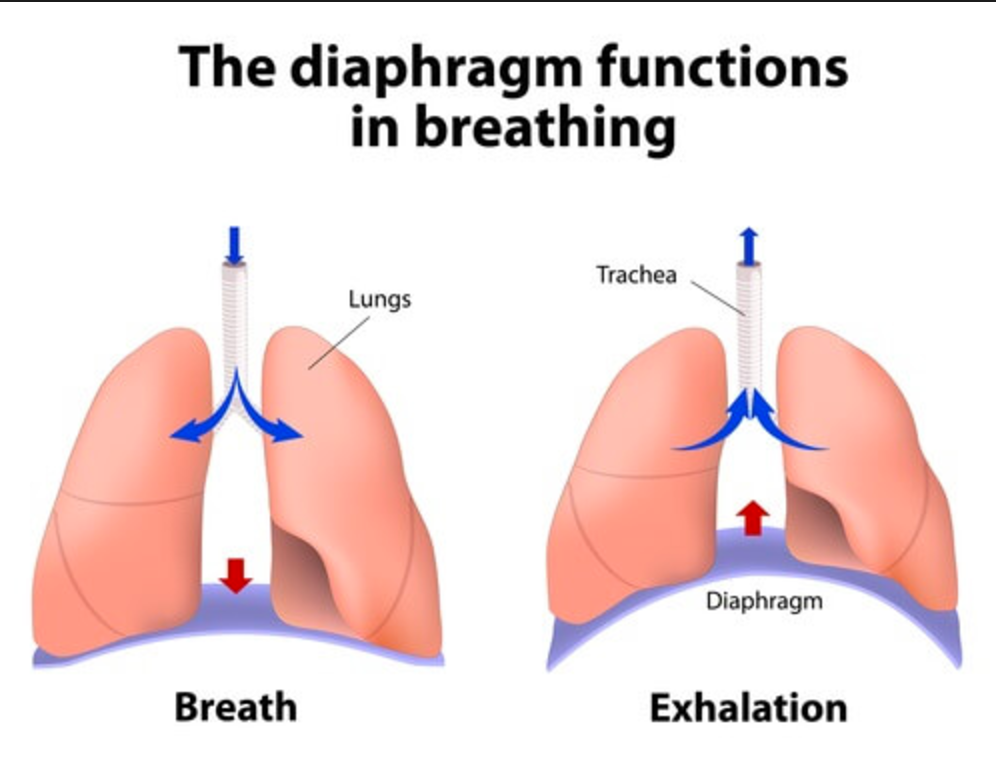
Movement of air in and out of the lungs is caused by changes in the thoracic volume.
Inspiration (inhalation) at rest begins with the contraction of your diaphragm and use of external intercostal muscles. Inhalation lowers the floor of the thorax while lifting the ribs up and out and this allows us to take in more air. The opposite happens at the expiration (exhalation) where the diaphragm and intercostal muscles relax and recoil (bounce back to original position) while pushing the air out. In sports and the exercise world breathing is a must and there are several breathing patterns for different sports. Every repetition or exercise should have both an inhale and exhale part.
During exercise inhalation movements are assisted by accessory inspiratory muscles which include neck and trapezius muscles. The function of these muscles is to lift the ribs and clavicle (collar bones) allowing larger amount of air in our lungs during exercise.
Rowing is named as one of the hardest endurance sports and proper breathing is very important to be able to sustain the amount of work. As a coach, I always teach my athletes proper breathing technique.
During the rowing stroke the inhalation should be at the catch and exhalation (releasing of the air) should be at the finish when the hands touch the body.
This must be trained daily.
For some athletes a correct breathing pattern is harder to learn than the rowing motion and it is the coach’s job to make sure the athlete is breathing properly. This is especially important during hard training loads and workouts.
During exercise the rowing stroke exhalation should be loud and noticeable. At this point breathing (exhalation) becomes active and forced. This forced exhalation allows smaller intercostal and accessory muscles to stretch which greatly increases the maximal rate and amount of air flow. By forcing the exhalation, we can drastically increase the amount of air without necessarily increasing the breathing frequency. It is important to note that as the rowing speed increases, the breathing frequency should increase as well. You do not want to breathe like fish at stroke rate 32!
Next time when you sit on the rowing machine, pay attention to your breathing!
Your breathing pattern should become mechanical, followed by each inhale at the catch and the exhale at the finish.
Perfect practice makes a perfect result.
Coach Misha Jezdanov
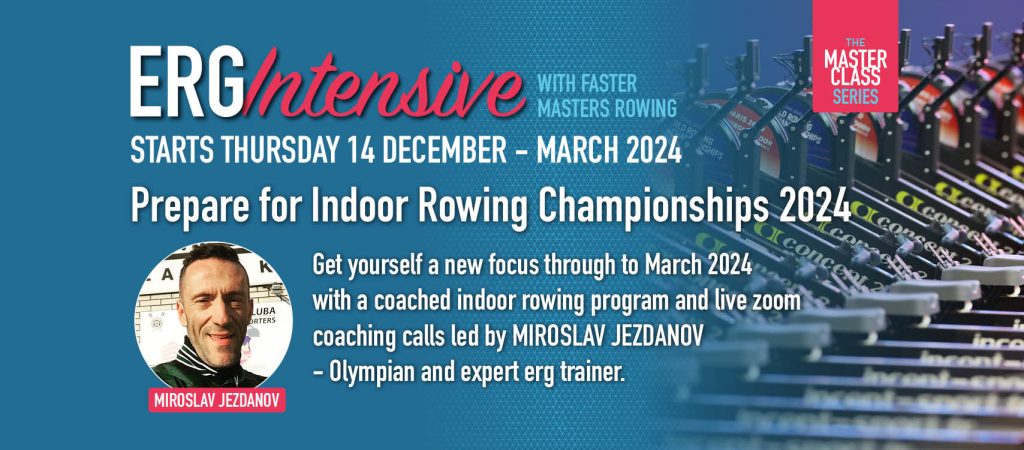

Join our community and get our exclusive Faster Masters Rowing Magazine, packed with tips, techniques, and inspiring stories. Includes four new articles monthly.
