Repeating workouts to improve your skill at doing them - how to sharpen into the piece, count down, ways to swap with bow four. How not to waste strokes and ways to start on the right stroke rate. Execution quality is a performance variable in its own right.
Timestamps
What do you think is happening when you do a workout? Execution skill improves with repetition. There are repeating workouts in any training program - this builds fitness and your ability to do that practice. The second time you do a workout, you know what it feels like, how to make your effort work consistently across the whole piece. This is performance-relevant knowledge. Poor execution comes from wasted strokes at the start of the piece, being at the wrong stroke rate, the wrong pressure, taking 5 strokes to get to the specified stroke rate. This affects your pacing (too hard or too light) and also changeovers (steps up in rate for example). Your physiological adaptation needs to be as good as it possibly can be. Over a season there is a compounding effect of successful physiological response to training stimulus.
Get into the work and don't waste your approach. For a 20 stroke firm / 10 light piece. All the 20 firm need to be at the right stroke rate and intensity. Use the last few light pressure strokes to build pressure and rate. By counting down into the work piece so each stroke builds to the stroke #1 rate and pressure. Have in your mind the target stroke rate - what does SR 24 feel like? Build your familiarity without needing a stroke coach to count rating.
First add pressure before adding rate. Rate without pressure leaves you "spinning" especially at rates over 24. Call "Going up in 3 -2 1 - GO" or "Going up, on the next stroke [wait one stroke] now".
Our cox calls "Build pressure now'; two strokes pass then 'Rate up now'.
At rates below 25 it's easy to hit the rate just using increased pressure - it is harder at rates from 26 and above to get the rate - you have to be more deliberate building the pressure then the rate. Start a change like that at the correct place in the stroke cycle.
Make these changes at the catch. The pressure change starts at the catch; stroke rate changes begin at the catch. To do this effectively, athletes must know they are making a change half a stroke cycle in advance of the change. Call the change at the FINISH. This gives them advance warning of the change.
There are changes which happen at the finish like stepping down in stroke rate or a rhythm call and these must be called at the catch. Be half a stroke ahead of time if you give the calls. Listen to when the cox or the caller made the call to change.
Your goal for the workout is to execute more and more successfully.
Three fixes for your indoor rowing technique faults.
Timestamps
Interrupt the fault before it becomes a habit. Foot connection gets lost at the finish as your toes come away from the footstretcher. When you lose connection you aren't moving the boat forwards, same on the erg because the feet are the only connection to the boat.
Take a $10 bank note and put it under the toes of the athlete - if they lose foot connection at the end of the drive, the money falls to the ground. Have a bet with your athlete - they can keep the money if it's still under their toes. The whole of the sole of your foot needs to stay pushing on the footstretcher at the finish. Try it separately for both feet.
Avoid over-compressing at the catch with knees going over your toes. Take a bungee cord or some electrical tape and wrap it around the rail so the seat wheel butts up to it at the correct catch position. The athlete will feel the wheels rolling over the tape - it acts as a gentle physical reminder to stop at the catch position. Check your catch position first using a mirror or a photo - get your shins vertical. Do some steady rowing to learn where your new compression limit is.
If you tend to pause at the catch, try this. On the erg the rail slopes downwards towards the footstretcher. Lift up the front leg of the rowing machine by 10-15 cms. Use a crate, an aerobics step or a big book. The incline means it's harder to rush forwards. Note if your catch alters when you change direction with the front leg raised. Gravity will tend to make you want to roll backwards away from the flywheel.
Most rowing clubs were designed around the racing calendar. And for a long time, that was fine. You joined young, you raced hard, you aged into masters. The structure made sense because life cooperated: school sport rolled into club sport, and the 4pm training session was nobody's problem.
That world is gone. And too many clubs are still running the 1980s membership model while wondering why retention is soft and the waiting list for adult rowing never quite materialises.
Here is what is actually happening at the waterfront, and what clubs could do about it.
Most clubs operate some version of the same three-tier structure:
The junior/senior racing programme targets younger athletes aiming at competitive 2000m events. It demands serious time commitment, typically four or more sessions a week, and is priced accordingly at roughly double a standard masters subscription. Sessions are structured around school and after-school hours, with early afternoon starts on weekdays.
The masters programme serves the 27-and-over crowd, offering flexible scheduling and a subscription at roughly half the cost of the racing tier. It is, by most accounts, the more sustainable and community-driven part of the club.
Learn to Row sits across both, priced at around the same level as the masters annual subscription, and offers a six-week entry point for beginners.
On paper this looks comprehensive. In practice there are three structural gaps that clubs are systematically failing to fill.
1. The Time-Poor Young Adult
She is 21, she works three days a week, and she wants to learn to row. She is not a schoolkid -- the 4pm weekday session does not exist for her. She is not yet eligible for the masters programme. She has looked at the website, found nothing that fits, and moved on to another sport.
This is not a niche case. The 18-to-26 cohort is precisely the age group most likely to be exploring new activities, most likely to stick with something that becomes a social habit, and most likely to become long-term club members. Losing them at the door because of a scheduling mismatch is an own goal.
2. The Recreational Non-Racer
He is 19 and he saw the rowing on television and thought it looked good. He would like to get on the water a couple of times a week for fitness and company. He has absolutely no interest in training ten sessions a week toward a 2000m race.
For him, the current structure offers one choice: the high-performance track at double the cost, with all the commitment that implies. He declines. The club loses a member who might have stayed for a decade.
Most sports have figured out how to separate competitive and recreational participation. Rowing clubs, by and large, have not.
3. The Lapsed Rower
She rowed at school. She knows how to hold a blade. She has moved to a new city, joined a gym, but would love to get back on the water occasionally without signing up for a full competitive season, paying full racing-tier fees, or re-sitting a beginner course she does not need.
There is no product for her. So she stays at the gym.
Clubs often treat the idea of hiring a paid coach as a luxury. The numbers suggest otherwise.
A modest Learn to Row programme, running two six-week courses per year, reaches financial sustainability well below capacity. If coaching costs are modelled against LTR revenue at a mid-range uptake of 15 participants per year, the coaching bill covers itself before recreational membership growth is even factored in.
Add in the retention benefit of paying members who can shift between a competitive and a social track as their life circumstances change, and the maths improve further. The alternative is losing members entirely when life gets busy, which means losing the subscription entirely.
The good news is that this does not require clubs to merge, restructure their governance, or abandon what makes them distinctive.
What it requires is decoupling commitment level from age. The current model assumes that age determines how seriously you want to row. It does not. A 22-year-old might want the recreational track. A 45-year-old might want to race. The tier should follow the athlete's goals, not their birth year.
Practically, this means:
There are implementation questions worth working through: health and safety induction for casual members, how equipment access and booking is managed, whether a paid coach coordinates the recreational group or whether it runs on a peer-led model. None of these are insurmountable, and most clubs will find they have partial solutions already in place.
Rowing is a sport with extraordinary retention potential. People who row tend to keep rowing, often for the rest of their lives. The physiological demands suit older athletes. The social dimension is strong. The masters pathway is, for many clubs, the healthiest and most engaged part of the membership.
But you have to get people in the door first. And right now, a significant slice of the market in the form of the young professional, the recreational adult, and the returning rower is hitting the club website, finding nothing that fits their life, and quietly going elsewhere.
Is your club's membership structure built for the rowers you have, or for the rowers who actually exist in your community?
That is the question worth putting to your committee this season.
Three cheap and simple hacks to help your sculling. Small clever fixes to real problems that scullers deal with all the time. One for your head, your wrists and your blade depth.
Timestamps
Sculling technique faults are very subtle and you can't always feel them from inside the boat. These three hacks move that feedback from external to the boat (from your coach) to inside (you can feel changes yourself and can act on them).
If you move your head during the stroke, this is the hack for you. Ideally you want your head to be in line with your spine during the stroke and to stay in line when you swing your body back/forwards. The head is heavy - 15 lbs or 7 kg. Wear a cap with a stiff brim so that you can see the horizon from under the cap brim.
The horizon is always horizontal - pick a single point to watch (a tree, a house, the back of the head of the person in front). Keep an eye on the horizon point while you row - this will give you clues about how your head moves.
When feathering in sculling you want to use your fingers and not your wrist. Take a piece of tape from your forearm across your wrist towards your knuckles - masking tape / electrical tape / micropore are all suitable. If you move your wrist it will pull on your arm hairs and serve as a reminder. As a rule of thumb tape 20 minutes before you start rowing - this gives time for the adhesive to bond with your skin.
A hack for those whose oar spoons go too shallow, too deep or corrugate through the stroke. Tape the oar so that when the oar is sitting in the water at the correct depth, you can just see white tape on the oar shaft.
How to position the tape - sit in the boat with it level and put the oar, squared, into the water carefully so you don't get the shaft wet. Let go of the handles and the blade will naturally sit at the correct depth. The blade will tend to sit 1 cm above the water surface (this gets covered up when you are rowing as you push a mound of water in front of the spoon). Track where the shaft gets wet and that's where you put the white tape. Measure the distance from the spoon insertion point and you can then put tape on other oars at the same place.
As you row, the white tape is then above the water surface while you are rowing - adjust your handle height so that the tape stays visible.
Three cheap and simple hacks to help your sweep rowing. Small clever fixes to real problems that sweep rowers deal with all the time.
Timestamps
Tricks and techniques for your own rowing - a low cost, improvised fix to a persistent problem. The best hacks give you physical feedback in the moment as a constant reminder so you don't have to keep something front of mind. Moving you into unconscious competence. Learn more about unconscious competence and the 4 stage adult learning model https://fastermastersrowing.com/rowing-technique-makes-my-brain-hurt/
If your inside hand moves up and down the handle - it drifts. This affects the amount of effort / load you can put onto the oar from square off to the finish. Take an elastic band and wrap it around the oar handle so it sits on the outside of your hand next to your little finger. If the band is tight, when your hand starts to move it won't roll the elastic band - you'll feel it and realise if your hand has moved off position. If your hand goes the other way, put the elastic band next to your forefinger instead. First check you have the correct spacing between your hands first.
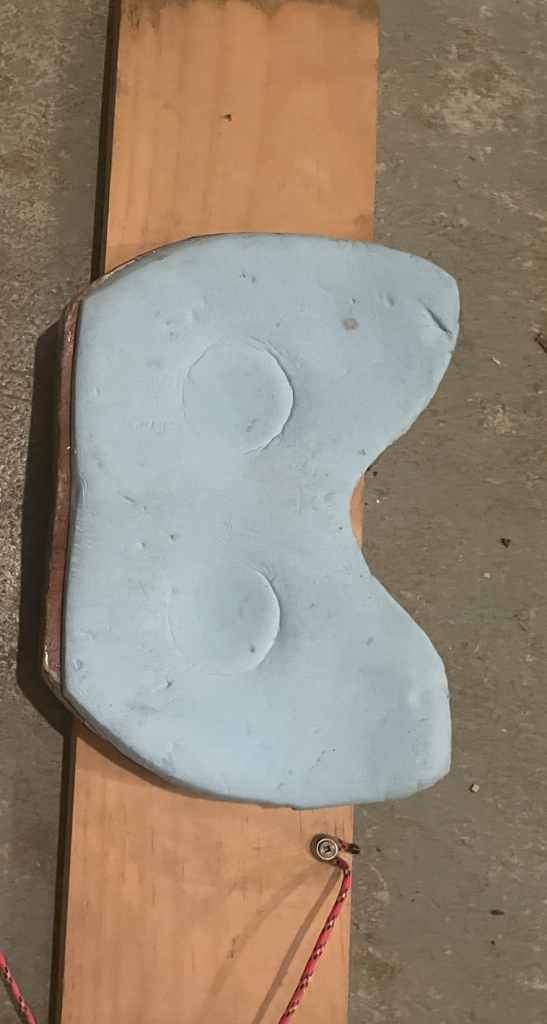
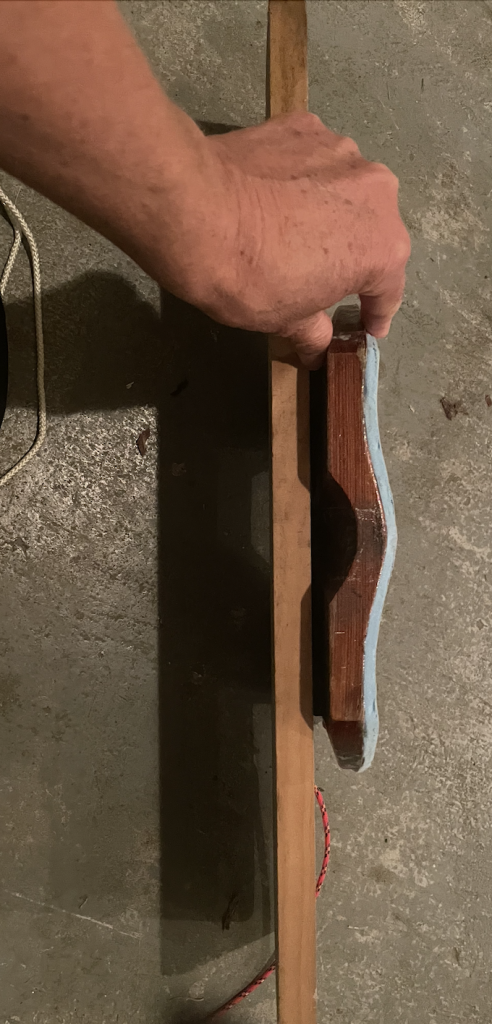
When you have someone who is too large to fit into the coxswain's seat - use the coxing plank. A plank of wood sitting across the transom / sax board of your eight. We put a sculling seat on top so it's comfortable to sit on. Put your feet into the bottom of the boat. And add a lanyard to attach to the steering wires in case the plank moved or fell off and it remained attached to the boat. The cox can then see above the heads of the athletes giving greater line of sight for coaching the crew. If your crew has to take turns steering the eight - this is the hack for you. [More images below.]

If you feather with both hands and twist your wrist to turn the oar when squaring and feathering - this is for you. The correct sweep feather action is to allow the oar handle to turn inside your hand grip for the outside hand, while only your inside hand wrist rises or lowers to turn the handle.
Take a piece of tape - sellotape/scotch tape or micropore or masking tape or electrical tape. Run it from your knuckle across your wrist and to your lower forearm. The idea is that it sticks to the hairs on the back of your hand so when you turn your wrist (and you shouldn't) it pulls on the hairs. This hurts.... you feel the tape tighten and serves as a reminder not to move your wrist.
The marks your blade leaves in the water after every stroke are one of the most honest pieces of coaching feedback you’ll ever get — and most rowers row straight past them. Today you’ll learn what a good puddle actually looks like and why size has nothing to do with it, what your puddles are telling you when they go wrong, and a practice tool that removes puddles entirely — and why that can be exactly what you need. Every stroke leaves a mark. Today we learn to read them.
Timestamps
This is your stroke made visible - what you actually did on that stroke. You should be aiming to make tight, swirly, deep — and no splash puddles. It's concentrated and without foamy white water around it. The depth and darkness of the water swirl indicates the power applied.
The puddle is caused by the curve at the front of the blade - as you lever the boat past the point the oar went into the water. The mound test - you want water to move effectively. Water flows and you cannot compress water with a rowing oar. This is why you can create a mound in front of the face of the spoon.
Look at the end of your stroke to see your mound. The water should be pushed up in front of the spoon with a corresponding hollow behind the blade spoon. Sustaining both through to the finish enables you to take the oar out of the water with very little effort. If your acceleration drops in the second half of the power phase, the mound lowers, the hollow fills up and it becomes harder to take the oar out of the water. Anyone can make a big splashy puddle by washing out - pull the handle down into your lap at the finish and you'll see the puddle changes.
What goes wrong and why?
Energy wasted on the extraction causes splash - feathering out, lack of a clean exit - these may be an indication of unnecessary energy being used to take the oar out of the water.
The language you use can be problematic e.g. "pulling". Using your arms can mean you rip the oar against the water. Water moves as a single block at a gradient of 1:200 - rowing needs to keep the water block solid. Breaking the water block causes little air bubbles to get into the water and this makes it harder for the oar to grip the water and it becomes less effective.
Use language such as burying the blade, pushing it horizontally and extracting smoothly. The boat moves forward because the water goes back relative to the boat.
Sometimes no puddle is the whole point. Try to row without making a puddle - this helps you to focus on your technique and if you are keeping the oar at the correct depth through the stroke and taking it out cleanly.
Try rowing with the oar only half under the water. This helps you to learn how to manage the handle which controls the oar height through the stroke. Align the catch and finish heights by controlling the handle.
What your puddles are telling you - take a look behind you from catch to finish and watch the puddle move away from the boat using peripheral vision or by turning your head to see the full stroke.
The three most damaging technique faults in masters rowing are: late catch (blade enters after legs start driving), early back opening (back pivots before legs finish), and rushed recovery (racing to the catch instead of controlled preparation). These errors waste power, increase injury risk, and get worse under fatigue. All three are fixable with specific drills and deliberate practice.
What it looks like: Your blade enters the water after your legs have already started pushing. The first few centimetres of leg drive happen with the blade in the air or just touching the surface.
Why it happens:
The cost:
How to identify it:
Drill: Pause at Half Slide
Drill: Arms-Body Only Rowing
Mental cue: "Blade, then legs" not "legs and blade together"
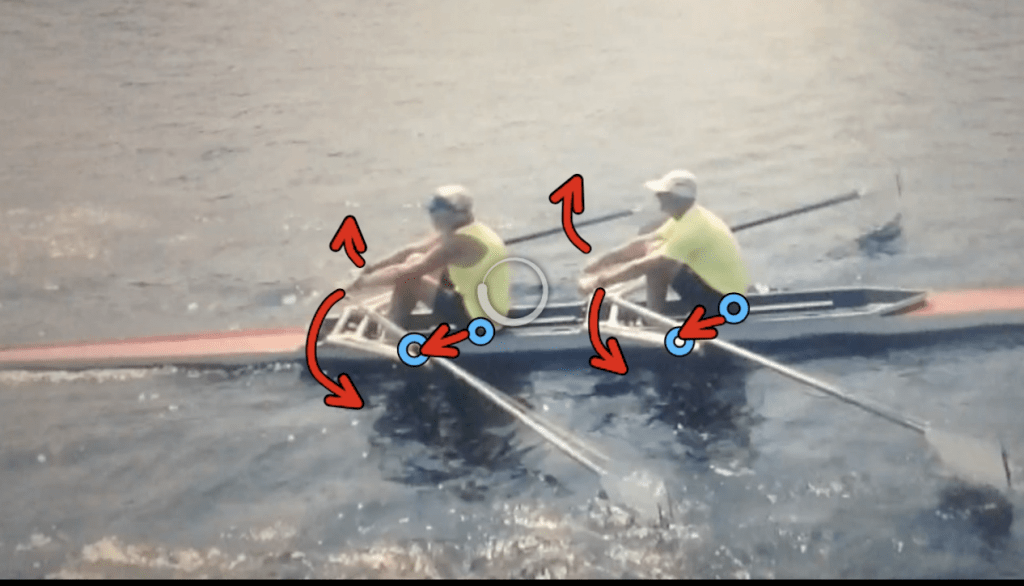
What it looks like: Your back begins pivoting open before your legs start driving. You're essentially trying to "lift" the load with your lumbar spine instead of transferring leg power. It's easy to do because when you shoulder lift, you can really feel the connection with the oar in the water.
Why it happens:
The cost:
How to identify it:
The fix:
Drill: Legs-Only Rowing
What it looks like: Your slide speed on recovery is as fast as your drive speed. You're racing back to the catch, creating a hard, uncontrolled collision at the front end and pushing the stern into the water which slows the boat.
Why it happens:
The cost:
How to identify it:
The fix:
Drill: Ratio Rows
Drill: Pause at Hands Away
Mental cue: "Quick drive, slow recovery" not "race back to the catch"
The problem: Sliding so far forward that your knees are past your toes, shins angled back toward stern.
Why it's bad:
The fix:
The problem: Hands push down and body swings forward before arms are fully straight creating a rushed recovery.
Why it's bad:
The fix:
The problem: Death grip on handle, white knuckles, forearm pump after hard pieces.
Why it's bad:
The fix:
The problem: during the power phase the back doesn't swing dynamically and add to the stroke power.
Why it's bad:
The fix:
These faults rarely exist in isolation. Usually, one fault causes another:
Common chain: Rushed recovery → Late catch → Early back opening → Poor release → Rushed recovery...
Breaking the cycle:
Timeline: Expect 6-8 weeks to automate new patterns. First 3 weeks feel awkward and slow. Weeks 4-6, things click. Weeks 7-8, new pattern is natural and faster than old technique.
Frequency: Film yourself every 2 weeks
Setup:
What to watch for:
Compare to: Exemplar technique videos (Olympic rowers, elite masters)
Every session starts with technique:
Progression:
Maintenance:
If you're struggling to self-correct:
Cost: $50-$150 for one-off analysis, worth it if you're stuck.
Should I hire a rowing coach as a masters athlete?
Fixing these three faults typically results in:
Timeline:
Our Technical Drills Videos provide:
Stop fighting poor mechanics. Fix them once, benefit forever.
Join our newsletter for weekly technique tips and drill progressions.
The anger caused by a gap between expectation and reality. This episode is for intermediate rowers who are learning how to race. How to turn your anger into something useful.
Timestamps
00:45 What happens if a race outcome isn't the result you hoped for?
Should you suppress the anger, spiral into it, or neither?
Anger is expectation minus reality. The bigger the gap, the bigger your anger. Name your gap not the "failure". It's an outcome not a judgement on you, the athlete. Intermediate rowers are learning how to train first, and now you are learning how to race. This is the same process.
You've done enough training to have expectations of success but you haven't yet done enough racing to get the outcome you desire. Experienced racers expect this gap. Make the gap concrete - a time, a distance behind the winner. Name the gap and move it from being an identity problem to being a performance problem.
Notice what you say..... "I worked hard but the crew fell apart". Name it in numbers not feelings and emotions.
Less "but" and more "and".
Your post-race debrief language will have used the word but. This cancels everything which went before it such as your training investment. And allows you to hold two truths at once. I trained hard and I had a bad race. Neither cancels the other out. You accept the outcome and your next race is still ahead. As masters there's always another age group or challenge to move into.
You're going to take one thing from your toolbox of skills, mental strength, fitness and change it. Changing everything resets expectation and creates another gap. You can only test the effect of what you've changed if you change only one thing at a time.
Ask yourself - what's one thing I already know how to do better, but I didn't do today? Your answer is already there, in your toolbox. Use the "and" mindset as you think about this. I
You are learning how to do this and pattern recognition is an important part of this learning. Experiencing different situations will teach you if what you have in your toolbox is sufficient to help you close the anger gap. Training alongside another crew can help you experience more race-like situations.
Go to your crew mates and coach and find out what their gap was and discuss what you're going to do about it next time.
Knee pain in rowing typically stems from over-compression at the catch (knees past toes, excessive slide length), improper foot stretcher position, weak supporting musculature, or rapid volume increases. Fix by reducing compression 2-3cm, adjusting foot stretcher position, strengthening quads and glutes, and addressing any training load errors. Most knee pain is preventable and fixable without stopping rowing entirely.
What's happening: You're sliding so far forward that your knees track well past your toes, creating extreme knee flexion angles under load.
The problem: This position puts your knees at a biomechanical disadvantage. You're asking them to produce power from a position where the joint is maximally stressed.
The force issue: Every stroke creates hundreds of pounds of force through your knee joint. Multiply by 10,000 strokes per week at extreme flexion, and you get pain, inflammation, and potential injury.
Visual check: At the catch position, look down at your knees. If they're significantly past your toes, or if your shins angle back toward the stern, you're over-compressed.
Why masters athletes do this:

The hidden culprit: Your foot stretcher settings might be creating the over-compression problem.
Too low: Enables over-compression if you have good joint mobility.
The solution is often simple: Move foot stretcher height one hole higher (reduces compression by 2-3cm). Create a "reminder" for yourself by putting electrical tape on the slides - you will feel it when your seat wheels slide over it and that will remind you to stop sliding beyond that point. When on the rowing machine, you can wrap an elastic bungee around the slide or use electrical tape as in the boat. It's very obvious when your wheels go over the tape.
Test: Get photographed from the side while rowing and see where your knees are relative to your toes at the catch.
The mechanism: Rowing requires strong, resilient leg muscles to absorb and produce force. Weak quads and glutes force your knees to compensate.
Age factor: After 40, you lose 3-5% muscle mass per decade without resistance training. Weaker legs mean more stress on joint structures.
The vicious cycle:
Breaking the cycle: Add dedicated quad and glute strengthening (more on this below).
Too much, too soon: Rapidly increasing training volume stresses tendons and joint structures faster than they can adapt.
The 10% rule violation: Increasing weekly volume by more than 10% creates overload that manifests as knee pain.
Example of too-fast progression:
Proper progression:
The problem: If you're opening your back before your legs finish driving, you're not fully utilising leg power. This can lead to pushing harder with legs to compensate, creating knee stress.
Check: If your lower back fatigues before your legs during hard pieces, your sequencing is wrong.
The fix: Master legs-then-back sequencing. There are skills drills which your coach can teach you (or check out our Rowing Drills videos).
What are the most common technique mistakes in masters rowing?
Action: Cut your slide length by 2-3cm until your shins are vertical at the catch.
How to measure:
Mental shift required: Accept that you're trading marginal power (last 2-3cm contributes minimal drive) for healthy knees that let you train consistently for years.
Reality: Most masters athletes over-compress. Reducing compression usually improves technique and reduces pain with minimal power loss.
Position test:
Effect: Moving shoe heel height effectively changes your compression without changing your movement pattern.
Week 1-2 of pain:
If improving after 2 weeks:
If not improving:
Bulgarian Split Squats:
Step-Ups:
Terminal Knee Extensions:
Romanian Deadlifts:
Glute Bridges:
Single-Leg Deadlifts:
Hip Flexor Stretches:
Quad Stretches:
Ankle Mobility:
Weeks 1-2:
Weeks 3-4:
Weeks 5+:
If rowing is too painful:
Goal: Maintain fitness while allowing knees to recover.
If you can row with modifications:
Arms and body only rowing:
Foot stretcher position: As flexibility changes with age, your optimal settings change. Reassess regularly.
Heel height: Make sure heel cup of your shoe relative to your seat top height is suitable for your flexibility. For men it's 17 cm plus; for women 15 cm plus depending on individual ankle mobility.
Compression distance: Mark optimal catch position, check you're not sliding past it when fatigued.
This isn't rehab, it's maintenance. After 40, resistance training is non-negotiable for injury prevention.
Minimum: 2 sessions per week, 45 minutes, focusing on legs and posterior chain.
Is it worth doing strength training for rowing at age 50+?
Follow the 10% rule: Never increase weekly training volume by more than 10%.
Deload weeks: Every 4th week, reduce volume by 30-40% to allow accumulated stress to resolve.
Monitor: Track weekly volume. If knee pain appears, first check if volume increased too rapidly.
Monthly video analysis: Check that compression hasn't crept back, sequencing is still correct, positions are maintained.
Drill work: Daily technique drills maintain proper patterns even under fatigue.
Catch position checks: Every few weeks, have someone confirm your catch position. Make sure you're not sliding past it.
Don't self-diagnose serious issues. Meniscus tears, cartilage damage, and ligament problems require professional assessment.
Cost: £60-100 per session, typically need 3-6 sessions.
ROI: Prevents chronic issues that could end your rowing career.
Our Technical Masterclass includes:
Our Masters Performance Programme provides:
Join our newsletter for injury prevention strategies and training insights.
Limiting beliefs can hold you back due to fear of failure. Is this the biggest hurdle for your rowing progress?
Timestamps
I would love to go and race at (this regatta) but I don't want to come last. What is it that they are frightened of? Would you like to do the world masters regatta?
What holds us back? Feeling well prepared for your event is important but masters' fears show up differently than kids'. Children are less good at thinking through the consequences of their actions. Anxiety holds you back from trying new things. A mind shift to assess what failure means to you. A failed piece is one where you have learned nothing about your own effort or your own pacing. Did you stay within your capabilities? Did you try anything different, notice anything different?
Try to think differently about "failure" in training - we should feel safer here and able to try new things. Some feel more anxious when rowing with more experienced athletes - how could you give confidence to someone less experienced than you? Buy the worst house in the best street - a definition of success tends to look up (better) than you.
While out practicing, could you try a high risk drill during your training? Take the training wheels off and take a risk - limited but "do-able". What about a 5 stroke rule - commit to doing five strokes of your new thing / drill in a way that is confident and reflects your new norm. Do it at the same point on your waterway every single time you go out. Even if those strokes aren't perfect you will still learn from them. The point is the repetition and becoming more familiar and this builds confidence.
When you come off the water after rowing you do a debrief - what did I do well, what could I deliberately risk next time? Use understanding risks as a mindset change to help you conquer your fear of failure. It only needs to enable you to feel just a little bit more capable of trying something different.
A limiting belief is something you tell yourself but which you won't get past unless you try. "I cannot do square blades" won't enable you to learn square blade rowing. Challenge your limiting belief or it will stay with you. Taking risks may help you get more satisfaction from your rowing by learning something new. In the debrief, share one good failure you had and what you learned from it.
Fear of failure steals boat speed more than lack of fitness. Pick one "low stakes" thing which you can try this week - intentionally take a risk. How did you go, what happened as a result and did you learn something from it?

Join our community and get our exclusive Faster Masters Rowing Magazine, packed with tips, techniques, and inspiring stories. Includes four new articles monthly.
