Improve your rowing ratio while lifting in the gym.
Timestamps
Lifting heavy has lots of benefits - today we'll talk about ratio. The contrast between the power phase and recovery phase. How to use this concept of ratio in strength training.
As we age we find our muscles and tendons don't have the same range and so our stride gets shorter. Strength training can help improve or maintain RoM. Weight lifting works in two planes - when you lift the weight and when you return it to the start point. Concentric muscle movements are shortening the muscle (as you lift). Eccentric muscle movements are lengthening the muscle (as you return the weight to the start). Eccentric muscle work can help improve your range of movement. Working on this part of the strength lift can use the rowing ratio as part of the movement.
The braking effect that you use as you control the weight in the eccentric lengthening muscle phase as you lower the weight down can enable you to have greater force production. When lifting heavy for few repetitions or using small muscles e.g. doing chin-ups against your body weight you may find the difference between the last successful lift and when you fail is large.
Do your first chin up
One way to improve your strength and do your first chin up is to start at the top of the lift with your chin over the bar (you may need a chair to step or jump up there). Then slowly lower yourself by straightening your arms doing just the eccentric part of the lift. Try a slow count of ten to complete the movement. You will gain strength more quickly by doing this slowly muscle lengthening under load.
When you've done this a few times, try doing one chin up - you probably can lift yourself up. Use approximately a 3:1 ratio in your lifting for big muscles - legs and back. And 2:1 for smaller muscles like arms. The more ratio you can manage the more you will be working the braking effect on the eccentric lift. You will do fewer repetitions using this method as you tire faster.
Consider a difficult lift like a squat using an olympic bar. Getting a deeper squat - to 90 degrees or to a deep squat position is challenging.
3x per week for 6 weeks.
Start each lift with an ultra-light load. This helps refamiliarise your muscles with the movement. Then add weight so that you keep good form. Try to do 3-5 sets of each lift each time you go to the gym.
11:30 Take your ratio training from the gym back into the boat.
Can you push the oar faster through the water so that you can take longer on the slide recovery? You should be able to increase your ratio thanks to your work in the gym.
By Andrew O’Brien
Editor’s note: Not all masters crews have a dedicated coach. Here, coaching refers to the shared work of crew members keeping the training focused and allowing the boat to move efficiently.
If you row long enough, one thing becomes clear: energy matters. Not in theory, but in practice. There is less of it to spend, and it takes longer to recover once it’s gone.
For masters rowers, that reality doesn’t mean rowing less or caring less. What cannot be done harder must be done more efficiently. Where muscles begin to tire, intelligence has to take over.
This article is about energy-efficiency in masters rowing. It isn’t about climate change, and it won’t fix global warming (nor will it replace a misspent youth), but the idea of sustainability still applies.
Masters rowing thrives on enthusiasm and experience. What it cannot afford is unnecessary work.
In rowing, effort is in service to the boat. The boat responds positively and immediately to efficient stroke-making.
Good rowing environments recognise this. They protect the energy rowers bring to the boat by reducing waste. When effort is treated as valuable rather than expendable, performance improves and people last longer in the sport.
Energy-efficiency should not be confused with energy conservation. This is not about backing off, lowering standards, or dulling enthusiasm. It is about providing better service to each other and the boat for the same amount of effort. The goal is not less work, but better work. A simple principle helps here: the rower serves the boat. Not the coach, not tradition, not habit. A boat that is well served is one that moves a given load at a given speed with the least physical cost.
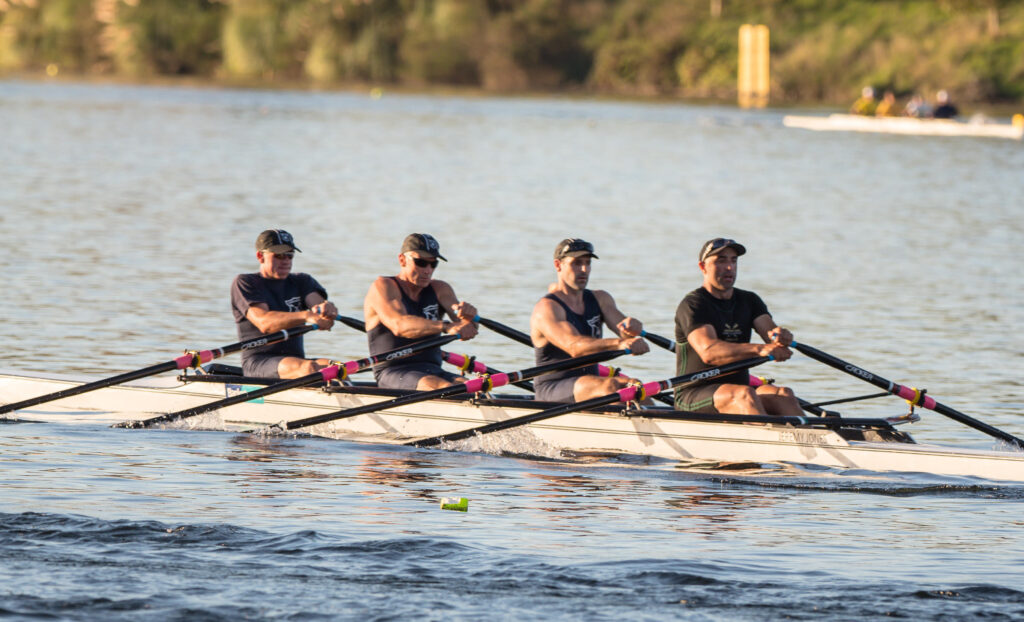
Good rowing happens when individual efforts are necessary, compatible, and free of waste. When that is the case, nothing is working against the boat, and nothing is being added that the boat does not need.
From that point of view, much of the noise falls away. Crews are left doing as little as possible and as much as necessary to move the boat at its optimum sustainable speed. Effort is still present (sometimes considerable effort) but it is directed rather than scattered.
This matters particularly in masters rowing. We do not have spare capacity. Every unnecessary movement, every forced position, every over-correction costs something that is slow to recover. What remains, when waste is removed, is effort that counts.
Crews that encourage natural movement save energy collectively. Grimacing, over-tension, and constant fixing are usually signs that effort is being spent without return.
Movements that require ongoing correction are rarely efficient.
There is a strong connection between what is unnatural and what is inefficient. This is why masters rowing gains little from chasing stylised or exaggerated movements, especially those rehearsed away from the water. These are not poses to be assumed, but actions to be lived. What matters is a small number of natural movements, repeated consistently, in the environment that counts: the boat on the water.
Life already provides a useful filter. Movements are chosen and repeated because they do not cause injury, require less energy than alternatives, and achieve the desired outcome. How we balance, lift, reach, breathe, and endure in everyday life often translates well to rowing. What feels natural is usually what is most sustainable. Life commends it.
In the boat, these movements are simply sequenced and connected naturally. When fatigue, habit, or unpredictable circumstances get in the way, efficiency drops. The work, whether carried by a coach or shared within the crew, is to notice that early and remove what does not belong, so what remains can be applied repeatedly. The alternative is familiar to most masters rowers: working harder for no gain.
Inconsistent movement, incompatible timing, and effort piled on top of effort. It is tiring, frustrating, and often injurious.
Masters rowing cannot afford that kind of waste.
What ultimately makes the difference is not authority or instruction, but responsibility. In many masters crews, the work traditionally associated with coaching is shared: paying attention, asking questions, protecting effort, and keeping the group focused on what actually moves the boat.
People rarely change because they are told to. They change when they recognise waste.
Crews that respect the effort each person brings, time, energy, attention, physical capacity, are less likely to squander it. Expectations become clearer, responsibility becomes collective, and improvement becomes sustainable.
For masters rowers, this is not a marginal issue. Power still matters, but it is no longer the limiting factor. The most valuable commodity is an energy-efficient crew.
Every masters crew wants to be that crew.
Andrew O'Brien is the author of the Good Coxswain Guide.
Alex Wolf & Sam Dutney in conversation. Two leading thinkers and innovators for masters rowing discuss strength training for masters.
The principles around maximal force applies everywhere. Teach athletes how to express maximal force. Learn the ceiling of what you can do. Turn muscles on and off.
Practice being forceful really quickly.
Building habitual capability - your day to day. Take a small change from what you do now and a little bit more than you can already do. That's enough.
Strength training is one of the most potent stimuluses for our health. The only thing which can repair your muscle structure is targeted loading, not rest.
The knee takes a load of up to 2 times body weight for rowers - masters it will be 1.2 to 1.7 times body weight. When squatting the leg is not the limiting factor - the lumbar spine tolerance is the limit. This is not the case in a rowing boat because the forces are horizontal.
The 7 stroke max test has a strong correlation to performance. Increasing this has got a 1:1 correlation with improvement.
How can you know if the improvement will come from force production or maximal force?
The rowing stroke is primarily concentric force production. Does eccentric have an effect? Yes, it's a long stretch shortening cycle. The end of the drive back to the catch has a significant contribution to boat speed.
The Reactive Strength Index. How you control a decelerating force and turn it round into an accelerating force. Rate of force is how much, when and how quickly.
Utilise each exercise efficiently is key. The king of exercises is the one that reaches your outcome. You must lift enough to create an adaptive response.
Want easy live streams like this? Instant broadcasts to Facebook, YouTube, LinkedIn. Faster Masters uses StreamYard: https://streamyard.com/pal/d/5694205242376192
How to use your glutes in rowing.
Timestamps
David Frost (webinar speaker - Functional Movement for over 60s) said Are your glutes 'along for the ride'?
Are your glutes working - how do you know if they are working?
Watch video of yourself rowing - check your legs are pressing down flat and your arms draw. But can you see your back swing? Are you starting leaning forward and do your shoulders move dynamically? Activating the back swing uses the glutes. They are the hinge that connects your legs to your back.
The power phase starts with your legs and when you get to a point where your legs are very nearly straight, you should be beginning your back swing. If your back is passive and isn't accelerating the oar through the water (if the water mound in front of the spoon reduces) you aren't using your back enough to go faster than the boat is currently going through the water. Your body has to move quicker than the blade to keep pressure on the face of the oar spoon.
If your back is passive then you've probably lost connection to the foot stretcher. When you do activate your glutes you're recruiting extra muscles to power your stroke. But it's hard to activate the glutes. Strengthening the glutes is also important so we can make them really useful. Christiano Ronaldo the footballer was warming up with glute activations - this is interesting - an elite pro athlete still feels the need to activate his glutes before starting playing.
06:00 Exercises for glute strength
First know how to activate the muscle and know what it feels like when it is working before trying it in the boat. When approaching the catch clench your bum (butt). You are looking for the feeling of 'holding in a fa*t and you don't want to let it out'. This activates the muscles and when you drive with your legs, the muscles are engaged.
Watch the numbers on the erg first - do 10 strokes approaching the catch first. Then do normal rowing without clenching for 10 strokes. For an improved back swing, the body swing only drill is good to do - get a video of it free from the Coach Mastermind course.
Different needs for different levels of experience. This goes without saying, because within any one masters group (whether beginners or elite racers) I find vastly differing back-histories. We have top racers who have never lifted weights and beginners who have a lot of experience.
This article sets out some of the goals for core strength based on the athlete's expertise in the weights / strength gym. It's not based on their rowing experience.
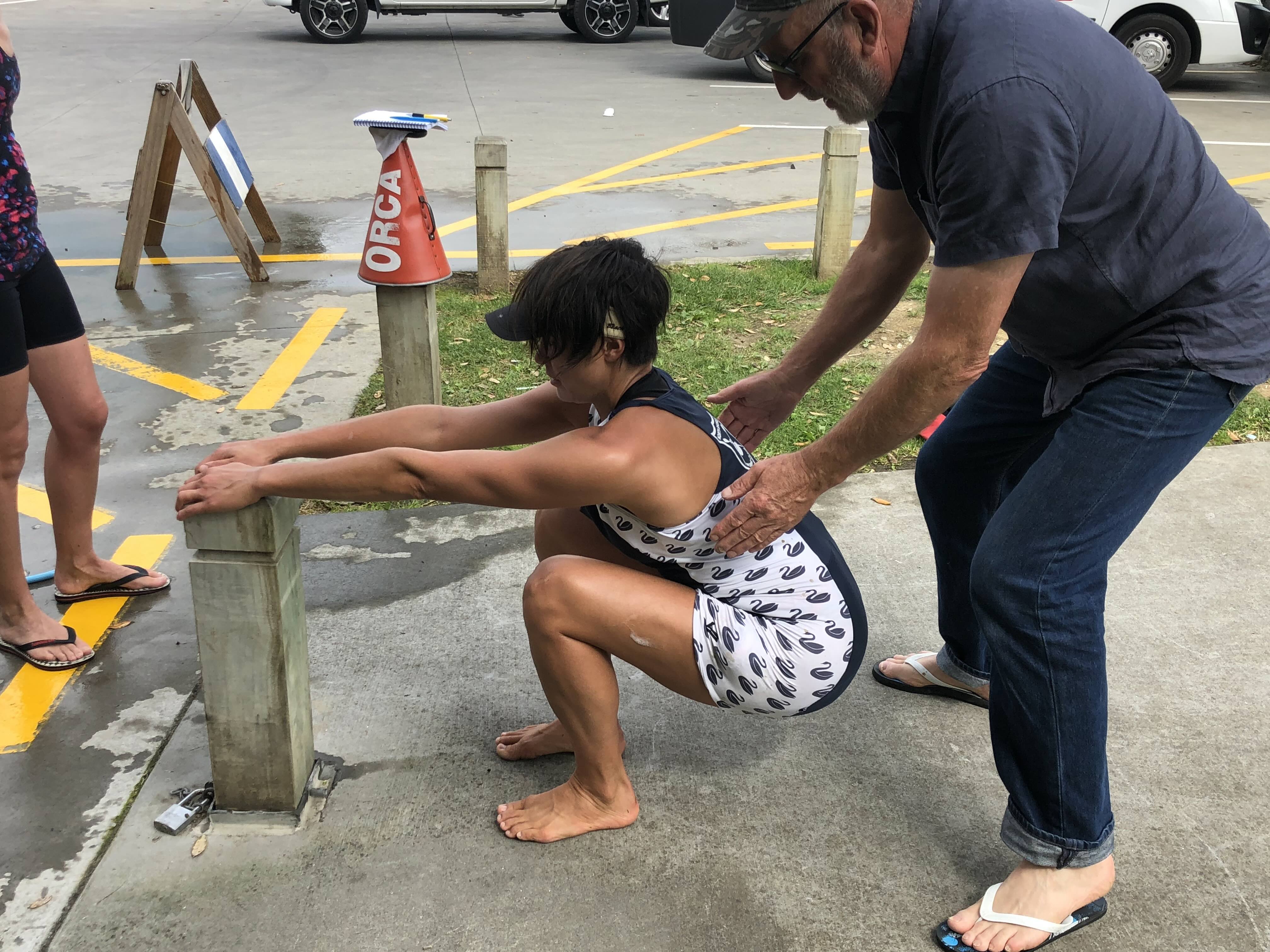
Focus: Activation and endurance rather than brute strength.
Exercises:
Focus: Stability under movement and fatigue resistance.
Exercises:
Focus: Maintaining stability under high force and dynamic conditions.
Exercises:
Why Train Core in the Boat?
While rowing itself is a core workout, supplementing it with land-based core training (planks, Russian twists, anti-rotation exercises) will give you even better results.
When working with less experienced athletes, I explain core stability in the boat as two things. Holding your "tummy firm" and "clenching your glutes as if you're holding in a fart". This always gets a laugh and it's a surprisingly effective way to show them which muscles they need to control.
1. Pause Drills for Stability:
2. Slow Ratings and Controlled Movements:
3. Single-Leg Rowing for Core Activation:
4. Side-to-Side Balance Drills:
5. Half-Slide Rowing for Core Control:
6. Sculling for More Core Engagement:
In-boat drills for core - get them to tighten their tummy muscles at pause points. Then rolling forward, get them to tighten glutes (describe this as holding in a fart) as they approach the change of slide direction at the catch.
Yes, you can train your core effectively while rowing, as the sport itself naturally engages core muscles. However, to specifically target core strength and stability, you can incorporate focused drills and techniques into your on-water sessions.
We offer a monthly strength training program which can be introduced at any time of year. It includes core strengthening exercises.
Understand how your movements contribute to the power phase in the rowing and sculling stroke.
00:30 There are many different ways to row - below we share how you can test this for yourself.
Using the legs, back and arms in sequence one after the other.
Start the legs and back at the same time and then adding in the arms later. Blending the overlap between each body part happens in practice so that the power doesn't drop off between each body part.
03:40 Force curve alignment
The sequential movement gives a longer time in the water and a longer duration of the power phase from catch to finish. Simultaneous gives a higher force curve because the power is higher, but it is a shorter curve because you cannot sustain the power as long as in the sequential.
04:55 Legs | Back | Arms Rowing is about the effective delivery of power and recruiting muscles into that endeavour.
Legs - the first part of the movement is from your knee - you push the footplate away so only the shins and ankles move. Initiate the stroke with the legs. Before your legs are fully straight, activate the back. One of the most difficult things to teach is how to keep your legs pushing straight while the back swing begins. Letting the legs drift without adding to the boat speed is a waste of power. The arm draw is also affected as some forget to continue the back swing when they start the arms drawing. Many masters have a good leg drive and arm draw but the back can be neglected.
Based on my experience legs is 65% and back is 25-30% and arms 5-10%.
08:45 Test this for yourself
In the boat or on the erg set up speed measurement using meters per second rather than 500m splits because it's more sensitive to boat speed changes. Row at firm pressure, low rate. Then stop using your arms and see how much the speed drops - then stop using the back and the arms (row legs only). Then do the reverse - do the pick drill and measure your speed as each body part is added into the stroke. This will show you how much of your stroke comes from each body part.
Faster Masters teaches a drill how to improve your stroke. Contact us to find out.
Get stronger by doing resistance work in the boat using a bungee. What's it useful for? How to set up your boat.
Timestamps
Do you need it? All masters rowers need this to keep up strength and bone density. We lose strength as we age. It helps us to stay fit and active as we age. You don't have to go into the gym. Weight training is lifts which are similar to the rowing action e.g. a seated arm draw.
03:45 Weights on the water gives you specificity
It aligns the weight training with the rowing action and movement. In the boat gearing helps you to not get over-loaded.
Each year I did weight lifting and added more weight to the bar I could lift. But in the summer I'd lose that strength during the racing season when I didn't do weights and did more water workouts.
06:45 Strength and conditioning includes work on core muscles Resistance training helps us to recruit more muscles into the rowing stroke. It's hard to learn the overlap between the legs - back - arms. Watching masters rowing, very few have an active back swing.
Video of good rowing technique demonstrating legs - back - arms.
Compare this to a video of yourself. Do your legs continue to press down as your back starts to swing? Look at the body rock forwards as well as back. When you have a heavy load, figure out which muscles are working because they have to work harder. On the erg, increase the fan resistance to 10 and try it. It helps you to be mindful as you row because everything is slowed down.
1 - Lower the rate. Do this resistance work at low rates, moving slowly and thoughtfully to make yourself deliberate and check your movements while you do each stroke. I like rates 16-20 if you can manage. Otherwise rate 24 is good.
2 - Increase the resistance - in a crew boat get half the crew to sit out so you carry their mass while you row.
Caution - you are carrying a large load when carrying rowers sitting out. Build up gradually to doing this for extended periods of time. Gradually increase the number of power strokes, start with 20 strokes and then switch to the other half of the crew doing the work. Three sets of 20 is enough to begin with. Do 2-3 sessions of this before changing the number of strokes or repetitions (sets). Well-trained athletes can build up to 50 or 60 strokes and many more sets.
14:15 How to do the workout Structure your outing like this: Do your warm up, then do steady state rowing for 10 minutes, do the 3 sets of power strokes, then paddle light or stop and have a rest after three sets. Then do another 10 minutes of steady state rowing, another 3 sets of power strokes and then warm down and end the workout. This would take an hour to do. To increase the amount of power strokes - increase the repetitions - increase the sets - reduce the amount of steady state
15:15 Other ways to increase the load in the boat
You can also increase the gearing on your oars or sculls. Or you can add a bungee on the boat - under the hull to provide the resistance. This can be an elastic cord or a boat tie. Put it under the hull before you go on the water and attach to itself or onto the riggers.
Take a boat tie and put under the hull so it reduces the smoothness of the boat hull. Attach it behind the rigger because when you row it could slip off if put sternwards of your rigger! You do need to be able to reach the bungee when in the boat in order to take it off at the end of the power strokes. increase the resistance by twisting the boat tie under the hull. You can also add a short section of garden hose - thread the boat tie through the hose.
The end of the workout - after your last set of power strokes is to take it off the boat. Then row your last steady state work without a bungee - your learned pattern of movement from the resistance training gets put into your normal stroke nad that additional work from overcoming the resistance helps to make the boat go faster (check it on your app / speed coach).
Using the recruited muscles and building into your stroke. Rowing slowly and deliberate movements really helps to improve your technique, especially at the catch. The slower hull boat speed means your placement into the water can be more accurate, once under the water you will also really feel the load. If you can slow the rate down to 16 - the boat is going through the water more slowly and the additional load at the catch placement helps you to feel what you're doing better. After taking the bungee off you continue to row with that level of skill in the final 10 minutes of rowing.
Want easy live streams like this? Instant broadcasts to Facebook, YouTube, LinkedIn. Faster Masters uses StreamYard: https://streamyard.com/pal/d/5694205242376192
3 tips for setting up your erg / indoor rowing machine correctly so that it is "like your rowing boat".
Support this show with a donation https://fastermastersrowing.com/podcast
01:00 This Past Week - what we do to advocate for masters rowing. Speaking at the US Rowing Convention, CRASH-B erg training program launch
06:00 Setting up your erg
Resistance - the drag factor on Concept2 erg, Water rower, RP3 and Rowperfect. C2 drag factor is 100 - 110 or 115 for masters.
Comfort - set your seat and foot height to avoid lower back load and over-use injuries
12:00 How to set up your erg to be like your boat - single scull. Do short 250m pieces at firm pressure low rate, come into the dock and get on the erg (also on the dock) and row 250m at similar pressure and rate. Do they feel the same? If no, adjust the erg damper setting and drag factor.
Fixed Head rowing machines versus floating head rowing machines - what's the difference? How does it affect the set-up?
14:30 Why am I doing better splits on a resistance 10 than 4?
23:00 Monitor height - set it for a "long core" posture as advised by Baz Moffat
A good drive reduces the "slip" in the chain and increases your effective leg power in the rowing stroke.
37:00 Coffey Simulatoar - set the inboard of the sculls to match your boat.
Bio Rower - set the finish / release position correctly to match your boat.
Feet on the footboard | Tips, advice and discussion from Marlene Royle and Rebecca Caroe.
- How the foot pressure changes through the rowing stroke.
- Drills to practice foot connection
01:00 This Past Week - what we do to advocate for masters rowing.
We will be speaking at the US Rowing Convention (virtual) on An Inclusive Vision for the Future of Masters Rowing.
https://usrowing.org/sports/2021/9/29/2021-usrowing-convention.aspx
The goal is to move the oar handle using the kinetic chain.
Pushing onto the heels during the power phase. The heel connection happens naturally.
If you push with quads to initiate then as you add the heels it transfers into the glutes.
Focus on the last third of the drive - activate the heels and glutes
At the end of the drive phase, do you point your toes? or keep heels down?
Keeping the suspension and stying up through the drive is best.
19:00 Get the right size shoes - if your calves hit the deck.
Shoes and foot flexion during the drive phase are important. The carbon sole rowing shoe helps your foot perform better - allows your toes to spread as pressure comes onto the feet.
27:00 Bont Rowing offer - will be shared with everyone on our newsletter list this week
Head across to this link: https://shop.bontrowing.com/account/register?fastermaster (this link will redirect to AUD, USD or Euro depending on location)
- Create an account.
- Check email and verify account.
- Browse the range, select products and add to cart.
- Head to checkout and use account email. Discount of 15% will be automatically applied.
28:00 Feet on the erg - do they come away from the foot stretcher?
- Rowing quarter slide from the release. Try to stand up in your shoes
- Feet out rowing and square blades. Note where you lose pressure on your feet and try to move the timing closer to the finish.
- Timing the release off your foot pressure. when you lose connection, take the oar out of the water.
- Can you hold the foot pressure as you make the turn around the finish?
- Recovery when you start to square, make sure you ave a good connection with the foot stretcher
- Row one foot in the shoe and one out - are they different? Swap.
37:00 Caryn Davies recommended rowing on the erg feet out for all rates lower than 26.
Adjust the heel cup height - does it give you better contact?
Equal pressure on blade - feet - handle through the stroke
Leg to back connection to make stroke power in rowing
- Faster Masters Rowing Radio - the podcast for masters rowers. Tips, advice and discussion from Marlene Royle and Rebecca Caroe.
Support this show with a donation
https://fastermastersrowing.com/podcast
02:15 This Past Week - what we do to advocate for masters rowing. Rigging inaccuracies around the pins.
07:00 The Caught Short Kit for female athletes who menstruate - Help yourself to pads and tampons. Can you make one for your club?
The power of the legs has to be connected to the oar handle.
Leg drive must directly move the oar handle.
If you drive and don't move the handle = shooting the slide.
If you move the handle and don't move the legs = no power
Feel Pressure on your hands and feet - check for yourself.
Often described as the hardest part of the rowing stroke to train.
14:00 How does the kinetic chain link? This is how you are connected together. The biomechanics of how the body moves and flexes.
The levers of bones connect through the joints.
Ligaments connect bones to bones.
Tendons connect muscles to bones.
There are 2 types of kinetic chain in exercise sport
The open kinetic chain - where the limb is free and not fixed to an object
The closed kinetic chain - where the limb is connected to the ground or something firm
18:00 Rowing is a closed kinetic chain you are working off the oar handle, foot plate and the oar in the water.
- as you drive off the catch it's the quads that activate first and as your heels go down you will add in your glutes.
Gluteal amnesia - it can be hard to activate the glutes as we age.
Strong glutes support your lower back.
23:40 Train your glutes by practicing isometrically. Squeeze them when standing, driving, sitting. To load your body weight in the boat you have got to use your glutes.
Be aware of them being strong and activated as you row.
- keep pressure on the foot stretcher in the last third of the leg drive.
Glute bridges
Side squats
Fire Hydrants (this is funny.... check out the comments on the video at this point)
Hungarian split squats
Use exercise bands
Lunges
When the blade is loaded - notice if this varies.
Feel the blade is or is not stable in the water.
Handle pressure stays continuous and horizontal through the stroke.
If the body comes in too early you can lift the handle and the blade goes deep as a consequence.
Exaggeration exercises - try swinging the back early or later.
Make the back swing more dynamic
Arms and body only rowing to isolate the swing.
Check your force curve on the erg.
Back swing adds length to your stroke.
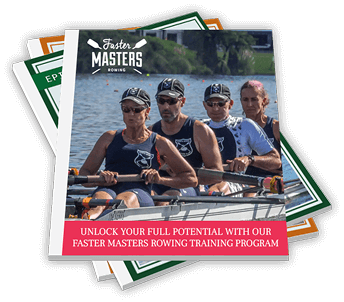
Join our community and get our exclusive Faster Masters Rowing Magazine, packed with tips, techniques, and inspiring stories. Includes four new articles monthly.