When did you last walk past your club’s erg room and think, “that looks like fun”?
A journalist writing for The Economist once admitted to peering into her university boathouse at 7am and seeing 30 sweaty men rowing in silent, robotic unison. Her verdict: boring, joyless and elitist. Later, on a trip to New York, she tried two indoor rowing studios, then a high-intensity class back in London. Candlelight, thumping playlists, instructors cheering the newcomers. She left a convert.
What hooked her wasn’t the machine. It was the crowd, the music, the numbers on the monitor and the chance to beat the person next to her. (Her stroke rate went from 35 to over 50 at a sprint. We won’t be coaching that, but we admire the enthusiasm.)
Studios built whole businesses selling rowing as sexy. So what does this mean for those of us who row on the water with clubs who struggle to fund raise enough to keep going?
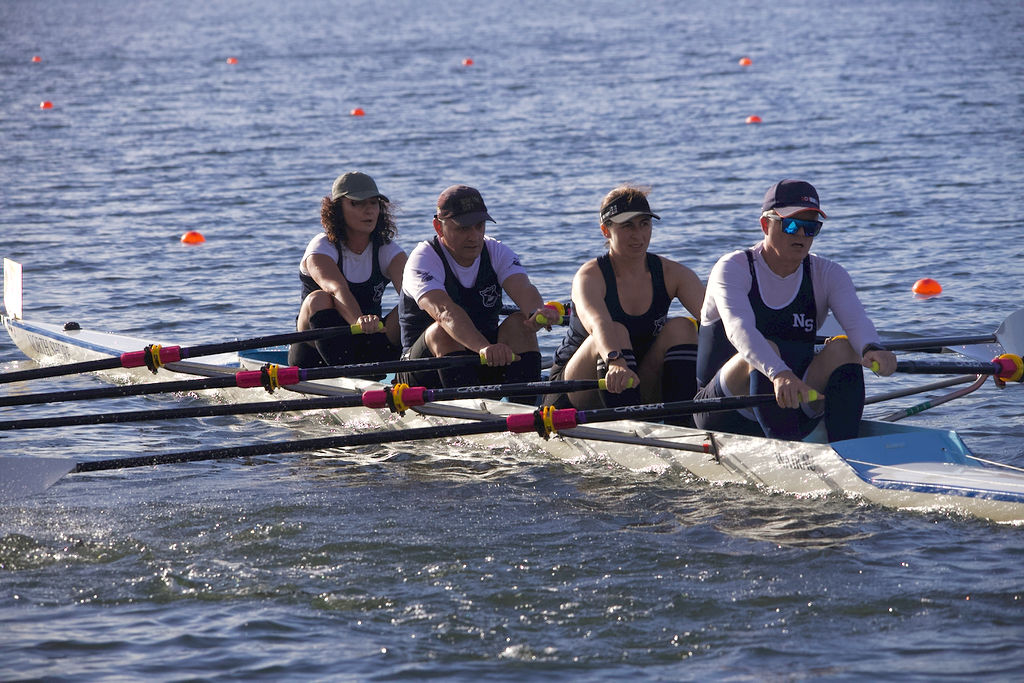
More people than ever have now sat on an erg, know the catch from the finish and understand what a hard 500m feels like. That is a ready-made pool of potential club members, already fit and already curious. Rowing’s image shifts too, away from blazers and boat races towards something ordinary people do on a Tuesday night.
But indoor numbers don’t convert by themselves. In UK, an estimated 10,000 school students take part in indoor rowing competitions each year, and one writer asked why so few of them make it onto the water. Interest needs an invitation.
Yes, if you can hold on to the people who come. Derby Rowing Club ran back-to-back learn to row courses for 68 people and kept 82% of them. Their insight: retention was highest where a squad already existed for newcomers to join. Indianapolis Rowing Center got 120 adults through the boathouse door in a single month, and 40% stayed. My club, North Shore in Auckland retains over 80% of our learn to row class - but only if they form friendships and enjoy the challenges set during the course.
Growth also has costs. Irish clubs surveyed by Rowing Ireland named coaching capacity, equipment, safety cover and facilities as their main barriers. In New Zealand, masters make up nearly 30% of club membership, and many already struggle for water time in peak season. Recruiting without boats, coaches or a squad to move into creates frustrated novices and resentful members.
Call it the Boutique Effect. The studios didn’t change the rowing stroke. They changed the experience around it. Here is what we can borrow.
And the club doesn't have to run these sessions themselves - find a local personal trainer, offer them your gym or ergs in off-peak times when the club members aren't using them.

Most boathouses are busy at dawn and on weekend mornings, then sit empty. Erg rooms, gyms and clubrooms are assets your club has already paid for. Personal trainers and fitness coaches are always hunting for space, so invite them in. A trainer running lunchtime or evening erg classes brings paying clients through your door, earns the club hire income and introduces dozens of people to your building and your sport. British Rowing’s Go Row Indoor Club scheme is built on the same idea.
Out-of-hours hire only works if it doesn’t land on one volunteer’s inbox. Venue booking software such as SpacetoCo lets you list your spaces, take bookings and collect payments online, so the boathouse earns its keep while you’re at work. Or you can install their venue booking software directly on your website (SpacetoCo works in UK, Australia and New Zealand).
| KEY TAKEAWAY Growth is only good for your club if the pathway exists before you open the door. Recruit to your capacity, then build more capacity. |
Masters are well placed to lead this. Around one third of masters rowers started as adults, so we remember what it felt like to be new. We’ve shared ideas on running better adult learn to row classes before. If you’d like to talk through a growth plan for your club, book a confidential Rowing Concierge chat.
Self-assessment: is your club ready to grow?
☐ We know how many seats, boats and coaches we can offer newcomers each week.
☐ Every learn to row graduate has a named squad or crew to join.
☐ Newcomers are welcomed by name and celebrated at their first session.
☐ We know when our boathouse sits empty, and who could use it.
☐ We have talked to at least one local personal trainer about hiring our erg room.
☐ Beginners get simple benchmarks to measure their progress.
☐ We run at least one fun internal competition each season.
☐ Existing members still get the water time they need.
Why the rowers, crews and clubs that cope best are not the ones where nothing goes wrong. They are the ones that can change direction when the plan falls apart. Resilience isn't powering through with brute force, it's the ability to adapt to try a different approach and let go of what's not working (in the boat, the crew, the club). Same question every time - What's our next move from here?
Timestamps
The perfect picture of life when the obstacles are bigger and the path isn't straight. In rowing we get situations where a pivot is needed. Ross was right you do need to have the ability to pivot.
In technique you find the coaching approach isn't working - trying harder may just create tension, stress and no improvement. The pivot is to change the approach not the effort. Have a different cue (aural not verbal) or body position which is a different way to achieve the change. Try video, try it on the erg, in the single, slower / faster. All these approaches enable you to make a change by thinking about a pivot to a different way to do it.
You want to get a group together to do something - it often doesn't work. It can be hard to break into a group which appears to be already sorted. Don't wait for the "perfect" lineup - think about changing the approach instead. Row with the crew you've got - cut an eight into a four, have a regular list of alternates/substitutes who can come at late notice. We often suggest building your own crew rather than trying to break into an existing crew. Ask new joiners to try rowing a quad on a Wednesday. Look at the Learn to Row graduates and pick out a few who might be able to join you. "super stars" may get invited to join the fast crowd but most of us don't get selected like that. Be available to be the regular substitutes when the fast crowd crew needs an extra person. This can lead to the two crews blending and helping each other out - it builds trust.
Things break - often just before an important regatta. Or the club has no money to do what you want to do. Your pivot could be to start with what you have. Can you borrow or share a boat? Could you run a club repair day and invite the local boat builder to show you how to do repairs on site? Ask if someone has tools who could lead a working bee to fix up the club house - simple things that don't require a lot of expertise.
Other fundraising ideas can come from other sports - would a group watch party for a coaching video be fun? Sell food at the same time. when things don't go to plan, shouting Pivot louder is not a solution. Keep asking the same question "what is our next move from here?". Listen to the quiet people - the introverts - they often have good ideas and get shouted down by the loud folks.
These things compound and that can become the "new normal" for your club.
The Parents of Wanaka Rowing Club Junior Squad wrote this on their private Facebook page and Rob Bruce sent it to me.
(Random impressions from a rowing parent from a small rowing club.)
Note: RowIT is the Regatta Central of NZ and it includes the results of everyone including Olympians… going back years. Truly a great database.
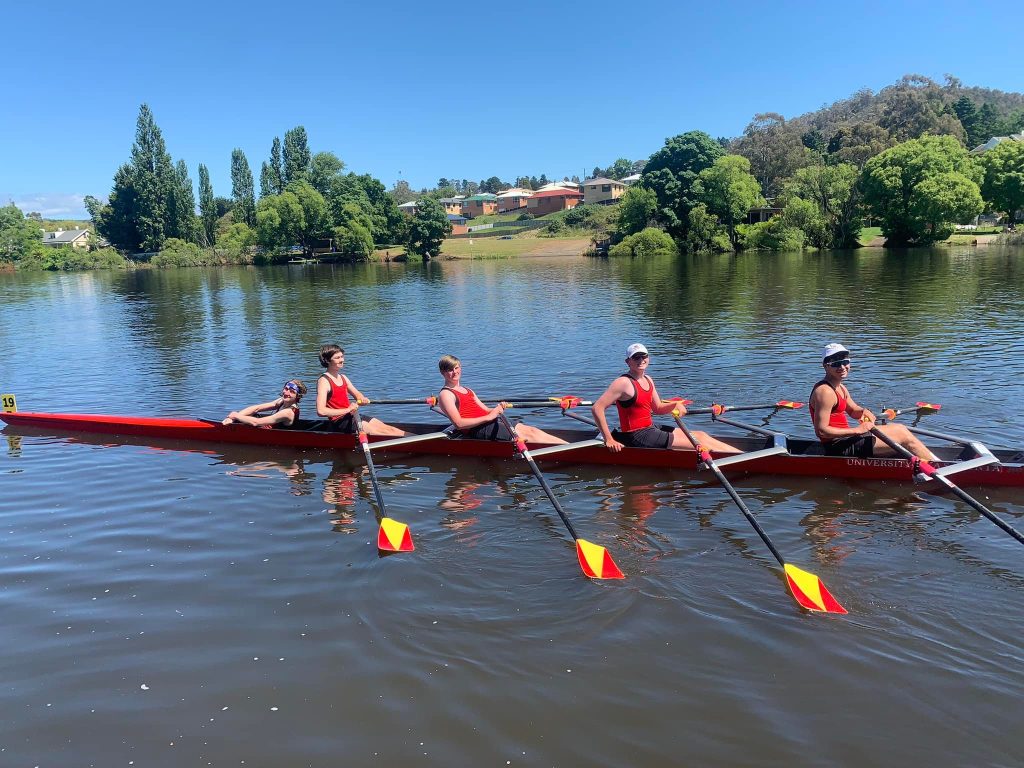
Recently I've heard a lot from athletes who join new clubs or graduate from the learn to row class into the competitive group and feel isolated and a little "adrift". The symptoms are often based on being the newbie, not knowing how things work around here and a sense that you are not being "seen" as an individual and don't know where you fit in.
Many of these resolve over time as you get to know your new training group and robust leadership from coaches or group captains can definitely smooth the path.
Further, this issue shows up more for intermediate / beginner rowers than the more experienced athletes. That's because the more experienced you are, the more you know how the rhythms of the rowing year run and even if you're in a new club, you know what to look for and can ask the right questions. Not that this article isn't for you, but it is directed more towards intermediate athletes.
When joining a new club or moving into a new group here are some suggestions of what to do
In the first few sessions
Middle stretch
Mindset

These good things don't happen in isolation. Use the structures within the rowing club organisation to facilitate the good behaviours and attitudes you want to see.
If your club doesn't yet have these structures, or you are feeling left out, book a Rowing Concierge 20 minutes and chat it over with us. We may be able to help with specific situations.
Fundraising using adult learn to row courses can be very profitable for masters clubs and also provides a ready stream of new members.
Adults are very interested in trying rowing - the sport is so high profile in many countries that scullers and successful crews are household names. For masters rowing clubs learn to row courses serve two separate and useful purposes - firstly fund raising and secondly a source of new members for your masters training group.
There are three main parts to the course - finding the right dates to run it, finding volunteers to help coach, and finding the right equipment.
Dates first - spring and autumn are good times because the weather in NZ is often quite stable and there are fewer demands (School holidays, overseas trips) that people take at these times. A simple learn to row course can be six lessons total with a follow up course of another six lessons. This allows people to give it a go and then continue if they like rowing or drop out honourably if they don’t!
Find three consecutive weekends and run your course on both Saturday and Sundays. The follow up course ideally should be on the next three consecutive weekends without a gap. When you have a gap, more people drop out.
Volunteers - you don’t have to be an experienced coach or an experienced rower to volunteer. If you did the learn to row course six months ago, you know enough to help with newbies. The club needs roughly 6 volunteers for 12 students learning to row. Most of what you will be doing is helping people get their footstretchers set up correctly and then sitting the boat level while they try rowing.
The best learn to row coaching structure and method is detailed in the book Masters Rowing - Training for fitness, technique and competition by Volker Nolte and Wolfgang Fritsch. Wolfgang wrote the chapter and it is really clear setting out what to teach first, what to follow up with.
The main thing which adults need and which is mis-understood compared to coaching young people is to get on the water from the very first lesson. Ideally don’t use ergs to teach on that first weekend - the details of half slide and feathering can be learned later. Get your students in a boat rowing square blades and full slide (however they can) is what gets them hooked. Later on you can teach them body sequencing and what the coxing commands are.
The equipment is also important - if your club has access to coastal boats or surf-boards-with-riggers those are great for the first learn to row course. Pontoon floats can be attached to boats too for stability, They’re stable and get people started really easily - and they can also be used for club rowers wanting to practice catch drills - Eric Verdonk (New Zealand single sculler) used them extensively before winning his Olympic medal. Alternatively, regular club or high school boats can be used with experienced people sitting the boat level. Think 50% novices and 50% experienced in each boat to begin with. The most challenging athletes are those weighing over 100kg - they are hard to accommodate in school boats as they’re typically 70-80kg average athlete weight.
What to charge for your course is also an important question. Compared with other sports, rowing tends to under-charge for the expertise and the experience of learning rowing. It’s very time intensive on volunteers so clubs should make it worthwhile. Charging between $300 - 400 for six lessons is a fair price with each course having between 10-16 athletes. This could net you $3000 - $6,400 for the course.
Advertising your learn to row course is best done on your website - have a page titled “Adult Learn to Row” and put the dates of the next course up there for the whole year. An expression of interest form can collect names of people ahead of time (not everyone can do the dates and so you can offer them future courses if you have their contact details). Another good avenue are the parents at your local high school - they are bringing their kids to the club anyway and so going rowing themselves at the same time gives them something to do! And don’t forget the local newspaper and radio station - they love hearing about local activities and could get on board by sending a journalist on the course to report back.
After the course ends, it’s important to have a pathway to membership of your club. Plan which group the graduates can join so they can continue learning and having fun on the water.
Good luck raising good coin with adult learn to row.
My club has been having an intense discussion recently about buying a new pair/double. Nothing particularly unusual - except the new boat has to fit into our existing fleet.
So far we have

We did an anonymous survey of members to ask their weight. Over half our members are under 70kg. You can see the mis-match between the boats and the athletes.
When researching hull designs we found that manufacturers seem to be changing what they are building. In the old days boats were designed around a mid-weight and then by raising/lowering the oarlocks you could go +/- 5kg either side of the midweight. So a 75kg boat could suit 70 - 80kg athletes.
Now it appears that the weight range is huge - up to 20kg.
Our researches found three grades 55-75kg, 60-85kg, and 75-90kg.
Boatbuilders may use the same outer hull and create a boat suitable for a particular weight athlete by raising or lowering the deck. Other methods include installing longer pins so the oarlocks can be raised/lowered across a greater range.
The question we will be discussing Is a wide weight range desirable or does this mean "One Size Fits None"?
Anything electronic or electrical comes with wires - and wire management can result in a jumbled spaghetti tangle in a rowing club with multiple cox boxes, speed coaches, megaphones, boat lights and other paraphenalia.
This helpful post on the Masters Rowing International Facebook Group shared a lot of different solutions which clubs have set up to manage electrical charging stations for rowing electronics.

The range of options starts with home made shelving with circles cut into MDF board and a multiblock electrical charging point hidden behind into which the chargers are permanently plugged in. some use nylon piping cut into the wooden shelf to contain the circular boat lights and cox boxes (fun fact - the reason the cox box is round is because the original prototype was housed in plumber's piping!)
To ready-made lockable steel cabinets with sliding trays with cut in circles and a single electrical charge cable at the back of the box. The advantage of this is it can be taken to regattas and plugged in at the hotel.
Others use pre-purchased shelving (adjustable shelf heights help for different types of equipment.


Space Saver Rowing Systems has a ready-built box suitable for both cox boxes and stroke coaches. One uses a flat tray, the other has holes cut in.

And lastly there's the de-luxe version - Capital Rowing Club in Washington DC have a video of their storage - built into shelving which has adjustable shelf heights it is used for electronics and charging megaphones as well as spare parts, life jacket storage and more. Impressive work!
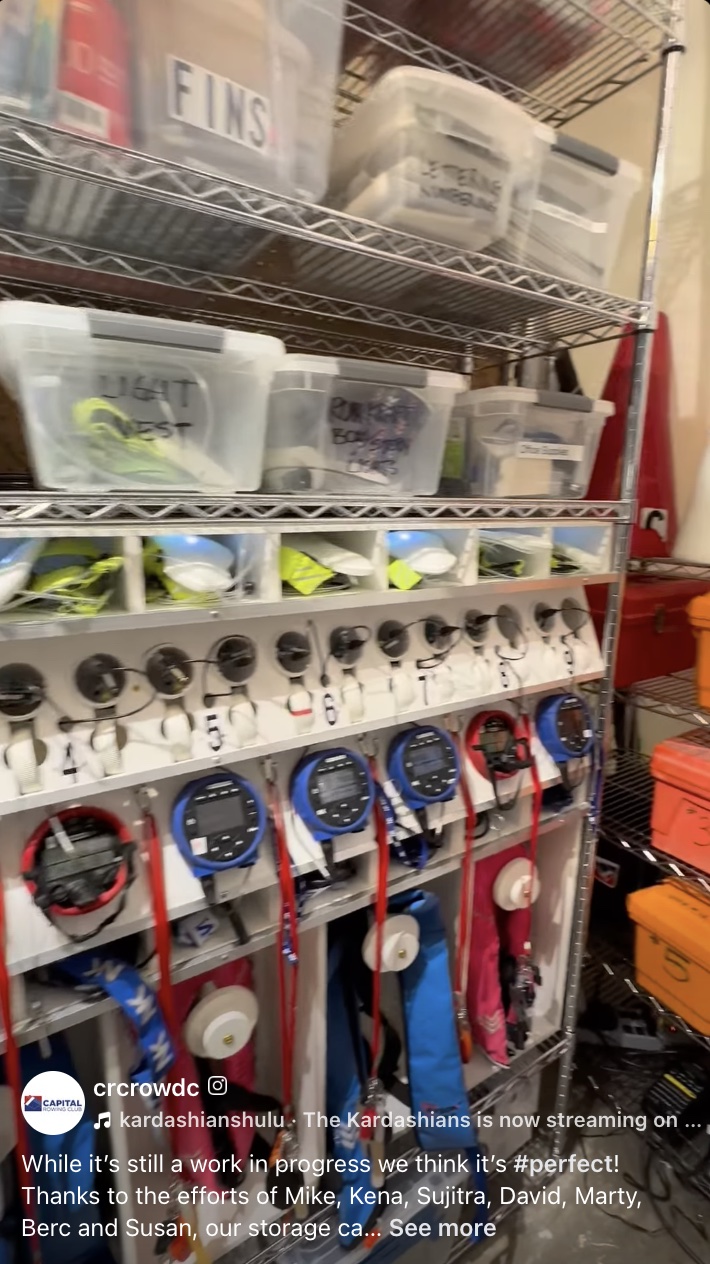
Watch the video of their magnificent storage. I like that the life jackets are stored below the cox boxes on hanging racks with a large button on the end (so they don't fall off). Wonder about the pink/blue options?
A quote has been reverberating through my head recently.
'This is how a species prepares to depart for the stars. You don't depart for the stars under calm and orderly conditions. It's a fire in a madhouse.'
Terence McKenna
That's Terence McKenna, the counter-culture philosopher and mystic, speaking in 1998. He was watching the early internet age ignite around him and reaching for language big enough to describe it. Nearly thirty years on, the quote has only grown more visceral.
But here's the thing. You don't need to look at AI or technology to feel the fire. If you're a masters rower, you've got your own madhouse to contend with.
The body that carried you through your thirties starts sending unfamiliar signals. Recovery takes longer. Injuries that once resolved in a week linger for a month. The split times you used to hit without thinking now require a negotiation between ambition and biology. And the coaching advice that made sense at 35 needs reinterpreting at 55. There is no stable ground. The conditions keep shifting.
Amid all this, we reach for explanations. Training plans, sports science, lactate thresholds, periodisation models. The information available to masters rowers today is extraordinary, and it is genuinely useful. But analysis has limits.
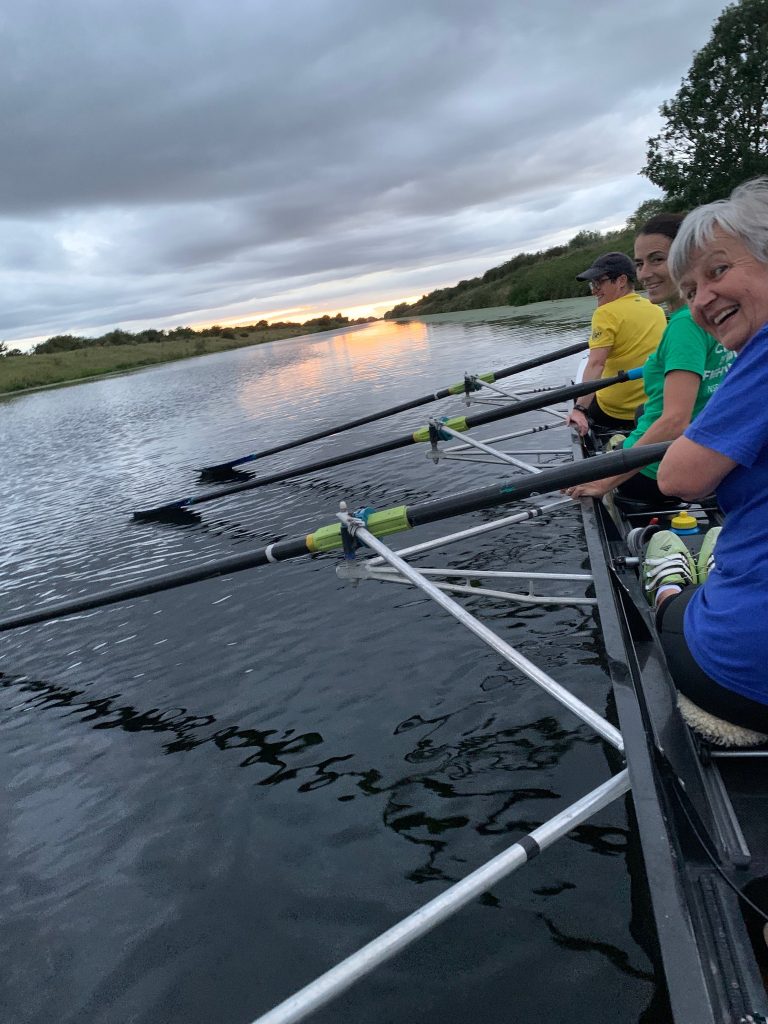
A training plan can help you make sense of the adaptation. It cannot know how it feels to sit at the start line at 62 and wonder what your body will give you today. Only another person who has sat at that start line can understand this, and can commune with you on the basis of that shared understanding.
This is a deep truth, and masters rowing keeps proving it.
What sustains masters rowers through the disorientation of ageing is not primarily the data. It is each other. It is the person in the next seat who knows, without being told, what a hard ergo session costs you now. It is the coach who has watched dozens of athletes navigate this territory and can say, honestly, this is normal, keep going. It is the group chat that lights up at 5am on a cold training morning, everyone grumbling and going anyway.
Authentic connection to other people is not incidental to the masters rowing experience. It is fundamental. It makes the sport what it is, and it makes us who we are within it.
That is why it means so much that 28,500 masters rowers have found each other inside the Masters Rowing International Facebook group. That number is not a vanity metric. It is evidence of something real: a global community of athletes who understand, without lengthy explanation, what this life asks of you. Every question posted, every race report shared, every word of encouragement offered to a stranger on the other side of the world is a small act of community-building. A small act of sanity in the madhouse.
As the physical challenges accumulate, that connection becomes more urgent, not less. We gather around shared effort, in boat houses and on water, in the corners of the internet where the conversation is real, because the alternative is to face the hard parts alone. And that is intolerable.
The sport will keep changing. Our bodies will keep surprising us. The fire will keep burning.
But in the end, what gets us through is a powerful truth that rowing has always known: our connection to the given world, and to one another, is what makes the whole thing worth it.
We need to keep building that. A Republic of Being Together, one stroke at a time.
The Republic of Being Together already exists. You'll find it in the Masters Rowing International Facebook group, where 28,500 rowers from around the world show up for each other every day. Come and join us. And if you want the training knowledge to match the community spirit, the Faster Masters newsletter is where that conversation continues. [Sign up in the footer below.]
I read Abby Bowman’s article on Junior Rowing News about the fitness boom with interest. She makes some really solid points - but there is a lot which is missing.
The article raises excellent points about rowing's struggle to capture the fitness boom, but it overlooks one of the sport's most underutilised assets: masters rowing as a sustainable business model that could transform how clubs operate and retain athletes throughout their lives.
Masters rowing represents an untapped opportunity for rowing clubs to generate consistent revenue with minimal overhead. Unlike youth programmes that require extensive coaching, supervision, and coordination with parents and schools, masters rowers are self-directed adults who pay membership fees without requiring financial aid, organise their own training schedules around work and family commitments, maintain and care for equipment responsibly, often require minimal coaching intervention, and create a stable, recurring revenue base that doesn't disappear during summer breaks or academic transitions.
This is essentially a self-serve model where the club provides access to boats and facilities whilst masters athletes take ownership of their experience. The friction points that make youth rowing administratively intensive disappear with adult athletes who don't need permission slips, complex safeguarding arrangements for every session, or academic scheduling coordination.
Faster Masters Rowing has been leading innovation in this space, developing new business models specifically designed around the realities of adult participation (Webinar: Masters vs Juniors). Their approach recognises that masters rowers have different needs and capabilities than youth athletes, and that clubs need practical frameworks for serving this demographic effectively.
Most rowing clubs face a fundamental business challenge: their most expensive assets sit largely unused for significant portions of the day and week. Youth programmes typically monopolise peak hours after school and early mornings, but leave vast gaps mid-morning to early afternoon on weekdays, late morning at weekends, throughout summer when school programmes wind down, and during holiday periods.
Masters rowers naturally fill these off-peak times. Many work flexible schedules, work from home, are semi-retired, or can take lunch breaks for a mid-day row. This means clubs can generate additional revenue from existing infrastructure without needing to purchase more boats or expand facilities. A single eight can generate membership revenue from a youth crew, a university crew, and multiple masters crews throughout the day, maximising return on that capital investment.
The café culture mentioned at Putney should include masters rowers post-morning row, not just cyclists. Clubs are missing this mid-day social and economic opportunity.

The article identifies the problem but doesn't fully address one of rowing's most critical failure points: the mass exodus of athletes after youth rowing ends. Whether athletes finish school rowing or complete their university careers, rowing loses an enormous percentage of trained, passionate athletes because there's no clear pathway forward that can balance a career and training (not 12 times a week).
The typical trajectory looks like this. An athlete rows through school or university, graduates and moves to a new city for work, assumes rowing requires the same six-day-a-week, 5am commitment as in their competitive days, decides they can't maintain that lifestyle with a full-time job, and quits rowing entirely.
Masters rowing provides the bridge, but clubs do a poor job of communicating this transition. The masters model offers flexible training where you row when your schedule allows, three times a week, twice a week, or just weekends, with no mandatory attendance policies. Racing is optional, you can do one regatta a year or go pot hunting every weekend, it's your choice. Many masters rowers train purely for fitness and social connection without ever racing. Progression is self-directed, you set your own goals. There are multiple entry points, you can come back to the sport at 27, 35, 50, or 70, with masters categories ensuring age-appropriate competition.
Faster Masters Rowing has developed comprehensive adult return-to-row courses that provide structured entry points for late-stage beginners, including those who never rowed at school or university. More importantly, they've created a genuine pathway for masters rowers from beginner through intermediate to racing, with clear progressions that accommodate the reality of adult life (the New Masters racing grade). This isn't just about teaching technique, it's about building sustainable participation that recognises people have jobs, families, and other commitments.
One of the most overlooked barriers to masters rowing growth is the lack of coach education focused on working with older athletes. Many coaches are younger than the athletes they're working with, having come straight from university rowing into coaching roles. They may have little experience understanding the movement limitations that come with age, the time constraints of juggling work and family, or the life responsibilities that mean an athlete can't simply add more training volume. Plus adults learn differently than children - they want to understand WHY we’re doing something - the GOAL of a drill and whether they’re improving.
Faster Masters Rowing addresses this directly through coach education programmes that teach coaches how to work effectively with masters athletes. This includes understanding how to programme for bodies that recover differently than twenty-year-olds, how to work with athletes who have previous injuries or movement restrictions, and how to create training plans that fit around work schedules rather than assuming unlimited availability. A coach who understands that their 45-year-old athlete has a demanding job, teenage children, and aging parents to care for will create fundamentally different training plans than one who simply scales down what worked for university crews.
This education also covers the psychological shift required when coaching adults who are often highly accomplished in their professional lives. The coach-athlete dynamic is different when you're coaching a surgeon, a barrister, or a senior business executive who has three decades of life experience on you. Effective masters coaching requires mutual respect and recognition that the athlete brings valuable knowledge about their own body, schedule, and goals to the relationship.
To capitalise on these opportunities, clubs need to market masters rowing as flexible fitness, not just competitive racing, emphasising the train when you want, race if you choose model in all communications. They should create dedicated off-peak masters sessions that showcase equipment availability during business hours, advertising lunchtime rows or mid-morning masters slots. Other modes can include a 3 month summer membership or “challenges” like racing the Veterans Eights Head starting 60 or 90 days prior and disbanding afterwards.
Clubs must actively recruit graduating youth rowers with clear messaging about the transition to masters (like the AA age category which starts at age 21), hosting sessions for graduating students about life after competitive rowing. They need tiered masters programmes that accommodate everyone from former internationals to absolute beginners, with different commitment levels clearly defined.
The business case should be tracked and celebrated, calculating revenue per boat across all programmes to demonstrate how masters rowing improves asset utilisation and club financial sustainability. Finally, clubs need to build social infrastructure that mirrors what other fitness communities offer, the post-row coffee culture, the social events, the challenges, the community aspect that makes showing up rewarding beyond just the workout.
Rowing will never be as accessible as a park run 5k, but it can absolutely compete with boutique fitness offerings like CrossFit, climbing gyms, or cycling clubs, all of which require specialised equipment and facilities. Masters rowing is the key to unlocking this potential because it provides financial sustainability for clubs to support all programmes, maximises return on expensive infrastructure investments, retains athletes throughout their lifetime, creates the flexible adult-friendly model that fits modern lifestyles, and builds the social community that makes fitness sustainable.
The fitness boom hasn't passed rowing by. Rowing just hasn't fully activated its secret weapon: a flexible, self-directed masters model that turns the sport's infrastructure challenges into sustainable business opportunities whilst keeping people rowing for life, not just for school.
Club management using digital tools - online course [1 hour]
Masters vs Juniors - how to balance the needs of your members and your assets - online course [2 hours]
Defensive protectors for oars and sculls to prevent the paint wearing off and the spoon degrading. Things you can do to preserve the spoons and handles.
Timestamps
You paint the spoons in the club colours and the paint wears in the middle of the back of the oar and the tips of the blades get worn off at the corners (so you no longer have a sharp corner). Defensive protectors for oars Our dock is wood and the surface gets greasy and is a slip hazard. We put non-slip matting onto the dock - water drains through the holes. The brand is Ako Matting and is recommended for ice, snow and water uses. The downside is the surface is abrasive on oars because of the non-slip elements.
We have a rule that when you land and leave the dock we always put our oars tip side down on the dock. This helps to preserve the paint and stop the wear patterns on the back of the oars. Tips down meant we got wear on the tip of the blade.
Croker Oars have tip protectors - little triangles which fit over the corners and you superglue in place. The plastic takes the wear rather than the carbon oar.
Concept2 oar users can use the vortex edge - it's a strip which goes along the length of the oar tip.
The wear on the tip of the oars reduces the surface area of the spoon. And the wear is always in the same direction - my sculls ended up thinner than 3mm. This is the legal minimum for World Rowing rules - I had to sand down the tips of the blade to restore the minimum 3mm.
A scuff pack kit made to protect the back of the oar from rubbing when your oars are on the bank. Defensive protectors for oars.
Lastly - blade wraps - vinyl that is pre-printed with your club colours and they are cut to the oar spoon shape. Use a heat gun to apply them and it also gives some protection to the oar spoon.
How to wrap oars
Take care of your oars to make them last longer. If you paint your oars the old fashioned way is to sand them and use marine-grade gloss paint with undercoat and topcoat paint layers. Others have used spray can car paint too. We had stickers (decals) of the club logo made to put on the shaft of the oars so that they can be identified - helpful if you don't paint your oars and they look the same as every other club. Easy for them to get lost at a regatta.
Want easy live streams like this? Instant broadcasts to Facebook, YouTube, LinkedIn. Faster Masters uses StreamYard: https://streamyard.com/pal/d/5694205242376192

Join our community and get our exclusive Faster Masters Rowing Magazine, packed with tips, techniques, and inspiring stories. Includes four new articles monthly.
