That voice in your head is a compelling coach, a guide and sometimes a critic.
You know how it goes… you’re sculling along focused on a technical point, like squaring early. And as you row, sometimes there’s a good stroke and sometimes a less good stroke.
Does it critique you? Or is it supportive, quietly reminding you to square early? What happens after a while… does it go quiet? Or does it shout loudly about your (in)competence?
Mostly adults are ultra-critical of themselves.
This does not help you to learn. If you can cultivate objective remarks rather than subjective value-judgements you'll find that your voice in your head can be an asset to your rowing.
When adults learn rowing (or anything new) they do not learn in the same way as young people. This is a core module in our upcoming Masters Coaching Certification course. When you coach masters, you have to understand their mindset to be an effective coach.
If you're an athlete, you can learn how to leverage self-coaching in the Sculling Intensive course.
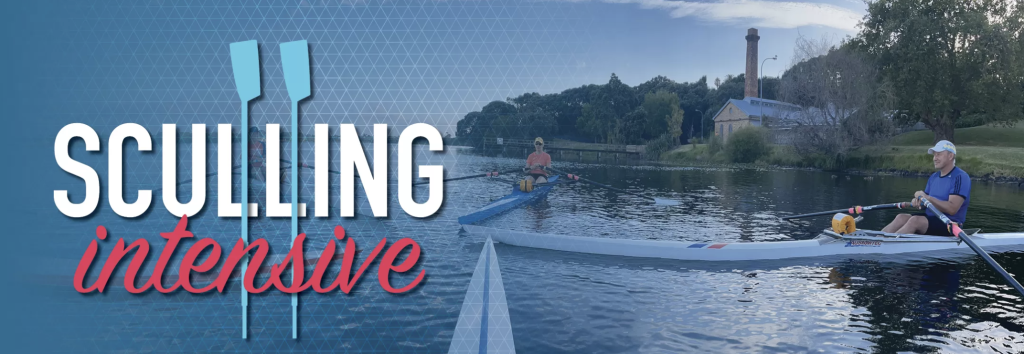
This is self-guided learning to build your skills (regardless of whether you are experienced or a beginner). EVERYONE who's taken the course has learned how to improve their technique and skill in a single scull.
Things you wish you'd been told or learned earlier before teaching learn to row. You'll never stop learning because this is rowing - it's normal!
03:00 Marlene's first learn to row class 1982.
07:30 Use lifting a box to demonstrate the stroke sequence.
09:00 Port is on the right. Port wine is red, red is right (both start with R).
09:45 Tension - how comfortable are they on the water.
11:00 You won't get fit learning to row. It's mental and technical. Mental - relax enjoy the view.
13:00 Comfort in the boat drills -sit at the catch. Be aware of where your body weight is. Can you feel your feet, seat, and oars against the oar locks?
15:30 Let day one be about experiencing on the water. Demonstrate what a full stroke looks like. Get full strokes in. Be in the boat on day one not on the rowing machine
18:30 Have helpers. First impressions of rowing. Load up your staff for the first day and give attendees assurance and individual attention.
20:30 Don't try too hard. Let them row the way they want to. Check people don't get into a situation they cannot get out of. Wedged against the bank in a lx on a windy day. Use a rope if they are very tentative.
24:15 Make sure you can see all your athletes simultaneously.
24:45 Don't talk too much. One thing at a time.
21:00 Rowing is fun but safety is serious. Highlight the safety features of the boat. Spatial awareness is low when learning something new.
29:40 Rowing lingo - use some but not too much. You'll never stop learning to row. Enjoyment, safety, you want big smiles and a sense of achievement at the end of each lesson.
Should we row differently based on our strength or sex? Marlene and Rebecca discuss lower and upper body strength in relation to rowing technique.
03:15 Differences between men and women in general. The standardised testing difference is about 15%. For a standing broad jump - can you jump your height?
05:30 Boat speed differences at international level is 10-12%. The assumption is that women tend to be weaker. But your training affects this. Activating muscles and adding body weight to the handle improves boat speed.
07:00 stability versus mobility. A strong person can row harder because they have a strong heart/lungs engine. Women post menopause have tendon laxity causing instability in joints. Men generally need more mobility as they age.
11:00 Rowing technique basic principles of large to small muscles. A late body swing requires strength. Most of us now a less-segmented stroke. Hold the pressure on the blade in the water. Personal dimensions matter too.
14:00 New rowers are taught a more segmented stroke by Rebecca for specific reasons.
17:00 Try rowing legs only then rowing with straight arms - can you sequence differently? The bent arm catch can stabilise your shoulder.
19:15 Emphasise posture with women as they carry more weight in the chest and so need more shoulder stability. 20:00 immobile athletes can't get a forward swing. Work on this on land. An upright technique like Marcel Hacker - it's possible to apply all your body weight.
23:00 Your ability to adapt technique matters for crew combinations. Try new things as a transition. Do it gradually. A different coach may use a style that's new to you.
Watch for strains /stresses in your body as you change technique.
Coaching is one of the top 5 frustrations for masters rowers.
Getting coached and finding coaches are challenges. But have you thought about your part in this learning process?
How coachable are you?
The coach tries to teach; you try to learn. Like any muscle it needs training.
If you adjust your mindset towards empowerment, this could make a major change in your views on “coaching” for masters rowers.
We’ve got an video below about the 5 types of feedback which empower athletes and coaches - find out the effects of each on you (as an athlete) and also on your coach.
As a coach I love it when an athlete asks for feedback. As a masters coach, I know that feedback is critical to comprehension.
One of the tropes about masters is that they won’t change when coached. Much of that comes from outcomes where the coach is inexperienced teaching adults.
A coach must understand how adults learn - we need to understand the ‘how’ and ‘why’ as well as the ‘what’.
Marlene and Rebecca have written a certification for “Coaching Masters Rowing”.
In module 3 on Teaching and Learning, we include advice on the relationship coaches have with masters athletes, how to structure your practice to enable learning, and advice on feedback.
Watch the 6 minute video below illustrating the effect on the athlete of the 5 types of feedback - then watch it again with your crew and club group.
Coaching masters is not the same as youth rowers. We debunk the myths about masters rowers being 'un-coachable'. Adjust how you coach, how the athlete interacts with you and with the rest of the crew.
Guest Duncan Holland explains his framework for the empowered athlete.
02:27 Debunking the myth of masters being uncoachable.
"I find it relatively easy & a lot of fun."
Duncan Holland
Learning in different ways. Words or pictures and videos.
05:00 Organising masters is easier than juniors.
What do you need to coach? - enough knowledge of how to row, how to rig, how to race.
This makes it easier for ex-rowers.
08:00 How to give feedback is the next most important skill.
Feedback is the base interaction between athlete and coach.
09:00 The need to write a program if athletes want to get faster. It's better if the coach writes it. Faster Masters sells training programs for masters rowers.
10:00 How to be safe on the water. Local regulations are known.
Five different levels of feedback
20:00 The empowered athlete.
The wrong idea is the coach is boss.
The coach is one of the tools an athlete uses to meet their goals.
24: 00 Coaches are rare. Athletes have knowledge gaps. Athletes take responsibility for their technique. Help is available. For example people in your crew.
25:00 How to use a model of rowing technique.
You must have an agreed model of how we row. Put the model on the wall in the training room. Compare how you row to the model. Ask for help and HOW to change. Seek feedback.
29:00 The empowered athlete is in control asking for feedback in a situation where they are in charge.
32:00 How to solve the problem of getting a coach for your masters crew.
Join coxswain Kim Degutis, (Riverside Rowing Club, Cambridge, MA USA) as we talk head racing and tips for coxing masters crews. Dive deep as we talk - what's different about coxing masters - how to get a group who want to row eights - advice to anyone wanting to start coxing masters
01:00 Rowing genealogy from our past. Marlene's ancestors were in the first families of Newfoundland, Canada. Alfred Royle was at Ottawa Rowing Club pre WW2. Rebecca's Great Grandfather, WD Caroe Rowed for the First Trinity BC in 1880s. They won the Ladies Plate coxed fours event at St Neots Amateur Regatta winning a solid silver medal, which Rebecca now owns.
05:00 When Marlene started rowing in 1977 Westside RC, Buffalo was the only club in town compared to 1900 when there were 11 rowing clubs.
08:00 Kim Degutis working with the mens masters sweep group of 19 athletes. How Kim got back into rowing - "I saw a single oar with a broken collar and picked it up and returned it to the club and met the crew."
10:30 My first stroke taught me how to cox. I had a great relationship it was sometimes non-verbal.
11:30 what is it like coxing masters? Depends on their age. It can be very intimidating. Be confident and own that seat - they should be respectful. You have to earn the rest by proving yourself. Masters appreciate a cox who is clear and runs a good practice. Know what you are doing. Appreciate that it's not a rower coxing.
13:45 At races coxswains get passed around to other teams. I had to jump out of the boat very quickly for a short turn-around between races. I'm 5' 3" and got very wet. I shoved off the dock too hard and went head over heels into the lake. When we got to the start the referee asked "Did you guys have a pool party?" I now have a reputation of flipping at the start in Canada at the Burnaby Lake Race.
16:30 A serious incident that happened helped me to learn a lesson. On the River Charles, Elliot Bridge is the most dangerous going upstream. Boats coming down stream swerve wide and are hard to see. We 'traded paint' with another crew.
20:00 Advice to anyone thinking of coxing masters.
Take a fun, encouraging approach. You can be more serious if a crew is more competitive. Intonation determines how to speak to them. Word choice matters. Vocabulary matters - explain the technique you are aiming for. Time on the water teaches you a lot. Working with coaches - use the intonation they use and fold this into what you say.
22:30 A competitive crew wants you to be demanding. If you want to go fast you need this.
23:00 How to organise a masters sweep group. We try to make the 8 and he go out together with the 4 being a faster lineup so they can be similar speeds. Kim is an eights specialist. A bow-loader four is very different - it feels different, more intimate, finesse is needed. An 8 is a dump truck - just GO.
25: 00 Working with a new crew - tips. They can have different flexibility and movement patterns and different technique. How do you get them together?
Pause drills work well for timing. Watch them row for 500 meters - see what's happening and look out for technical deficiencies. We do a lot of eyes closed rowing.
Learn to row programmes for masters. Masters rowing has two types of member - returning rowers who learned in their youth and adult beginners. Should club boards consider adding more learn to row programs? We discuss the advantages and disadvantages.
01:30 Learn to row - who wants to do it?
02:30 Clubs need a strategy and goals first. Does LTR fit into this? Marlene coached in 1982 Boston, MA and it was the only learn to row in town.
04:30 What is the funnel pathway to membership of the club? This is important to figure out. A community club needs presence with townsfolk.
06:00 when someone tries rowing it is either a yes or a no. Do they like it?
08:30 Pathways - some run LTR over 6-8 weeks and that isn't effective. it's better to do a weekend to get them hooked. A 48 hour camp where you - row Sat/Sun and learn a lot.
12:30 For a small club after LTR integrating a whole group is challenging.
Large clubs with coaches can have 3 groups - beginner /intermediate / advanced
13:30 Give the Learn to Row course members the best coach you can - It's their first impression.
So they feel understood. Many clubs host introductions to rowing throughout the year. We recommend you add an entry level class - with a skills checklist to confirm skills before you can join the intermediate group.
17:15 LTR courses are a great fundraiser. The goal of the program is an adventure camp. Learn something new and fun.
20:00 Are masters receptive to coaching? Or is it a lack of coach communication skills?
Masters attend camps because of coaching. When you ask what's important to them you find a focus for your coaching.
You can't coach masters like juniors. Give people time to explore rowing.
Masters Rowing - the book by Volker Nolte and Wolfgang Fritsch has a chapter on running a masters learn to row course. It's exactly the way Rebecca teaches her novices. Buy the book.
Want easy live streams like this? Instant broadcasts to Facebook, YouTube, LinkedIn. Faster Masters uses StreamYard: https://streamyard.com/pal/5694205242376192
When our rowing friends or coaches die, what can we do? We discuss ways to memorialise rowers. And what we can do to support and celebrate with rowers facing end of life.
02:00 Rowing and death. Iconic coaches are passing away. Makes you think about who influenced you and who you worked with.
03:30 Ways to Memorialise people.
07:30 Frank Cunningham from Lake Washington RC published a book comprising all his newsletter articles.
14:00 Rowers facing end of Life
Supporting sick rowers - we did a weekly quad outing which was gentle. Marlene's friend wanted to enjoy time on the water after a cancer diagnosis.
Keep line of sight in singles for safety. And wait for each other during the row. People enjoy having something to look forward to each week.
18.30 Keep active as rowing makes you stronger, physically. Psychological benefits - you are with friends, out in nature, on the water. Adapt your boat to suit their needs.
20 00 Cyclical sports are healing sports - calming effect on the nervous system. Pay attention to the small things as time becomes more precious.
What are limiting beliefs and how do they affect your rowing? Some of call it the voice of the inner lizard. We’ll talk about how to set yourself on a good course for this holiday period.
01:22: Jess DiCarlo talks about the book of the month, The Compleat Dr. Rowing by Andy Anderson. He is Dr. Rowing from the column in Rowing News magazine. .
03:15 The story of the Japanese rowers, rowing words, and the style of stories
04:55 The story “Seat racing a Twinkie” or was it a ham sandwich?
15:15 What are limiting beliefs? The definition.
17:00 Jess talks about perfectionist think; what do I do if I can’t follow a plan? About perfectionism.
18:30 Enjoying the process of what you are doing.
19:15 Marlene talks about Dr. Amy Johnson’s book “It’s Just a Thought” how you deal with limiting beliefs and changing habits. Where are the thoughts formed and how to deal with them. What is the inner lizard. Buy Dr Johnson's book.
23:40 About changing habits and habitual thoughts.
What ever you give attention to is reinforced.
28:10 Marlene talks about the resource: Limiting Beliefs Activity Sheet from UCDavis Success
Coaching and Learning Strategies
Activity question: What limiting belief do you want do you want to work on?
When you talk yourself out of taking action, what do you tell yourself?
29:30 Marlene talks about Mel Robbin’s 5-minute morning routine and boosting your energy for the day.
31:50 Take your thinking and break it into little tiny steps to create momentum.
33:55 During the holidays even if you miss your regular workout still do something- stretch, a 20-minute walk- it still counts. Limiting beliefs are not truth unless we act on them.
35:22 If you accomplish 80% of what you want to do you are doing quite well.
37:00 Happy Christmas we will be back the first week of January.
A deep dive into one master's training year plan.
01:30 One Masters training - Annual rowing spend $1450. Coached program. Focus on drills and skills 2-3 races in a year.
03:00 How to be coached First time on an athletic program. Expectations for giving feedback during a session.
09:00 Set expectations on how their rowing will progress. Learn how to row hard.
14:00 Volunteer coach - why do this? The pleasure in teaching.
When Questions are asked what's in it for me? The squad falls apart.
20:00 Does the Club have a strategy? Can it be revised? 2 covid seasons was a stable group. Now members are travelling more. What type of a club do you want to be? Set expectations.
25:00 Masters are a diverse group. Doing something for ourselves makes us hard to manage. Pathways of managed decline.
Join our community and get our exclusive Faster Masters Rowing Magazine, packed with tips, techniques, and inspiring stories. Includes four new articles monthly.