You’re likely a rowing coach with a track record. You’ve coached a while, starting with youth rowers and maybe some of the older athletes.
And now you have a new challenge: coaching masters.
The thought of coaching people older than yourself is daunting. I’m not sure why - maybe some of them were YOUR coach when you were in training, maybe you have uncertainties about how hard you can push them or whether technique should adapt for older athletes.
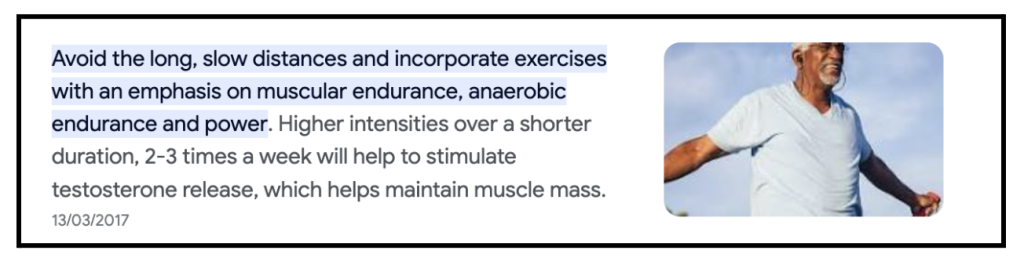
A quick online search will show results like this image below.
It’s RUBBISH for rowing coaches.
Mis-directed advice, inappropriate for rowing and shows the ignorance of our sport from the writer. You can do better than this.
The first thing that you need to know about coaching older athletes is that they don’t want to be “treated gently” or “wrapped in cotton wool”. An athlete is an athlete, is an athlete.
As a coach you have to understand what their capabilities and limitations are. Just like when you coach young people who are still growing, maturing and gaining skill they can’t instantly jump in a boat and row steady state for 90 minutes. Older athletes want to have a quality sporting experience. They want a pathway to improved skill and fitness and to have fun along the way.
Your job as a coach is to create that environment which enables each athlete to flourish.
The eight hallmarks which masters rowing coaches use to shape the experience of the mature adults they work will reflect on the needs of their masters athletes which are different from those of youth, adolescent, or high-performance athletes.
When you understand these, you’ll find it straightforward to adapt the structure of your coaching preparation, your session structure, your briefing, your vocal delivery, your feedback and your follow up.
When you first start with a new group of rowers, it’s helpful for you to understand what they are capable of doing. A functional movement assessment will give you objective measures to understand their flexibility and mobility. After all, here at Faster Masters Rowing, we frequently say that masters rowing is “Rowing With Adaptations”.
Take the US Rowing Masters Rowing Coach Certification course and learn the detail for yourself.
Mastering Masters Rowing: The Benefits of Expert Coaching
Nobody can learn to row from a book or from a video.
It’s a sad truth that despite a lot of investment in online training and advice, rowing is one of the few things which anyone benefits from expert coaching, particularly when you first start.
And in case you think I’m biased, I run an online rowing coaching business and we NEVER take on clients who are beginners. We always tell them to join a local rowing club so they can get expert coaching.
In this way rowing is rather like learning to ride a bicycle - you have to experience it for yourself. Learning what rowing feels like is a critical input to your acquiring the skills.
Getting yourself to a good club near your home is easy - just search for “[Your Country] Rowing Federation” and you’ll find the website for the organisation who runs rowing for your country. They all have learn to row pages which list clubs who offer courses.
Note that adult learn to row and children learning may be listed separately.
Once you’ve found a club, go and meet the people - speak to the rowers and speak to the coaches. A good masters rowing coach has several attributes
Ask when the club will next be running a learn to row or learn to scull course and sign up to the waiting list. It’s fun to learn in a group with other adults.
After you have completed your learn to row course, the next steps are to practice regularly.
The more often you can row, the more likely you will learn quickly. A great way to learn is to join a group who train together two or three times per week. After three months you will have been out on the water over 20 times and the sculling movements will be familiar, you’ll have worked out a lot of the early challenges (how to feather, ways to stay in time) and you will be ready to start to learn faster.
There are two ways you can learn faster - practice with a more experienced rower in front of you - so you can copy their movements. And secondly, get videoed. If you can have someone video three strokes of you rowing, send it to an expert coach for rowing video analysis. You will get some detailed advice on what you are doing well and not so well and also drills and exercises to practice so you can speed up your improvement curve.
Rowing is fun and is frequently challenging - as you get more skilful, you continue to work on the same “Basics” as beginners learn - but you get to execute them to a high level of skill. The more refined and consistent you can make your movements, the faster your rowing skills will advance.
As a coach you have got good knowledge about how to row and how to TEACH rowing. But when it comes to working with masters athletes, somehow the boundaries and rules seem a little different.
You will have noticed some things which just don't line up with your previous coaching experience working with younger athletes.
Think about the people in your club group who are masters rowers.
These are all good questions and worthy of your attention BEFORE you start coaching masters.
Don't worry if you are already coaching masters, the rest of this article will help you understand some of the underlying things which may help you smooth out some of those wrinkles and improve your experience when working with masters athletes.
Let’s start with the basics - learning to row is a process and it is identical, however old you are. Each athlete advances at a speed which is unique to them but can be influenced by frequency of practice, athleticism and existing fitness. For masters this is just the same.
Masters span a very wide age range - from 27 to over 70 years old. And that is the REAL difference for this type of athlete. As you age through the decades, your physiology changes and so a coach needs to be familiar with what should be possible for each age group.
Within any masters rowing group will be beginners as well as very skilful advanced technicians. You are expected to coach them all. That brings obvious challenges as you may not be able to split the group into less- and more-skilled crews. If you can, that’s a good start because you won’t have half your group getting bored while others learn the basics.
There are methodologies which you can use to teach diverse skilled crews. These are based on our Framework for Skills Progress. In the same way that you probably learned to swim first doing ten metres, then 25 metres and 50 metres (and getting a nice swim badge for each distance), teaching masters rowing successfully can be better organised when the coach knows the Framework for Skills and can move individuals through each of the stages progressively.
Setting appropriate expectations for yourself as a coach is important. Have you tried asking your group to do an erg test or undertake selections for regatta crews? We bet we know what happened.
First there were sideways glances between athletes, then someone spoke up and asked what would happen if they did not do the test, then they listened and when the test date came around.... crickets. Very few athletes showed up. And you're left thinking, What did I do wrong? Surely they want to be in the best boats with athletes of similar speed as themselves?
Some of the coaching tools you use for youth rowers are not accepted by masters. Their goals and expectations are not the same, nor can your goals be forced onto this group.
Many adults come to rowing having been injured out of another sport - they have weak knees from Netball, Basketball, Soccer or Rugby - maybe they’ve had a heart atrial fibrillation, or are a cancer survivor. As a consequence, their bodies are not as mobile, flexible or stable as youth athletes.
You need to be confident using our Rowing with Adaptations methodology when coaching masters. This helps you set appropriate and achievable goals, boat rig and training program rates / distances / times suitable for your group of masters rowers.
When it comes to group organisation and structure, some compare masters to “herding cats”. That’s not possible - each cat goes in its own direction. But rowing is best done as a group and with a singular focus. As the coach, you are a leader as well as a collaborator.
That sentence alone sums up some of the apparently conflicting aims of masters rowing. It really is NOT like youth rowing.
Yet we bet you've tried a few things and found that the group doesn't always follow your lead or coalesce around a single goal.
Getting your group to cohere and agree to shared goals can be challenging. So part of the Masters Coaching Certification course is about group administration and management so that you can enable your members to all have a good rowing experience, and to select a focus and intensity that suits them this year. Next year, it may all be different.
This part of a series of articles for masters rowing coaches to share guidance and insights which will help your coaching practice.
If you've found this article by accident, you can receive the rest of the series by email.
It is the season for ergo testing and one of the issues coaches face is how to compare the scores of athletes whose body weights vary a lot. Is it “fair” to compare a 2k score for a 90kg man against a 75kg man?
The debate has been exhaustively reviewed and discussed here.
But there’s a fundamental underlying issue which is weight comparison. If you weigh more than me and we’re sitting on the water in single sculls – I have less load to heft down the race course than you do. So power to weight ratio is an important consideration in coaches’ selection criteria for crews.
The best selection is to use single sculls on water – assuming still water, no wind and athletes with perfectly matched bladework skills. On land, a RP3 2k test will produce scores that are aligned against on-water times and is weight-adjusted and boat class adjusted [if you are selecting an 8 set the test on the eights setting].
The Dutch coach Bert Cocu shared with me his spreadsheet for entering C2 scores and adjusting for weight. Note the sheet also has a athlete’s height column but that’s not included the formula.

And here’s a sample set of data for women corrected back to a 75kg average weight. it shows the actual score and the adjusted score re-ranked by athlete (colour coded) in column ‘Corr (75)’.
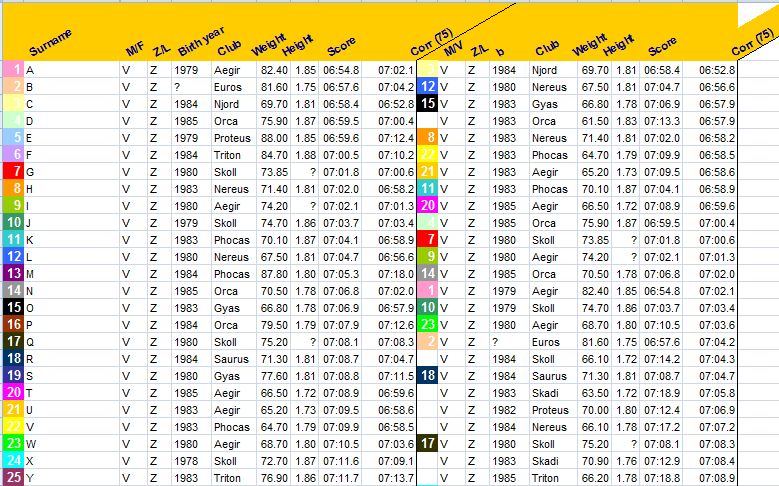
Rowing Erg Adjustment Calculatorhave shared the formula as well.
Get yourself fit any time you want by joining our self-guided Erg Intensive camp program. In it you get a training plan for 3 months, videos to watch expert erg coaches explain how to improve yourself and a peaking program so you are bright, rested and ready to race on test day.

.
Nobody can learn to row from a book or from a video.
It’s a sad truth that despite a lot of investment in online training and advice, rowing is one of the few things which anyone benefits from expert coaching, particularly when you first start.
And in case you think I’m biased, I run an online rowing coaching business and we NEVER take on clients who are beginners. We always tell them to join a local rowing club so they can get expert coaching.
In this way rowing is rather like learning to ride a bicycle - you have to experience it for yourself. Learning what rowing feels like is a critical input to your acquiring the skills.
Getting yourself to a good club near your home is easy - just search for “[Your Country] Rowing Federation” and you’ll find the website for the organisation who runs rowing for your country. They all have learn to row pages which list clubs who offer courses.
Note that adult learn to row and children learning may be listed separately.
Once you’ve found a club, go and meet the people - speak to the rowers and speak to the coaches. A good masters rowing coach has several attributes
Ask when the club will next be running a learn to row or learn to scull course and sign up to the waiting list. It’s fun to learn in a group with other adults.
After you have completed your learn to row course, the next steps are to practice regularly.
The more often you can row, the more likely you will learn quickly. A great way to learn is to join a group who train together two or three times per week. After three months you will have been out on the water over 20 times and the sculling movements will be familiar, you’ll have worked out a lot of the early challenges (how to feather, ways to stay in time) and you will be ready to start to learn faster.
There are two ways you can learn faster - practice with a more experienced rower in front of you - so you can copy their movements. And secondly, get videoed. If you can have someone video three strokes of you rowing, send it to an expert coach for rowing video analysis. You will get some detailed advice on what you are doing well and not so well and also drills and exercises to practice so you can speed your improvement curve.
Rowing is fun and is frequently challenging - as you get more skilful, you continue to work on the same “Basics” as beginners learn - but you get to execute them to a high level of skill. The more refined and consistent you can make your movements, the faster your rowing skills will advance.
To set clear objectives for your upcoming year you need to dedicate some time to look at your past season. For masters and club rowers, November and December are the transitional months from the conclusion of the summer and fall competitive seasons into the preparatory phase for the following year. Scholastic rowers will want to review last spring’s season but some can have the added advantage of having raced in the summer or autumn head races to give more perspective to the whole picture. To adequately analyze your performance characteristics you must look at your response to a variety of training factors to determine your level of success. An honest analysis of what you achieved and what your limitations were plus setting goals based on those observations provides a valuable tool for establishing new objectives for the upcoming season.
You need to first look at how well you were prepared physically. Did you build adequate stroke power, aerobic endurance, and speed to perform at the level that you had intended to? Review your races to identify areas that you improved on and others that need further development. For example, you might note that your final sprints were more effective this season so your anaerobic speed was better but you still need to improve your endurance for the third 500-meter segment of the race because in every race you slowed considerably at that point. Review your logbook for consistency of training sessions and track your weekly training volume. Look at what type of workouts you thrived on and which ones you avoided. Ask yourself what type of workouts helped your fitness and racing capacity the most and what didn’t you do enough of?
When reviewing your technical preparedness examine individual elements of the stroke- your catch, drive, release, recovery. Consider the quality of your bladework, oar handling, your ability to row at varied stroke rates, or hold form at under high stress. To what extent do you feel that your technical abilities affected your overall performances? Catching a boat-stopping crab with 100 meters to go in a semi-final, knocking you out of the final, because you were over-gripping and your forearms locked up, is one of those situations when better skill would have advanced you to the next race because fitness may not have been the limiting factor. If you made technical changes in your training were they positive or negative? Prioritize the technical elements that you feel will improve your standard of rowing or sculling.
Evaluate how you were able to handle the problems and challenges of actual racing. This includes steering, race plan execution, racing strategy, and your psychological preparation for competition. These represent tactical areas that you can improve. If you were racing your single and you rowed out of your lane in every race, causing you to go many extra meters, you need to put time into correcting your steering so you are not rowing farther than everyone else in the race and disrupting your speed by having to correct your course multiple times. For the races that you would rate as peak performances, where you were in a state of flow and everything came together, write a one-page description of how the race felt and what were the positive factors that you think contributed to such a great race. How were each of these factors reflected in your best races of the year?
Once you have listed your strengths and weaknesses, you need to set new goals to work towards. Your goals can be stated in simple language and be based on your past performances, rate of improvement, competition dates, and priority of training factors such as physical, technical, tactical, or psychological elements. Coaches will want to determine goals for their teams, as well as, helping athletes set individual goals.
Set both subjective and objective goals.
Subjective goals are more open by nature such as: becoming more aware of lateral pressure into the pins throughout the entire stroke, developing a better sense of swing at higher stroke rates, improving the ability to keep the shoulders relaxed in the second half of the race, or gaining more confidence for the start of a sprint race.
Objective goals are measurable such as: place in the finals at US Masters Nationals, qualify for an automatic entry for next year’s Head of the Charles, improve anaerobic threshold demonstrated by improving 6k erg score from 1:45/500m to 1:43/400m in three months, or train 5 days per week for 90% of the weeks from December to April.
Write your goals down in your logbook stating three main subjective goals and three main objective goals for the upcoming season. Always begin your goal with a verb. Then spend time to draw up a plan. You need to make a road map of how you will get from where you are today to where you want to be next season. Setting short-term weekly or monthly goals will help break your goals into achievable steps. Review each goal and determine what you need to accomplish it. Set yourself up for success at each stage in order to build confidence to reach your long-term goal. You cannot row a 2k erg score in 1:59/500m unless you have accomplished 2:00/500m. Take small steps.
A good coach can give you valuable advice along with informed perspective. Helping you to determine realistic goals and outlining a plan together are benefits of good coaching. Be flexible throughout the year. After you outline a plan, keep in mind that it is just an outline. There will be times when outside stresses interfere with your plans or your response to training may indicate that you need to adjust your plan. You will have to incorporate more rest or more work depending on whether or not you are adapting positively to your training.
It is important to make wise daily decisions that are based on your goals. You must prioritize training elements especially when juggling the demands of school, work, family, and friends. Spend time on those elements that improve your rowing the most and keep you motivated to do better.
For single scullers a pre-determined plan can help you stay focused during those long preparatory months. Next year’s races aren’t that far away.
The same principles apply to a group or crew - but I always feel single scullers train alone and so their year plan is a good crutch to see you through setbacks and so I place more importance on it.
Stepping back to reflect on your rowing of this year will make clear how to better your performance for next year.
Your inner voice is probably already whispering to you but get it down in writing anyway.
Scrub your log book in an annual review; it will give you the information you need. To start your annual review, set aside a big chunk of time in a place where you like to hang out. Read through your entire journal for the year. Jot down notes about thoughts or events that stand out as you are reading. Make a list of your disappointments or commitments you did not keep. Reflect on what comes to mind reviewing the down points. Then list your accomplishments and apexes of training and racing that went very well. Reflect on what comes to mind reviewing your accomplishments. Finally, summarise your year in one word.
Questions to prompt your ideas are: What went well? What didn’t go so well? Why didn’t I achieve my goals? What big things did I learn?
My favourite questions are: What should I start doing? What should I keep doing? What should I stop doing?
This helps you recognise the good habits that are productive, habits that are interfering with your progress, and the habits you need to change to make progress. Think about the word you chose to sum up your rowing year and why you chose it.
What’s going to make next year awesome?
Write down 10 action steps that will get you there, for example: Drink more water, learn to steer a single straight on a buoyed course, improve my posture when sitting at my desk, arrive 15 minutes early for every practice, or hire a trainer.
That voice in your head is a compelling coach, a guide and sometimes a critic.
You know how it goes… you’re sculling along focused on a technical point, like squaring early. And as you row, sometimes there’s a good stroke and sometimes a less good stroke.
Does it critique you? Or is it supportive, quietly reminding you to square early? What happens after a while… does it go quiet? Or does it shout loudly about your (in)competence?
Mostly adults are ultra-critical of themselves.
This does not help you to learn. If you can cultivate objective remarks rather than subjective value-judgements you'll find that your voice in your head can be an asset to your rowing.
When adults learn rowing (or anything new) they do not learn in the same way as young people. This is a core module in our upcoming Masters Coaching Certification course. When you coach masters, you have to understand their mindset to be an effective coach.
If you're an athlete, you can learn how to leverage self-coaching in the Sculling Intensive course.
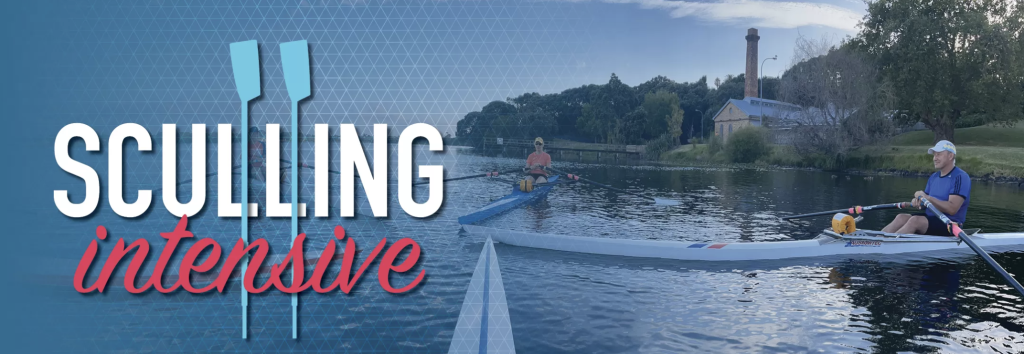
This is self-guided learning to build your skills (regardless of whether you are experienced or a beginner). EVERYONE who's taken the course has learned how to improve their technique and skill in a single scull.
Things you wish you'd been told or learned earlier before teaching learn to row. You'll never stop learning because this is rowing - it's normal!
03:00 Marlene's first learn to row class 1982.
07:30 Use lifting a box to demonstrate the stroke sequence.
09:00 Port is on the right. Port wine is red, red is right (both start with R).
09:45 Tension - how comfortable are they on the water.
11:00 You won't get fit learning to row. It's mental and technical. Mental - relax enjoy the view.
13:00 Comfort in the boat drills -sit at the catch. Be aware of where your body weight is. Can you feel your feet, seat, and oars against the oar locks?
15:30 Let day one be about experiencing on the water. Demonstrate what a full stroke looks like. Get full strokes in. Be in the boat on day one not on the rowing machine
18:30 Have helpers. First impressions of rowing. Load up your staff for the first day and give attendees assurance and individual attention.
20:30 Don't try too hard. Let them row the way they want to. Check people don't get into a situation they cannot get out of. Wedged against the bank in a lx on a windy day. Use a rope if they are very tentative.
24:15 Make sure you can see all your athletes simultaneously.
24:45 Don't talk too much. One thing at a time.
21:00 Rowing is fun but safety is serious. Highlight the safety features of the boat. Spatial awareness is low when learning something new.
29:40 Rowing lingo - use some but not too much. You'll never stop learning to row. Enjoyment, safety, you want big smiles and a sense of achievement at the end of each lesson.
Should we row differently based on our strength or sex? Marlene and Rebecca discuss lower and upper body strength in relation to rowing technique.
03:15 Differences between men and women in general. The standardised testing difference is about 15%. For a standing broad jump - can you jump your height?
05:30 Boat speed differences at international level is 10-12%. The assumption is that women tend to be weaker. But your training affects this. Activating muscles and adding body weight to the handle improves boat speed.
07:00 stability versus mobility. A strong person can row harder because they have a strong heart/lungs engine. Women post menopause have tendon laxity causing instability in joints. Men generally need more mobility as they age.
11:00 Rowing technique basic principles of large to small muscles. A late body swing requires strength. Most of us now a less-segmented stroke. Hold the pressure on the blade in the water. Personal dimensions matter too.
14:00 New rowers are taught a more segmented stroke by Rebecca for specific reasons.
17:00 Try rowing legs only then rowing with straight arms - can you sequence differently? The bent arm catch can stabilise your shoulder.
19:15 Emphasise posture with women as they carry more weight in the chest and so need more shoulder stability. 20:00 immobile athletes can't get a forward swing. Work on this on land. An upright technique like Marcel Hacker - it's possible to apply all your body weight.
23:00 Your ability to adapt technique matters for crew combinations. Try new things as a transition. Do it gradually. A different coach may use a style that's new to you.
Watch for strains /stresses in your body as you change technique.
Join our community and get our exclusive Faster Masters Rowing Magazine, packed with tips, techniques, and inspiring stories. Includes four new articles monthly.