It's the Head of the Charles 2019 - my bucket list rowing event. Months and months of training, and poof! Over in a flash.
Three days back and there’s still much to process. I didn’t update during the regatta because I wanted to absorb the experience–and I needed to sleep at night.
I did make this short video, the 7 Days Countdown to HOCR. I wanted to capture everything that leads up to a race, plus the results.
The first half of the trip went off with zero problems: Louisville to Laguardia Airport. Now that airport is a disaster. Poor signage, terrible food choices behind security, and one bathroom for 15+ gates?
My flight from Laguardia to Boston was cancelled. Not delayed. Cancelled, due to poor weather. The plane never left Boston. Luckily I saw “CANCELLED” flash on the screen before the gate attendant announced it. I rebooked on the app, getting the next flight out before it filled up, then scrambled to make sure my gate-checked luggage would be re-routed. Then I started wondering if the next flight would also be cancelled. How would I get to Boston before 9am? I started researching train and bus, just in case.
What a hot mess! Mom brain is real and I swear I’m losing it. In between this chaos, I temporarily lost my wallet. It happened when charging my phone. I guess my backpack wasn’t zipped all the way. When I put it on the counter, it flipped out over the sill. I didn’t see it, but neither did anyone else. 15 minutes of sheer panic once I realized it was gone. I could get to Boston–but how would I get home? How would I get money to eat? But I found it, the next plane did arrive (even if late) and I made it to Boston and my cousin Maggie’s about 9 p.m. Rode the bus with a youth team from Great Britain.
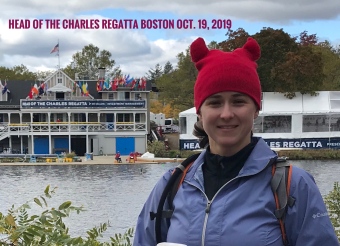
After a poor night’s sleep, I was excited to get to the racecourse. This time I rode a bus with Newport Aquatic Center youth. Their cox talked about heading to Vespoli, also my destination, so I followed them from the stop to the river. At that point, it was easy to figure out. Just follow all the other rower-type peoples heading for the water.
And holy bananas. Six docks? Streams of boats? Official merchandise? Yes! And I soon as I saw my friends from Florida, I teared up a little. For real, but out of joy. I’m here and this is happening!
Our practice row happened thanks to a sub from CRI, a lovely woman who was so encouraging and helpful. Thank you Sarah for stepping in so we could row!
Two doubles collided under Elliot and a men’s single flipped in front of Cambridge. And that was all in the first two minutes of our practice!
Conditions were windy and chilly, but not terrible. Hands tore up on the grips even with light hands. They happened to be my least favorite Concept2 grip, so I expected it. Overall, it felt like a solid row and it was nice to get the jitters out.
My Mom came to watch the races. We met up after practice, sipped some hot cider and walked around the venue scoping out the scene. It was nice to have her there to cheer us on and I got to wear my rowing nerd hat while explaining everything. “That’s HOCR headquarters, this is the last bridge, etc.”
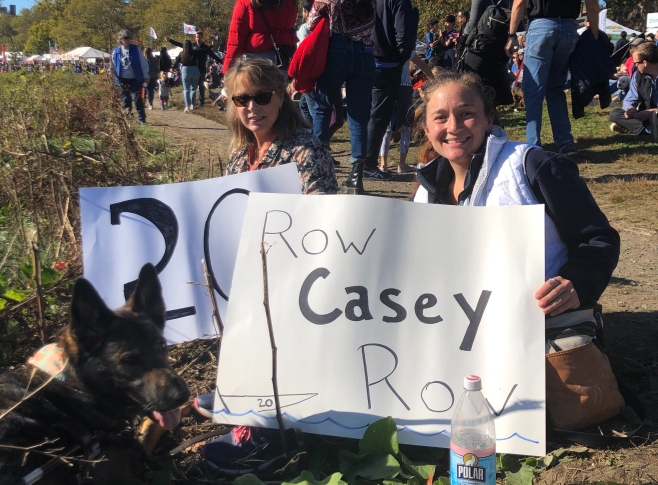
Mom and Maggie, with signs for our race! So sweet.
A beautiful, clear blue sky day. We never had the chance to row our 4+ line-up until race day.
We were hopeful for a top 11 finish. It seemed reasonable to me that we could be close to 11.
I am super proud of how well I did mentally. There were some moments of jitters. In the morning, at my cousin’s place, getting ready. Laying out the uniform. Seeing a fellow rower on the transit. Standing by the river watching the other boats coming down. Hands on. Some dry mouth while rowing up. Hearing the announcer calling boats onto the course.
But overall, I didn’t lose it like I have in the past. I felt focused. Excited. I let go of the unknown and welcomed the experience. I was happy to be there, in that boat, with four other ladies who I knew had my back. It will be what it will be.
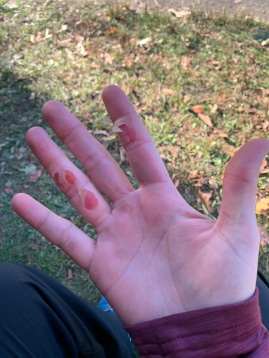
My hands were a big concern. I had the worst hot spots on the right hand bandaged, but worried about their staying power. Sure enough, one slipped off on the way up. But it turned out the bigger problem was the outside palm of my left hand. I The rotation had rubbed a section raw it was doing me no favors. n the rush to leave, I’d left my tape behind. Luckily 2-seat, Caitlin, had some surgical tape. It stayed on the whole race and saved my hand, I swear.
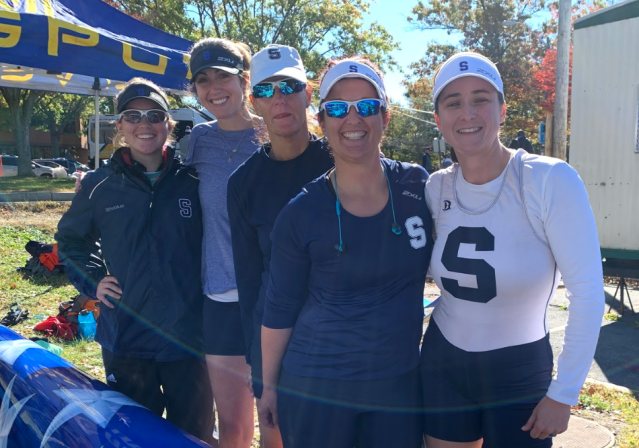
Our women’s masters 4+: Cox Sarah, 2-seat Caitlin, bow-Beverly, stroke- Holly, 3- me
The race happened so fast, what I have left are fleeting moments. I was so dialed in during the race I didn’t see the crowds on the sidelines, the banners on Elliot bridge, the enclosures, my family by Weeks. Here’s the rundown of what I remember:
Where do zombies like to row?
The Dead Sea!
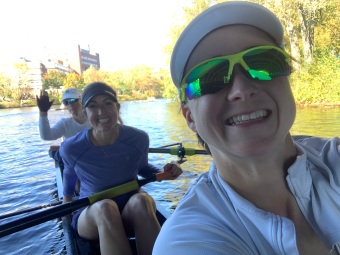
On our way to the start…taken during an Elliot Bridge traffic jam.
Panic! We’re going to hit! We’re under a bridge! Cox’n is yelling, and I’m screaming too, “POWER! POWER NOW!” and jamming it with everything I got, eyes glued not on stroke but the white bow surging forward and the sunglasses of their cox. I think stroke is yelling too, and we are standing on it—
Swoosh! Inches, they change course cutting to starboard and we cut to port. (Apparently, says our cox, the same thing was happening in her bow, which is why she was also yelling.)
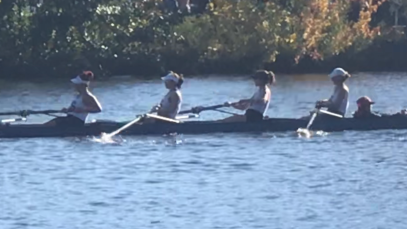
I was looking forward to row2k’s pictures to see how close this almost-collision was, but they posted nothing. Only one picture of our boat at all.
About fifty meters past the finish, we’re on the paddle when our cox’n says, “Hey, Texas, do you know Felicia?” Holly and I whipped our heads around, thinking about the same thing–”Oh my god, our cox’n did not just ‘Hey Felicia’ that boat”– but she quickly followed up with how she used to cox with some girl there and to say hi. Relief. Holly and I chuckled at that.
My right hand: as soon as we went on paddle and the race adrenaline wore off, I felt the damage. Light pressure on the right hand all the way back home. Strangers asked if I was in an alumni about because clearly I don’t row enough. I also turned down the offer of alcohol from the first aid station. Not a glutton for punishment.
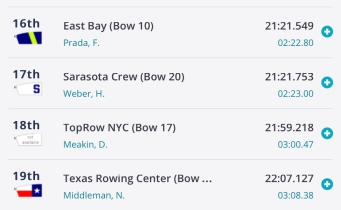
Someone looked up the results. I don’t think it was me, but maybe. We were all disappointed to find ourselves at 17. A general, “really?” The row felt decent for a composite 4+, maybe a little messy near the end, but it came back together. If boat 17 had yielded, we probably would’ve been 16, as it was a 0.2 second difference.
I hoped for a better end, but the goal was experience. That we nailed 100%. It was an awesome race. I enjoyed every second. I felt strong, I know I made a solid effort by how my muscles felt at the end, and I conquered those pesky inner demons. Triple win.
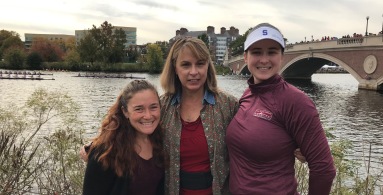
My Mom and cousin Maggie came to watch us race.
No rest for the weary. The Head of the Hooch is less than 10 days away and I’ve got three races including the single. I landed home Monday and
picked training back up on Tuesday.
It’ll be my second race ever in the 1x, the first being over six years ago. With the HOCR out of the way, there’s nothing to stop the mental wheels burning about the Women’s Master 1x, but I’ll save that for another time.
You may be wondering what is Faster Masters? Let me answer by telling you a story. Grab a comfy seat and a drink because this will take you 5 minutes to read.
Rebecca and Marlene are your coaches were both competitive younger rowers and (eventually) reached the end of their careers and wondered what to do next.
Marlene had won major titles in sculling and sweep rowing including a US National Championship, a Collegiate National Championship, and a Head of the Charles title. In 2000, she set two world records on the Concept2 Indoor Rower; Rebecca was a multiple Henley Womens medalist and Henley Royal Regatta finalist with a string of medals in UK head races, National Championships and a Boat Race win.
After deciding to quit, both were at a loss about what to do next. Was there a place in rowing for older athletes with a bit of coaching experience?
We noticed in every rowing club there is a committed group of older athletes who enjoy training together; they turn up regularly; they get given old boats to use and after training they huddle in the club room drinking tea and clearly having a good time chatting together.
Everyone ignores them.
Nobody knows or cares that they were once the youthful heroes of the club training all hours and winning medals. Once in a while a newcomer is added to the group – someone who moved to the area, a visitor from overseas or a beginner who is starting off in the sport. They quickly become embedded in the group and make friends.
The group gets no coach allocated to advance their skill; they do boat maintenance as they use older shells and oars cast aside by other training groups. And yet …… they have the same commitment and drive to succeed, to gain skill to move a shell with ease, becoming fit, strong and worthy competitors in rowing races.
Rebecca was asked by David Hudson and Andy Ripley to coach the masters group at Tideway Scullers School, her London UK club. This was a revelation. The group were the most attentive students, striving to effect technique changes, hungry for more drills and more insights to make their boat go fast. And as they trained with a common focus and a common purpose they got faster, stronger and that season they won medals, lots of them.
Marlene took a different path – becoming a coach and starting Royle Row training camps and coaching.
But before the internet, few of these masters could find each other and learn together or share experiences. They met occasionally at the Head of the Charles or the FISA Masters Regatta but dispersed afterwards back to their clubs. The group was global but isolated, motivated but un-focused, and unable to progress.
Mike Davenport, the author of the Nuts and Bolts Guide to Rigging and Jimmy Joy, host of the Joy of Sculling Conference were both guests on Rebecca’s RowingChat podcast. Behind the scenes, both gave invaluable advice on how to share coaching advice from a distance, how to bring groups together for a few days to progress rowing skills; how to write clear explanations allowing the reader to coach themselves.
And this motivated both Marlene and Rebecca to continue coaching and to start sharing their knowledge online. Rebecca started writing for an audience of Masters on the Rowperfect blog; Marlene penned articles for Rowing News and gained new club clients who bought her training programs.
The snowball started to roll.
Rebecca invited Marlene to be a guest on RowingChat in January 2016 and that episode became one of the most downloaded ever. They continued chatting offline and decided to launch an advisory self-coaching program called Faster Masters Gold. It is 8 detailed ebooks covering drills, technique adaptations as you age, developing stroke power and racing 1k. The globally popular Facebook group, Masters Rowing International was formed and it continues to grow (>6,000 members) as masters find a community with aligned interests ready to answer each others’ questions and share advice. (Do join and invite your rowing friends.)
These early successes encouraged Rebecca and Marlene to continue to discuss the challenges faced by masters athletes. We found ways to overcome the isolation; to demonstrate smart ways for more people to really enjoy rowing and to make strong progress towards goals - despite clubs who do not support and encourage masters.
Today, Faster Masters Rowing helps athletes with a framework for their training and an online community to support the trials of training, injury, setbacks and to celebrate progress towards success.
Join our community and get our exclusive Faster Masters Rowing Magazine, packed with tips, techniques, and inspiring stories. Includes four new articles monthly.