1% gains for racing - Greg Benning shares his methods - online training [70 minutes]
Timestamps
01:00 Get more speed
Your net boat speed is the power you put in to the power phase and the amount the boat slows down when the oars are out of the water. Rowing boats surge through the stroke cycle.
03:15 Simplicity is key to the recovery
Keep the movements sequential and well-organised. Maximum boat speed comes after the extraction at the finish and as you transfer your body weight onto the feet. A key point is when you can get weight on the feet. As your arms straighten and your body follows - then the boat gets an extra burst of speed if you can sequence this correctly and smoothly.
05:00 4 focus points
Keep the slide seat wheels moving, rolling towards the stern and full compression.
Poise and relaxation, both are needed. Keep your body lifted and in a fixed state so you sit high on the front of the seat along with relaxation.
Muscles get tired when they aren't getting enough rest. The more rest they get on the recovery the more we can activate muscles on the power phase. How to activate and release muscles.
Continue sliding until the blade is under the water. Don't chicken out.
10:30 Common errors
You must have weight in the hand - elbows have to be higher than your wrist in order to give downward pressure.
Keep a flat wrist as you feather into your fingers allows you to keep weight in the hand. In sweep only the inside wrist bends.
Squaring on the recovery can mess with the rhythm. If you square late or it's a large movement this contributes to losing rhythm.
When to release your knees - a critical timing point to when to relax your muscles. You will get this right when you know what the feeling of weight in the hand is and the feeling of total relaxation in your leg muscles are.
Increase relaxation - know how to do this will help you to improve the other focus points.
14:20 Things to try
Increase relaxation by 1% and what happens to the boat run, ratio and how the recovery feels. Does the boat speed change? [Remember they average over 3 strokes].
Hi Rowing Community! Does anyone here have experience with costochondritis and hypermobility/EDS? I’m hoping to speak with someone who has dealt with this and how they modified training and form. Thanks!
Replies to the post
Anne Grainger I had costochondritis in 1992 (Barcelona). I used lots of ice (not sure that would be the case today) and took high dose ibuprofen while competing. It took several years to fully recover and by then I had stopped competing.
Sue Ann Curtis I only have hypermobility so I don't know if I'd be very helpful. I don't need to modify otw, but have found that I have developed some bad habits in sculling to try not to have subluxes in my shoulders. The proper technique really doesn't cause my shoulders to have subluxations I think i am just paranoid. I have not experienced any knee over extensions, but I do know that can potentially be a problem as well if you go all the way back at the catch and lock your knees. I know someone who has experienced this.
Where I run into the most problems is weight lifting and have found certain lifts i can't do at all. But most olympic lifts are fine.
Gretchen Newman Hi Suzanne! I have Lyme, fibromyalgia, and EDS. It’s definitely been a struggle, but I’ve found that sculling works better than sweeping. I can’t train on the water more than 3 days a week bc recovery is significantly slower than normies.
Long pieces are the worst due to the repetition. Sprints almost always lend to cramping at the end for like 10 minutes so cool down is imperative. I’m also a bodyworker, so I tend to be life focused on wellness anyway. But diet, protein, carbs, balanced, are essential. Soft tissue work with a scrapping IASTMT tool post row helps significantly, along with regular massages that focuses on intercostals and the whole posterior chain.
Strrrrrong shoulders through cross training at the gym, really anyway that you can get more muscle on will protect your joints from EDSh symptoms. I’ve worked with a couple personal trainers that specialize is weight training for EDSh, it changed my life and got me back into the competitive shape I was in college and high school. Prior to that training I could barely run a 5k, now I run halfs a few times a year.
I think just understanding that your recovery needs are going to be significantly different and that little tweaks in the boat are important. For the longest time on the drive I hyperextended my knees, so I’ve had to adapt to bringing my feet closer to my body, so the backs of my knees slightly touch the track helping them to not hyperextend. I get way more track bites but my knees don’t hurt like they used to post row. I was falling through my finish until I devoted a couple times a week to a low volume ab workout that helped stabilize my lumbar spine. And learning to end my finish a little earlier took the brunt off my low back which I think might always be my weak spot with EDSh. I was famous for a deep lay back…. But completely unneeded, it was just how I was built before knowing about EDSh.
I’ve found that low volume rowing is actually really beneficial to my symptoms. And that when I focus on strength out of the boat, and am aware of what stacking my joints and properly loading them feels like, this transfers to the row. First identify where you are overreaching, extending too far, and compromising joint stacking, then make little adjustments to those areas incrementally. Idk if I’ll ever get used to a more upright finished and closer feet but I am trying my best.
[Note: This is not medical advice, we are only sharing what our community has advised.]
Speed murdering mistakes #1
We start a mini series on things which kill boat speed. And how to fix them. Part One: Dragging oars along the water surface
ResourcePontoon Floats are a cheap aide to building confident bladework - discount coupon lower down this page.
3 Value Bombs
Watch a crew - are blades parallel, is the space between athletes' heads moving at the same time
Gain boat speed by learning how to move with the boat hull on the recovery.
Knowing what you will do if you have a lurch/wobble gives you confidence
Timestamps
00:30 We love boat speed, the feel of the boat moving well. Technical aspects which coaches see over and over and are fixable.
02:30 Dragging oars along the water surface.
Why do people do this? Is this using the water as a balancing aide. Dragging the oars creates friction and slows the boat down.
03:50 Losing boat feel is a consequence of oar drag. The boat pitches fore and aft in the water as we row. The trim is not constant. Moving with the boat on the recovery, you can feel the boat surge as the bows lift out of the water.
Skilled rowers go a lot faster because they adapt and adjust body movements to align with how the boat is moving. When blades drag on the water it's harder to feel the surge.
06:30 The causes
Confidence, Tension, Fear of the unknown.
Fear - if you worry that the boat becomes more tippy because your oars are high above the water, here's the cure. Pontoon floats give stability and help to build confidence.
Buy Pontoon Floats here Your ability to recovery from a wobbly stroke is part of the cure for blades dragging. Get a discount using coupon FASTERMASTERSRO
08:30 if you're skilled enough to go in a single scull - when your oars are out of the water - once your arms are straight, your oars are perpendicular to the side of the boat - this is the point of maximum stability, sometimes called the safe position.
What could happen during the recovery and where do your lurches happen? If your oars are feathered, the maximum tip/lurch is until one oar touches the water surface. This is like a stabilising pontoon float. You won't flip or capsize. If your blades are square when you get a lurch - just take that stroke immediately. Never mind how far up the slide you are. Then get the finish stable and focus on the next recovery.
11:00 Know what the worst that can happen is and know that you have a solution.
12:00 For wobbles at the finish, ensure you keep elbows high and finish in the correct hand position. Get weight in the hand too. Use double bounce exercise, the stationary stability drill, pause drills to practice this.
13:00 Get the sequence correct off the finish
Do your handles stay at the same height after feathering as they were in the drive phase? If you flex your wrists to feather you may not be pushing the handle down. Get some video to find out what you do. How to progressively gain confidence keeping the oars off the water surface on the recovery.
Summary of the cures for blades dragging on the water surface
Weight in the hand ensures the extraction lifts the spoons above the water surface
Finish sequence helps create stability
Get good blade height above the water so if the boat set is variable, you still don't touch the surface.
Watch the full Speed Murdering Mistakes mini-series
I heard today that Jimmy Joy the legendary coach and founder of the Joy of Sculling conference died. Today's podcast is my reflections and memories of his work.
Timestamps
01:00 I never met Jimmy Joy We corresponded for years. His drive to share what he learned shaped what he gave back to the sport. He emphasised sculling as part of the need to become a well-rounded athlete. The Joy of Sculling Conference was Jim's conduit to educate others in the sport.
03:00 My rowing blog contained articles by Jim. His perspective was unusual - he focused on the blend of mind and body and how these come together to create the Flow State. Hanlan's Spirit was about Ned Hanlan who innovated by lengthening the slides in sculling boats. Rebecca took texts and used the blog platform to publicise books. In 2013 Jim contributed a chapter to the ebook How to stop worrying as a coach. The Quantum Sculler was Jim's deep insight into meditation practice as a way to get into flow state.
06:30 Rebecca describes her Flow State experience in the book "The Greatest Rowing Stories Ever Told". She had an out of body experience - looking down on herself rowing with no consciousness of how hard I was working, delivering surging boat speed.
08:00 Training for Flow can be taught and learned. Listen to Rebecca's podcast interview with Jim https://rowing.chat/jimmy-joy/ The art of sculling is a meditative practice.
10:00 Themes from the extract from the Quantum Sculler. Higher consciousness awareness described by Jim.
Sculling takes on the quality of lightness - there is no struggle in the mind.
Attention is inclusive - outward and inward things.
Wholeness in sculling - the relationship with the equipment.
The exactness of movements. Intuitional movement eventually becomes transcendent.
The practice of quiet sitting - developing comfortability sitting and breathing
Recognise the benefits of patience, stillness - these qualities one's life and sculling - the power developed internally parallels the external physical training
We are all inter-connected - the ability to remain in the present moment, a quiet, humble and ego-less strength - become conditioned to sitting for longer developing attention
Embrace the surroundings - the mind becomes steady, calm, non-judgemental
Maintain balance between thinking, feeling and sensing - the union of the stillness of body and mind is deeply felt.
Want easy live streams like this? Instant broadcasts to Facebook, YouTube, LinkedIn. Faster Masters uses StreamYard: https://streamyard.com/pal/d/5694205242376192
Often the first rowing drill taught, but so often executed poorly and without care. This is one of the best drills to teach how to recruit more muscles into your stroke. Learn how to teach it, what it does for your boat and errors to watch out for.
Timestamps
01:00 The arms and body drill - how to set up the boat from the finish, get run on the boat and recruit more muscles.
Sitting in the finish position - shoulders behind your hips, leaning backwards and feet pressed flat into the shoes. Row just with your arms at square blades. Row the oar in and out of the water with your arms only - straighten, then bend them while keeping your body and legs still and not moving at all. Then move to a second position - adding a body swing forwards after the arms are fully straight and extended - place the oar into the water, swing back and then bend your arms to complete the stroke. The familiarity of the drill makes us less careful in the execution.
02:30 What is the arms and body drill for?
It's mostly to teach sequencing. Release the oar from the water at the end of the power phase, how to enable the arms to lead the recovery with the body following on. It also teaches - how to make a square blade extraction - correct hight of blade handle at the finish - weight in the hand to control the handle as you extract - it leads into learning timing for feathering.
03:40 How to use this drill - key coaching points
Timing of the finish release and moving onto the recovery
Getting the oar out of the water depends on doing it before the handle reaches the body and before you lose contact with the footstretcher. Try varying your finish extraction point by 1cm, 2 cm with loose shoe laces to find when you lose pressure on your feet to find the timing point for your finish extraction.
Getting a strong finish
If the oar isn't continuously accelerated through the power phase it becomes harder to get the oar out of the water. Doing the drill with good pressure helps the oar come out easily. In sweep you can add more power with your inside hand due to the rotation of the oar around the pin.
Getting the body position correct after extraction
Ensure shoulders are behind the hips and the swing back is inline with your crew mates. Keep the body position still while extracting the blade and straightening the arm is important - I call it "separation".
09:30 How to teach the drill
Start by getting the static positions correct - the finish blade squared and buried under the water - move to hands away position - then rock to body over - and then place the blade in the water for the point of entry. Understand the handle height when the oar is under the water. If you can place the oar under the water at the point of full reach forward you can sharpen the catch timing and use your hands to anticipate the moment of change of direction.
11:30 Errors to watch out for
Sloppy body positions - swing back and forward, arms straight before swing forwards (or simultaneous)?
Blade height above the water on the recovery - does it stay at the same height above the water until the catch?
Handle height at the water entry point - check alignment with the back of the person in front of you (or the stern canvas).
Feathering too early - trying to feather underwater or feathering the oar out of the water rather than having a square blade extraction. Check weight in the hand to press handle downwards and that there's enough power behind the blade. Masters often compromise their back swing - it should add to the boat speed.
15:45 Advanced versions of this drill
Add a backspash when the oar enters the water - handle rising ahead of the change of direction.
Timing the release with improved downward pressure on the handle (1cm / 2cm earlier)
Wide grip on the handles (sculling slide hands down the shaft; sweep inside hand slide down the shaft) do you get a different feeling of control?
Do at firm pressure and add in more people so the boat goes faster - how does this affect release timing and placement?
Want easy live streams like this? Instant broadcasts to Facebook, YouTube, LinkedIn. Faster Masters uses StreamYard: https://streamyard.com/pal/d/5694205242376192
5 dos and don'ts for. crew alignment… when to coach the whole crew versus coach one individual.
Timestamps
01:00 When in a mixed ability crew it can be challenging, especially if you think you're the least experienced. Working on one thing for the whole crew at the same time created common endeavour in the boat. Whole crew coaching creates a singular focus. Five situations where there's an advantage of picking whole crew or individual coaching.
03:30 Warming up
We all do this every practice - the outcome we want is to refresh our memory of the movement and to be warm enough to do the workout. I need the warmup to activate muscles and get into the rowing stroke pattern. This is best done with a coaching focus on the whole crew.
Focus points - these help each person to check their own movement and technique in one area of the stroke. It brings everyone together in one point of the stroke cycle and creates alignment. Try using these in your next workout. First create a common understanding of the static positions in the rowing stroke.
07:30 Drills - learning
When doing them for the first time, it's important this is done by the whole crew, practicing together. Do the drill 3 times in a workout so the crew learns it fully and is confident executing it.
You already know how to do the drill this is the moment to move to an individual focus. Are we all moving in the same way? Check they are doing the drill correctly, that they are moving in time with the rest of the crew.
Tell the crew how to make the change, not just the change you want made. This can help everyone to do the movement in the same way. Example how to get blades closer to the water before the catch. For regular crews, you may already had agreed how to do a drill or movement - so this may not be needed.
13:30 Pieces
This is a whole crew focus situation where a common mental focus is needed and helps the piece to be executed better. A call to focus on one part of the stroke is good as the crew all does it together. Keep 10 strokes between every focus call, ensure the crew had done the focus you called. It's the only thing the crew is trying to do together. Exception is to call it a second time if the crew doesn't do the change you called.
15:30 Moving from a drill to a piece
Take a technical focus into a hard work piece is an opportunity for individual focus. It's harder to do the change when you are under pressure, in a more challenging situation. This helps create more alignment in the crew.
Talk about what happens after the workout - did the changes work? Was it more effective to do individual or crew coaching?
Pair oar boats are fun and a huge challenge. We discuss what you should do when trying a pair for the first time and what makes pairs go fast.
Timestamps
03:00 set up the rig correctly.
handle at the right position
release at the same place
oar handle height.
Set up to the pin "work through" position so you are both the same. If you don't know what this is, ask us!
05:00 You can adjust inboard/out- board to unique settings for this crew.
07:00 Who sits where?
Stroke - needs to be regular and rhythmical. Strength of the rowers affects seating - bow has more leverage so weaker athlete can go here. Who steers?
09:00 Experiments are encouraged.
What makes a fast pair?
10:30 Fast pairs are good communicators.
Technique - hand heights on the recovery must match. Practice your hand heights and high balance.
12:30 Stability on the recovery. Find exact timings - arms, squaring, body rock etc. Sequence together. Use physical reference points to guide you.
15:00 Who feels things more?
Body awareness is needed - control your weight as you go through the stroke.
17:00 Choose a gathering point where you focus on being precisely together in timing and body position. This creates synch between you.
Power alignment
19:30 Match your power curves Use land ergs to wore on this. Initiate the power in the same way.
21:30 Steering a pair.
Use pressure more than the rudder. Recovering from a mis-steer is a critical skill. Build steering habits into your practices.
What are the limits to masters rowing? Can we challenge ourselves more? Is comfort more important than skill? Rebecca and Marlene discuss technical skill challenges and physical challenges as you age. Risk versus rewards.
Timestamps
02:00 are limits being challenged now? Pay attention to how our bodies are changing. A class of masters who are high performance athletes exists. along with newcomers to the sport. Masters handicaps are less accurate for older athletes showing that masters are getting faster.
04:00 Head of the Charles results the top 50 year olds times were faster than 30 year olds and comparable to 40 year olds in recent years. They likely have more experience and more time to train.
Training in your comfort zone
07:00 I see people rowing in a comfort zone of technique, fitness and watermanship. Without coaching, people settle into habits. A good coach develops your skill to meet the challenge to get better. Marlene experiments every session.
11:00 The childlike approach to play and experimentation. Comfort in the boat is the goal. Doing tricks in the boat proves you are comfortable.
Try rowing a circle with oarlocks open
Take your hands off the handle at the finish & at the catch.
Technique pathway
13:00 The pathway of learning technique. Coaches need this to keep athletes interested. Starting with the core skills. Grading in achievable small steps. Be an advanced waterman ship rower or sculler. Get in touch to see our technique pathway.
18:00 Buy the best equipment you can afford. Responsive equipment helps you row better.
3 mini-challenges for you.
Physical and mental limits
Marlene answers the question why row slow and highlights benefits it brings your training and technique.
Timestamps
02:55 Is 2 sets of 6 x 500m tougher than 4 x 30 minutes?
What’s your favourite workout? Shorter fun- longer harder?
05:52 Time on the water to relax into your stroke
06:15 Stroke rhythm needs to be developed at slower stroke rates of 16 to 20 strokes per minute
08:10 Good breathing habits help rhythm and is better patterned at slower rates. Strength work can help you with your breathing pattern in the boat.
If you can't do it slow....
09:40 Controlled movements and good bladework positively affect the set of the boat. "If you can’t do it slow you can’t do it all”
11:34 Making every individual stroke a drill will teach you to feel boat run. At low rates the majority of the stroke cycle your oars are out of the water.
15:10 Long row develop concentration.
Marlene refers to Jim Joy’s article “Effortless Power or Powerless Effort” and quotes:
“The foundation is the subtle movement of the swing- trunk, legs, arms….Stay focused in the present on the what is not the what should be” Joys’ principles.
Jimmy Joy
Going fast will follow.
17:15 As we transition to a new season this all becomes relative.
17:55 Question: when is low too low; or long too long?
Depends on your level of conditioning; low too low there are benefits to rowing at low heart rates fat is utilized more than carbohydrates. Skill levels benefit to paying attention to sequencing, details of your stroke, what muscles you are engaging.
When is long too long? When you technique starts to break down. That is a good measure of a session. No sense to row poor quality strokes. Focus on good quality strokes.
Come off the water rowing best strokes.
Row slow before going fast
Improve technique with slow rowing
Rowers research, read and learn all the time. How to take your new ideas into the boat and test them out - do they work? Book of the Month with Jess di Carlo | Faster Masters Rowing Radio - the podcast for masters rowers.
Timestamps
03:00 Sculling Intensive course launch Every 5 years do a major reset and go back to basics on your sculling. This serves as a refresher course.
06:00 This Past Week - what we do to advocate for masters rowing. When people get nervous wierd things happen. Write it down and make a checklist for your regatta timings.
07:45 Coaches Eye has closed down.
Book of the Month
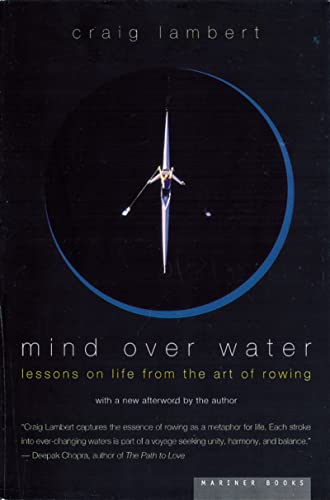
09:45 Book of the Month Mind over Water - lessons on life from the art of rowing by Craig Lambert Buy now. [affiliate link].
Craig Lambert's rowing book
It is based on the Head of the Charles Regatta and being an older athlete learning how to scull. Craig recalls the Great North East Blackout of 1965. Read more rowing books.
21:00 You Belong Here. Rowing shows you are part of the club.
Apply new rowing techniques
23:30 Finding new rowing things to use in your practice. As a student of rowing it's an ongoing process.
24:45 Have a good system to capture information - a reference archive.
27:00 Putting the new idea into practice. As a coach it's important to hear how others describe things.
30:00 Back to basics - choose how to do the thing,. Break down the stroke - exaggerate or isolate that movement.
32:00 The value of repetition - do it multiple times. Can you verbalise what you want to happen?
34:00 Technique first and then power. Test your limits. Use this method to coach and apply your learning.
How to incorporate new things into your technique
Got a program already? Get our monthly magazine
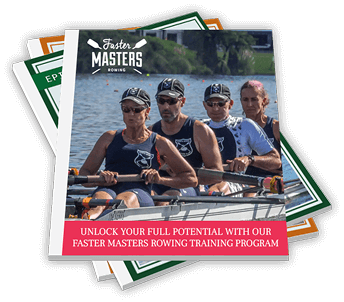
Join our community and get our exclusive Faster Masters Rowing Magazine, packed with tips, techniques, and inspiring stories. Includes four new articles monthly.
PLUS get the Rowing Fundamentals bundle (US$279 value).