
How long it actually takes for a training program to feel like it's working.
I've had some version of this conversation more times than I can count.
A rower gets in touch, keen and ready to go. They've decided this is the year they get serious about their training. They want a program, and they want it now. Understandable. But almost every time, the first thing I have to do is talk them out of starting the way they want to start.
Here's what they usually want: three volume-heavy sessions a week, a big jump in intensity, and results within a month. Here's what actually works: building the base slowly, tolerating a few weeks of feeling like you're going backwards, and trusting that the technical work you're doing now is what makes the fitness work later.
I've been coaching masters rowers for 25 years, and one pattern shows up again and again. The rowers who rush the early weeks, who skip the basics, the drills, the stroke sequence because they'd rather just row fast, who push volume before their technique can hold up under fatigue, are the ones who plateau or get hurt.
The rowers who commit to a slower start are, almost without exception, still rowing a year later, still improving, and enjoying it more.
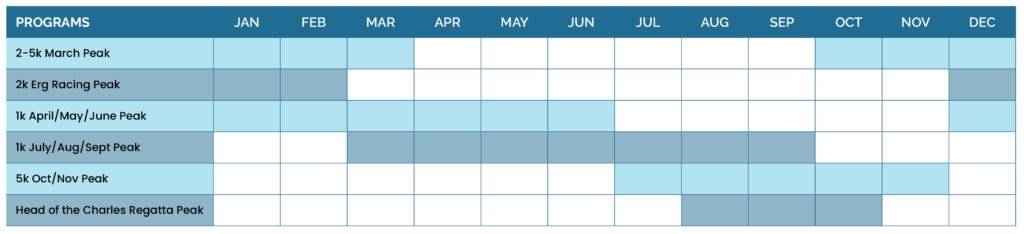
Take a look at what our base training months look like on a Faster Masters Rowing Program.
There are several programs available simultaneously - you pick the one best suited for the date of your next race.
Why the early weeks feel like nothing is happening
When you start a proper, periodised training programme, the first few weeks are mostly invisible work. You're grooving technique, getting into the rhythm of training and managing your recovery. You're building the aerobic base that everything else sits on. None of that shows up as a faster split or a better feeling on the water, not yet.
This is the phase people are most tempted to cut short. They want to feel like they're training hard, and slow technical work doesn't feel hard in the way a big erg session does. So they add volume too soon, or drop the skill drills, in an effort to feel like they're making progress.
It usually backfires. Technique that hasn't been embedded falls apart exactly when you need it most, under fatigue, in a race, in rough water. And an aerobic base that's been rushed doesn't hold up either. You end up training in the "grey middle" where the easy rows are too hard and the hard rows are too easy.

What a realistic timeline actually looks like
Using our 1k April May June peak program as an example - this begins in December. Like all our programs you need to do at least 3 workouts a week. The priority ones are marked with an asterisk * in the download.
December base preparation (weeks 1-4) has three Cat 6/ UT2 sessions, one Cat 5/ UT1 intervals and up to two strength or additional Cat 6 / UT2 sessions.
January base preparation (weeks 5-8) first fitness gains become noticeable as we repeat workouts you will see improved splits and faster recovery between workouts. The session profiles are similar but the top stroke rate is now up to 26. An additional 300 hard strokes builds on the December base.
February specific preparation one (weeks 9 - 12) has two Cat 5 / UT1 sessions and one Cat 4 / AT working over the 1k race distance at sub-race stroke rates. Additionally one of the base workouts is now at UT3 (low Cat 6) to build base fitness and improve technique at low rates.
By March specific preparation two - the stroke rates are up to 30 for big boats and 28 for small boats with more 1k race distance workouts are in the program - including a race trial on the last Saturday of the month. The repetitions are there so you can monitor your progress when doing the same workout several times.
April specific preparation two is the first month where 1k peak races are happening. You may do a trial race or this may be your big event. More Cat 4 / AT workouts over measured distances (500, and 1k) to build familiarity and pacing expertise.
May and June, continue the build up to race events with elements of race strategy included in the training including racing starts, power starts, sprint finishes and stepping up and down in rate.
It's not a fast process. But it's a lot faster, and a lot more durable, than the stop-start version most people default to: train hard for six weeks, stall or get injured, take time off, start again from scratch.
What I tell people now
I still tell rowers the truth about how long it takes. Some of them go elsewhere, looking for something quicker. Most of them, once they understand why the early weeks matter, settle in and do the work.
The ones who do are, almost without exception, the ones still improving a year from now. They buy an annual training program from Faster Masters Rowing and take breaks between their big events because they know we have got their training planned in a manageable build-up over the full masters rowing calendar.
HOW CAN WE HELP YOU?
Ask us anything. Support is here when you need it
If you want to trial a program, buy it. You can cancel at any time. The full suite of programs and pricing is here.
See you on the water!
Further resources
- How much should I spend on rowing training and coaching?
- What's the best training program for masters over 50?
- How long to get results?
- Rowing training basics - UT2, UT1, Threshold explained (Category 6, Category 5, Category 4)
