
When a newsletter reader wrote in about rowing with osteoporosis, one line in that question deserved an article of its own: "all the other things that we do around rowing (boat lifting/carrying in particular)".
The advice in that post stayed general, as it had to. The land side of the club day needs a clear answer for every masters rower, not just the one who asked.
One boathouse truth covers most of it: if you cannot lift 10 pounds overhead, you won't be able to lift your share of a boat.
What rowing asks of your body
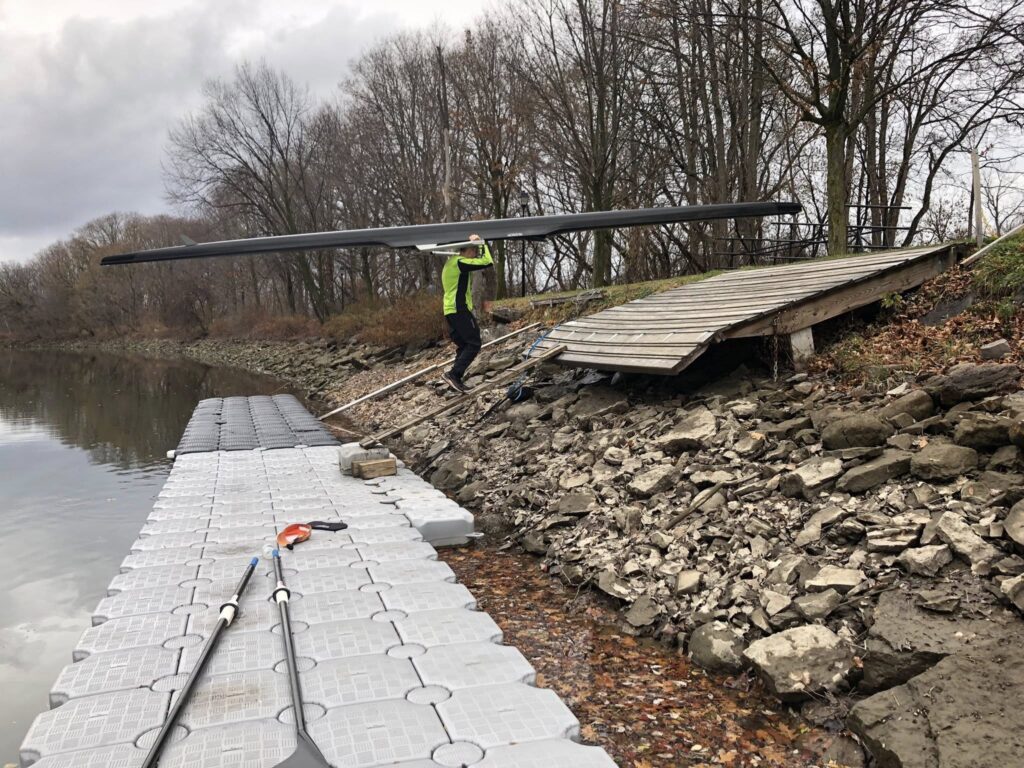
Count what happens before you even take a stroke. The eight comes off the rack and goes up above heads. A rigged single weighs about 30lb, and ways to carry a single scull include your head, your shoulder, or balanced over head. Loading the trailer requires boats at head height and higher. Rigging is hunched over a spanner. Next, the pontoon step: press the boat above heads, balance and step into the shell with one leg.
Now add the grip. Wet gunwales, slippery oar handles, trestles, grass.
Your erg score does not measure any of it.
Why the land side fades faster than the rowing
One British study measured strength and power in 100 healthy people aged 65 to 89. Across that age range, strength losses worked out at the equivalent of 1 to 2% a year. Explosive power, the quick push that gets a boat moving upwards, went at the equivalent of roughly 3.5% a year. What did that study actually test? Rising from a low chair, lifting a weighted bag on to a surface, stepping up on to boxes. That is a day at the rowing club without the fun part on the water.
Grip is different. A review of grip strength across twelve British studies suggests it climbs to a peak in early adult life, holds through midlife, then declines from there.
Balance goes early and quietly. In one study of 1,702 people aged 51 to 75, roughly one in five could not hold a 10-second one-legged stance. And that stance, held on dry land, is the easy version of the pontoon step.
Why doesn't rowing itself protect all this? The stroke has no overhead phase. Your hands never go above your shoulders between the catch and the finish. Rowing keeps your engine in excellent order. The lifting muscle is another matter, and the strength training piece on this blog has already made that argument.
The most fixable problem in masters sport
So is this simply what 60 feels like? Only if the lifting goes untrained. The evidence on training it is unusually strong.
A Cochrane review of 121 trials with 6,700 participants found progressive resistance training gave older adults a large gain in strength, plus a moderate to large improvement in getting out of a chair, on two to three proper sessions a week. A separate meta-analysis of 47 studies in adults 50 and over measured strength gains of roughly a quarter to a third across the big lifts. In every age group those trials covered, muscle adapted to training. If you want that case in full, read the case for building muscle in your 60s and beyond on huuman's blog.
Your gym programme covers the big picture. The land side of the club day only needs three small habits on top:
- Carry things by hand. Shopping, watering cans, a pair of blades down to the pontoon. Once a week is enough to keep your grip and your core honest.
- Keep something overhead. Press a light weight overhead once a week and lower it with control. Shaky at 10 pounds? That is the gap to close before the 30lb a single asks of you.
- Practise standing one-legged. Ten seconds a side while you brush your teeth. For rowing-specific versions, balance exercises for rowing has a full set.
Your programme still does the real work. These three just stop the boathouse jobs becoming the hardest part of your week.
Trailer loading is training
Loading the trailer for a regatta counts as a training session. Same for a morning spent rigging. Your back and hands do not care that no metres were logged, and recovery after 50 is slow enough without pretending Saturday's boat loading never happened. Treat a heavy land day like a hard erg: take an easier day after it, with proper food and proper sleep.
The same lifting also helps at night. A systematic review of 13 trials found that regular resistance exercise improves sleep, with the greatest benefit for sleep quality.
Your rowing already has a programme and a coach. The land side has neither. It mostly needs to develop a habit. That is a job for remembering, a training diary, or huuman, an everyday coaching app that keeps the lifting and the sleep on track between club days.
The boat hasn't got any heavier. Ask for help with the awkward lifts; that's half the point of a club. Then keep your own 10 pounds overhead, and lifting your share stays routine.
Guest post by Elisa Lindner, Senior Growth Manager
Huuman Life GmbH
