Rebecca and Marlene discuss
- The difference between exercising and training
- Keeping balanced as a single sculler
01:00 Welcome. Marlene was teaching at the US Rowing Convention on Training for Life. She covered the effects of ageing on your rowing practice and keeping consistent training.
07:00 There’s a new Royle Row website http://roylerow.com/ it includes a link to the Newsletter archive in the footer.
Training does not go inside exercise. You can do WOTD and that’s exercise. But it has no relation to what you did last week and your plan for tomorrow.
11:00 Training - there is a goal.
When you are training there’s a system. Each session contributes to the period of training. The Faster 5 sits under the training umbrella. We do the thinking for you. Train effectively. Challenging but do-able is our goal.
Balance and stability matter.
Balance is the narrow width of the hull. Stability is a wider platform - keeping the riggers level. You have to know where your body weight is and stay symmetrical.
How are you sitting on your seat? How much weight is on the footstretchers? Is your head neutral, back or forwards?
Sit at the release, blades square - weight over the handles. Do the tapping drill.
Level riggers equal a balanced hull.
22:30 Stability is within your control.
Your hands keep a downward pressure on the handles while the oars are out of the water. Staying stable takes your core and your handle height consciousness. Left hand to the stern of the right hand.
Faster 5 Bladework ebook (on our website). Watch videos of Thomas Lange sculling in rough water.
https://fastermastersrowing.com/faster-five/
Adjust on the handle. This skill enables us to row with oars off the water. on the recovery
32:30 Staying emotionally balanced in the 1x. This is “type 2 fun” - you do it and afterwards it feels great. But you’re afraid beforehand.
Mix it up with a crew boat sometimes to build confidence in your skills as this is more stable.
Be clear what your focus is - what you’re working on. Train in 1x but also in a group as a pack single sculls outing.
Go to a camp and join other rowers for fun, especially if you train alone.
42:00 Personal body maintenance. Rebecca went to her osteopath for a “loosener” body massage and realignment before the holidays.
n
Feathering is a key bladework skill for rowing and sculling. Marlene and Rebecca recorded this podcast in which they demonstrate feathering and explain
- How to Feather Correctly for sweep and sculling
- Drills to stop dropping the wrist while feathering
Remember that the Faster Five explains all the detail we discuss today and more. The Bladework ebook is what you will need.
04:00 Virtual Races are happening. A round-up.
09:00 Live Races happening at Secret City, TN, Head of the Hog, FL, Head of the Schuylkill / Hooch and Fish all offering erg or water participation. And US Rowing website has a virtual challenge.
14:00 How to deal with friction on oars in the oarlocks.
It was recently pointed out that I was dropping my wrists while feathering. This morning I noticed that there seems to be some friction and resistance with my C2 sculls in my C2 oarlocks, making it a little hard to feather with just my fingers. The collars are worn and a bit rough and I plan to reverse them to get a smooth surface for feathering. Any other suggestions to make it easier to feather with just fingers?
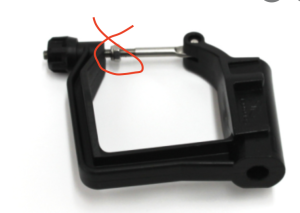
If you have worn collars they should be replaced annually. You can also spread the oarlock by moving the lock nut on the oarlock swing arm to give you more room to turn the oar.
How to feather with your fingers.
Release timing is key - getting the timing correct will ensure your wrist is flat. If you feather out the blade at the finish this makes your wrist bend.
You MUST do drills to change this pattern of rowing.
For all of these Watch your oar as you row. And SLOW DOWN the stroke rate so you can get it right.
Grip is not in your lower palm on the recovery. Check your blisters and callouses aren't here!
The weight of the oar is in your outside hand and the inside hand feathers. It is OK to bend your wrist in sweep for feathering.
Rebecca and Marlene explain The Faster Five essentials for rowing
Technique, Bladework, Stroke Power, Racing and Fitness Assessment.
12:00 We launch the Faster Five. These are principles which are important to learn, how to practice and what to practice. Things to pay attention to and key reference points.
The Faster Five represents the Faster Masters Rowing philosophy of teaching and a structure for you to plug into when you are studying rowing and learning how to become the rower you want to be.
16:00 Faster Five - Technique . Reference points so you can practice on your own. It takes thousands of strokes to learn the correct technique. It takes 3 seasons to become a sculler and 2 seasons for a sweep rower to feel they can apply good power in both sweep and sculling.
19:30 Faster Five - Bladework. timing and co-ordination is important. When you hold something in your hand (the oar) your brain thinks it's part of your hand. This is why it takes a long time to learn. Reduce your wash and blade is a key part of the learning from the Faster Five. The timing, finesse and precision takes drill work, focus and concentration. Developing high speed co-ordination is key to becoming a skilled rower.
23:00 Faster Five - Stroke Power - this comes after the bladework which brings confidence to your rowing. Power requires you to trust the oars and use your body weight. Learning the sequencing, being explosive and being effective at moving the boat.
26:00 Faster Five - Racing - the principles of racing well. Mental and physical, starts, steering and race strategy. What works for you and your crew. Back up plans. Relevant for all rowers whether you race or not because you can test yourself and get progress markers.
30:00 Faster Five - Fitness Assessment. A battery of tests to gauge your quality of rowing including stroke power, VO2 max, anaerobic threshold. Comparing the results works on both an erg (watts) and on water (500m spit to watts). The relative comparison gives proportional fitness measures. This changes over time.
34:30 If you are injured and come back to rowing your test shows you the right level of intensity you can manage.
38:00 Where to get the Faster Five. Link is in the website footer
https://fastermastersrowing.com/courses/the-faster-five/
When you subscribe to ANY monthly recurring program on Faster Masters Rowing the Faster Five is included as a welcome gift.
When athletes stop doing our training program you lose a lot. You lose commitment, you lose engagement and you lose someone else coaching and doing the thinking for you.
When you stop doing our training program you lose fitness, you lose your edge and you don't stay engaged and showing up. When successful athletes stop doing the Faster Masters program 100% of the time they never maintain the results they had on the program. Success does not carry on without an ongoing, developing training program.
40:00 Faster Masters is more than just a training program. Faster Masters is not babysitting athletes. Depth of instruction and insight from masters specialists. The Faster Five took us months to complete and includes our years of coaching expertise.
Masters feel like "disregarded" athletes - we are on a mission to get the sport of rowing to appreciate masters athletes. What we can bring to them, the goals we have are important. We deserve respect. We are building a global family of athletes.
It's the time of year that people start to pull crews together for head racing season. Many new sweep crews will be formed for HOCR (Head of the Charles) and other autumn head races. So what can you do to get your crew rowing well together, fast?
It is really hard to get a crew to blend their style and technique quickly. This is one reason why longstanding crews often race faster than "jump in and go" crews.
The best place to start this process is doing drills to get the combination of your movements aligned. Remember, nearly everyone will need to make adaptations - no one individual rows perfectly. Consider a dollop of humility as you approach your practices, especially if you are one of the more experienced in the crew.
As with all rowing drills, it's important to do each drill up to 3 times per training outing in order to really master the method, to improve how you execute it together and lastly to see the effects of the drill on your rowing. Execute to a high standard is a good motto.
Listen to the podcast from 24 minutes when we discuss the drills recommended for crew sweep rowing. And the timestamps below help with a list of the drills you need for your crew,
03:50 The past week - coaching, rowing, getting colder in Canada
08:30 Subscribe to our Newsletter and get confident rowing and sculling
https://fastermastersrowing.com/newsletter/
10:00 National Voice for Masters in NZ - communication meeting about how and what to message
11:30 Row2k published our article Rigging 101 for Masters covering easy adjustments to your boat and the level of difficulty of each. We focus on the cause and effect of rigging changes
https://www.row2k.com/features/5242/Rigging-101-for-Masters/
Rigging feet heel height to seat top is in the 17 cm range. This hugely affects ability to compress and get power in the first part of the stroke
15:00 My problem is I row a men’s heavyweight single and I weigh 115. I dig a bit deep on the drive. I suspect this is operator error but I really want it to be a rigging problem. Thoughts?
Digging deep while sculling in a big boat. This affects the steepness of the angle of the oars into the water.
Drills to improve digging - rowing circles, half blade buried.
Also avoid corrugating through the water.
19:00 Darkness is coming. I was going to ask a question about navigation lights, but then did my own research and bought these Navisafe lights, and wanted to share the information. Two nautical miles range, Coast Guard approved. I got two: one is set to green/red for the bow and the other to white for the stern
Early thoughts about boat lights for rowing boats - Rebecca uses Rail Blaza lights are 360 white lights which can also go on a pole.
https://www.railblaza.com/products/illuminate-i360-all-round-white-navigation-light/
https://www.railblaza.com/products/quikport-mount/
24:00 Sweep crew drills for HOCR and Autumn head races
Start with rhythm drills
- pause drills
- release drills
- blade depth drills
Get keyed into the voice commands of your coxswain
- Wide grip drill is very good
- Row in 6s to get accustomed to the movement
- Reverse pick drill for leg drive co-ordination
28:00 Drive pressure drills
- go from half to three quarter pressure building during the stroke. Light, medium, hard thinking that you’re rowing with glass oars for 5 strokes at each pressure.
30:00 Drills to increase stroke rate
- Half slide drills
- 20 strokes acceleration at half slide every 5 minutes during a longer low rate piece
- Rolling or flying starts are good every 3-4 minutes
Other things to practice
- Plan and practice emergency stops and re-starting as you may need to use that in the race.
- Inside hand on the back stay drill
-Getting familiar with Sweep if you’ve mainly sculled - Use your peripheral vision to watch the blade entering the water.
38:00 heart rate variability testing our recovery. It detects instabilities in our physiology. Marlene and Rebecca both use the HRV4Training app.
Marlene and Rebecca discuss coaching the release this week.
Faster Masters Magazine is designed for masters rowers.
If you want to become a student of the sport of rowing, learning more will give you confidence in your own rowing practice.
https://rowing.chat/sponsor/masters-rowing-magazine/
Timestamps to the show
06:00 Faster Masters has a newsletter subscribe page where you can get access to deep information and training tips which are not in the podcast.
https://fastermastersrowing.com/newsletter/
07:50 The US Rowing virtual masters camp has occupied Marlene for the past 3 weeks. She has been presenting sessions on stabilisation exercises by Brett Gorman. In the boat, avoid extreme movements and control your movements.,
Rebecca has been working on creating a "National Voice" for masters in New Zealand, if successful she hopes other countries will follow suit. It is starting with a Facebook Group, New Zealand Masters Rowers
14:00 if you think we should run a virtual camp - let us know.
18:30 Who do you share your water with? Swimmers are a challenge to spot without a bright cap.
Marlene tells a story about getting waked by a destroyer in Greece from the naval base in Poros.
A discussion on Facebook
24:00 Coaching the release. You have to practice drills to get it right. Slow down to work out the timing.
Exit : Feather. Can you get blended and not separated in these movements?
Check your hands are coming in level, wrists may bend to feather to make room between the handles and your thighs - so you won't have room to tap down.
Timing is important. Regulate the tension so you can release cleanly.
33:00 Should the blade come out exactly the same time as the knees go down?
n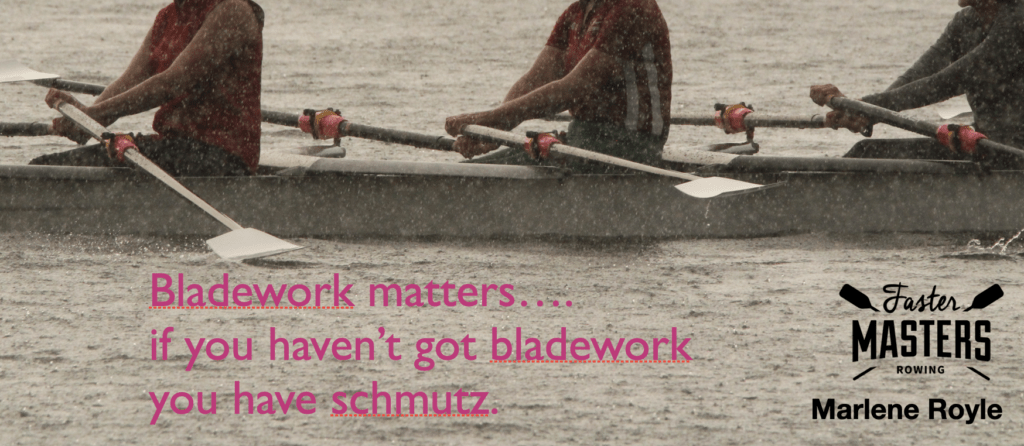
Marlene-ism for masters rowers quote from Larry Gluckman
Managing to control a 3-4 meter long stick with your hands is difficult - doubly so when you are sculling and have two to work with.
Bladework skills are acquired with practice and three key underlying concepts
A correct grip in rowing and sculling is comparable to the grip you'd use to hold a kitten or a small bird - light enough to allow the animal to feel secure in your grasp but not too tight so you strangle it and cause pain.
Mostly your grip is about controlling the handle and managing the mass of the oar using just the part which is in front of your body. This requires an understanding of how the principle of the fulcrum and a lever work. One centimetre vertical adjustment on your handle is 3-4 centimetres on the blade tip.
Using the fulcrum of the oarlock, your hand can affect how high or low the oar is above the water during the recovery and also how deep or shallow the oar is during the power / drive phase of the rowing stroke. The oar pivots around the oarlock and is designed so that a small amount of downward pressure on the handle can lift the oar spoon high over the water.
Teaching yourself how to "feel" the weight in the palm of your hand is a key bladework skill. It takes little effort and certainly will not exhaust your fitness, but it does mean you decide where the oar moves through the air. This is particularly important on windy days when a gust can blow the oar spoon when it's not being controlled by the athlete.
As a cyclical movement, rowing and sculling should make it very easy for the athlete to prepare for each part of the stroke. Good bladework reflects this and you can see an athlete square long before the catch / placement at the start of the power / drive phase, You can see them extract the oar at the finish and press the handle down so the oar clears any waves and feathers high above the water surface.
Less skilful rowers slide forward into the catch position and only square after the seat has arrived and their body is at full compression. They fail to extract the oar by pressing down on the handle ( frequently cocking a wrist to feather) and you see them feather the oar partly under water.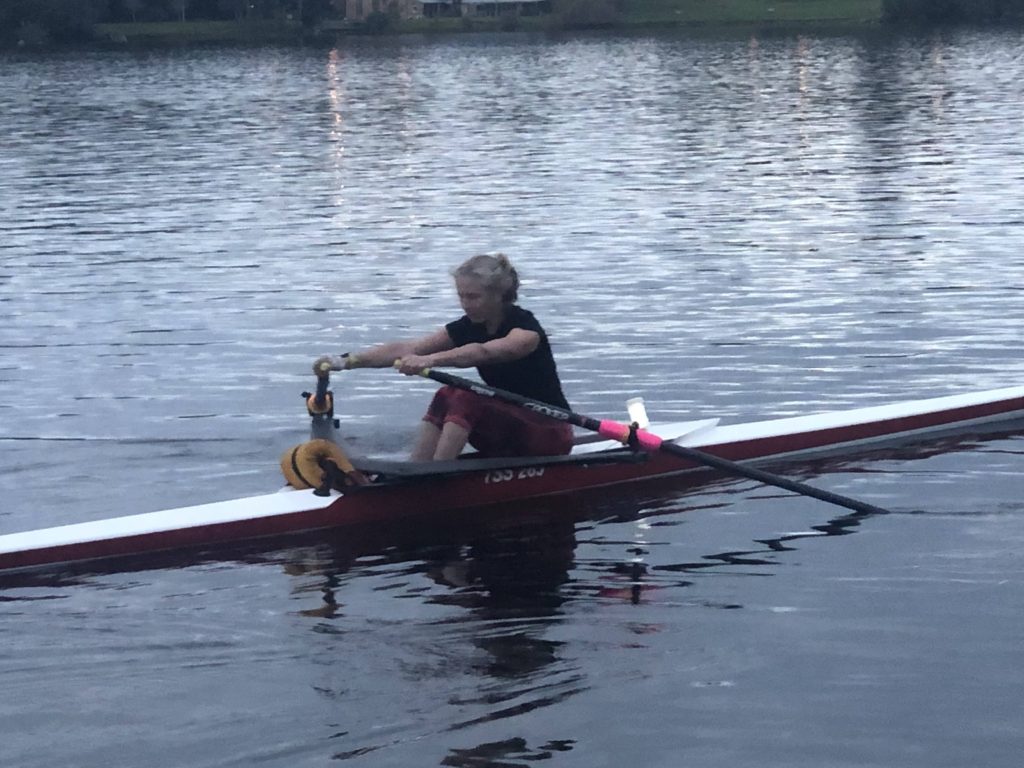
The Faster Masters Rowing training program teaches drills and exercises to learn good bladework.
Marlene Royle and Rebecca Caroe discuss
02:20 Staying on your program during weird times. If you abandon your rowing training program the spiral down happens quickly. Keep your long term goals, and view rowing as a process.
07:00 Dealing with goose poo on your dock or pontoon - how to repel swans and ducks
10:50 Emergency stops - how to do them and how to avoid having to make them
14:30 Look around to avoid having to stop. Call out to other water users as a precaution.
18:00 Traffic patterns and circulation rules for your local water for public access.
23:00 Rowing with sweaty hands in hot weather
27:00 How to do a standing entry into a boat from the dock
34:00 Last week's exercise - feedback
The image is taken from a popular rowing 'fail' video on YouTube called 'St Ignatius Stop Rowing'.
Back after our holiday break, Marlene and Rebecca discuss this week's masters rowing news, We talk about Listener questions and the Fall Racing Season Program. Buy a question / answer https://fastermastersrowing.com/our-courses/
02:00 Ian Perkins asks I have recently been getting feedback that I’m opening my body early at the catch.
Check the muscle sequencing on the drive phase. Bring the handle with you as you initiate the drive. "Drive the knees away from the chest which is different from lifting the chest away from the knees."
06:00 The legs only rowing drill
10:00 Andres Carazo asks about Training for Head Races. What would be the best way to start the program should I wait til next Month to start, or should I just go ahead and start with the head race module mid-month?
15:00 Rowers versus Oarsmen article https://fastermastersrowing.com/oarsmen-versus-rowers/
Bend a Rowing movie by Daniel Pallotta. Watch the trailer https://vimeo.com/ondemand/bend
16:00 process-oriented athletes and goal oriented athletes. Has Covid thrown you off schedule?
19:00 get ANY race practice it will help you.
HOCR remote race announced https://www.hocr.org/remote-event-announcement/
22:00 Drills for the entry. practice sitting at the top of th slide and get comfortable there.
25:00 The "Catch" drill to help to bury the blade before initiating the drive.
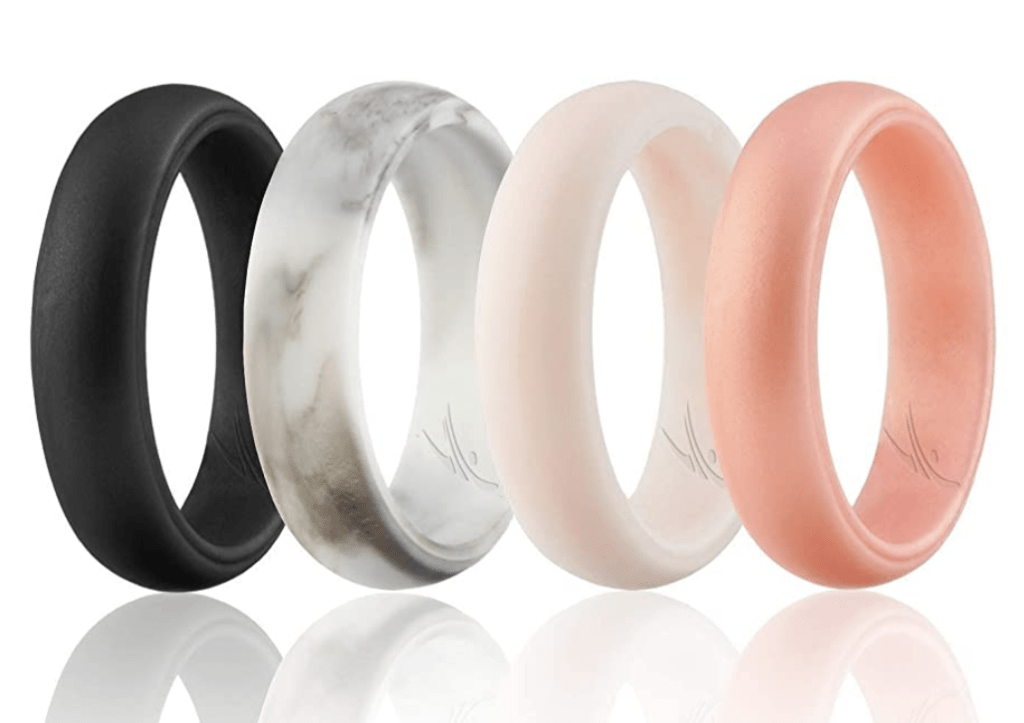
Silicone wedding ring to wear while rowing
Marlene Royle and Rebecca Caroe discuss drills as part of rowing practice for masters rowers.
03:00 Silicone wedding ring
Silicone wedding rings
Men https://amzn.to/2V5tIqH
Women https://amzn.to/2YjEbRp
06:50 Carol Daley’s question I’d like to hear Marlene Royle, Rowing Coach discuss a little more in depth about inboard and its relationship to rigging.
Goal of rigging is to have a longer stroke / time in the water.
Effective stroke length incorporates physiological comfort.
16:00 changes in rigging should not create pain or aches 2-3 days after you make the change.
22:00 New to the 1x tip is get a good posture in the boat - get a correct placement and correct extraction of the oars. Get your own oars allows for customisation of rigging.
27:00 When to incorporate drills into your practice. The role of drills. Drills for crews are about blending timing and rhythm. Early in the session your attention is at a peak.
31:00 The push and pull drill.
Help Rowing Retailers Recover – We are building a giant sale page with a product from as many rowing businesses as we can. Send us your favourite product web link and we’ll get permission to add it to the page. #RowingSale
Blake Gourlay book - the Movement of Rowing
https://rowing.chat/sponsor/blake-gourlay-book/
GPS Speed orders
https://rowing.chat/sponsor/gps-speed-orders/
Marlene and Rebecca kick into a discussion on how to row on rough water.
This is one of the biggest challenges that new rowers face. It is hard because feeling unbalanced makes you tense up, shorten your stroke and feel anxious. All these things contribute you to having a WORSE experience of rowing in rough water.
Our top tip is to gain ONE technical skill which will help you overcome these challenges. When you can handle your oar blades successfully, the relaxation and lack of balance can both be improved with practice.
Every time you go rowing, you should practice this one technique so that when it is rough water, you are ready and skillful.
Image CREDIT: Ellen Braithwaite at Open Water Rowing Center in Sausalito. Photographer Stefan Benton
07:00 Tips for new 1x single scullers. The Crossover hand position. Nest your right hand knuckle under the heel of your left hand
13:00 Sculling in rough water. Feather higher - focus on the release of the stroke and move fluidly round to crossover hands position. Relaxation - an active lack of tension. Lower body - let your hips adjust the balance with the boat hull.
20:00 Greece junior world championships - the "Hurricane" regatta. Relax your neck and focus on quality in a drill to improve your skill.
25:00 Square blade rowing as training for rough water. 31:00 Good drills for square blade rowing. What to do if you have a mental block?
38:00 Align and activate your lats using your scapula. Marlene demonstrates how.
Join our community and get our exclusive Faster Masters Rowing Magazine, packed with tips, techniques, and inspiring stories. Includes four new articles monthly.