But we can certainly influence how we age with proactive interventions and choices in our own lives. The Faster Masters Rowing Radio podcast welcomes Clare Delmar to the show to guide us through who is researching aging well and where we can find their writings and publications.
12:00 The science of longevity - Why we should be interested in aging and what we already know. Cancer research tells us what happens to cells in the body. Key tenets:- shifting healthcare, medicine and personal focus from lifespan to "health span". Living well longer.
14:45 Top risk factors for health conditions - the number 1 is aging for prostate cancer. We should think that aging is not just a fact of life - we can learn about it and about the process of aging.
Chronologial / biological age
17:45 Difference between chronological and biological age. Measure this with biomarkers. We can manage our biological age ourselves.
Who researches aging?
20:00 Which people are doing work in aging who we should follow? There are scientific geneticists, society researchers (employment, housing, transport), medical (treatments and interventions) and personal health (what we can do ourselves). Cell senescence is key - cells are dying and not being replaced. 24:00 Gurus on longevity. What they are talking about
David Sinclair is a professor at Harvard Medical School whose book, Lifespan is evidence-based. https://amzn.to/3ntcj9O Nir Barzilai also has a book Age Later, the new science of longevity. https://amzn.to/3A20YCB Interventions he suggests include supplements and drugs to help reduce aging. 28:00 Covid has taught us about repurposing drugs. Metformin is a diabetes drug Mir is working on. 29:30 Eleanor Sheeky has a great YouTube channel the Sheeky Science show. https://www.youtube.com/c/TheSheekeyScienceShow/about
30:30 Researchers into societal and cultural perspectives and the policies needed Sergei Young https://amzn.to/3fsxF2H Susan Flory
https://www.susanflory.com/ Tina Woods has a book on AI driving interventions. She's also on the UK Parliamentary advisory group. https://amzn.to/33Gc2sK Andrew Scott at London Business School has a book https://amzn.to/3qw4uSC Ashton Applewhite - social media around ageism @thischairrocks 36:30 Novos Labs are a supplements company. Their website is informative.
37:15 How you you monitor our own health? Clare takes supplements not because she feels bad. She wants to live well. Daily yoga practice has been massively helpful for strength, balance and mobility. Daily exercise - sculling, run or cycle Diet and nutrition - the impact on physical and mental / emotional health. I eat gut-friendly foods. I have cut out sugars so I'm less dependent and greek yoghurt daily. 44:00 Tips - apply to your everyday. A dietary intervention is the concept of intermittent fasting - body ketosis. Everybody is different. 47:00 Opinions on a vegan diet? It's an individual choice. With aging it's protein levels that are critical to less stress and cell repair. Women need fat in our diet. Clare is a convert to non-meat proteins - pulses / beans and plant based milks.
Rowing and aging show audio recording
Baz Moffat is the co-founder of the Well HQ, a community that promotes womens health in sport. She has a personal interest in pelvic health and is working to counter the mis-understandings about pelvic floor, bladder and bowel health.
This video is part of the Rowing Through Menopause webinar - Baz talks for 40 minutes (details below) and will teach you what we should know.
Use Discount Coupon MENO1524 to get 15% off the purchase price of Rowing Through Menopause.
An in-depth review of all the detail you should know about your pelvis.
Pelvic floor for rowing - what should your pelvic floor be able to do and what is 'normal'?
Bladder health - how often a day should you wee?
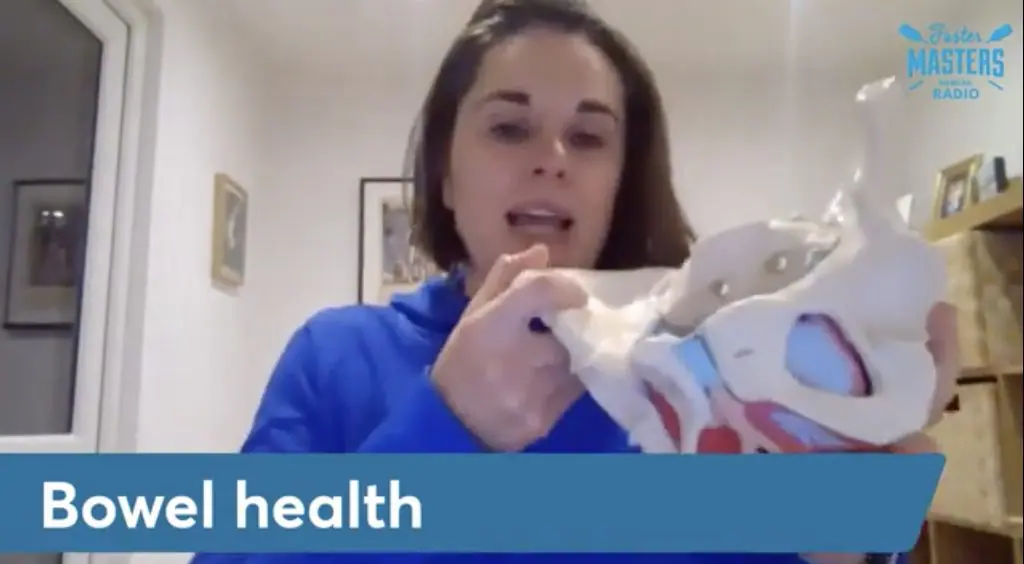
Bowel health - In mid-life we have a lot of stress hormones. If you don’t go to the bathroom regularly and excreting these hormones they get re-absorbed and stored around your middle as fat. That's why mid-life women struggle to lose weight if we are stressed / lack of sleep / constipated.
Strength and conditioning in mid life as part of looking after your pelvic floor.
How to "cue" your core to strengthen and align with your breathing, your diaphragm and pelvic floor
Baz Moffat - pelvic health expert
10:00 Baz Moffat from The Well HQ. Interest in pelvic floor but it was "medicalised" as a topic. And hadn't been re-interpreted into sport. The team at the Well includes an exercise physiologist and a general practitioner (family) doctor. 16:00 The "Caught Short" kit of period products for your club changing room
90% of women will leave a venue if her period starts and they don't have a product to use.
Baz Moffat, The Well HQ with her model pelvis.
Pelvic floor for rowing
18:30 pelvic health for rowing What is your pelvic floor? Its role is to hold everything up and keep you dry. Coughing, laughing, sneezing, jumping should not make you leak, wind or urea /faeces. Athletes have higher levels of dysfunction than the population. Upwards of 50% of masters rowers (women) have prolapse or stress incontinence issues. We have normalised this and it should not be so.
23:00 Kegle exercises are pelvic floor drills which are OK for starting. 26:00 It's taboo to mention because we are arrogant about our physicality. Prolapse is when the vaginal wall is not strong enough to hold up everything inside. Level 1 or 2 feels like a drag and can be fixed with pelvic floor exercises and pessaries to protect the vagina during exercise.
Bladder & Bowel Health
30:00 Bladders.
Most people don't know how many times a day they should go to the loo. You should be weeing 8-12 seconds around 5-8 times per day. Healthy habits - we lose collagen as we age and this can cause a floppy bladder so it doesn't retract. Go every 3 hours or so. Respond to the urge. Bladder irritants - sugar, caffeine, spices, cold temperatures, alcohol. We get more sensitive with age.
35:00 Bowel health - bowels are different from bladders. Excreting waste product includes hormones. In mid-life we have a lot of stress hormones. If you don't go to the loo they get re-absorbed and stored around your middle. Stress, lack of sleep and constipation mean you cannot lose weight. When you get the urge you have 15-20 minutes to go. People prefer to go at home. You should respond to the urge, not wait. As we age digestion slows. Lack of oestrogen and more progesterone make you more likely to be constipated. Complementary health therapies and naturopaths can help a lot. Sit on the toilet with your knees higher than your hips is helpful if you are constipated. Lean forward, relax and let go. Your menstrual cycle also affects your bowel health.
Strength and conditioning in midlife
43:00 Strength and conditioning in mid life Evidence is from age 30 women lose muscle strength, muscle mass and bone density. Counteract the rate of decline with exercise. Lifting technique matters - learn this first. Function and form are your limitations. Focus on the "big lifts" squat, bench pull, bench press and dead lift. Check you are breathing. We do not need to hold the breath in order to stabilise the core if we are lifting 10-40kgs. Use a flowing breath.
49:00 In the Faster Masters subscription training programs we focus on do-able exercises and things you can do at home.
52:00 Keep your core long and ensure your stomach doesn't puff out. What should coaches cue when a female athlete sits in a rowing boat? Do not tell her to "hold" her core. Breathing in and out should move both the diaphragm and the pelvic floor - holding the core stops this happening. Tell her to seek "length" because a long muscle is a strong muscle.
58:00 We have 3 arches in our body - feet, diaphragm and pelvic floor. All are needed.
Train Like a Woman webinar 8 December 2021- it's free and also recorded so sign up
Following a training plan sounds so simple. You just read the workout and do it, right?
Well - yes, but. There are many things which can get in the way of an effective training program - firstly training on the right day with the correct workout. Rowers are competitive folks and many harbor fears of missing a workout and then guilt that they need to "catch up" on the missed session. This is the most common trap you can fall into when getting your training wrong.
Our podcast explains some of the reasons why you should vary your workouts, how to plan workouts to fit your schedule and when you should not change the workout programed.
How to follow a plan
How and when to vary the plan
What to do when life or the weather gets in the way of your plan
What to do if you get sick or injured and can't train
When it's NOT OK to vary the training plan
What to do when your crew is on a different program.
Follow a rowing program
05:28 This Past Week - what we do to advocate for masters rowing.
Have you got a club newsletter and would you like to use masters rowing articles we've written? Get in touch https://fastermastersrowing.com/contact-us/
Marlene's article on the oarlocks open drill is published in Rowing News Magazine
15:30 Rowing into a headwind with lumpy water is it better to keep the rate up to maintain boat speed or stay long and row slower?
Hold onto your finishes - know why you make your compromise.
23:00 Guidance on painting blades. Clean / Sand / Prime / Paint one colour.
masking tape skill is essential. Pull it off immediately you've painted. Paint the other side of the oar the next day.
29:00 How to follow a training program or training plan
You need structure to your week. Map your days and align to your training phases.
A plan is organised to build progressively - skills, fitness and mental skills.
What is the plan is set to achieve? Strengths, weaknesses or a race event and a peak?
35:30 General preparation times of year are different from specific preparation. More flexibility is possible. But stick to the sequence.
37:00 Varying the plan (how and when). We keep sessions to 60 minutes in the Faster Masters Rowing training plan so consider your days. If you are tired or under-recovered you should vary the plan.
39:30 What to do when life or the weather gets in the way of your plan. Wait a day. If you are injured or sick, be conservative and rest.
42:00 When it's NOT OK to vary the training plan. coming into a peak event, the taper is designed to restore your muscle glycogen to its full levels. This takes 7 - 10 days. Too much work will hinder this and you won't get a peak performance.
45:00 What to do when your crew is on a different program. don't overdo the intensity if you combine programmes. Can you blend the club team boats into your programme?
n
“What is that?” He opened my box. A seasoned security guard, he looked at the folded skeleton of metal, puzzled, like the guys at gas stations who think your boat is a missile on the roof of your car. But in this Middle Eastern airport the situation was more serious. “It’s a rowing machine,” I answered, “for exercising.” “Well then, put it together and exercise,” he said.
I put my erg together as a crowd gathered. It took some time. Two sniffing dogs were nearby. Then I started rowing. After a few minutes, I was ordered to stop. The monitor was removed and sent to a scanner for explosive devices. I had to prove I was really a rowing coach so the guard insisted I turn on my laptop and show him some of my emails. Four hours had passed. They were still suspicious of me until a young baggage porter stopped and said that his mother has one of those machines. “She even races on it,” he added. Only then they decided I couldpack it up and be escorted to the airplane.
I must admit that it was not always so complicated. In Italy and Slovenia, when seeing my machine no questions were asked. When they saw my erg, they just smiled and waved me through. Yes, there are countries where our sport is respected. Having an indoor rower with me was a good way to stay fit when I was away for extended periods of time, but for short trips working out requires creativity, diligence, and organization. For many adults who travel for professional purposes, training on the go is a fact of life.Recently, some masters shared their experiences with me about how they stay on track when away from the boathouse.
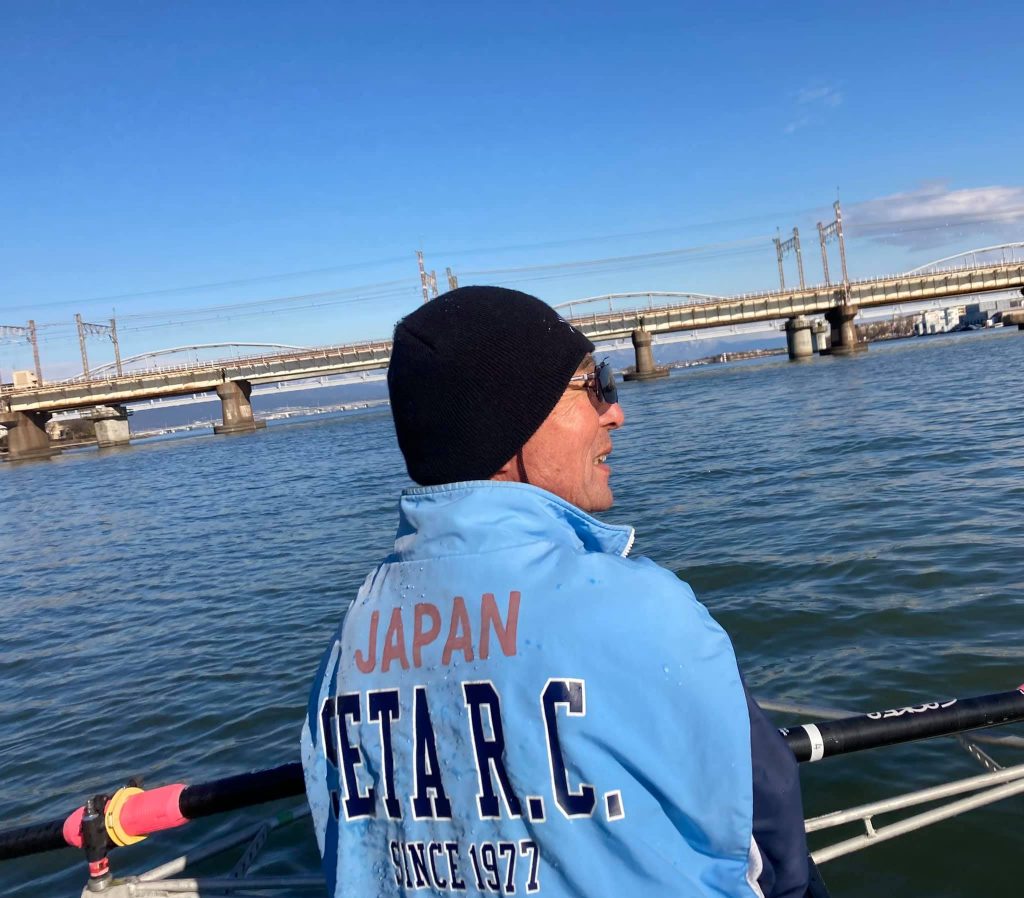
Steve Shimomura Rowing in Japan
Time and Motivation to Train
The two biggest obstacles for exercising when away are finding the time and the motivation. Work in different continents can mean being in several locations in a short amount of time. Asian itineraries with appointments in China, Taiwan, Japan, and Korea in the matter of a few days often means a long day in one location and then a short flight or long drive to another. In addition to a tightly packed schedule, business dinners also consume time in the evenings. Staying motivated is tough when you are tired, hungry, and the nearby fitness room is dreary or you feel pressured that you are not getting your workout in and losing shape. A trip is more enjoyable if it isn’t preventing you from getting your workout done. All agree that you have to do something each day- no matter what. Be it nothing more than a 20-minute run, a couple weight exercises, or stretching. One missed day easily becomes two or three. Sticking to basic daily maintenance keeps you feeling in sync with your normal routine and goes far in the long haul.
The most effective strategy is planning your training as part of your travel schedule.
You’ll need to do some work up front. Know what exercise equipment is available at your hotel. Then, for the future, keep your own notes about each location. If you will be in a rowing city, make call a local club ahead of time to inquire if visitors can access an erg or shell. The use of ergs is usually easier than a boat but in some cases you might be able to get a morning row by arrangement. Rowing at a new club, in an interesting setting, is an aspect of business-related travel that is universally met with delight. Commit to setting your alarm clock and getting up early. Define what your workout will be; how long, what routine plus, warm-up, then allow extra time to adjust for any inefficiency. Always pack running shoes, workout gear, and a stretching strap.
Sean Maloney of Bair Island Aquatic Club travels overseas 30 percent of the time. He advises,
“If you are out running stick on main roads even though in some places the pollution is bad. Taking side roads has led to being attacked by dogs (Thailand and India) and of course getting lost.”
Potential illness and changing time zones are major factors to contend with on foreign journeys.
Maloney says,
“Avoiding illness? No magic remedy. I get sick on trips. Economy class on planes is a big culprit. If you can go business class the air is less crowded with germs. Obviously the basic stuff- never drink tap water in Asia or emerging markets, never eat ice cream, never eat salads unless you are in a good hotel.”
Eat lightly and stay well hydrated.
Taking a multivitamin and extra vitamin C can help keep your resistance up. Carry hand sanitizers with you at all times and wash your hands frequently. On long flights, drink a lot of fluids and eat less than you would when not traveling; bring good snacks with you. Rowers can be more comfortable with upgraded seats that have more room. Otherwise, get up and stretch frequently. To avoid jet lag, try to get into the correct time zone as soon as you can. Resist sleeping a lot on long flights. It is better to get to your hotel when sleep is past due. The first day might be brutal but adjust as soon as you can. For small time changes you can ignore the differences and use the extra time to do something relaxing.
Finally, pad your weekly program with two days off so you are sure to get in all the sessions you planned.Do a harder day before you leave and allow for an easier day when you are back home to catch up on needed rest. Pay very close attention to how your body feels as this is when you may likely get sick.Sleep as much as you feel you need to get back in balance.
We dive into the challenging topic of eating disorders in rowers including revelations from one listener about his bulimia.
Timestamps to the show
02:00 This Past Week - what we do to advocate for masters rowing. Reading ROAR by Stacy Sims.
10:00 What's in the April program on Faster Masters?
1k and 5k programs. Technique videos of sculling we like. Rigging Quick boat setup. Guidelines on crew lineups for training. Organising race day checklist.
15:00 Masters Championships events around the world - UK, USA, Australia, New Zealand, European Masters all have dates for regattas in 2021
Jessica notes that coping with the stress of training led to her eating disorder
Genetics loads the gun but the environment pulls the trigger.
The desire to be lean as an athlete is a psychological condition. Get professional help.
My brain is the major factor in success as well as equipment, training program, technique.
23:00 Matt Whitcomb talks about athletes working with dieticians. Going to your coach for help is hard because there's an imbalance in power because coaches are often selectors too. Showing vulnerability can affect selection.
The best a coach can do is say I am here for you if you need to talk.
The coach's job is to facilitate help, not solve the problem. They can help create a culture of openness where these things can be discussed without judgement.
31:00 Mark Madeley confirms that when he was training internationally, the lightweight rowing coaches didn't know about nutrition. He was a lightweight for South Africa and suffered bulimia under pressure training alongside the heavyweights and being expected to eat with them as well.
34:00 Focus on your lean body mass not your weight on the scales
Sleep 7-8 hours a night
Front-load your calories with carbs in the morning and protein int he afternoon. Your body metabolises carbs better earlier in the day.
Increase your intake of foods with Vitamin B12, Magnesium, healthy fats and omega 3 oils.
Match fruits and vegetables and grains with proteins to control blood sugar spikes.
37:00 Red Flag warnings for female athletes are a triad disordered eating, amenorrhea and osteoporosis.
41:00 a consultation with a sports nutritionist can be beneficial. Timing your calories can affect weight as much as what you eat.
43:00 Taking really good care of ourselves is this week's goal.
n
Rebecca and Marlene discuss:
- How does cross training fit in? Pluses and cautions
- Force curves - common observations
- Listener Calls
Timestamps to the show
06:00 This Past Week - what we've been doing to advocate for Masters Rowing
Marlene's coaching correspondence included an athlete who was under-performing and concerned about making progress. What time of day do you train? A busy schedule means you aren't getting enough sleep. You're tired. No wonder you're under-performing.
Book Recommendation The New Toughness Training for Sports James E. Loehr https://amzn.to/3qDrMUf
Try to add 1 hour sleep a night so you get 7 not 6 hours. Take rest days during the week and do strength training.
Have a snack at work 3-4 pm and train at 5 pm when you get home. Then have a lighter dinner and eat a little later so you can get to bed by 11 pm not 12.30 am.
Rebecca's participating in the Pembroke Virtual Regatta doing 1100 meters four days in a row.
16:00 Scrimmage organisers if you would like to get a checklist ebook on how to organise, get in touch and we'll publish.
One Sporting World launch auction fund raiser for mental health - it's live now https://m.facebook.com/events/445557209931337
The Magic Wand survey - What is the #1 thing you want/need as a masters rower? https://www.facebook.com/groups/595853370615544/permalink/1618329025034635
21:00 Force Curve Analysis - common observations.
Last third of the drive is not symmetrical on the force curve - you are losing drive suspension
First part of the curve is very sharp - you are kicking the catch
25:00 How does cross training fit into masters rowing?
Include strength training - is it just aerobic or is it everything?
Strength is important - it sustains muscle mass and protein stimulus for both men and women
We don't insist you do cross training. Does it fit in your schedule? Variety helps alleviate boredom.
Be careful - if it isn't something you do regularly - the shock to your body can be tough bringing tissue fatigue and possible injury.
36:00 Listener calls - we want to know new topics you'd like to hear on the podcast.
Send a text message to us +64 22 647 3993
n
Marlene and Rebecca discuss
- Erg racing mental approach
- Guest: Claudia Pace from Sagamore Rowing Club talking about running a club masters program
- Should you scull or sweep first?
Timestamps to the show
06:00 This past week. Mitzi Nicoletti medalled twice at Denver Indoor Sprints.
A nice testimonial - Marlene Royle & Will Ruth
"Just listened to your Science of Rowing podcast as I’m getting ready for my cold long-SLOW-distance trail run. I think one reason you both are such great coaches for masters (and ancient) athletes is that you don’t just say "do it this way" but are open to conversations about technique and training. Not all, but most masters rowers I know are smart, analytical, and questioning. They need to bring their brains, not just bodies, into the coaching relationship. I spend lots of time around and with college rowers and I’m always surprised that they are so comfortable remaining so ignorant of our sport: they express little interest in learning the reasons behind technique or training or rigging or history etc. Most seem satisfied just doing what their coaches tell them to do. Way different for most masters rowers I know."
To understand ask "why" three times to fully understand.
Running a Scrimmage Regatta - checklist for organisers
15:00 Sweep or sculling first - which would you choose for a new rower. Sculling is better developmentally and a single is your "private coach".
23:00 Sagamore Rowing Association special guest Claudia Pace
Claudia explains how to run a masters club program
A third of our members chose to join Faster Masters Rowing club program in November. We like to work on our own things and use zoom. The group's interests are not homogeneous. Everyone found their performance improved significantly. People have been more "applied" in virtual situation .
29:00 Everyone comes to the club with a different skill level. The program suits divergent goals. We do a monthly coaching call for team leaders.
33:00 How to persuade the Board / Committee to go with Faster Masters training program?
It's a good way to keep members engaged. Important to offer something over winter. We priced it out per person and made the fee accessible for everyone.
36:30 Figure out what level you can afford to do. Need a viable number of people. We walked through the program with Marlene and explained it to members. We agreed to do a trial for the winter and since then we've decided to extend it over summer.
If you don't have a coach and can't afford to hire a coach it's a good alternative to having in-person coaching.
41:00 The additional content each month really sold us. You can get out of the program whatever you want. Nobody says it is too hard and I can't do it. It is challenging.
45:00 Mental approach to ergs. There is no excuse and so do not vocalise. Be very well rested. if you are going to tolerate pain you must be rested. Helps to deal with the mental side of the discomfort.
n
Marlene and Rebecca discuss
- Synching schedules. It's the hardest thing for a masters group to figure out.
- Injuries outside training
What is a sporting injury?
Anything that prevents you doing a full training load. And so a strained muscle, a stiff lower back or a hand blister can be part of you failing to complete a training session successfully.
Clearly there are scales and grades of injury - a blister is not the same as a broken leg!
Masters do not get injured more than younger athletes, but we are more likely to be adversely affected for longer and to take longer to return to full training.
What to do if you suspect you have an injury
Recognise an injury when it happens - feeling a "twinge" while rowing? Stop.
Get professional medical help if it is warranted - this could be an osteopath, a physiotherapist, a sports masseuse or a medical doctor. You know your body; you will make a good educated guess as to which sort of therapy will help you recover.
Be mindful during your next training session - Should I be at full strength? Should I cut back? Would a day's rest and stretching / yoga be better for my recovery?
As a rule of thumb, the earlier you treat your injury the faster it is resolved.
The amount of time you are off training is equivalent to the amount of time it'll take you to get back to the fitness you had before you were injured. So 2 weeks off from injury equates to 2 weeks of training (after the injury is healed) to build back to your full training volume and recover lost fitness.
Take injuries seriously - training on an injury usually makes it worse, not better.
Timestamps to the show
05:00 This past week - Marlene is a nordic ski coach; she guested on The Science of rowing podcast and will be studying coastal rowing coaching at the Rowing Canada Aviron conference with Guin Batten.
Rebecca has been reviewing the novice masters status in New Zealand and seeking a rule of racing change. You get the behaviours your tolerate in your club.
15:00 Ways to align your crew schedule. Review your lineups, the number of people in your group and seek regular days.
Cliques in clubs can rip clubs apart. Good leadership is essential.
22:00 No wasted water time. This is something we value a lot.
23:30 Marlene has seen a huge increase in injuries from our athletes. when you get injured you have to heal the injury, rehabilitate it and then progress back to training.
These are non-rowing injuries and were caused by carelessness on land. Your body is fragile. It doesn't take much to derail your training.
Accidental injuries when you are in a fatigued state your tissue is fatigued.
26:50 The further you lean away from your body to pick up your boat it puts you at risk of injury. This is relate to poor judgement.
Be mindful of how you move your body.
34:00 The United Nations list of
Craftsbury Common is one of these heritage sites - the Trouble with Harry movie was filmed there.
35:00 Mike asks are there any good videos that can explain all the basics to a never/never rower - someone who has never sculled before?
Rebecca uses these two videos in slow motion for her beginner class. There's no commentary so you can overlay your own interpretation. https://www.youtube.com/watch?v=882yriTw1VA https://www.youtube.com/watch?v=gQMaxr-gxp0
n
Marlene and Rebecca discuss - Mapping out a good erg program - Feedback on caring for elders
Winter rowing training
Through winter the weather affects our rowing. Some are iced in and others just have windy and bad weather days.
We all need to use the erg and water interchangeably - in this episode Marlene and Rebecca discuss how they map out a good erg program.
Start with knowing your spring goal -
are you using winter training to stay fit for 1k racing next summer
or are you using winter training to do a long distance head race in March
Your program needs to reflect these different goals.
Winter is good for building underlying fitness through a base preparation program which maintains your physical form.
Customise your program by doing the Faster Five Fitness Assessment - then you will be working within your personal capability ad know that your training is in the correct zone to improve your physique to achieve your chosen goal.
07:00 US Rowing Conference. Wednesday December 9th 2020 the Training day. Marlene is talking on Training for Life at 12.45 EST. See the full schedule. https://rowcon2020.sched.com/ Speakers include Stephen Seiler who was on a previous RowingChat episode https://rowing.chat/power-in-rowing-symposium-stephen-seiler/ 09:30 Update on the National Masters Strategy New Zealand - we are creating a model framework. If you want to copy the model, contact Rebecca Caroe 15:00 Caring for Elders was last week's topic. Feedback from a listener. Training is a great outlet for your stress cortisol levels. 18:00 Short intervals on the erg or a power workout are time-efficient which suits carers. 21:00 Mapping a good erg program. Faster Masters programs for December 2020 include 2 separate programs. Base preparation for 1k (next summer) and Base preparation for 5k with a spring peak. if you are planning the Tideway Head Races or the Heineken Regatta or CRASH-B erg races. Every workout has a land and water instruction including stroke rates. Faster Five fitness assessment helps you to individualise your program. 25:00 Understand the purpose of the workout. Priority sessions. Adapting workouts for the erg - 2 points lower in rate. 28:00 Check the resistance and the drag factor of 80-90 on Concept2. Marlene recommends erring on the light side for resistance. 30:00 Riggers on the rack don't line up - how to rack your 1x when some boats have forward wings and others have back mounted wing riggers. 32:00 Marlene's nightmare of having to use a ladder to rack her single scull on the top rack.
09:00 US Rowing conference Wednesday December 9th 2020 the Training day. Marlene is talking on Training for Life at 12.45 EST. See the full schedule. https://rowcon2020.sched.com/
17.oo Training while caring for kids or elders 19:30 Rowers can be very generous - they give their all. Take care of yourself first. Boundaries are needed - scheduling is a problem. Be as consistent as you can. Reduce cortisol levels by training regularly. Choose from erg / walk / stretch / row on water. 22:00 Don't give up on structure. Commit to 30 minutes a day. Resources in a past episode we covered https://rowing.chat/rowing-training-while-raising-kids/
Dionne is "super-Mom" she trains around her kids naps and their sport sessions. 28:00 Run with the kids to school and then you run home alone. 30:00 Protect and defend your time. The beautiful word called "NO". Find some regular training partners who can sub in for you at the last minute if something comes up. 35:00 Erg Studio at home - make it a nice place to be. n
Got a program already? Get our monthly magazine
Join our community and get our exclusive Faster Masters Rowing Magazine, packed with tips, techniques, and inspiring stories. Includes four new articles monthly.
PLUS get the Rowing Fundamentals bundle (US$279 value).