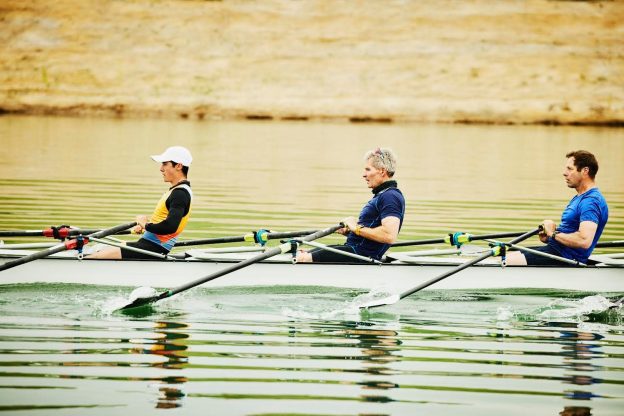
All masters rowers are concerned with ageing. Many of us are cautiously watching for signs of ageing including flexibility limitations, strength decline and endurance falling. Faster Masters Rowing did a podcast with Clare Delmar in which she talked about the scientific research related to ageing which we can use to inform our choices in how we live and how we row.
Science and aging
David Sinclair, professor of genetics and co-director of the Paul F. Glenn Center for Biology of Aging Research at Harvard Medical School. David is the author of Lifespan - Why We Age and Why We Don't Have To. David Sinclair has a popular Youtube channel with short and longer videos on discrete aging topics.
Nir Barzilai, founding director of the Institute for Aging Research, the Nathan Shock Center of Excellence in the Basic Biology of Aging and the Paul F. Glenn Center for the Biology of Human Aging Research at Albert Einstein College of Medicine of Yeshiva University. Nir is the author of Age Later – Healthspan, Lifespan and the new science of longevity. He did a TedTalk on science of longevity
Novos Labs Slow down your aging - supplements manufacturer
Do Not Age the world's trusted longevity partner - supplements including NMN and TMG
*Note links to Amazon are affiliate links.
Carrying a rowing boat takes practice - it's easy when you are shown how to do it correctly.
In this episode of the podcast, Rebecca demonstrates 3 ways to carry a single scull as well as carrying a wing rigger a 3-stay euro rigger boat and a reverse wing rigger 1x.
04:00 How to carry a single scull
Marlene was photographed in Steve Kiesling's 1991 book, the Complete Recreational Rower and Racer carrying her single.
07:00 Watch a video of how to carry a single scull.
Rebecca lifts each boat out of the water.
Showing how to find the balance point.
Lifting to waist height - rest the shell on your thighs for stability.
Lifting to riggers vertical and carry on your shoulder or at waist height (in the crook of elbow)
Lifting to carry the boat above head height, resting on your head.
12:35 Marlene's cautionary tale about carrying a wing rigger on a windy day Carry the boat with your hands in 2 different places to give more stability - not opposite each other on the gunwales. A wider grip is possible when you hold the riggers.
15:15 practice by putting the boat on slings / trestles.
3 things to practice
Pick it up until you find the balance point. Walk around and put it down several times. Put the boat on a rack - a low rack is easy to use as you can rest the boat on your thighs.
Practice holding the boat and rolling it over the right way up and upside down using your thighs to rest the hull on while turning.
Practice carrying the boat above heads with straight arms
Practice putting the boat on a high rack or on your car roof rack
21:00 Upper body strength is needed - about 30lbs is the weight of a rigged single - in order to carry the boat over your head. Do an arm press up to 30lbs to get stronger.
27:00 Is a wet launch pick up easier for a single scull? Don't leave your oars floating on the water when taking your boat out of the water.
3 tips for setting up your erg / indoor rowing machine correctly so that it is "like your rowing boat".
How to set up an erg
Support this show with a donation https://fastermastersrowing.com/podcast
Timestamps
01:00 This Past Week - what we do to advocate for masters rowing. Speaking at the US Rowing Convention, CRASH-B erg training program launch
06:00 Setting up your erg
Resistance - the drag factor on Concept2 erg, Water rower, RP3 and Rowperfect. C2 drag factor is 100 - 110 or 115 for masters.
Comfort - set your seat and foot height to avoid lower back load and over-use injuries
Make your Erg "boat-like" is the key.
12:00 How to set up your erg to be like your boat - single scull. Do short 250m pieces at firm pressure low rate, come into the dock and get on the erg (also on the dock) and row 250m at similar pressure and rate. Do they feel the same? If no, adjust the erg damper setting and drag factor.
Fixed Head rowing machines versus floating head rowing machines - what's the difference? How does it affect the set-up?
14:30 Why am I doing better splits on a resistance 10 than 4?
23:00 Monitor height - set it for a "long core" posture as advised by Baz Moffat
25:00 Drills for leg drive off the catch
A good drive reduces the "slip" in the chain and increases your effective leg power in the rowing stroke.
Drive suspension drill - put resistance high - slow motion rowing - equal contact for feet and fingers - the pressure is the same
Legs only rowing drill Start with the set-up from the finish - get into the forward-leaning catch posture, then roll up the slide. Row only using your legs - keep shoulders forward of your hips and arms straight.
Quarter slide push drill From the catch, row ONLY the first quarter of the leg drive, return to the catch. Progress down the slide in a pyramid. If your erg monitor offers a force curve display, use this to check your effectiveness in spinning the fly wheel as you lengthen and shorten the slide
37:00 Coffey Simulatoar - set the inboard of the sculls to match your boat.
Bio Rower - set the finish / release position correctly to match your boat.
Podcast Episode - how to set up the rowing machine
Listen to the podcast on Setting up your Erg
Baz Moffat is the co-founder of the Well HQ, a community that promotes womens health in sport. She has a personal interest in pelvic health and is working to counter the mis-understandings about pelvic floor, bladder and bowel health.
This video is part of the Rowing Through Menopause webinar - Baz talks for 40 minutes (details below) and will teach you what we should know.
Use Discount Coupon MENO1524 to get 15% off the purchase price of Rowing Through Menopause.
An in-depth review of all the detail you should know about your pelvis.
Pelvic floor for rowing - what should your pelvic floor be able to do and what is 'normal'?
Bladder health - how often a day should you wee?
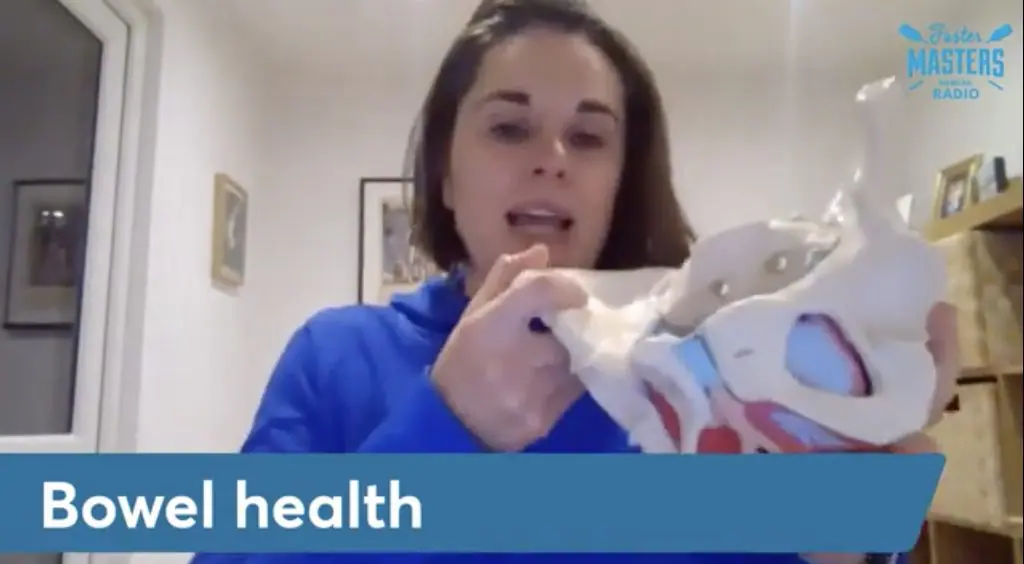
Bowel health - In mid-life we have a lot of stress hormones. If you don’t go to the bathroom regularly and excreting these hormones they get re-absorbed and stored around your middle as fat. That's why mid-life women struggle to lose weight if we are stressed / lack of sleep / constipated.
Strength and conditioning in mid life as part of looking after your pelvic floor.
How to "cue" your core to strengthen and align with your breathing, your diaphragm and pelvic floor
Baz Moffat - pelvic health expert
10:00 Baz Moffat from The Well HQ. Interest in pelvic floor but it was "medicalised" as a topic. And hadn't been re-interpreted into sport. The team at the Well includes an exercise physiologist and a general practitioner (family) doctor. 16:00 The "Caught Short" kit of period products for your club changing room
90% of women will leave a venue if her period starts and they don't have a product to use.
Baz Moffat, The Well HQ with her model pelvis.
Pelvic floor for rowing
18:30 pelvic health for rowing What is your pelvic floor? Its role is to hold everything up and keep you dry. Coughing, laughing, sneezing, jumping should not make you leak, wind or urea /faeces. Athletes have higher levels of dysfunction than the population. Upwards of 50% of masters rowers (women) have prolapse or stress incontinence issues. We have normalised this and it should not be so.
23:00 Kegle exercises are pelvic floor drills which are OK for starting. 26:00 It's taboo to mention because we are arrogant about our physicality. Prolapse is when the vaginal wall is not strong enough to hold up everything inside. Level 1 or 2 feels like a drag and can be fixed with pelvic floor exercises and pessaries to protect the vagina during exercise.
Bladder & Bowel Health
30:00 Bladders.
Most people don't know how many times a day they should go to the loo. You should be weeing 8-12 seconds around 5-8 times per day. Healthy habits - we lose collagen as we age and this can cause a floppy bladder so it doesn't retract. Go every 3 hours or so. Respond to the urge. Bladder irritants - sugar, caffeine, spices, cold temperatures, alcohol. We get more sensitive with age.
35:00 Bowel health - bowels are different from bladders. Excreting waste product includes hormones. In mid-life we have a lot of stress hormones. If you don't go to the loo they get re-absorbed and stored around your middle. Stress, lack of sleep and constipation mean you cannot lose weight. When you get the urge you have 15-20 minutes to go. People prefer to go at home. You should respond to the urge, not wait. As we age digestion slows. Lack of oestrogen and more progesterone make you more likely to be constipated. Complementary health therapies and naturopaths can help a lot. Sit on the toilet with your knees higher than your hips is helpful if you are constipated. Lean forward, relax and let go. Your menstrual cycle also affects your bowel health.
Strength and conditioning in midlife
43:00 Strength and conditioning in mid life Evidence is from age 30 women lose muscle strength, muscle mass and bone density. Counteract the rate of decline with exercise. Lifting technique matters - learn this first. Function and form are your limitations. Focus on the "big lifts" squat, bench pull, bench press and dead lift. Check you are breathing. We do not need to hold the breath in order to stabilise the core if we are lifting 10-40kgs. Use a flowing breath.
49:00 In the Faster Masters subscription training programs we focus on do-able exercises and things you can do at home.
52:00 Keep your core long and ensure your stomach doesn't puff out. What should coaches cue when a female athlete sits in a rowing boat? Do not tell her to "hold" her core. Breathing in and out should move both the diaphragm and the pelvic floor - holding the core stops this happening. Tell her to seek "length" because a long muscle is a strong muscle.
58:00 We have 3 arches in our body - feet, diaphragm and pelvic floor. All are needed.
Train Like a Woman webinar 8 December 2021- it's free and also recorded so sign up
Future Plans | Faster Masters Rowing Radio
Faster Masters future
- What we've done so far
- What we'd like to do in future
- Your ideas
Support this show with a donation https://fastermastersrowing.com/podcast
Timestamps
01:00 It's the holidays in USA so Rebecca is hosting solo today.
02.30 US Virtual Rowing convention - Masters Monday will feature Marlene and Rebecca talking on a Vision for the future of Masters Rowing. This link is to the schedule https://usrowcon2021.sched.com/
04:00 Coaching in a rowing tank
- what can you do inside a rowing tank with a group of beginners?
Sweep or sculling
Use the mirrors
Drills for technique
Recommend you stay square blades for beginners. -
Teach the timing points - watch the outside elbow (sweep) both elbows (Sculling) watch the slide.
Film the athletes
How to Film the athletes in a rowing tank so they can learn whether they're following accurately.
90 degree square off and 45 degree angle shots - advantages
Roll through the line of athletes and which to focus on and for how many strokes.
07:00 Faster Masters future -
we'd like you to be a part of our planning
- What we've done so far - Training programs; webinars (one off)
11:45 Rowers who don't want to race. Would you like a Faster Masters program which suits your goals (technique and skill rather than fitness workouts)?
12:40 What we'd like to do in future - new webinar topics. What would you like to learn?
- Your ideas - A program setting up your rigging, footstretchers and oarlock heights
- Menopause and Rowing
- Nutrition - how our needs change as we age and what we can do about it. Aging well.
13:300 Concierge service - book a 20 minute free meeting with us to answer your rowing questions. https://fastermastersrowing.com/concierge
n
How to plan your rowing season
- when to peak
- how racing contributes to peak events
- winter / summer racing
- what to work on for fitness
You are gearing up for a big performance. When you peak you want to be as rested and prepared as possible.
The taper period is longer, if your training volume is high.
7-14 days before the big event to allow recovery and attain a fully rested state.
11:00 you can do 2 to 3 peaks per year.
In between you review the date of your last peak and when the next major event is.
Every race is NOT a peak.
Winter peak can be races or big erg events
Summer peak can be national championships
13:00 After a peak event you have to regenerate - physical and mental
Choose your calendar and find your events.
Look at intermediate events between the peaks too
Consider cross-training.
Catch up on home things and deferred activities when you are regenerating.
17:00 What to work on for fitness
Take the tempo down and do long endurance work less than 22 stroke rate.
Do your technique work to correct flaws.
Cross training can also help.
Get back into a routine to build strength - circuits and body weight work. Variety.
20:00 The Faster Masters Fitness assessment is 4 tests. Peak power, top end race tempo, anaerobic threshold, base fitness aerobic.
The proportional fitness of peak power impacts your results.
Base fitness tells us if your bottom of the fitness pyramid is wide or narrow. Helps manage intensities fro training and your recovery ability.
It takes about 3 years to build base fitness.
Newcomers should do cross training to get fitness on land. A light sweat - not out of breath. Up your intensity if you can (not too hard).
Keep it 'conversational' while you train.
Low intensity strengthens your cardiac muscles.
Use fat as your primary fuel.
29:00 doing multiple races in a day - like A/B races to try different lineups
Helps you define your race plan and try different race strategies
n
Feet on the footboard | Tips, advice and discussion from Marlene Royle and Rebecca Caroe.
- How the foot pressure changes through the rowing stroke.
- Drills to practice foot connection
Timestamps
01:00 This Past Week - what we do to advocate for masters rowing.
We will be speaking at the US Rowing Convention (virtual) on An Inclusive Vision for the Future of Masters Rowing.
https://usrowing.org/sports/2021/9/29/2021-usrowing-convention.aspx
06:40 How the foot pressure changes through the rowing stroke.
The goal is to move the oar handle using the kinetic chain.
Pushing onto the heels during the power phase. The heel connection happens naturally.
If you push with quads to initiate then as you add the heels it transfers into the glutes.
15:00 Drills to practice foot connection
Focus on the last third of the drive - activate the heels and glutes
At the end of the drive phase, do you point your toes? or keep heels down?
Keeping the suspension and stying up through the drive is best.
19:00 Get the right size shoes - if your calves hit the deck.
Shoes and foot flexion during the drive phase are important. The carbon sole rowing shoe helps your foot perform better - allows your toes to spread as pressure comes onto the feet.
27:00 Bont Rowing offer - will be shared with everyone on our newsletter list this week
Head across to this link: https://shop.bontrowing.com/account/register?fastermaster (this link will redirect to AUD, USD or Euro depending on location)
- Create an account.
- Check email and verify account.
- Browse the range, select products and add to cart.
- Head to checkout and use account email. Discount of 15% will be automatically applied.
28:00 Feet on the erg - do they come away from the foot stretcher?
29:00 More Drills to practice foot connection
- Rowing quarter slide from the release. Try to stand up in your shoes
- Feet out rowing and square blades. Note where you lose pressure on your feet and try to move the timing closer to the finish.
- Timing the release off your foot pressure. when you lose connection, take the oar out of the water.
- Can you hold the foot pressure as you make the turn around the finish?
- Recovery when you start to square, make sure you ave a good connection with the foot stretcher
- Row one foot in the shoe and one out - are they different? Swap.
37:00 Caryn Davies recommended rowing on the erg feet out for all rates lower than 26.
Adjust the heel cup height - does it give you better contact?
Equal pressure on blade - feet - handle through the stroke
n
The world went digital last year and rowing clubs pivoted. We moved online, virtual and row-from-home.
Let’s not lose the momentum. Now is the time to take full advantage of digital tools to run your rowing club – from collecting membership dues to crew lineups; from boat allocations to regatta availability, there are valuable tools to help you run the club which you need to know about.
Shortcut your learning about tools which will
– Save time
– Recruit
– Fundraise
– Run the club efficiently
– Deal with politics in the club
– Grow the club community
You will meet
– John Wojtkiewicz has been working professionally as a leader, coach and administrator in the competitive rowing community for over 25 years. He currently helps those seeking strategic and tactical help in growing their rowing organization via his consulting service, Madder Consulting. He also coaches the youth boys team at the UCLA Marina Aquatic Center (MAC Rowing) in Los Angeles, CA.
– Rebecca Caroe is an expert masters rowing coach, and three time rowing entrepreneur. She has served on rowing club management committees from her student club to her masters club. Rebecca enjoys finding new digital tools that could be useful for rowing.
After attending this webinar you will
– See the potential for digital tools for your club
– Know how communication can deal with club politics
Monday 22nd November 2021 (London GMT 8 pm; New York EST 3 pm; San Francisco PST 12 pm; Sydney 7 am 23rd Nov)
We are recording the webinar. Your ticket gives lifetime access to the recording and rigging charts.
PLUS bonus content for download
Digital tools checklist – 12 areas of rowing club management where digital tools can be used
Rowing Hashtags master list
Full slides
Rowing Club Management Software list
Choose a rowing camp that suits your needs | Faster Masters Rowing Radio
Timestamps
01:00 This Past Week - what we do to advocate for masters rowing.
Doing race debriefs after a big event helps to decide future priorities.
06:00 Faster Five - Technique.
how to get set up properly in the boat - adjustments to make.
Going faster by not slowing down.
08:00 Developing new speed - improve what you already have.
Improve the quality - makes rowing more fun.
10:00 Do the basics really well.
Are you getting your blades off the water?
Rowing harder and maintain technique.
Rowing harder in difficult conditions.
Rowers have to maintain the same quality under conditions of fatigue and pressure.
You can always do drills stationary, even if you are tired.
16:30 Camps for rowing
A change is as good as a rest.
Reasons to go on camp.
Training - get a good block of hard work done.
New challenges - a new coach, new lineup, longer distance,
Crew Selections - get your lineups right for racing
Fitness - get fitter and stronger
17:50 Sweep or Sculling camp?
Single scull or team boats?
How much do you want to spend $$ and How much time away do you want?
Consider the time split between rowing and tourism - you can bring your non-rowing partner who can do wine tasting, another sport, cycling, walking.
Look at your local area - can you camp locally?
Or a weekend camp at your own club? Row twice on Saturday and Sunday.
You will learn a lot from a new coaching voice - their focus can be revealing. How they teach is important when making your choice. What is the coach's outlook?
26:00 Go on camp as part of your race preparation - book in a few days or a week ahead of a big regatta.
Camp as a retreat
Camp as travel
Camp for competition
29:00 Fine boats versus restricted boats versus clinker boats.
n
Got a program already? Get our monthly magazine
Join our community and get our exclusive Faster Masters Rowing Magazine, packed with tips, techniques, and inspiring stories. Includes four new articles monthly.
PLUS get the Rowing Fundamentals bundle (US$279 value).