Lord, Give us strength, technique, determination, and courage to row beyond our abilities…
With humility preceding honor, let “honor” ignite Love…
Love for you, love for our neighbors, love for ourselves, love for our competitors…
and especially love for our enemies.
Lord, let us ever and always row radiating the love with which you first loved us.
In Jesus name, Amen.
Proverbs 18:12 states: "Before a downfall the heart is haughty, but humility comes before honor" (NIV) This verse contrasts pride, which leads to destruction, with humility, which is the pathway to honor. Honor and love are deeply connected in relationships — honoring others is one of the most powerful ways to nurture and ignite love. Honor means recognizing another person’s inherent worth, dignity, and value. When you honor someone — whether a spouse, friend, or family member — you affirm their humanity and create a safe space where love can grow. This respect builds trust, which is essential for any lasting relationship (various sources).
30 Love the Lord your God with all your heart and with all your soul and with all your mind and with all your strength.’[b] 31 The second is this: ‘Love your neighbor as yourself.’[c] There is no commandment greater than these.” Mark 12:30-31
43 “You have heard that it was said, ‘Love your neighbor[a] and hate your enemy.’ 44 But I tell you, love your enemies and pray for those who persecute you, 45 that you may be children of your Father in heaven. Matthew 5:43-45
Quote for the day- Jim Denison 7/8 26: “Love cures people: the ones who receive love and the ones who give it, too.” —Karl Menninger
People express and receive love through five distinct languages: (1) words of affirmation, (2) quality time, (3) gifts, (4) acts of service, and (5) physical touch. – Gary Chapman author of The 5 Languages of Love.
Thanks to Patrick F. Hamner of BachmanROC Rowing Club for sharing.
If you've ever wondered if there is a ranking list of top rowing bloggers, there is!
The best Rowing blogs curated and ranked based on multiple factors, including content relevancy, subject expertise, posting frequency, and freshness of content. Blogs with highest credibility within the Rowing space are ranked higher. This list is updated regularly to ensure it reflects the most active, influential, and valuable Rowing blogs on the internet today.
https://bloggers.feedspot.com/rowing_blogs
Leading the rankings are the British Rowing and the US National Rowing Foundation followed by At The Thousand - a British Henley on Thames based team. Rowing News (magazine) and few national rowing federations follow with some now-defunct listings which aren't getting updated. Is it fair that they're still included? What about us newbies?
We are number 12 - but I also feel we're at number 9 because that's Rowperfect UK and Rebecca started that site blogging in about 2009.
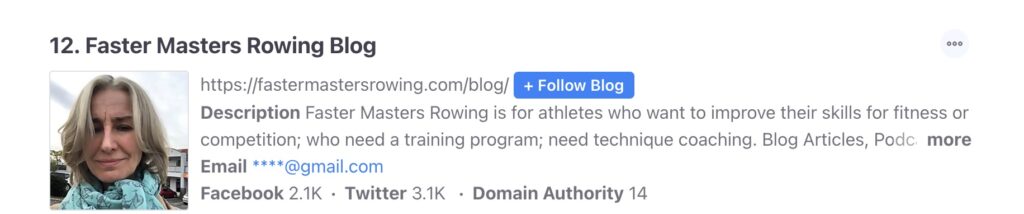
FeedSpot helps you find the best blogs on the web.
By Bruce Ware, President PWRC and member of the Coach Mastermind Group.
The Prince WIlliam Rowing Club's season is off and running; a small subset of the Club is prepping for our first 1K sprint regatta - I am entered to row a 2x with my wife, and we're the oldest boat in the group with the biggest handicap!
In my role as President of the Club, I've been trying to incorporate some of the great ideas that have come up in our discussions on this Coach Mastermind web-chat. Yes, Rebecca sets up a main topic for the session, but when I join in, there's always something else I need to talk about, to get advice about, and maybe even just to vent some frustration.
The other participants bounce ideas on how to handle some of the usual challenges each of us faces as masters rowers and coaches of masters, and I make frequent use of those suggestions.
"People join in because they know how broad and multi-faceted our discussions become. And what can I do to boost those numbers, to get more people to join the discussions?"
Like I said, the topics are multi-faceted and change every session. For example, I know that one of the best ways to recruit and strengthen a masters rowing club's numbers is to market the club as a "fitness for life" approach that can meet the health and fitness needs of many differently-abled people. One corollary method is to offer a "pay-to-row" option, where people can come out to row as their work-schedules and other commitments allow.
My Club has not offered this option, but we are starting to see some requests coming in asking for this sort of arrangement. With a Club of nearly 100 members that has a mixed mission of "high-performance" racing, recreational and "social" rowing, and a large learn-to-row novice component, I have to recognize that I cannot just open the floodgates to "pay-to-row" without impacting our coaches' ability to set line-ups, especially the racing squad coaches.
My treasurer says "no way! too much of a headache!" I know my racing squads and their coaches would object, so I have to exclude them. And LTR novices have claimed a "seat" in a boat that someone else who we had to leave on the "waiting list" (club resources and assets being limited, we had to cap our LTR novice group at 32 for this year) could have purchased and used.
How do I allocate financial resources to a Club equitably? The LTR novices don't need anything special, as they already have boats and a full coaching staff. The intermediate "recreational/social" squad only occasionally has some small teams that want to compete in a regatta, but they don't require a lot of extra resources. The sculling squad is small - 7 or 8 of us, we have our one coach and plenty of shells to use - a 4x, 3 or 4 2xs, and a half-dozen 1xs - so our major additional expense would be for entering and traveling to regattas, and those are not frequent events.
So, the racing squads, which make up only about 30% of the Club's numbers, routinely claim over 70% of the Club's funds. Is that fair that a large percentage of the members' dues is used to "subsidize" that rowing activities of a minority?
These sensitive topics are the kind of things we talk about on Coach Mastermind!
You should be there {{ subscriber.first_name }} because you might have encountered these sorts of situations in your own clubs, and could offer suggestions on how to handle it. I coach juniors and high school kids, not masters. I've offered to coach masters, but don't want to give up my own rowing!
But running a masters club means I need to rely heavily on masters coaches, and this is one of the best places I can come and get that kind of help.
Please, when Rebecca posts next month's session, make the effort to join us.
As experts in most aspects of Masters Rowing, Marlene and Rebecca are available to keynote your conference, club kickoff event or fundraiser.
Rebecca and Marlene can customize topics to suit your needs. If you want a 2 hour webinar; a weekend training clinic, a half day workshop or a 30 minute keynote. The topics can be delivered in any of these formats.
Marlene Royle topics
Rebecca Caroe topics
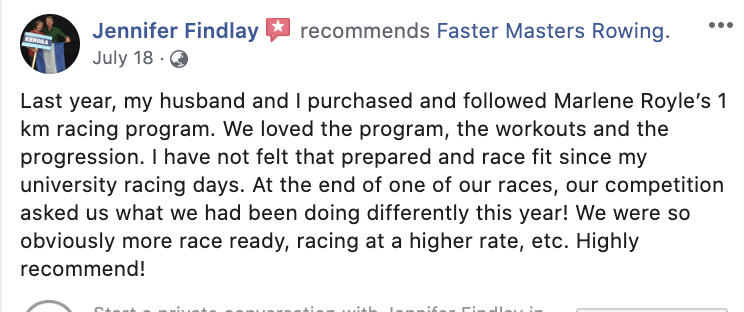
Testimonial for 1k Racing Program on Faster Masters Rowing
Thanks to Jennifer who writes
Last year, my husband and I purchased and followed Marlene Royle's 1km racing program. We loved the program, the workouts and the progression.
I have not felt that prepared and race fit since my university racing days. At the end of one of our races, our competition asked us what we had been doing differently this year! We were so obviously more race ready, racing at a higher rate, etc.
Highly recommend!
She purchased the Faster Masters Rowing 1k Racing Program.
Graham Spittle is a listener to the Faster Masters Rowing Radio podcast. On our November Q&A episode he asked this question
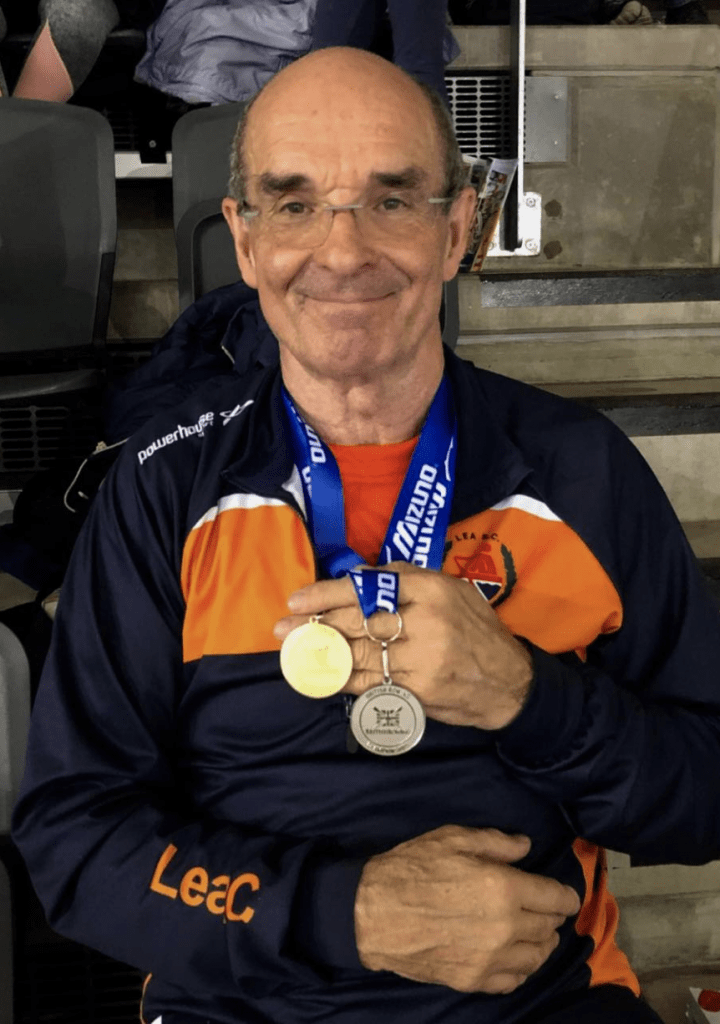
I have been watching YouTube and it seems some people do a pre-warmup, warmup. As a 71 year old heavyweight is this necessary?
British Rowing Indoor Championships (BRIC) were held this past weekend at the Olympic velodrome. It seems Graham was keen to learn about warm ups because he was preparing for this indoor rowing event.
Graham explains what happened on the day [taken from the Masters Rowing International Facebook Group thread]..
OK - it’s a rare bragging post from me, but with included thanks to Rebecca Caroe and Marlene Royle for their opinions and advice on pre-warmups!! Also thanks to legend Eric Murray, on the BRIC Asensei stand, for letting have a pre-warmup warmup on one of their ergs 👌🏼👍🏼
I had good day at the BRIC office yesterday, despite a messy cough and cold causing an extreme training taper(drought) kicking in a week too soon!
But - I’d paid my money, I had tissues and (clean)lozenges and wasn’t gonna let a cold get in my way!
(I had, however, re-assessed my 2k target from ~7:00mins, to ‘whatever I could manage’!)
1st race 09:15 2k 70-74 hwt 🥇😎
With little expectation, other than I was pretty certain I wouldn’t come last, I found, at about 500m, that I was in the lead!? I thought I might as well stay there, for as long as I could and, funnily enough, I was in the lead at the finish too, by a smidge!!
2nd race 14:10 500m 70-74 hwt 🥈😎
5 hours later and feeling not awfully well, I did consider scratching, but it was only going to be 90 odd seconds, so , like gladiator bait at the Colosseum I lined up in the Race Floor tunnel, like gladiator bait at the Colosseum!
The winner shot off at 44spm, but he hadn’t raced the 2k earlier, however, I managed to stay within .4 of a second, to take silver!
Christmas shopping now seems less daunting!! 🥴
Gordon Williams is our very first medalist training on the Faster Masters programme. He won Mens F 1x at Lake Ruataniwha in New Zealand's South Island during September, beating a long-time winner into second place just before the line.
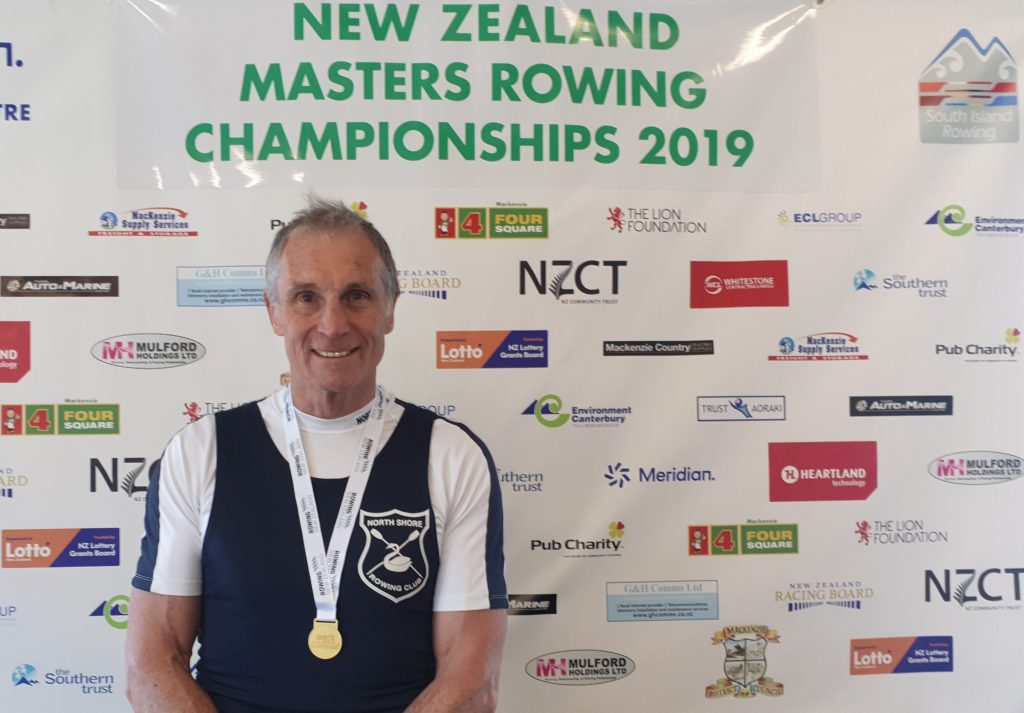
Gordon Williams M F1x Gold Medalist using Faster Masters Training Program
Truth be told I rowed like a lumberjack for the last 15-20 strokes - no finesse at all. Carolyn Steele said to me after that the last 15-20 were “very ugly but seemed to be effective” LOL.
Bruce nearly caught me. I need to learn to keep my cool for that last 150m. Start & middle were well judged and no different to how we always try to race. Stayed close to the front 3 guys though intentionally marginally behind them until 250. Concentrated on staying at that 250 (rate 32 SPM) pace through to 600. Then just pushed for 250 by increasing leg drive and maintaining stroke rate at 31-32 SPM. Panicked through lack of oxygen going to my brain at 850 and started sprinting up to 37 SPM just before the line. Silly really given that I know from rowing the “Chris 500” at the lake, that I should stay at 32 and just lengthen as long as possible, pause longer on the back and force the leg drive harder. But I didn’t do that and should have. I know it cost me at least 1sec elapsed time and that would have been “free speed”.
From a training perspective it was all about practising to be ready to accept the pain and just keep going without quitting or letting that pain take over. You have to do the programmed “hard” work pieces on the water in training if you expect to be prepared and mentally strong enough to stay upright in the boat and sprinting at the end.
[Gordon's double and pairs partner is Chris Brake - he likes to do a flat out race at the end of early morning outings on the last 500 meters to the boating dock - Gordon calls this the Chris 500.]
For me the best training preparation I did was the “Chris 500” when “racing” alongside the 4X and racing against Chris and Martha in their 2X. I know we cannot do that every outing of course! - But probably once per week - someone in the Swans (Gordon's club) is equally crazy enough to want to race me home to the pontoon.
Congratulations to Gordon - you're in OUR record books forever.
Gordon Williams used the Faster Masters Individual Training Program to prepare for this regatta.
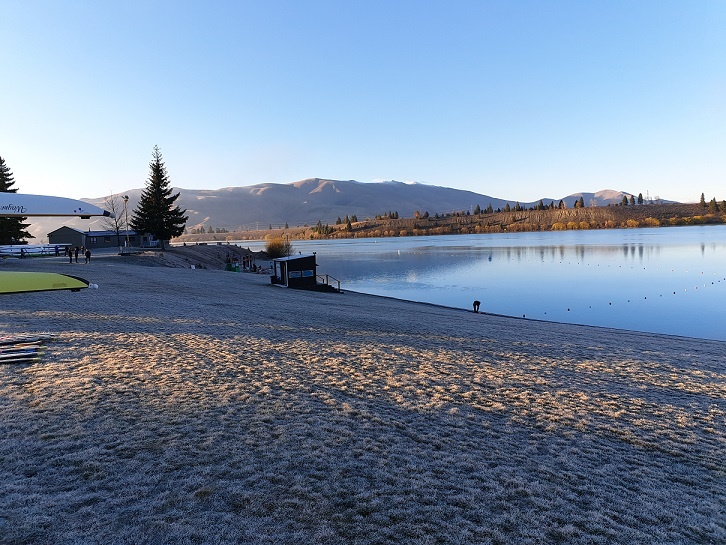
A view from the boat park to the finish line at Lake Ruataniwha
Gordon sent us these photos of the lake where the event was held - look it up - Lake Ruataniwha in Twizel. Seriously beautiful lake with its own back-story. It is part of a hydro-electric scheme and the engineer building it realised that it could easily be a rowing lake with some small depth modifications and straightening the bank out. So Max Smith ordered the changes and after they were done, he told his bosses that they had made a great recreational rowing race course.
He got fired for his pains.
And rowers in New Zealand got a wonderful race course in the middle of the South Island.
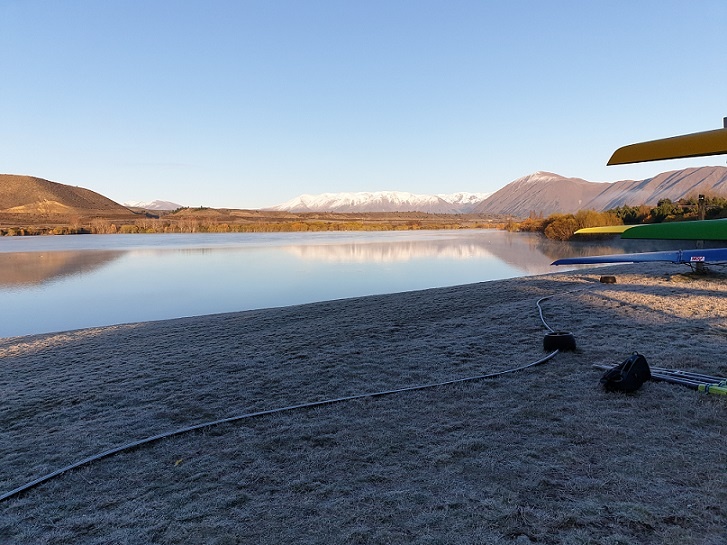
Lake Ruataniwha 2019 Masters Nationals
We got this question from a customer
Hi there, I noticed your programs are geared on a monthly basis to a particular rowing season. I’m based in NSW, Australia so can I access the appropriate programs to correspond to my rowing season? Currently we are just starting our regatta season having done some slow long rows during the winter months and then we finish up with our state and National championships around the end of May 2020.
Really enjoying your podcasts, thanks.
We provide BOTH a southern hemisphere and a northern hemisphere training programme. Your peak is probably May when the Australian Masters Nationals are. And so in that month, we offer a programme for people peaking in May and a separate (different) programme for people peaking in September.
During the months October to December – both hemispheres are on the same track. We think you may be doing the Head of the Yarra, and in the North they are doing Head of the Charles and the London Fours Head.
If you can tell us when your personal big races are, we will endeavour to build them into our programmes.
Just so you know, Rebecca (who is one of the owners) lives in New Zealand.
Faster Masters is definitely helping me - it is extremely hard to coach yourself sensibly.
Join our community and get our exclusive Faster Masters Rowing Magazine, packed with tips, techniques, and inspiring stories. Includes four new articles monthly.