This is an email I sent to new masters going to their first regatta.
Hello everyone
We will load boats on evening of Thursday 16th April allow 1 hour for this. Bring a 10mm spanner as you will be derigging your boat.
Drive to the regatta on the morning of 18th - car sharing is a good idea. Arrive by around 8 am and rig boats. The first race is normally about 9 am.
You will know the time(s) of your races by Thursday 16th. The regatta usually ends by 1-2 pm when we load the trailer.
Then we drive back to the club and unload and rig the boats - the person towing the trailer will advise timings for that.
Yes you need a uniform either a singlet or a row suit (singlet and shorts all in one) - we have some in stock or other ladies can lend you them. Email [named person] who organises uniforms.
Bring your own breakfast, protein and carbohydrate snacks - muesli bars, banana, sandwiches - all easily digestible. Bring electrolyte drinks if you like them too. Water will be available at the regatta.
Bring two complete changes of clothes - it may rain. So a light rain jacket, hat, dry socks, underwear, gum boots and leggings. If it is wet they won't penalise you for rowing in different clothing.
Or it may be sunny so sunscreen, hat, sunglasses.
You will wade out into the water as there is no pontoon so prepare for wet feet (jandals/flip flops float away and aren't suitable).
The regatta provides a burger and beer for afterwards, it's included in the entry fee.
There will not be food vendors but the host club may open their kitchen for coffee (likely not espresso though!)
You will be invoiced by the Treasurer for your race entry and a contribution to petrol for towing the trailer.
Here are two articles which may help you
And send me any other questions you may have.
Rebecca
Incorporating novices into your club is essential as part of keeping the membership from attrition.
Rebecca and Marlene discuss how to set up and teach a novice group and ways to incorporate them into your main club group after they finish a learn to row course.
01:15 This Past Week - what we do to advocate for masters rowing. Rebecca's rowing hack got published on row2k - the Coxing Plank. Marlene has been teaching new novices.
06:00 Beginners joining your group. Do you start in single sculls or team boats? The coach does a 1 on 1 session overview of the sport. Important to get in the boat in the first lesson.
Nobody ever asks how do I turn the boat around! First session - ensure they are comfortable, it's a stable boat, they can find where the water is with the oars.
14:00 Incorporating novices into your club - start them in a group together.
People learn at different speeds. - basic skills of stopping, backiing, turning and rowing. Do check how to structure your learn to row programme tuition in Volker Nolte's book, Masters Rowing. Wolfgang Fritzch wrote the chapter on novices. It's excellent. [affiliate link].
18:00 How we learn Just try it. We learn by discovery
People ask questions - it's best to let them do this and answer what they ask (it tells you a lot about how you teach and whether they have comprehended the information you shared). Incorporate drills to explain and clarify.
24:00 Tell people how to do things not just what change you want them to make.
Use drills to isolate part of the stroke and practice them slowly.
Remember if you talk to athletes while they are rowing they often don't listen. It may be better to talk when they have stoped rowing.
26:00 Jam sessions - mixing abilities in crews
Build this into your club season - mixed ability groups. The novices scale up and the experienced people scale down. It allows novices to experience acceleration in a boat. What does swing feel like? It's easy to improve rhythm and timing when you have been shown how to do it and felt the boat move.
30:00 Shadow rowing is useful especially for visual learners
31:00 Coaching groups of different speeds Individual attention for people of different abilities Give time to process the coaching advice. Position the launch (coach boat) so the slow people go first.
39:00 Feedback from a fitness athlete on the new fitness program.
Faster Masters Rowing Radio - the podcast for masters rowers. Marlene Royle and Rebecca Caroe are joined by Volker Nolte & Wolfgang Fritsch to discuss their brand new Masters Rowing book.
Support this show with a donation
https://fastermastersrowing.com/register/podcast-supporter/
04:00 Racing Starts Challenge sign up details
11:00 Wolfgang Fritsch and Volker Nolte's backgrounds in rowing - rowing coaches are easier to convince of things if you are also a coach
20:30 The message of the book, “Masters Rowing” is to enjoy rowing.
Buy the book https://amzn.to/2Saikeq
22:30 the 6 aspects of ageing
Chronological
Functional
Biological
Psychological
Social
Training
Understand how each is different and how you are placed. Biological isn’t the same as chronological - you may feel different or you may not.
28:40 How does rowing help successful ageing? The book addresses the ageing process and how to make your life better.
34:00 Warm up strategies for masters - as you age you need more warm up. Body function changes and the blood capillaries become tighter and less flexible so blood flow is inhibited.
36:30 One key recommendation for rigging as you age.
Use shorter oars. Adjust the rigging to suit the athletes.
Adapt training intensity to suit too.
Supplementary training and technique changes.
The traditional gig boats are good for learning to row, as are coastal boats.
Your perception of load changes too as you age.
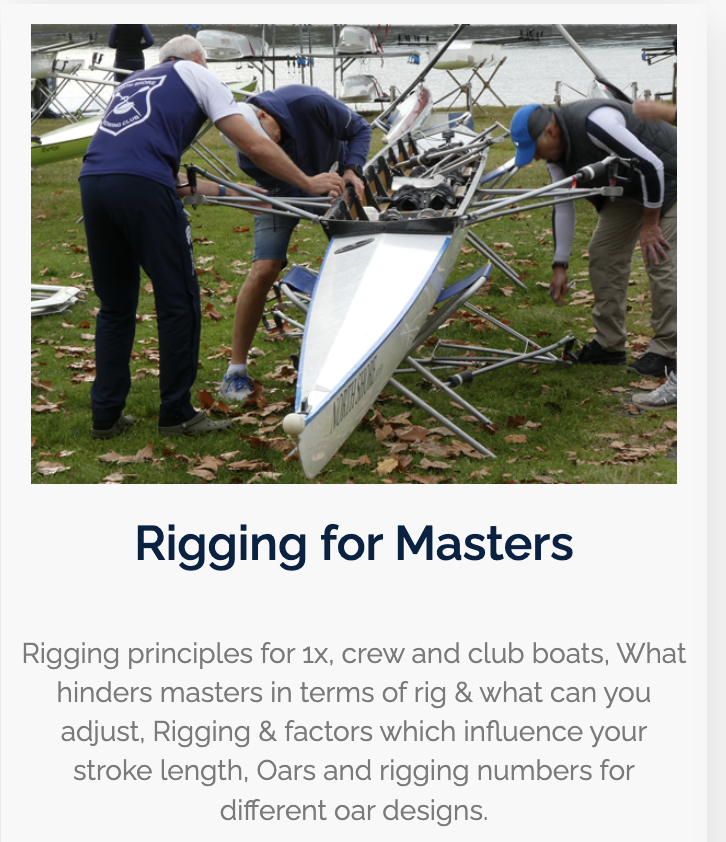
40:00 Marlene’s club has different size and weight boats and adding pontoons as people learn helps.
42:00 Crew boats add a whole level of fun. Volker recommends variety - crew boats rowing on both sides. Try to challenge people a bit and push your function a bit.
46:00 At what age do you see the biggest drop in performance?
Do we lose more in age than we can add in training?
Adjust your focus - you can still improve your skills at any age.
51:00 There are examples of training plans and how to write your own components in the book. Speed, power and endurance.
53:00 Learning to row is a fun adventure. It’s not a military exercise.
A well rigged boat is important.
Don’t use detailed positioning explanations - give the athletes an idea of the whole movement.
56:50 Children learn by trying. For adults, when they ask about something, give them advice. Don’t formalise the learning. Trust the coordination of the athlete.
The basic rowing movement isn’t difficult. Rowing becomes difficult when you want to go fast.
59:00 Volker’s podcast with Joe de Leo. Learning to row - do it organically.
https://www.stitcher.com/show/leo-training-strength-conditioning-endurance-health/episode/episode-130-dr-volker-nolte-dr-valery-kleshnev-power-measurement-and-biomechanics-in-rowing-76528104
There is no carry-over from erg to boat. The brain does not recognise it as the same thing.
1:03:00 Do you recommend sweep rowers to swap sides - yes It helps learn different movements and also swapping seats is a good learning.
Getting fit while learning to row and scull is challenging because learning how to handle the oars is more difficult than most people think.
Until you have good bladework skills you will likely find it hard to grow aerobic fitness from your on-water exercise. Do not get frustrated because we have recommendations. Firstly, you need to get used to being in a rowing boat - this will improve your rowing musculature and improve things like your ability to sit tall, rock from the pelvis and grow callouses on your hands. You need these before you can become rowing fit.
But you can get fit by rowing - we explain how in our podcast episode below.
Faster Masters Rowing Radio - the podcast for masters rowers. Tips, advice and discussion from Marlene Royle and Rebecca Caroe.
04:16 This Past Week - things we do to advocate for and advance masters rowing around the world. The CRASH-Bs had many athletes from Faster Masters racing.
Wayne Lysobey's book is Long Live Open Water https://amzn.to/30OY2rX
He wrote a poem for Marlene
There once was a man who did row
But when older he found he did slow
So he then did decide
He’d go fast on the slide
Either that or he’d get him a tow
08:00 the foot straps for rowers whose feet don't fit into big shoes.
There will be a masters Oxford and Cambridge boat race in Auckland on April 11th
11:00 Marlene refurbished her "guest boat" with a new footstretcher and shoes.
14:00 Video what's inside a Faster Masters Rowing subscription program
16:00 Our Favorite drills for Sweep 8s
Marlene likes rowing in 4s with the oarlocks open - it teaches how to keep weight into the oarlock.
Rebecca likes rowing with inside hand on the backstay20:00 One drill that we each love to do in the single & in an 8+
Our Favorite drills for Sculling 1x
Marlene likes open fingers on the recovery
Rebecca likes the quarter slide push drill
26:00 Ways to maintain fitness when you are learning to row the single
How to get fit in the single scull if you are a beginner.
Do combination workouts - it's hard to get up to pressure when you are learning and you may get tired but you won't get a hard cardio workout. Do hard sessions on the indoor rower.
Run to the club and try to get as many good strokes on the water as you can. Then stop.
Aim to start on the water rowing at the same quality as you came off from the previous outing.
Perfect practice makes perfect.
31:00 Use drills in single scull. These help you embed movement patterns.
Practice alternate strokes firm pressure and easy pressure. Learn how to build pressure in the stroke.
Take breaks - a rest is good as it frees up your mind as well as your body.
36:00 Try shadow rowing on the erg.
Join our community and get our exclusive Faster Masters Rowing Magazine, packed with tips, techniques, and inspiring stories. Includes four new articles monthly.