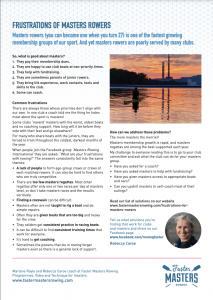
Masters rowers (you can become one when you turn 27) is one of the fastest growing membership groups of our sport. And yet masters rowers are poorly served by many clubs.
This article covers the (rather long) list of frustrations.... and also has solutions .... scroll down.
There are always those whose priorities don’t align with our own. In one club a coach told me the thing he hates most about rowing is masters!
Some clubs ‘reward’ masters with the worst, oldest boats and no coaching support. How long will it be before they vote with their feet and go elsewhere?
When people join the Facebook group ‘Masters Rowing International’ they are asked: “What are your frustrations with rowing?” The answers consistently fall into the same themes:
How can we address these problems?
Masters membership growth is rapid, and the masters regattas are among the best-supported each year.
My challenge to everyone reading this is to go to your club committee and ask what the club can do for your masters group.
Tell us what solutions you’re finding that work for clubs and masters.
Would you like to publish this article in your club newsletter or website?
Join our Masters Rowing Advocates mailing list and we will send you one article a month. Sign up on our Advocacy page.
You can copy the text on this page. Or download the PDF
Marlene and Rebecca discuss
- The Science of coaching masters athletes
- Erg Inspiration - how to make it fun
04:15 This past week we are supporting masters rowing around the world by:
- attending the Rowing Canada conference coastal rowing course
- Marlene was interviewed on the Science of Rowing with Will Ruth - details below
- listening to James Leath on intentional coaching
https://unleashtheathlete.mykajabi.com/
- Running a scrimmage regatta locally for masters
- Reviewing the "new masters" status for post-novice rowers before they become age group racers
10:30 Erg inspiration when you get depressed looking at the rowing machine
- make it fun. Ear buds, play list; podcast
- Groundhog day
14:00 Training programme for the Head of the Yarra - use the Faster Masters programme if you haven't got time to write a programme. Masters like to know workouts in advance because they like energy planning, time planning and consistency helps.
18:00 Rowing in 6s in an eight. What is the purpose of the exercise? If you want a stable platform, or a drill for the best chance to execute the drill, being stable is good.
When a pair drops out - have an agreed way to hold your oar when you change pairs; also an agreed way to join in the rowing; also an agreed way to hold the oar to stabilise the boat (against your knees or arms outstretched with upward pressure).
Discuss whether you want a "soft set" or a "firm set" in the drill and what the crew should do.
It's important to keep the handle pressure upwards (so the blade is flat on the water) to set the boat.
Facebook discussion
https://www.facebook.com/groups/595853370615544/permalink/1606787526188785/
24:15 The Science of Rowing - Marlene video interview with Will Ruth
[To get the video link, please join our newsletter]
The research article (Nova Scotia) is about coaching masters looking at Autonomy, Competence and Relatedness. The athletes who got coached experienced high relatedness and also greater frustration with autonomy.
To improve your coaching outcomes we need to ask if the psychological needs of the athletes being met?
Perceptions of masters are no different between the group who is coached and those with not much coaching. The sense of belonging is directly related to the amount of coaching the athlete receives.
40:00 Groups in your rowing club - how to enable a range of groups to form, un-form and meanwhile still keep the club stable.
Rebecca and Marlene go on a rant in this week's podcast - predictably they are feeling taken for granted.
01:00 the Head of the Charles interactive map of competitors
06:00 Virtual races coming up
10:00 Newsletter subscription - if you listen, please join us. Yes, we give you free rowing advice and our "payment" request from you is that you join the newsletter.
12:15 We want feedback from you, our listeners.
What are your opinions on investing in rowing training programmes? Why do you like free rowing advice?
You pay to travel to regattas, to camps, to race... and some people won't pay for a training programme. Why?
16:00 Many rowers read books for knowledge. Compared to having a coach this is curious as the coach is a bridge between knowledge and actual practice. By reading do you get better skills in your boat?
22:00 Explanation of the Northern and Southern Hemisphere parallel rowing seasons and how the programmes take account of this. The 1k and 5k head racing programs. The training cycles align with races.
25:00 Free rowing advice on the internet - how does that affect your improvement and your coaching? If you are serious about improving your programme should be written to understand your needs by someone who knows masters rowers.The difference between training for improvement or an event versus training for fitness,
29:45 Faster Masters is a business selling paid rowing training programmes. There's a hierarchy of services affordable for most people.
35:00 Tell us more about what you want from Faster Masters.
nMarlene and Rebecca discuss
Faster Masters Rowing announces the launch of the Faster Five.
Find out more at https://rowing.chat/sponsors/
Kanghua single for sale
The team at Kanghua has a single scull available for sale. It's an all carbon Spirit design for athletes weighing 60-65 kilogrammes. You can trial a Spirit single scull near your home club by contacting Eric Sims
https://rowing.chat/sponsors/
05:00 Interviewing and hiring a rowing coach. What to do and what not to do. You are looking for communication skills. Getting along with the group. Can they adapt their teaching style to the learning style of the athlete? What’s important to them as a coach - what do they get out of coaching?
09:00 Specify the goal of the programme - is it competition / fitness / recreational? What are the age range of athletes? Boat sizes - big or small. Write the advert for a rowing coach as specific as possible including qualifications needed
14:00 Interviewing a rowing coach. Get references. Invite them to a practice day. Watch how they interact with the athletes. Observe how they coach. Then ask scenario questions - how do they problem-solve this situation. In their reasoning check they have health and safety in mind and check they ask the right questions.
17:00 How would you select a crew? This is a great interview question to ask. Being a team player has a big influence on culture of the club. Remember unhappy members affect the club culture.
20:00 Coaching technique versus coaching people. They have to be effective communicators. Give the novices the best technical coach.
26:00 Have the crews give input into the selection - do a sample coaching weekend. Get feedback from your members. Use a survey which can be anonymous.
Read the article When Masters Can't Find A Rowing Coach
https://fastermastersrowing.com/when-masters-cant-find-a-rowing-coach/
29:00 Starting work with a virtual rowing coach. Several clubs are working with Faster Masters alongside having an in-person coach. It’s powerful to have a common goal for your group.
32:00 If your coach is not comfortable writing a program this can work well - buy the Faster Masters Rowing program and use it alongside your in person coach.
A client got in touch with us asking a question which we know many of you will relate to.
Hi, I'm a masters rower voluntarily coaching a novice crew; my crew are racing in the first weekend of December so we have 8 weeks basically to get some fitness up.
I'm wanting an erg program for them - ages 35, 59, 50 and 43 - two younger women fitter than the older ones.
Can you help?
Join our community and get our exclusive Faster Masters Rowing Magazine, packed with tips, techniques, and inspiring stories. Includes four new articles monthly.