Different needs for different levels of experience. This goes without saying, because within any one masters group (whether beginners or elite racers) I find vastly differing back-histories. We have top racers who have never lifted weights and beginners who have a lot of experience.
This article sets out some of the goals for core strength based on the athlete's expertise in the weights / strength gym. It's not based on their rowing experience.
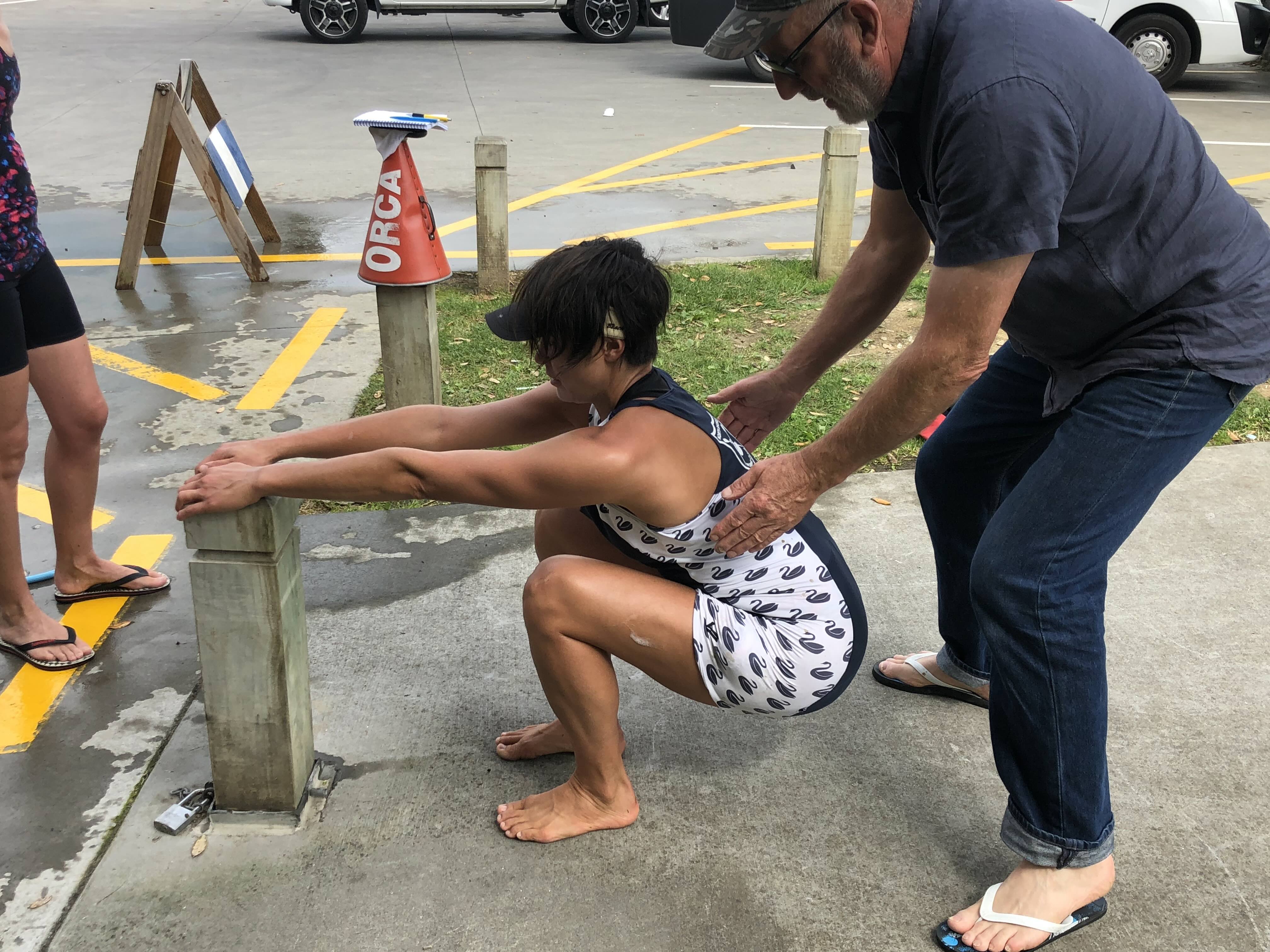
Hang body weight uses core muscles
Beginners (Building Awareness)
Focus: Activation and endurance rather than brute strength. Exercises:
Dead bug (for core engagement without tension).
Plank (basic but effective for posture control).
Seated stability drills (e.g., holding the finish position off the erg).
Focus: Stability under movement and fatigue resistance. Exercises:
Side planks with rotation (simulates the controlled motion needed in rowing).
Bird dogs (integrates core control with movement).
Hanging knee raises (engages deep core while mimicking rowing posture).
Advanced (Enhancing Performance & Stability Under Load)
Focus: Maintaining stability under high force and dynamic conditions. Exercises:
Pallof press (resisting rotational instability).
Single-leg deadlifts (core engagement in asymmetrical movement).
Weighted Russian twists (controlled rotation to simulate boat movement).
Working in the boat
Why Train Core in the Boat?
It improves stroke efficiency by preventing unnecessary torso movement.
It enhances boat balance, especially in small boats.
It reduces the risk of injuries, particularly in the lower back.
While rowing itself is a core workout, supplementing it with land-based core training (planks, Russian twists, anti-rotation exercises) will give you even better results.
When working with less experienced athletes, I explain core stability in the boat as two things. Holding your "tummy firm" and "clenching your glutes as if you're holding in a fart". This always gets a laugh and it's a surprisingly effective way to show them which muscles they need to control.
Ways to Train Core in the Boat:
1. Pause Drills for Stability:
Pause at Arms Away – After the finish, hold the position with arms extended to engage your core and maintain balance.
Pause at Body Over – This isolates core engagement and reinforces control in the transition from the finish to the catch.
2. Slow Ratings and Controlled Movements:
Rowing at low stroke rates (18-22 spm) with a focus on slow, controlled slides forces your core to work harder to stabilize the boat.
3. Single-Leg Rowing for Core Activation:
Rowing with one foot out of the shoe and resting on the foot stretcher forces your core to stabilise the movement and maintain balance.
Alternate feet to ensure equal training on both sides.
4. Side-to-Side Balance Drills:
Balance at the Finish – Sit tall at the finish with blades off the water for a few seconds, engaging your core to keep the boat stable.
Feet-Out Rowing – Rowing without strapping into the foot stretchers forces you to use core strength to maintain stability through the drive and recovery. An easier start for this is to loosen the shoe laces/velcro on the shoes.
5. Half-Slide Rowing for Core Control:
Rowing at half-slide limits leg drive, forcing the core to take more responsibility for balance and power transfer.
6. Sculling for More Core Engagement:
If you usually sweep row, try sculling (double or single) to increase the challenge on your core stability. Sculling requires more independent control of each hand, which engages the core more dynamically.
In-boat drills for core - get them to tighten their tummy muscles at pause points. Then rolling forward, get them to tighten glutes (describe this as holding in a fart) as they approach the change of slide direction at the catch.
Yes, you can train your core effectively while rowing, as the sport itself naturally engages core muscles. However, to specifically target core strength and stability, you can incorporate focused drills and techniques into your on-water sessions.
Get regular strength training
We offer a monthly strength training program which can be introduced at any time of year. It includes core strengthening exercises.
Get better at extracting the oar without being splashy and frantic. And why your elbow position is of critical importance.
Timestamps
00:45 Finishes for sweep
The goal is to get the oar out of the water in a smooth movement and as efficiently as possible. Start with the correct set up at the finish. Your handle end should be in line with the side of your rib cage.
Check the position with our outside hand pointing to the stern and across your side body. (see video).
Check your handle height when the oar is squared and buried under the water. Ideally your outside hand should be on your lower ribs.
Check your elbow position - the outside arm elbow should be pointing backwards towards the person behind you. You do not want your elbow flared out to the side over the gunwale of the boat. Because the most efficient way to pull on the handle is at 90 degrees to the handle. with your elbow flared sideways this is inefficient in terms of the ergonomics of how much force you can put onto the handle.
03:45 Drills for finishes
Pause at the finish with the oar flat on the surface of the water. This helps you check the height of your handle and your outside hand should be brushing your shirt. The handle height is the same as when your oar is under the water a the end of the power phase. Check you are drawing your finish to the right position.
05:15 Check your hands are doing the right job
Outside hand drawing through with pressure and controlling the height of the handle; the inside hand is squaring and feathering. Outside hand pushes down to extract the oar from the water and then the inside hand turns the oar to feather it. Practice this slow motion or in fours/pairs.
06:30 Wide grip drill
Wide grip (inside hand down the loom) helps to teach you which hand controls the handle. By isolating your inside hand closer to the oarlock pivot, it makes it harder to control the handle height with that hand. Control each hand by altering the grip tightness on the handle - loosen the grip alternately to keep the focus (inside/outside).
08:00 Elbow position affects your hands
If your elbow is lower than your wrist it's hard to push down on the handle with the outside hand. Progressively move your hands back to a normal grip starting from wide grip.
There's a tendency for may athletes to have too much control with the inside hand. You're also unlikely to be only feathering with the one hand.
Keep pressure through to the end of the stroke, holding your oar under the water 1 cm longer.
Work your inside hand at the very end of the power phase - the outside hand loses effective power at the end of the power phase because it's at an increasingly obtuse angle to the oar handle. Whereas the inside hand can stay at 90 degrees to the handle. Give an extra pull with the inside hand at the end of the stroke.
Stationary stability drill is a free video joining bonus in our Coach Mastermind Group as a joining bonus. Get yours here
12:00 Bring focus to elbow timing
And to your hand grip tightness while rowing. Ensure you aren't dominating with the wrong hand.
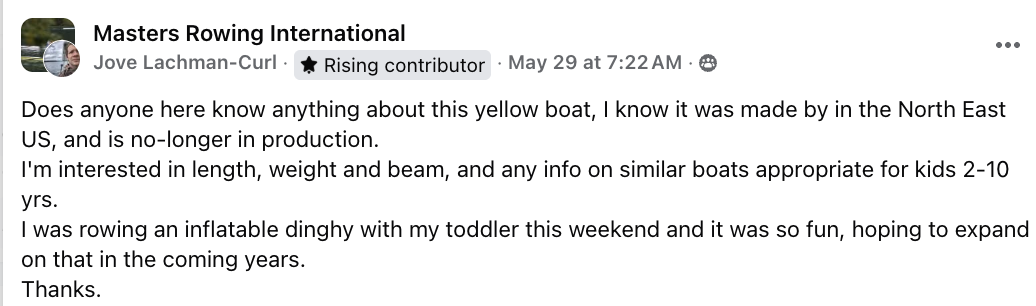
Getting an appropriate sized boat for your child can help them find the fun of rowing.
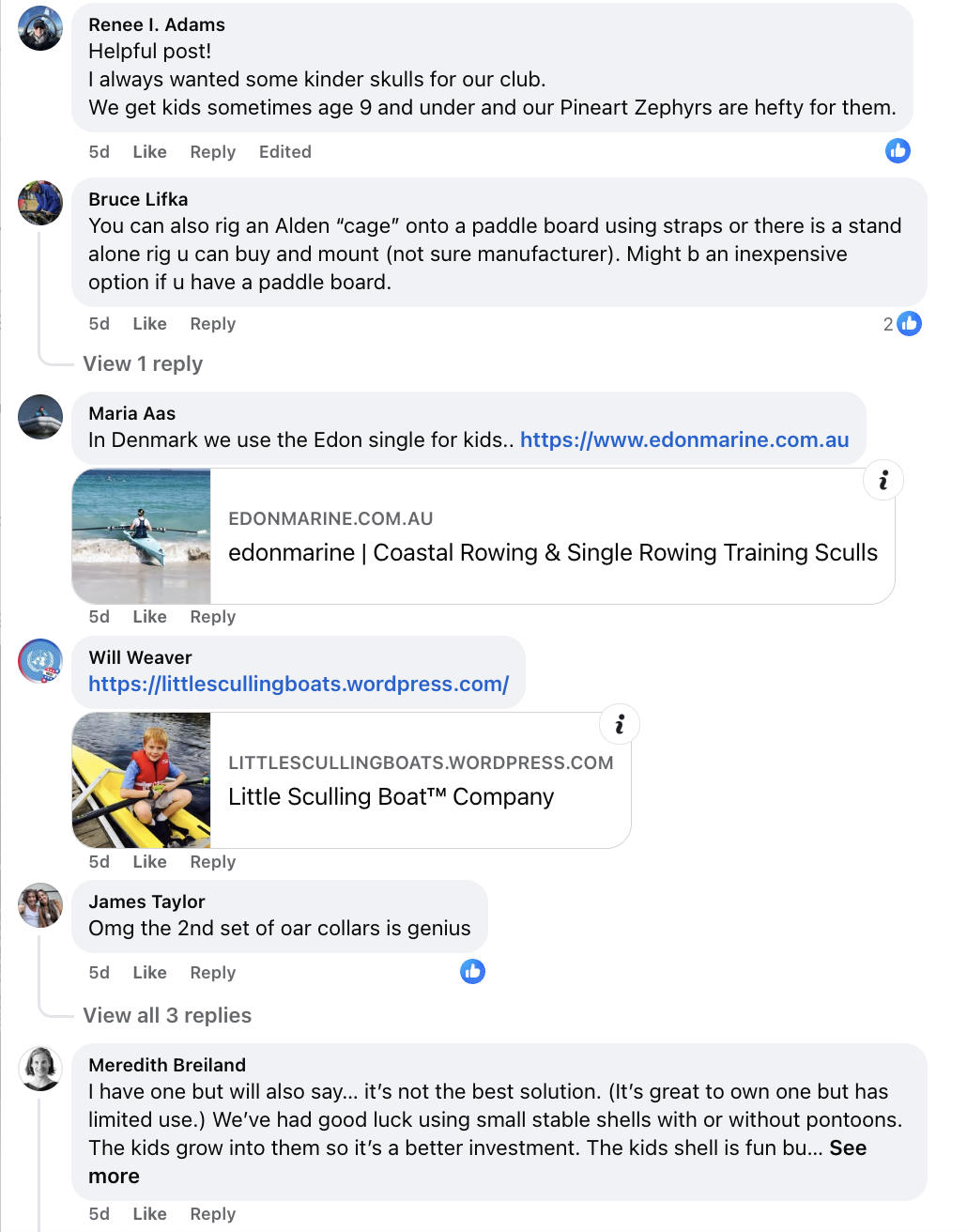
I've read a detailed discussion about this on the Facebook group Masters Rowing International and three main companies are mentioned. [The link requires you to join the group to read the post and answers.]
How to improve your rowing using self-diagnosis coaching and progressive drills.
Timestamps
00:45 A powerful coaching tool for both coaches and athletes.
Masters rowers like autonomy. Enabling the athlete to work things out for themselves facilitates mastery in a self-directed environment. The change is more likely to stick.
Where your rowing goes wrong - an example of a boat going "wonky" which was caused by the athletes stamping hard on the foot stretcher.
04:00 Progressive movements
Start by working out when you do not have the problem. In this case increase the pressure progressively from 60% pressure, 70% etc and work out when the issue started to happen. Discuss this with your crew about the cause of the problem. Then decide what fixes the problem? Can you make the change in 1 stroke?
identify the problem is happening
what to do to fix it
fix it in as few strokes as possible
row in the new way so the problem doesn't occur
06:15 An example from sweep rowing - balancing the boat
The boat is balanced generally when the oars are under the water and the imbalance occurs on the recovery when the oars are out of the water. Our model of good rowing has the boat balanced throughout the stroke cycle.
Is the boat balanced as the oars come out of the water? Yes. Is it still balanced when we get our arms straight / body rock forwards / roll up the slide. Work out where the problem starts to happen and then decide what to do to effect a change. The cause might be timing of the oar handle movement at the finish transition to the recovery.
What fixes this? Probably handle heights or sequencing of the finish body movement. If handle height is the issue. Choose a drill like rowing with the oar flat on the water on the recovery. Then progressively change this to increase the depth of handle push down to take the oar out of the water. Then keep the handle at this height throughout the recovery until the next catch.
The progression is to start with a 1 cm tap down; move to 2 cm and 3 cm. Can you keep the boat level at these stages?
The self - diagnosis method helps us to diagnose the issue, fix the problem and then row in the new way. Use your autonomy to try to fix the issue and see if you can make it work in practice.
Want easy live streams like this? Instant broadcasts to Facebook, YouTube, LinkedIn. Faster Masters uses StreamYard: https://streamyard.com/pal/d/5694205242376192
Masters rowing is about rowing with adaptations.
Timestamps:
00:45 Grant Faulkner quote: The speed the clock moves forwards and the things it takes away. Masters learn to enjoy age and the things we have to adjust for our rowing.
01:45 Recognising when you need to make the next adaptation
Nobody told me it was going to be like this!
Strength and Mobility are the main things you will notice first. Strength diminishes differently between men and women 50s versus 60s. Your 60s is a 'hold steady' decade. Read article. Use the Facebook group to post questions and get answers from people who have the same issues.
04:00 Mobility and aging
Range of movement in joints is important - pelvic mobility in the hips to get into the rowing stroke positions. Flexibility is also key.
Programs page has FREE STUFF including How to test your functional movement and strengthening exercises. David Frost's webinar on Functional Strength and Movement is a deeper dive into exercises for body strengthening for daily life - essential for older women who find it hard to lift a boat. If athletes can't get into the right positions for rowing it's difficult to teach them.
05:15 Technique changes with age
Adjustments to take account of mobility issues. Adapting Rowing Rigging For Masters Physiology article Try to maintain your technique and range of motion as you age. Adjust rigging to accommodate physical limitations - some are easy, medium and hard - they take tools and more time to set up.
We can still always improve our technique as we age. Despite losing strength, masters rowers can always be more skilful at the catch, get the blade in without slip, get a full leg drive, recruit extra muscles to add to power delivery. Technique has no regard for age - you can improve at all ages.
What is the next horizon for you? Most of us delay making changes - if you are losing strength, you should be shortening your oars (Volker Nolte's Rigging Webinar has charts for oar designs, Men and Women). Most masters row on oars which are too long for their strength and capability.
This webinar includes
Volker Nolte’s oar rigging chart – learn how to rig your oars correctly based on the oar make and spoon design
Mike Purcer's Masters 1x rigging chart (span, oar length, inboard) different for men and women.
Want easy live streams like this? Instant broadcasts to Facebook, YouTube, LinkedIn. Faster Masters uses StreamYard: https://streamyard.com/pal/d/5694205242376192
Why thinking like a scientist will fix the voice in your head and ways harness it to coach yourself in a rowing boat.
00:30 Positive self-talk coaching
When you row you are thinking about what you do - it's the voice in your head. The devil on one shoulder and the angel on the other. Masters work best when thinking about one thing at a time. Create the outcome you want with different ways of saying it - how will you do it, when will you do it.
02:30 4 competency stages
unconscious incompetence
conscious incompetence
conscious competence
unconscious competence
When you no longer need to use your brain to think about one technical point, you free up your mind to think about other things. Acquire the skill, learn it and put it into the background in your mind so you can do the skill without thinking about it. The voice in your head is working hard.
04:30 Objectivity is key
The voice in your head can be devilish. It talks subjectively to you which can make a negative spiral of thoughts which do not help you to row better. Train the voice in your head by thinking like a scientist. They are objective (no value judgements), it's an observation only. Assess if you did or did not do the movement e.g. squaring early. It's not "good" or "bad". Keep the voice in your head 'on task'.
06:15 Can you self coach in a rowing boat?
Watching your blade is a good way to start self-coaching. The blade is a good indicator of how you are rowing. Look at it at the catch, blade depth at the mid-stroke, look at the finish. Row in circles watching one oar at a time.
Play games with yourself - on the water have some fun. Take a small challenge - little goals give a focus for self-coaching. Try exaggerating part of the stroke so your body moves with precision and consistency as if you're demonstrating to a beginner. Notice how this impacts your stroke and how the boat moves.
You can do it deliberately wrong too. That's great fun. It creates a contrast between the two - find a happy mid point.
10:00 Positive Self Talk
Enable your brain to be a positive thought that adds to your rowing. Try rowing for 10 strokes without thinking of anything. After those ten, allow your brain to focus on your technique point and do the scientist observation again. If yes, continue rowing without thinking; if no, make a small change to get back to the technique and then continue rowing without thinking. Use this skill to train your brain through the 4 competency stages towards unconscious competence.
Want easy live streams like this? Instant broadcasts to Facebook, YouTube, LinkedIn. Faster Masters uses StreamYard: https://streamyard.com/pal/d/5694205242376192
I got this question from a customer and so sought answers from experienced masters rowers and coaches.
I am a board member with my local Masters club. This weekend, we held our annual open house to introduce members of the public to rowing and promote our upcoming learn to rowing program.
One attendee indicated she was hard of hearing (she has a cochlear implant). While I was able to work with her in the erg room by making sure to look at her while I spoke, she found that on the short row in the boat, she could not hear the coxswains over the speakers at all.
Generally, do you have any experience working with deaf or hard of hearing rowers? Specifically, do you know of any Bluetooth setups we might use to connect the cox box directly to the rower’s hearing aid or similar device?
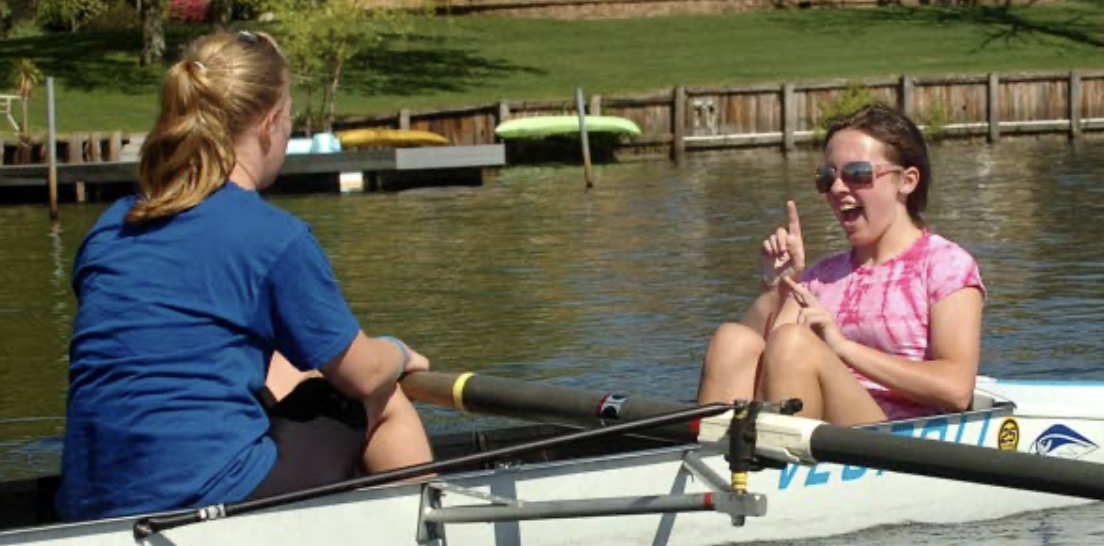
Image credit: Press of Atlantic City - coxswain using sign language ASL
Hand signals for coxswains
One respondent told us
I coach a deaf swimming team and the swimmers expressed an interest in rowing so I developed a system to do it. However, they always had an excuse when it came time to erg/row so while the commands have been reviewed extensively, they have never been actually used. That’s why the PM rather than comment on your post.
Items in “quotes” refer to existing ASL signs. D-A-S-H words are fingerspelled with the ASL alphabet signs.
I personally wear Bluetooth hearing aids which are pretty decent if basic, provided by the NHS, they’re Oticon Engage, but I don’t have CIs, a friend of mine however does, so I’ll ask him. He has a couple of remote mics which he can ask a speaker to wear via a neck loop, but I’m assuming that might be a little dangerous when rowing, so I’ll ask who the main manufacturers are, they should have a remote mic for sporting scenarios. I’ve established that the company which manufactures my friend’s Bluetooth microphone which feeds o to his CI is Phonak, the Roger range. It might be worth contacting them to see if they have a water/splash proof range or one which isn’t worn round the neck so potentially a choking hazard if the boat capsizes or anything. I know their headquarters are in Sweden but pretty sure they’ll have reps or offices around the world as they’re one of the world’s best hearing aid manufacturers.
I am a hearing aid wearer 59 years old. Have always worn my HAs whilst rowing both pairs and quad. And I have just discovered that the sailing/cruising community use a hearing device. Have looked it up on the internet just now and seen these Sensear.Another helpful thing is to use hand signals such as arm and hand down if the starter count down is quiet. I also mainly row stroke. Hope these help.
A remote bluetooth microphone works fine though you would have to verify if you were in bow because it is a Bluetooth connection and not sure what max distance for the device. We have a junior rower with a CI and she has a remote microphone that coach or other crew members can wear. We found that when she sat at bow in a coxed quad, she couldn't pick up the cox's calls, even though the cox had the microphone. It usually works well when she's closer, or in a double though. The other issue is the receiver falling in the water, which recently happened. Bluetooth is not a perfect solution. As to the we processor falling into the water that is sad. CI users have different answers including a headband and a different ear clip.
Hearing impairment and devices are on a huge spectrum so much of it depends on the specifics for the individual. I’m an experienced rower and wear hearing aids but try not to in the boat bc they’re expensive and don’t mix well with sweat and moisture. However, even with hearing aids I can have difficulty hearing the coxswain or coach bc the aids aren’t perfect and often just amplify wind etc. However, my hearing aids connect to my phone by Bluetooth to receive direct phone audio. So I have thought about experimenting with having the cox speak through a phone (like their phone to mine) to stream directly to my aids. The aids manufacturer sells an accessory that is a Bluetooth microphone the speaker can wear around their neck to stream to my aids but it is expensive. Another option I have considered is to mount my phone at my feet and use my LiveTranscribe app which converts speech to text like real-time captions. This should work for the cox or coach audio and would allow me to leave the hearing aids safe on dry land.
I have used voice to text apps (Otter, Live Transcribe) with an iphone paired with a Bluetooth wireless mic. The deaf/hoh rower places the phone where they can see it and the cox/coach speaks normally. It’s not perfect but gets the job done
Another fix is to sit stroke seat so I can watch the cox or get hand signals. But the cox then has to translate the coaching commands.
Whether I’m going with or without aids in the boat it’s a huge help if the coxswain commands are simple - extra chit chat or conversational-style commands can disguise the key words I’m trying to listen for.
When coaching and coxing an 8+ with an athlete with a cochlear implant, we had the individual sitting behind her repeat the calls. This isn’t a perfect solution but it helped.
My rowing partner is essentially deaf. He gives the cox a microphone that goes directly to his hearing aid. If we are rowing without a cox, the coach wears the microphone but needs to stay in range. I have not rowed without one or the other with him yet. We are on a busy intercoastal, need to stay safe. A remote microphone that works with the implant is best. They're called HAT systems. https://wataugahearing.com/.../hearing-assistive.../
How do you develop sculling ability in those who show potential but aren’t skilled enough to go in tippy singles yet - and how do you do this without over-using your team's skilled scullers who would like to have good solid training rows rather than always teaching others in the double.
Timestamps
01:00 A classic masters rowing problem! There is a 'pay it forward' mentality for many masters rowing clubs. What beginners cannot yet do - consistent hand heights - handles nested at crossover - poor timing - squaring is variable - following skill - little sense of weight in the hand affecting boat balance
03:00 What you can do Firstly put them into single sculls with pontoon floats - Revolution Rowing sell them. They give stability and balance to the single so they can learn quickly because all the boat movements are due to you. Very quickly they realise what's needed to get the boat balanced. - Teach the stationary stability drill - Squaring early - Pause drills - Legs only rowing - Square blade rowing - Backing the boat
05:00 Get the athletes fit A single is heavy to row plus the weight of the pontoon floats so the athletes work out how to push their legs and they have to sustain 40 minutes of rowing. So they get fitter faster. Single sculling helps them understand manoeuvring, turning, backing and going in a straight line - boat control skills.
07:00 Helper fatigue solutions Sharing the load is important. Member survey asked who would be prepared to help with learn to row. Find new people to help out. Mostly they want to know what to say / do and so write a lesson plan for them to follow.
09:00 Outing plans The best workouts which benefit the helpers as well as the learners. - Power strokes with half the boat sitting the boat; half rowing. - Learn a new skill yourself (steering, bow seat, doing the calls, stroking, sweep on the other side). Use the outing for yourself and improving your rowing. Get the new rowers fit is a great goal for these outings.
Want easy live streams like this? Instant broadcasts to Facebook, YouTube, LinkedIn. Faster Masters uses StreamYard: https://streamyard.com/pal/d/5694205242376192
Three innovations to improve your learn to row classes and prevent drop-outs. Time to get your club organised for LTR 2025. What's new that you could do this year?
Timestamps
00:45 Innovations in adult learn to row
Clubs do these to grow their membership. New joiners are an investment in time and effort - it takes time before that pays off. Around one third of all masters rowers started to row as adults. There are two pathways into masters rowing - people who started in their youth and then come back later in life, and those who start as adult beginners.
02:00 How to run a good adult learn to row class. Buy the book Masters Rowing by Nolte & Fritsch - the chapter on how to structure and teach LTR is really good.
The experience of your first lesson is very important to the success of the program. Can paperwork be done ahead of time? Rebecca starts with an interior tour of the boathouse, the oars, the boat types, the changing rooms. Handling the oars - how to hold the oar handle. How to put the oars on the dock, positioning so nobody trips. How to do the sculling crossover. Parts of the boat - how to open an oarlock, the button position, how to adjust the foot stretcher. Carrying the boat, getting in and out of the boat safely.
06:00 They start rowing. We don't give instruction about how to row in the first lesson. They do some confidence drills and then start rowing - working it out for themselves. This may sound like they've being pushed quickly into doing something they haven't been told how to do.
This method serves a purpose - they work stuff out for themselves - take personal control. There is a lot of rest and waiting while others row in the first lesson. Short periods of rowing then stopping and talking or watching - a learning from Tony Buzan (the Mind Mapping man).
08:00 Involve the club
You need volunteers to help, give support and be alongside the beginners. Ask those who did the prior learn to row class to be the helpers - they know enough. It helps the new beginners to see how quickly they'll learn. Invite them to coffee after the lesson.
09:40 Pricing a learn to row class
Don't be afraid to charge for what you deliver. Do check prices of courses in nearby clubs. You do not have to be the cheapest class. You can offer payment plans.
11:00 3 Innovations in adult learn to row
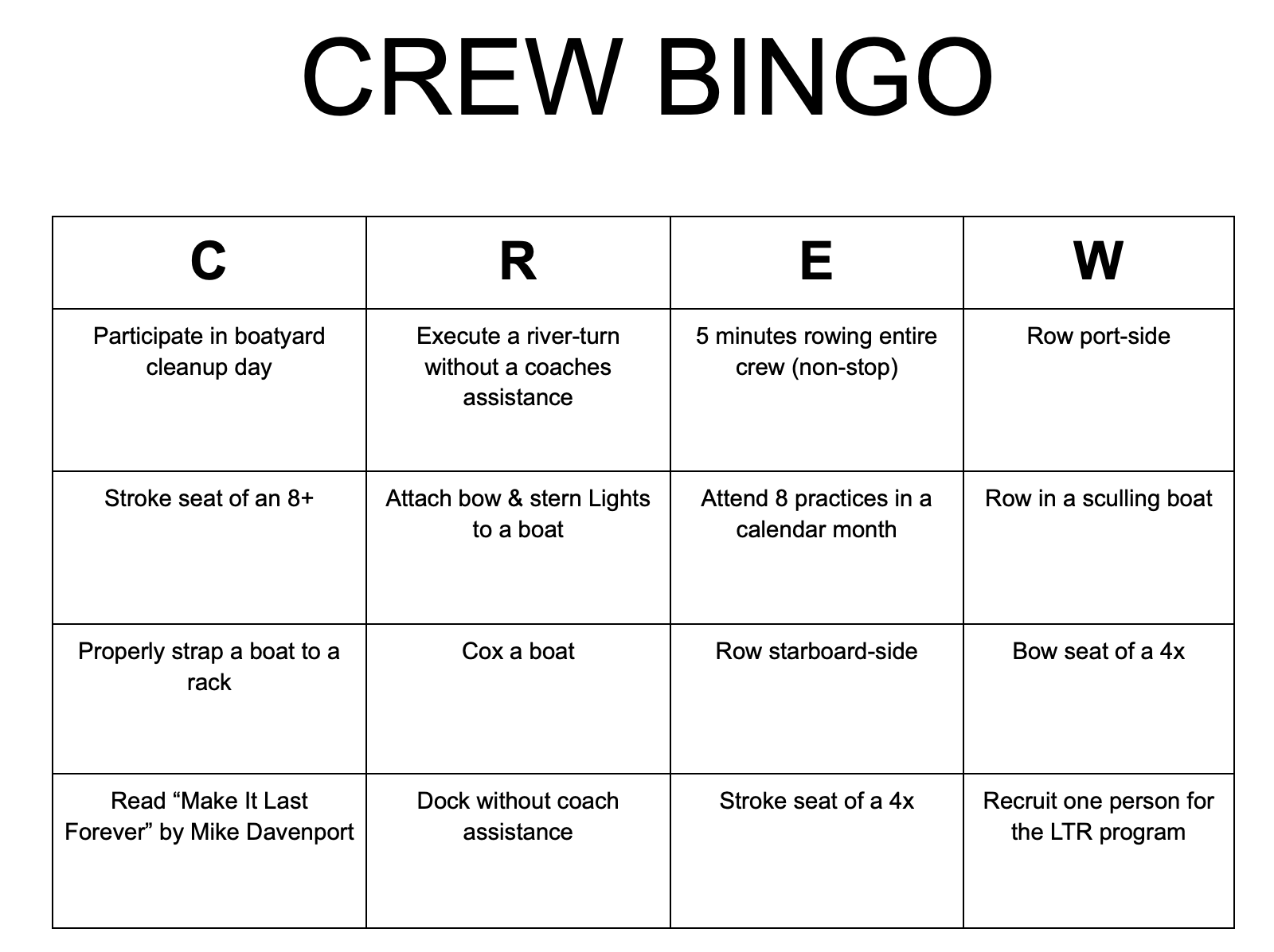
Bingo game - Michael Merwin gives a card to all participants - they have to do a lot of different things during the course. As they complete each cell, they check it off and a line of 4 wins a prize.
Flexibility - teach in different types of boat Pontoon floats - enable a lot of different configurations of experienced and novice athletes.
Each lesson, move people one seat down the boat. When you get to bow, rotate into the cox seat next lesson.
Want easy live streams like this? Instant broadcasts to Facebook, YouTube, LinkedIn. Faster Masters uses StreamYard: https://streamyard.com/pal/d/5694205242376192
Four types of recovery responses
There are four types of recovery responses to be familiar with:
Acute overload
Functional overreaching
Non-functional overreaching
Overreaching
Acute overload is the recovery that takes place on a daily basis, session to session. Proper diet and sleep are the main factors for long term recovery. However, immediate recovery interventions should start as a session concludes to signal the body to start repair. This can include a 10-minute cool down row with focused deep breathing, changing to some slow music after listening to upbeat music, a protein snack within 30 minutes ending a session, wearing compression garments, and light massage.
Functional overreaching is the gold target. It is the result of good management of the daily training load. It will show improvement in the performance of the rowers from week to week. As they repeat weekly sessions they get better. Repeating the same weekly sequence of workouts for a few weeks is an effective approach for masters. Making small changes or increases to achieve slow steady gains are preferable.
Non-functional overreaching is when athletes are not seeing performance improvements, they are feeling stale, and the usual number of recovery days is not enough for them to gain energy back. The prescription is then to recommend taking three or four days off perhaps a week. Often the athlete will then feel better and be able to return to their previous level of performance. Usually non-functional overreaching happens because the increase in the training load was too fast.
The definition of overreaching is, “Overreaching is considered an accumulation of training load that leads to performance decrements requiring days to weeks for recovery.”
Case study
An example of recovering from non-functional overreaching:
R.C.’s normal heart rate variability measurement is between 7.2 to 8.3. She had a moderate training session on Wednesday, rowed a hard session on Thursday, and then trained easy on Friday.
On Saturday her HRV was high 9.5 but she went to train but had to abandon her session due to fatigue.; She rested on Sunday but HRV was still high at 9.3. On Monday it was 8.7 so she took an additional rest day. Tuesday her HRV was 8.5, still slightly above normal, but she was able to resume training on Wednesday when her HRV was received to her normal range.
All in all she required three days rest to recover but was able to resume training at her previous level.
Fortunately, true overreaching is rare. This is when the athlete cannot recover for weeks and can take months to get back to their baseline performance level. Overreaching can be avoided with attention to the balance of work and rest on a daily, weekly, and seasonal basis.
Got a program already? Get our monthly magazine
Join our community and get our exclusive Faster Masters Rowing Magazine, packed with tips, techniques, and inspiring stories. Includes four new articles monthly.
PLUS get the Rowing Fundamentals bundle (US$279 value).