How do you work with your coach and how do they work with you?
What boundaries are there to the relationship?
How to give and receive negative feedback
01:00 This Past Week - what we do to advocate for masters rowing.
US Rowing Masters Conference
https://2022usrowingmastersconference.sched.com/
05:00 Ageing Well Webinar
https://fastermastersrowing.com/courses/ageing-well-for-rowing/
08:00 Athlete Coach Relationships
How do they work with you and you with them?
Goals of your program - fitness, technique, camp ....
Develop trust and respect
Understand communication - what would they like to get from the session or what to learn
10:15 Life stage and coach relationships
At high school they tell and you do.
Competitive teams - team culture, standards of behaviour and quality training matter
Masters are different our choices are more varies.
12:30 Igor Grinko coach to USSA, USA and China noticed the differences in athlete coach relationships.
15:00 What boundaries are there to the relationships?
private time
Communication - how, when, text / email / call / Face to face
Days off from the team
Scheduling crews - deadlines
Timelines for practice. Time to arrive and time on the water OTW
18:00 Preparing for the session - brief the coach ahead of time.
What is the approach - do you coach the whole boat or individually?
22:00 Use video to give individual feedback privately
23:00 How to give and receive feedback
Ask at the beginning what are you currently working on?
At the end one good point and one point to work on. Plus video of good sculling.
26:45 Separate their identity from the rowing skills - feedback is not criticism
28:00 Receiving feedback - coach-ability is a great skill to have. Try to do what the coach says.
Some coaches relay on athlete intuition to solve problems. Others explain the "how" relative to a reference point.
31:00 Give coach feedback afterwards for the crew.
35:00 If you want coaching, come close to the coach boat.
02:30 This Past Week - what we do to advocate for masters rowing. The March programs are ready including a focus on the pelvis and how to use it in rowing and sculling. Hip and pelvic mobility exercises.
08:00 Sponsor this week by the Rowing Directory including new listings for Glide Boat, The Flying Boatman, Shell Covers Australia, Adirondack Rowing and Trophy Oars
https://rowing.chat/retailer/
09:45 The Recreationals at Trafford Rowing Club - Susie Loates is the Vice Captain responsible for the group.
11:30 A recreational rower is anyone who does not want to commit to the full training plan of the racing squads. Members are parents, professionals with busy jobs and shift workers.
13:00 We seek a good technical row in sculling boats.
15:00 The Group uses Fitclub.me to book boats with up to 19 sessions available per week. We are welcome and a recognised part of the club.
16:30 How are sessions broken down - is a technical point or a workout set?
We arrange to out out 4-5 times a week.
Anyone can coach and we are encouraged to help other rowers.
Treated as an equal rower from day one.
19:30 The explore series of races. Uses stable 4x. These are 300 meter dashes races.
23:00 Advice for starting a recreational group.
Approach your committee or club leadership. You want a fair time on the water and a fair allocation of boats and equipment. Seen as the equal t racing squads.
25:30 Has the group got a leader? Susie has a rough plan for the group.
Membership fees are £25 per month for everyone in the club.
How is rowing going for you? What's it like elsewhere in the world? Learn more from our survey report. If you would like the anonymised raw data, get in touch.
Most masters have been rowing over 10 years and started rowing either at school/university or began over age 40.
The average spend on rowing per year is between US$500 to $2,000 with a significant group spending $4,000 or more each year.
There is some alignment between training effectiveness and rowing budget, those who invest the least get the worst results. Masters who train between 2-4 days a week report results between mixed, OK and good results in the past year.
Training frequency on land and water is consistent from summer to winter.
55% of masters follow a training programme. 39% do not plan their training.
Nearly 40% of masters row a single, 25% use the erg and many do crew boats as well. Weights, body conditioning, yoga, gym and cross training are the most popular land training choices.
Download the State of Masters Rowing 2022 report.
The most shocking finding is that half of all masters rowers either do not get coached or get coaching once a month or less.
Going on camp is popular with most choosing to go to improve technique or for race preparation. 60% of respondents plan on going to camp during 2022.
The pandemic affected rowing clubs postiviely and negatively - 30% reported a growth in members and 22% lost members compared to pre-pandemic yeas. Learn to row classes continue to be popular with most clubs running between 1-3 courses a year and 40% of clubs had more students.
Student drop-out after learning to row is reported at between 50-70%.
Racing was badly affected by Covid with over 70% doing three or fewer races in 2021 and 2/3 reporting they raced less than in previous years. 50% of masters race 5 times a year normally.
The majority of masters use data to analyse their rowing at least some of the time - only 25% report not collecting rowing data. Race results get more attention than training data by the very keen but 30% of masters don't analyse race or training data (clearly some collect data and don't analyse it). Over a quarter report uncertainty understanding what the data shows and 6% have technical issues interpreting rowing data.
We asked respondents for the personal and club challenges - the biggest challenges for clubs are recruiting new members, fundraising, coaching and equipment. A strong second tier of answers include 'getting people to row with', finding time to row and getting support from the organization.
For personal challenges Coaching, injuries and age-related issues lead the responses. It is interesting that the detailed responses frequently reference learning rowing and sculling technique as a personal issue.
Covid has of course created challenges as well from weight gain, restrictions in the number of people allowed to row at one time and training frequency. Many people referenced training in singles as a change as a positive result of Covid.
Choose a rowing camp that suits your needs | Faster Masters Rowing Radio
01:00 This Past Week - what we do to advocate for masters rowing.
Doing race debriefs after a big event helps to decide future priorities.
how to get set up properly in the boat - adjustments to make.
Going faster by not slowing down.
08:00 Developing new speed - improve what you already have.
Improve the quality - makes rowing more fun.
10:00 Do the basics really well.
Are you getting your blades off the water?
Rowing harder and maintain technique.
Rowing harder in difficult conditions.
Rowers have to maintain the same quality under conditions of fatigue and pressure.
You can always do drills stationary, even if you are tired.
A change is as good as a rest.
Reasons to go on camp.
Training - get a good block of hard work done.
New challenges - a new coach, new lineup, longer distance,
Crew Selections - get your lineups right for racing
Fitness - get fitter and stronger
17:50 Sweep or Sculling camp?
Single scull or team boats?
How much do you want to spend $$ and How much time away do you want?
Consider the time split between rowing and tourism - you can bring your non-rowing partner who can do wine tasting, another sport, cycling, walking.
Look at your local area - can you camp locally?
Or a weekend camp at your own club? Row twice on Saturday and Sunday.
22:00 Find a camp and find a rowing coach at the rowing directory
You will learn a lot from a new coaching voice - their focus can be revealing.
How they teach is important when making your choice. What is the coach's outlook?
26:00 Go on camp as part of your race preparation - book in a few days or a week ahead of a big regatta.
Camp as a retreat
Camp as travel
Camp for competition
29:00 Fine boats versus restricted boats versus clinker boats.
Tools say a lot about a rower. Learn what the pro coach carries in her single and in the coach boat
01:00 This past week - Marlene published an article Winning Head Races in Rowing
https://ludum.com/blog/training-plans/winning-head-races-in-rowing/
07:00 Your first head race - how to get mental and physical confidence.
Test yourself to find the optimal rate.
Try 3 minutes of the race one point in rate higher than you think. Analyse afterwards how you went.
Marlene has a mini bag with
- Top nut wrench
- Small adjustable spanner
- Pusher outer tool for clip height washers
and a bungee cord - 2 feet long.
- Metric and Standard wrench for top nut, 10mm and 8mm
- 3 Screwdrivers - C2, Flat head and Philips head
- Metric and Standard tape measure. 5 meters long
- Sharpie magic marker
- Electrical tape - white - and a pair of scissors.
Enough to get you back to the boathouse safely where a full repair can be done.
26:00 Rebecca's 3 gadgets she loves
- T-bar spanner
- Martinoli nut tool
- CARE pitch gauge
- The wing nut tool (for the slides under the deck)
30:00 Rules for lending tools
Have a deposit - leave me your phone / sunglasses / water bottle.
Efficiency in rowing: Time pressures weigh heavy on most masters rowers. How can we get more efficient with our busy rowing lives? Faster Masters Rowing Radio hosts Rebecca Caroe and Marlene Royle discuss tips and challenges
Support this podcast
https://fastermastersrowing.com/podcast
02:00 New Zealand Masters Rowing Championships rescheduled to 29-31 October.
National Championships will include 500m sprints for masters in 2x (handicapped)
Rigging for Masters Webinar - tickets are on sale
Event is 6 October 2021
https://fastermastersrowing.com/rigging
03:45 Rowing in a double with novices - coaching from 2x
11:00 Efficiency getting to the boathouse
- the night before: Clothes, Weather, Time alarm clock, Driving time, eating for energy, Program, Text your crew to agree bad weather plan.
15:00 Decide in the shed, not in bed
Apps for local wind forecasts
Windy
Windfinder
Wind Guru
17:30 Equipment efficiency
- Have a routine - oars first, then PFDs, then the boat.
Help each other, two people per boat get the oars, two hold the boat (for a 4x or 4)
22:45 Coaching efficiency
Scan the boat to check are the oarlocks in the right direction, are oars in right sides?, Height spacer washers, Do footstretchers need to be changed?
Remind each other - have you checked your footstretcher before you push out into the lake / river
25:00 Training efficiency.
Warming up - how much time do you need?
Know the practice routine warmup.
Rules about when we talk during the outing. Technique discussion and feedback during breaks.
Etiquette is important especially in big boats - 4s and 8s.
29:00 Warming down efficiency
When to start your warm down. Try to include 5 minutes each practice.
Marlene recommends stretching after you get out of the boat.
Rebecca stretches during the debrief after putting the boat away.
Consistency to day to day habits helps.
33:00 Meal preparation efficiency
Make bags of whole foods to take with you.
Always have food in your gym bag or car.
Don't skip refuelling.
Double batch your evening meal - make a large lasagne and freeze half.
Faster Masters Rowing Radio - the podcast for masters rowers. Tips, advice and discussion from Marlene Royle and Rebecca Caroe.
Support this show with a donation
https://fastermastersrowing.com/podcast
02:00 This Past Week We have been discussing future articles with Ed Hewitt at Row2k.
On the newsletter you can join our Advocates group where we share one article a month which you can share with your club group.
- basic boat set up for your private boat and for club boats
- customise your own boat
11:00 Volter Nolte - How to get a longer stroke
Using rigging adjustments for comfort. You will row better if you are comfortable in the rowing boat.
What are your rowing activities that contribute to your rowing practice?
23:00 Coming to practice regularly.
Objective measurements like kms rowed and number of practices you attend.
Compare yourself with your own previous performance. Use video to do the comparison.
26:00 James Loehr's book - Mental Strength for Athletes has the premise - no matter what you want you must have the physical preparation to do it.
When you step into the boat you become the performer.
https://amzn.to/3zniq2w
31:00 The process of acquiring skill in rowing.
What would I think of someone who does this # practices a week, this # kms rowed a week. View the facts objectively.
32:00 What do you want to get out of your rowing?
Outsiders don't really care as much as you do.
The Satisfaction you get is driven by you.
34:00 Your persona at the boat house - it has its own aura and is not the same as a gym.
Faster Masters Rowing Radio - the podcast for masters rowers. Marlene Royle and Rebecca Caroe are joined by Volker Nolte & Wolfgang Fritsch to discuss their brand new Masters Rowing book.
Support this show with a donation
https://fastermastersrowing.com/register/podcast-supporter/
04:00 Racing Starts Challenge sign up details
11:00 Wolfgang Fritsch and Volker Nolte's backgrounds in rowing - rowing coaches are easier to convince of things if you are also a coach
20:30 The message of the book, “Masters Rowing” is to enjoy rowing.
Buy the book https://amzn.to/2Saikeq
22:30 the 6 aspects of ageing
Chronological
Functional
Biological
Psychological
Social
Training
Understand how each is different and how you are placed. Biological isn’t the same as chronological - you may feel different or you may not.
28:40 How does rowing help successful ageing? The book addresses the ageing process and how to make your life better.
34:00 Warm up strategies for masters - as you age you need more warm up. Body function changes and the blood capillaries become tighter and less flexible so blood flow is inhibited.
36:30 One key recommendation for rigging as you age.
Use shorter oars. Adjust the rigging to suit the athletes.
Adapt training intensity to suit too.
Supplementary training and technique changes.
The traditional gig boats are good for learning to row, as are coastal boats.
Your perception of load changes too as you age.
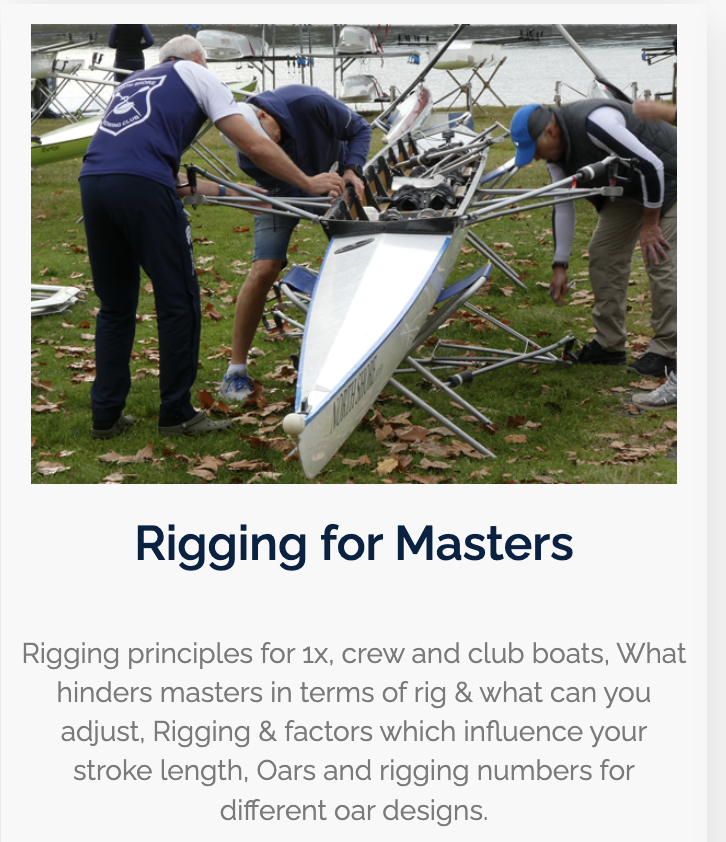
40:00 Marlene’s club has different size and weight boats and adding pontoons as people learn helps.
42:00 Crew boats add a whole level of fun. Volker recommends variety - crew boats rowing on both sides. Try to challenge people a bit and push your function a bit.
46:00 At what age do you see the biggest drop in performance?
Do we lose more in age than we can add in training?
Adjust your focus - you can still improve your skills at any age.
51:00 There are examples of training plans and how to write your own components in the book. Speed, power and endurance.
53:00 Learning to row is a fun adventure. It’s not a military exercise.
A well rigged boat is important.
Don’t use detailed positioning explanations - give the athletes an idea of the whole movement.
56:50 Children learn by trying. For adults, when they ask about something, give them advice. Don’t formalise the learning. Trust the coordination of the athlete.
The basic rowing movement isn’t difficult. Rowing becomes difficult when you want to go fast.
59:00 Volker’s podcast with Joe de Leo. Learning to row - do it organically.
https://www.stitcher.com/show/leo-training-strength-conditioning-endurance-health/episode/episode-130-dr-volker-nolte-dr-valery-kleshnev-power-measurement-and-biomechanics-in-rowing-76528104
There is no carry-over from erg to boat. The brain does not recognise it as the same thing.
1:03:00 Do you recommend sweep rowers to swap sides - yes It helps learn different movements and also swapping seats is a good learning.
Masters don’t get much coaching compared to other training groups.
There are many reasons for this - under 18 year olds cannot row unsupervised for safety and protection reasons and clubs allocate scarce coaching resource according to their priorities.
Whatever the reason (and we can discuss ways to overcome the frustrations of masters athletes in another article) it is clear that if masters are to improve skills and fitness, a degree of self-coaching is needed.
Training plans, practice schedules and goals are different for masters compared to other club training groups. Because finding balance between work and family life as well as rowing training is an individual challenge which can change from month to month.
Few adults respond well to authoritarian coaches - self-directed learning is more flexible and respectful of our age and life-experience.
In my view, the ideal way for a club committee to set up a masters group for maximum gain based on minimal coaching is to have a robust learning framework.
By this I mean consider the inputs to any learning.
In the case of learning rowing or sculling - first the athlete has to have a clear understanding of the rowing stroke cycle and the “pattern” of movement which they are seeking to learn.
Then they have to understand the difference between how they are rowing now and the desired state.
These two stages can be accomplished by using YouTube video resources and printed posters of good technique plus letting the athlete row while being videoed or in front of a mirror so they can see what they are actually doing.

Decide to focus on a MAXIMUM of 2 technical points per training session. Yes, the fewer the better.
Habits are hard to change and it may take thousands of strokes to make a technical change a permanent feature of your rowing stroke. You may do an hour of rowing at stroke rate 18 - that’s only 1,080 strokes. And so you see the scale of the challenge.
And so we frequently precede this by doing a drill or exercise to isolate that part of the rowing stroke and practice the movement carefully. A good example is pressing the oar down (tap down) with your outside hand (sweep) at the finish of the power phase of the stroke. You may do a drill to row alternate strokes square and feather. The goal being to tap down the oar by the same amount regardless of the square/feather. After the drill, move into the conscious / unconscious practice for the rest of the outing.
Frequency is rewarded
Doing the drill at least three times within the outing is the best way to continue to improve.
By going back to the “basics” of the drill and then moving to continuous rowing the crew gets the best possible chance of embedding the change into their normal stroke pattern.
You can also always make it harder for yourself by adding complexity like increasing the stroke pressure from light to half pressure to firm pressure. And also increasing the stroke rate will make both the drill and the subsequent continuous rowing more challenging to maintain the new technique.
Remember to check in with your cox, coach or fellow crew members to check that you’re doing the new movement correctly.
In a crew people sitting behind you can see your bladework quite easily - and so if you tell them what you’re working on, they can help you out.
Test your resilience by trying to maintain the technical change at increasing pressure and increasing stroke rate. It’s a fact that when we are tired, athletes “revert” to their previous technique. That’s why it is so very very challenging to make and hold onto a change.
Would you like to publish this article in your club newsletter or website?
Join our Masters Rowing Advocates mailing list and we will send you one article a month. Sign up on our Advocacy page.
You can copy the text on this page. Or download the PDF
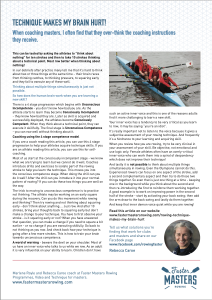
When coaching masters, I often find that they over-think the coaching instructions they receive.
This can be tested by asking the athletes to “think about nothing” for ten strokes and then to take 10 strokes thinking about a technical point. Most row better when thinking about nothing!
In our debriefs after practice many tell me that it’s hard to think about two or three things at the same time - their brain races from thinking catches, to thinking pressure, to squaring early and they fail to execute any of these well.
Thinking about multiple things simultaneously is just not possible.
There is a 4 stage progression which begins with Unconscious Incompetence - you don’t know how bad you are. As the athlete starts to learn they become Consciously Incompetent - they know how bad they are. Later as skill is acquired and successfully deployed, the athletes become Consciously Competent. When they think about a technical point, they can execute it skillfully. The final stage is Unconscious Competence - you can row well without thinking about it.
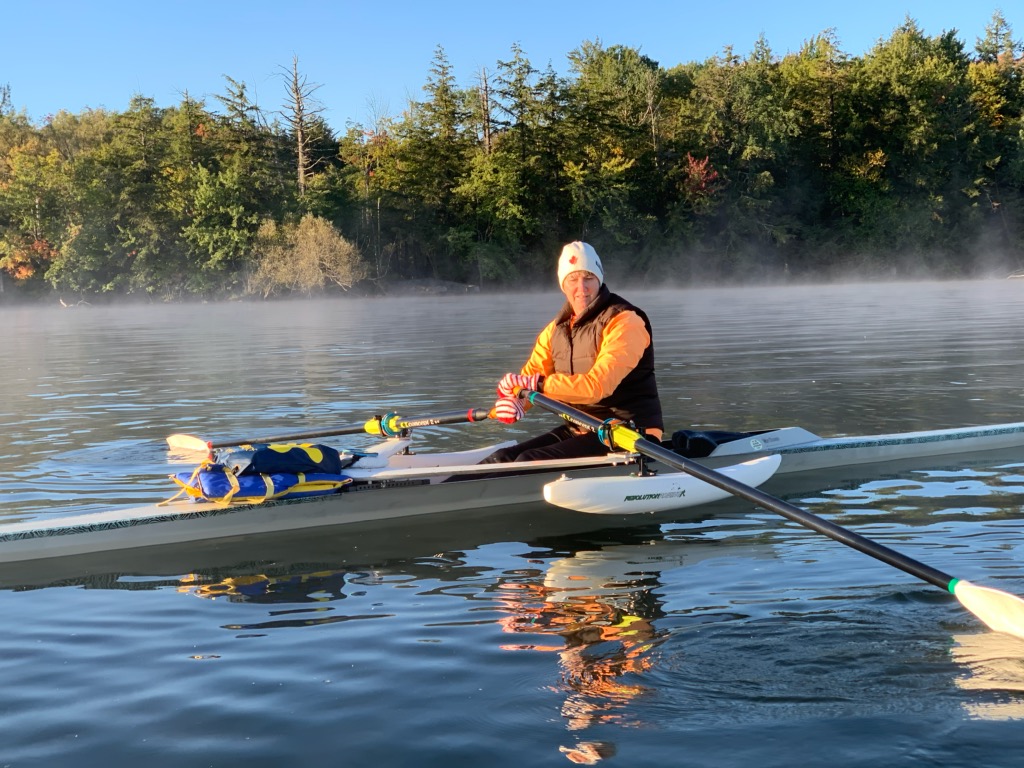
If you are a coach reading this article, you can use this 4 stage progression to help your athletes acquire technique skills. If you are an athlete reading this article, you can use this for self-coaching.
Most of us start at the consciously incompetent stage - we know what we are trying to learn but we cannot do it well. Coaches introduce drills and exercises to isolate part of the rowing stroke to help you learn the technique. This moves you into the conscious competence stage. When doing the drill can you do it well? After the drill can you introduce it into your normal pattern of rowing? If you can do these two things you are well on the way.
The trick to moving to unconscious competence is to practice not thinking. The athlete may be working on an early square during the recovery. Can you do this movement while rowing and thinking? Then try rowing and not thinking about squaring early - don’t think about anything.... Just row. And after 10 strokes, bring your thoughts back to squaring early but don’t make a change to your technique. You have to first observe your stroke - is it squaring early or not? When you have answered that question, you can make a change if you need to square a bit earlier - or no change if you are executing skilfully. Go back to not thinking as you row. And check back how your technique is going after a few more strokes. This is how to train your brain towards unconscious competence.
A word of warning - beware the devil on your shoulder. Most of us have an inner voice who talks to us while we row. As an adult it is very influential on your ability to learn. Children don’t have such an active inner voice and this is one of the reasons adults find it more challenging to learn a new skill.
Your inner voice has a tendency to be very critical as you learn to row; it may be saying “you’re an idiot”.
It’s really important not to listen to the voice because it gives a subjective assessment of your rowing technique. And frequently it’s a hindrance to your learning and acquiring skill.
When you review how you are rowing, try to be very clinical in your assessment of your skill. Be objective, not emotional and use logic only. Female athletes often have an overly-critical inner voice who can work them into a spiral of despondency which does not improve their technique!
And lastly it is not possible to think about multiple things simultaneously in rowing. Even the Olympians cannot do this. Experienced rowers can focus on one aspect of the stroke, add a second complementary aspect and then try to do those two things together. So even that is just one thing at a time - keeping one in the background while you think about the second and then re-introducing the first to reinforce them working together. A good example is to work on improving power in the second half of the stroke - start by activating your back swing; then add the arm draw to the back swing and lastly do them together.
And keep that inner demon voice quiet while you are rowing!
Would you like to publish this article in your club newsletter or website?
Join our Masters Rowing Advocates mailing list and we will send you one article a month. Sign up on our Advocacy page.
You can copy the text on this page. Or download the PDF
Join our community and get our exclusive Faster Masters Rowing Magazine, packed with tips, techniques, and inspiring stories. Includes four new articles monthly.