Dealing with foot cramps, forearm cramps & whiplash in the rowing boat.
01:00 This Past Week - what we do to advocate for masters rowing
Running a sculling camp. Collecting post-regatta feedback - 10 things you did really well and 10 things you'd like to improve.
09:45 Cramps in the boat. First look at nutritional causes - your electrolyte balance of calcium, magnesium, potassium levels. Check your hydration as well. Check your muscles - are you gripping too hard?
12:15 Muscle goes into contraction in a cramp and does not want to unlock or release. Calcium aides this muscle release. Neurological release by contracting the opposite muscle. Reciprocal inhibition if you contract one muscle the antagonist muscle must relax. Foot cramps - lift up your toes to contract the top of your foot muscles to relieve in the arch of your foot.
15:10 Calf muscle cramps
Extend your leg and pull the toes towards you. Also use elastic bands. A Charley Horse is a common US name for a muscle cramp.
17:30 Hamstring cramps
Contract your quadricep hard to release. Extend your knee and straighten your leg. Lie on the floor and lift your leg up straight off the floor.
20:00 Forearm cramps - often caused by tension in the hand.
Frequently happens when you switch from sweep to scull or swap sides in sweep. Avoid cramps by getting into the rowing stroke rhythm and release your hands within the stroke. Let the handle move with your fingers. Keep the circulation going.
If you do get a forearm cramp, raise your arm and pump your fist open and closed. Must be above the height of your heart.
Marlene-ism "Let the oarlock be an oarlock". 25:30 Abductor muscle cramp This is probably caused by the glute medius. Squeeze a water bottle between your knees to release.
27:30 Whiplash - if you get this in the boat when looking around quickly it's hard to release.
Warm up the muscle, stretch it and massage it with your fist or fingers. Cold muscles are more susceptible to cramps.
30:00 Thixotropic ligaments and tendons. Getting cramp towards the end of an outing happens. Take a little cooked potato with salt, or electrolytes or a banana to prevent this.
33:00 Question: How to work with a squad of different skill levels. Develop your sculling ability - have a pathway to progress. What am I signing up for? Set outings for integration with more experienced people. Switch seats in crew boats.
38:30 Pontoons from Revolution Rowing give stability for singles and doubles, as do Wraptor Balance pontoons.
Rowers research, read and learn all the time. How to take your new ideas into the boat and test them out - do they work? Book of the Month with Jess di Carlo | Faster Masters Rowing Radio - the podcast for masters rowers.
03:00 Sculling Intensive course launch Every 5 years do a major reset and go back to basics on your sculling. This serves as a refresher course.
06:00 This Past Week - what we do to advocate for masters rowing. When people get nervous wierd things happen. Write it down and make a checklist for your regatta timings.
07:45 Coaches Eye has closed down.
09:45 Book of the Month Mind over Water - lessons on life from the art of rowing by Craig Lambert Buy now. [affiliate link].
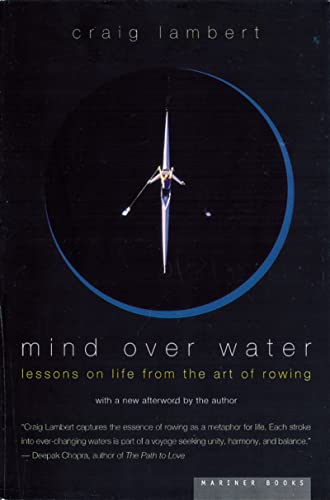
It is based on the Head of the Charles Regatta and being an older athlete learning how to scull. Craig recalls the Great North East Blackout of 1965. Read more rowing books.
21:00 You Belong Here. Rowing shows you are part of the club.
23:30 Finding new rowing things to use in your practice. As a student of rowing it's an ongoing process.
24:45 Have a good system to capture information - a reference archive.
27:00 Putting the new idea into practice. As a coach it's important to hear how others describe things.
30:00 Back to basics - choose how to do the thing,. Break down the stroke - exaggerate or isolate that movement.
32:00 The value of repetition - do it multiple times. Can you verbalise what you want to happen?
34:00 Technique first and then power. Test your limits. Use this method to coach and apply your learning.
Masters need more coxes | Marlene Royle and Rebecca Caroe with guest Katy Smith talking about ways to develop, coach and improve coxing for masters rowers.
01:20 This Past week-advocacy. A new dock arrived at Marlene's club. Recommend Ako Plus matting for non slip surface suitable for boat clubs.
08:00 Katy Smith from Asheville Rowing Club, North Carolina, USA.
07:00 Sculling Intensive Course announcement. https://fastermastersrowing.com/register/sculling-intensive/
11:00 Our team has 2 W8 and one M8. And specialised sculling groups.
12:30 Insufficient support for Cox development. Coaches have never coxed. But coxes need a leadership style. The US Rowing Level 2 coach certification has limited cox information.
14:00 Coaches need to sit in the coxes seat at least once. Learn what the role does. - Can you keep your line -point. - Technical skills development. - Responsible for safety - Docking and landing. I use my peripheral vision-what is going on around you?
18:00 Working with a coach Do they do all the coaching? Know what the coach expects from the crew. What skills are they working on? We see and hear things the coach does not. Act as a go-between with the coach and crew. 20:00 Help coxswains develop. Tell us feedback - we want it. When we give good calls, tell us. Are people afraid of hurting our feelings?
23:00 Fear of losing a coxswain. I ask directly for feedback. We used "no name" surveys to rate us.
25:30 Differences coxing masters requires more finesse with your voice - not using screaming tactics.
27:00 Flexibility with line-ups. Explain the goal for this practice. Mixed ability crews - give experienced people the expectation of developing novices. It's important to allow novices a voice. Buy into the workout.
31:15 Coxes arriving to the masters level - understand how necessary it is to being out on the water. Our masters learn coxing as well as rowing.
33:00 We have a learn to cox program. Choose to rotate through rowing and coxing - half outing rowing, half coxing.
35-00 Coaching the coxswain by Chelsea Dommert. She reviews how to master steering, docking, setting up your race plan with the coach. https://amzn.to/3L7Zegp
38:00 I auto record my outings using Cox Orb Platinum. I share them with the womens 4 crew. Coaches could listen to recordings and give coxes feedback.
41:00 It's important coxswains know how to row. At masters lend everyone needs to learn every role in rowing. To contact Katy [email protected]
Durable boats for club use | Faster Masters Rowing Radio - the podcast for masters rowers. Tips, advice and discussion from Marlene Royle and Rebecca Caroe.
01:00 This Past Week - what we do to advocate for masters rowing.
03:00 September Programs have 3 tracks Time for good quality endurance training.
08:00 What is the normal stroke rate for a 60 year old masters in a single scull for head racing? Maintain the best average speed for the whole race. Work out your efficiency at different rates.
13:00 if your release timing is not together. If you cannot hit the rate - look at this first.
15:30 Look at meters per second as an alternative to 500m splits.
Support this show with a donation.
19:00 Durable equipment - boats and oars. Why do we want hard wearing boats for rowing? How do you choose boats - we review the spread of athletes in the club group - Height, sex, weight and skill level in rowing and sculling. Our learn to row boat is a coxed quad - wooden inside and with a carbon exterior. After graduating from learn to row we use a flat bottomed quad which is easier to sit and good enough to race in. It is a "forgiving" boat for technique inaccuracies. Hull designs vary - our top quad has a narrower hull - it's harder to sit and weather-cocks into the wind. Good bladework skills are needed to control this boat. We need both beginner boats and racing boats.
23:00 Rowing boats are made from a choice of fibreglass, Carbon and Kevlar, and Wood. Modern boats are a honeycomb sandwich construction. This gives rigidity to the boat. Painting the outside of the boat covers the joins and overlaps in the carbon fabric layers. Gelcoat is the transparent outer layer of protection. The materials it is build in reflect how heavy the boat will be when it's finished.
25:30 Boats have minimum weights allowed for racing by World Rowing FISA. A single scull is 14 kg. Look at the boat builders plate - it has the boat weight as well as the athlete weight (average) it's designed for. Under-weight boats require you to carry extra weights - lead weights added to the foot stretcher.
28:30 Flatter based boats for learn to row are sometimes a little heavier. A single can be 17 kg. Stiffness of rowing boats has increased since wing riggers became popular. They attach using a flange along the length of the boat. This allowed boat builders to remove the internal 'shoulders' for the boat and to redesign the cockpit.
32:00 Buying a boat- consider the prices. Often the hull design is the same but materials differ.
33:45 Composite materials changed our design and manufacture. Skinny oars have extra soft flex. Heavier oars are built with heavier materials. Oars are made from Aluminium, Wood and Carbon fibre.
40:00 Marlene's "Old trick" to give more weight in the hand is to wrap lead tape around the shaft to create weight in the hand. Gives more stability to the oar.
43:00 Boat maintenance is key to durability. More than the construction type. Check your boat regularly - is everything tight? Wash the boats regularly - especially the slide tracks. Boat storage - indoor or outdoor? UV light slowly deteriorates the hall. Cover your boat if stored outdoors.
47:00 Rowing in salt water requires daily washing. We recommend regular strip downs to remove salt residue.
Rowing is a sport that rewards discipline. Book of the Month | Faster Masters Rowing Radio - the podcast for masters rowers. Tips, advice and discussion from Marlene Royle and Jess DiCarlo.
01:00 This Past Week - what we do to advocate for masters rowing. 03:05 Jess discussed her book choice
Rowing Through the Barbed Wire Fence – Rima Karaliene.
What it was like rowing in the Eastern Bloc from 1960s. 13:30 Privileges came with the elite sport team membership in Soviet Union.
27:20 We discussed the concept of discipline being connected to a goal to help you make decisions and create good habits.
Book Mental Discipline: The pursuit of peak performance by Mike Livingston
29:00 Rule followers are one type of discipline follower.
30:00 The 80/20 type people mean you are highly likely to be successful. To get the benefits of what you are trying to accomplish with your goals. Regular practice of discipline improves your skills.
33.00 Knowing yourself helps - do you need a team or a training partner?
Over training happens to masters too | Faster Masters Rowing Radio - the podcast for masters rowers. Tips, advice and discussion from Marlene Royle and Rebecca Caroe.
01:00 This Past Week - what we do to advocate for masters rowing.
02:40 Block format racing allows more events and easier for boat sharing
05:00 squads for masters racing. Being ultra-flexible because things come up unpredictably.
08:00 Testimonials from our customers
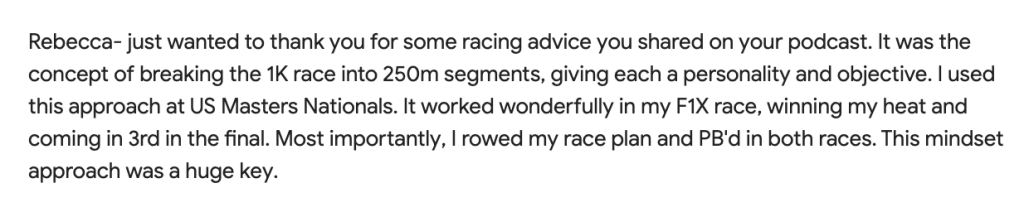
13:00 Henley on Todd - Alice Springs
18:00 Over training,. what is it? Over-stress when your system gets run down. Increasing training volume or intensity too fast. Insufficient recovery. If you do not rest your body creates a situation where it forces you to rest. -
Type 1 - muscular - it hurts.
Type 2- central nervous system- lack of balance, co-ordination low motivation.
21:15 When I got over-training. Be very careful. It was caused by too high training load. We have to push boundaries in a training program in order to get fitter.
25:00 Warning signs of over training
30:00 Using your down time profitably. Go down to base training only. Avoid hard AT or Interval work until your heart rate is back to normal. Do not be on your feet- row /cycle is better than jogging. Go out in the coach boat-watch and learn. Join them at the training sessions. Get a sports massage Nutrition HELPS - get protein and B vitamins in. A blood profile test shows deficiencies like B- 12 and iron Do Yoga. Do Pilates. Take a core class -sit ups, press ups, stretching and mobility work. When you start to feel better begin training again.
Rule is #days off = no of days to come back to full training. Be conservative - older athletes take longer to rebound.
40:00 Adaptation happens at the cellular level.
Good stress and bad stress - what they are and how to handle rowing stress | Faster Masters Rowing Radio - the podcast for masters rowing.
One thing to improve masters rowing - Rebecca is asking this question on LinkedIn.
02:00 This Past Week - Marlene met Tony, a faster master from Sherbrook, Canada.
04:00 Good stress / bad stress
A good stress helps you grow , challenges you. Something unfamiliar but which stimulates you to improve.
It pushes you in a positive direction.
Bad stress is too much of a challenge which causes breakdown.
Coach tells stroke "you are responsible for the outcome of this race". Putting athletes into situations which are way over their heads is inappropriate
10:45 Learning to push yourself into situations where you are vulnerable and uncertain is part of the rowing journey
12:30 Integrating new people into the club as an outing plan.
Good stresses - training with incremental goals. Raise the bar gradual.
A more challenging boat balance situation. It was clear we had gone too far so we switched boats.
24:30 When I push off the dock all the bad stresses stay on land. This is a skill. Learn to leave them behind.
28:30 In racing when starts are delayed can you do anything about it? How can you use the time profitably?
32:00 Why does Let it be work best as a stress mantra?
Percentage of people reporting reduced stress from the 3 mantras.
Daily things which impact you in the boat.
Irene's Question:
"Could you maybe talk about how to best behave in an eight to support steering? Some curves are so tight we need to dampen the power on the inside, but do we lean in a direction, do we adapt our stroke length or something? And what about in longer curves where we can continue rowing at full power on both sides but still want to support the cox - how do we best do that? Or do we let her do her thing and just row?"
Techniques for steering in an eight round a sharp corner.
Ted Pytlar joins Marlene and Rebecca to talk about his club masters group and their experience of rowing, racing and training | Faster Masters Rowing Radio - the podcast for masters rowers. Tips, advice and discussion from Marlene Royle and Rebecca Caroe.
04:00 This Past week Rowing News Magazine published Marlene's article on Periodisation of Technique.
08:00 Merijn Soeters new Book of rowing photography
10. 30 Our podcast name - we emailed a question to all newsletter subscribers
11:30 Ted Pytlar's background in rowing
13:30 Moving to the single scull - the ultimate boat. The club mix of boats has changed as the interest in rowing singles has changed.
16:00 Delaware River is rocky and can get shallow so we lose skegs often
17:00 Training Goals - focus on head race preparation. We organise ourselves as a group of 4 we know where the rocks are. After hurricanes we re-survey the river
22:00 after hurricanes we get high flow and use peripheral vision to steer and avoid landmarks.
23:00 We have a LTR annual program with a waiting list. 16 people limit.
We don't have enough coaches and 10 sessions is not enough and so we added a plus plan to integrate them into experienced boats.
26:00 We have a plan to beef up the masters program structure with regular outings
Customise a track for each person's flexibility.
28:00 the board has a LTR co-ordinator and organised coaching roster.
Scullers have a skills test for 1x use and also a masters program co-ordinator with input from members. We bring in a professional coach a couple of times a month
31:00 Swapping from sweep to sculling
I didn't realise the importance of stability at the catch and release in 1x in order to get the rest of the stroke to work well.
Subtle mistakes you can make on port /starboard can really mess you up. It took a while to figure them out.
Loose hands is critical in sculling.
33:50 you have to be at a certain point in your rowing journey to realise or hear certain things. As you get better you realise what the coach meant.
35:00 Try to get an understanding of the complete stroke. Mine is 4 pages long.
A picture in your head
37:30 Some adapt technique which is a coping measure because they are afraid of tipping over
39:30 The swirling vortex behind the blade isn't needed - just bury them deeper. Differences of opinion between people happen in rowing - it's good to know them all.
45.00 Rowing movie - Heart of Champions review by Rebecca
https://www.amazon.com/Heart-Champions-Michael-Shannon/dp/B09LRZR2F1?ref_=nav_signin&
Incorporating novices into your club is essential as part of keeping the membership from attrition.
Rebecca and Marlene discuss how to set up and teach a novice group and ways to incorporate them into your main club group after they finish a learn to row course.
01:15 This Past Week - what we do to advocate for masters rowing. Rebecca's rowing hack got published on row2k - the Coxing Plank. Marlene has been teaching new novices.
06:00 Beginners joining your group. Do you start in single sculls or team boats? The coach does a 1 on 1 session overview of the sport. Important to get in the boat in the first lesson.
Nobody ever asks how do I turn the boat around! First session - ensure they are comfortable, it's a stable boat, they can find where the water is with the oars.
14:00 Incorporating novices into your club - start them in a group together.
People learn at different speeds. - basic skills of stopping, backiing, turning and rowing. Do check how to structure your learn to row programme tuition in Volker Nolte's book, Masters Rowing. Wolfgang Fritzch wrote the chapter on novices. It's excellent. [affiliate link].
18:00 How we learn Just try it. We learn by discovery
People ask questions - it's best to let them do this and answer what they ask (it tells you a lot about how you teach and whether they have comprehended the information you shared). Incorporate drills to explain and clarify.
24:00 Tell people how to do things not just what change you want them to make.
Use drills to isolate part of the stroke and practice them slowly.
Remember if you talk to athletes while they are rowing they often don't listen. It may be better to talk when they have stoped rowing.
26:00 Jam sessions - mixing abilities in crews
Build this into your club season - mixed ability groups. The novices scale up and the experienced people scale down. It allows novices to experience acceleration in a boat. What does swing feel like? It's easy to improve rhythm and timing when you have been shown how to do it and felt the boat move.
30:00 Shadow rowing is useful especially for visual learners
31:00 Coaching groups of different speeds Individual attention for people of different abilities Give time to process the coaching advice. Position the launch (coach boat) so the slow people go first.
39:00 Feedback from a fitness athlete on the new fitness program.
When to take risks with your race plan - what types of risk to choose and when to use them.
Support this show with a donation.
01:00 This Past Week - what we do to advocate for masters rowing. Marlene has been teaching beginners
08:00 Race Plans - these are included free in our subscription training programs. Check the Performance module for 1k and 5k template race plans.
09:00 Mentality for racing - it's individual.
It's process based mentality and NOT results based.
11:30 Racing is 90% mental Know yourself and make a plan to calm yourself. A race is an opportunity to express yourself.
12:45 Your brain will tell you to protect yourself. It will try to keep you safe. In between your thoughts, talk to yourself. Make your mistakes in practice and in trials.
15:30 Racing is often intuitive - build your experience to improve this. 19:00 The four quarters and what to do strategically in each
23:00 Mary Whipple took a risk to let the boat "breathe" Bring the focus back to the boat - not us.
29:00 Taking an extra push after pulling level with another crew. Put them away if you can
34:00 Pull a trick out of the bag for each situation you face.
Perfect races rarely happen.
Marlene Royle
Be prepared to respond to every situation that arises.
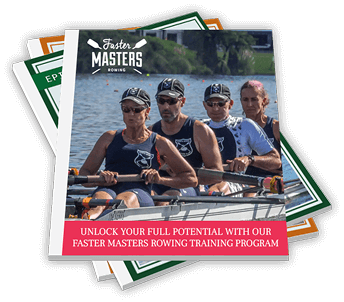
Join our community and get our exclusive Faster Masters Rowing Magazine, packed with tips, techniques, and inspiring stories. Includes four new articles monthly.