Learn from each event you do so that you can personalise your pre-race preparation.
01:00 Pre-race checklists - how to prepare before the regatta and how to improve through the season. Ritual of things to do to get ready for competition.
One day before, get everything you need together. Add elements of structure by packing and folding your clothes.
03:00 Do repairs to equipment / adjustments before you leave home.
At the regatta there are so many distractions and it's easy to make mistakes. Take enough food with you. Your normal food and additional snacks. At a new race course, know where the bathrooms are, where to get water, how long it will take to walk your boat to the boating dock.
05:00 Equipment checklist - car rack, boat, seat, riggers, oars, slings, electronics, bow marker numbers, tools, seat pad, spare fin / collar / oarlock, duct tape.
Clothing for whatever weather you might get - row suit, tights, pants, wind shirt, sweatshirt, socks. Also have an extra bag of clothes if you might get wet.
08:00 Copy the checklist for each regatta, copy it and update for each event. Nerves and excitement mean you can forget things. Have your GPS and road map, hotel room, entry confirmation, know how to get to the race course, a pop up tent to rest between races.
09:45 What to do immediately Where to put your boat, rig it, tie it down. Know who else is using the boat and knows where they are and the oars. Organise your "pad" and your trailer.
11:15 How to assess after the race.
Look at the entire 24 hour period before the event. Write down 10 things which went well for you. You nailed these! Sleep, eating, boat readiness. The warmup, the start etc. They can be subjective or objective.
Then look at 10 things which could be better for the next regatta. Note these and decide what needs to go on the checklist and what needs to go into your training programme for the next race. Consider the big picture. Then reflect on this at the end of the season.
15:00 Ten things we wish we'd learned before going to race overseas. A new article on the Faster Masters blog.
16:00 Racing overseas with a time difference - plan for this ahead of time. This takes an adjustment. If you arrive and can race within 48 hours of arrival, that's will work fine. If you don't and it's longer than 48 hours you need 1 hour per day to adjust to the new timezone. Also consider altitude and its effect on you.
If your race time is significantly different from when you normally train, try to schedule practices at the time of your race. Learn how to manage your meals and your body.
To set clear objectives for your upcoming year you need to dedicate some time to look at your past season. For masters and club rowers, November and December are the transitional months from the conclusion of the summer and fall competitive seasons into the preparatory phase for the following year. Scholastic rowers will want to review last spring’s season but some can have the added advantage of having raced in the summer or autumn head races to give more perspective to the whole picture. To adequately analyze your performance characteristics you must look at your response to a variety of training factors to determine your level of success. An honest analysis of what you achieved and what your limitations were plus setting goals based on those observations provides a valuable tool for establishing new objectives for the upcoming season.
You need to first look at how well you were prepared physically. Did you build adequate stroke power, aerobic endurance, and speed to perform at the level that you had intended to? Review your races to identify areas that you improved on and others that need further development. For example, you might note that your final sprints were more effective this season so your anaerobic speed was better but you still need to improve your endurance for the third 500-meter segment of the race because in every race you slowed considerably at that point. Review your logbook for consistency of training sessions and track your weekly training volume. Look at what type of workouts you thrived on and which ones you avoided. Ask yourself what type of workouts helped your fitness and racing capacity the most and what didn’t you do enough of?
When reviewing your technical preparedness examine individual elements of the stroke- your catch, drive, release, recovery. Consider the quality of your bladework, oar handling, your ability to row at varied stroke rates, or hold form at under high stress. To what extent do you feel that your technical abilities affected your overall performances? Catching a boat-stopping crab with 100 meters to go in a semi-final, knocking you out of the final, because you were over-gripping and your forearms locked up, is one of those situations when better skill would have advanced you to the next race because fitness may not have been the limiting factor. If you made technical changes in your training were they positive or negative? Prioritize the technical elements that you feel will improve your standard of rowing or sculling.
Evaluate how you were able to handle the problems and challenges of actual racing. This includes steering, race plan execution, racing strategy, and your psychological preparation for competition. These represent tactical areas that you can improve. If you were racing your single and you rowed out of your lane in every race, causing you to go many extra meters, you need to put time into correcting your steering so you are not rowing farther than everyone else in the race and disrupting your speed by having to correct your course multiple times. For the races that you would rate as peak performances, where you were in a state of flow and everything came together, write a one-page description of how the race felt and what were the positive factors that you think contributed to such a great race. How were each of these factors reflected in your best races of the year?
Once you have listed your strengths and weaknesses, you need to set new goals to work towards. Your goals can be stated in simple language and be based on your past performances, rate of improvement, competition dates, and priority of training factors such as physical, technical, tactical, or psychological elements. Coaches will want to determine goals for their teams, as well as, helping athletes set individual goals.
Set both subjective and objective goals.
Subjective goals are more open by nature such as: becoming more aware of lateral pressure into the pins throughout the entire stroke, developing a better sense of swing at higher stroke rates, improving the ability to keep the shoulders relaxed in the second half of the race, or gaining more confidence for the start of a sprint race.
Objective goals are measurable such as: place in the finals at US Masters Nationals, qualify for an automatic entry for next year’s Head of the Charles, improve anaerobic threshold demonstrated by improving 6k erg score from 1:45/500m to 1:43/400m in three months, or train 5 days per week for 90% of the weeks from December to April.
Write your goals down in your logbook stating three main subjective goals and three main objective goals for the upcoming season. Always begin your goal with a verb. Then spend time to draw up a plan. You need to make a road map of how you will get from where you are today to where you want to be next season. Setting short-term weekly or monthly goals will help break your goals into achievable steps. Review each goal and determine what you need to accomplish it. Set yourself up for success at each stage in order to build confidence to reach your long-term goal. You cannot row a 2k erg score in 1:59/500m unless you have accomplished 2:00/500m. Take small steps.
A good coach can give you valuable advice along with informed perspective. Helping you to determine realistic goals and outlining a plan together are benefits of good coaching. Be flexible throughout the year. After you outline a plan, keep in mind that it is just an outline. There will be times when outside stresses interfere with your plans or your response to training may indicate that you need to adjust your plan. You will have to incorporate more rest or more work depending on whether or not you are adapting positively to your training.
It is important to make wise daily decisions that are based on your goals. You must prioritize training elements especially when juggling the demands of school, work, family, and friends. Spend time on those elements that improve your rowing the most and keep you motivated to do better.
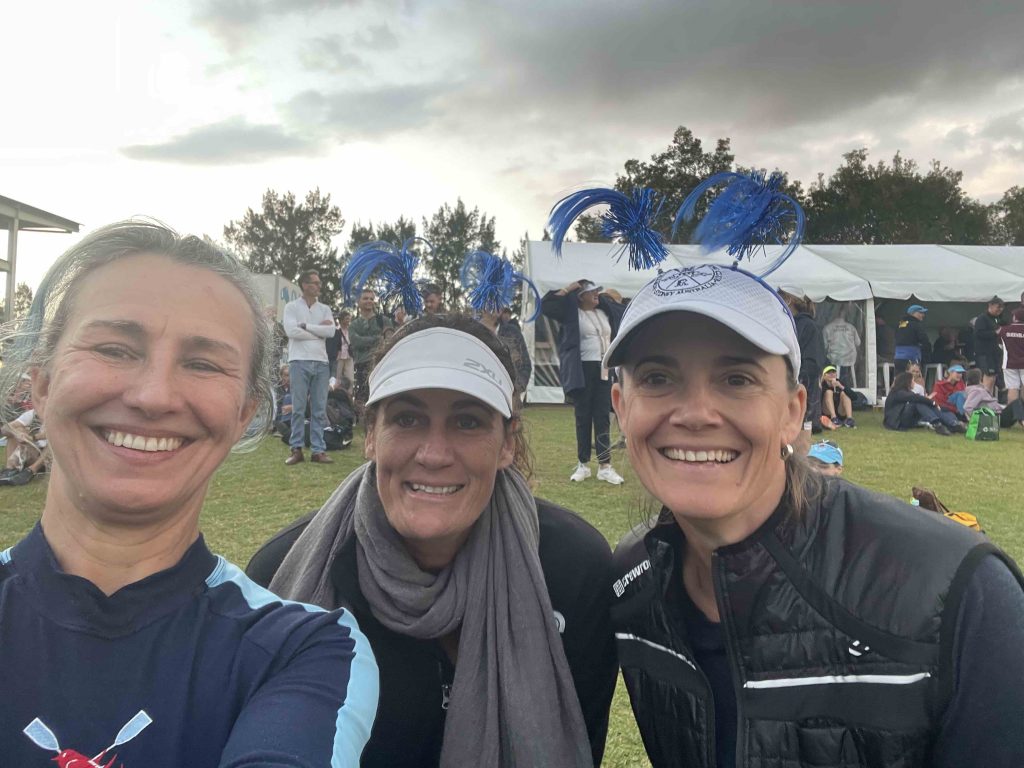
We've just got back from an overseas trip to go to a regatta. Great fun and lots of new experiences.
We met a club with the same name as ours!
What do we wish we'd known before going?
Steering is hard to get perfect. Learn the key issues as we get ready for racing season. positioning the foot, roles in the boat, how to steer and how much.
01:00 Who steers - bow or stroke? Considerations - bow for head races, stroke for a straight, buoyed lane course.
02:15 How to set up the foot position. Make sure the steering wire is set so you get equal steering to both sides. Set the shoe to the mid-point. Get a shoe with a snug fit.
04:00 Looking around - on a straight lane course, you don't look around. For head races - look round when you need to.
On a head race depends on the course and how many bends it has and how well you know the river/lake. Know the places where boat positioning changes. Have a mental map of the course, or print out a map to take in the boat. Know the 'next thing' coming up on the map.
Break the race down into segments.
08:00 Steering with your toe without over-steering. Know your equipment as boats differ.
Check the wires attached to the T-bar over the rudder - set them wider or narrower depending on how much turning circle you need.
Check the rudder is straight before tightening the shoe nut clamping the wire. Are the wires attached to the t-bar wide or narrow to the midpoint? This can be adjusted.
11.30 You can make the boat turn without steering, especially in a sweep boat. Keep the boat level while steering - use lateral pressure into the pins.
Steer corners in the fewest possible strokes. Always look before you steer so you know where you are relative to the next bend.
14:00 Roles in the boat. Who does what?
It is possible to steer, call and stroke all at once. But can you cope?
In a four person boat you need a stroke, someone to do the calls and you need someone to steer. Who can read a race best in your crew? They must know what to do as the race develops and what trick to "pull out the bag" to respond to every situation. Three seat can act as guide for stroke - give them reminders - monitors how stroke is going.
17:45 What can go wrong?
Try to stick to the race plan but also respond to what's happening in the race and to our crew so you make adaptations on the fly during the race.
Know what you will do if
19:30 If you drift to one side of the lane [look for the vanishing point on the buoy line]. Make your steering adjustment gradually to go back to the middle of the lane.
20:15 In head races what goes wrong is
Steer towards something solid (like a bridge pier rather than the arch).
How close you dare steer is based on your sense of risk, your crew's confidence and. your confidence in them. How does the crew respond to a quick, urgent steering requirement? What words do you use when you need pressure on one side?
23:30 Practice during your training sessions. Make notes about the course and the advice in this podcast.
Know your boat and know your crew. Be confident making decisions on the fly. There will be errors and you will mis-judge things sometimes.
Animosity within the crew kills ability.
Know how to get back on track. Practice them. It's fun refining your skills and seeing yourself get more confident.
Head racing rowing stories for you to learn the best tactics for overtaking, starting, fending off another crew, maintaining form, race plans, and sprinting for the line.
5 Tips for head racing
01:50 Head Racing is fun - we are going to share one tip each for five critical parts of your race. Firstly, the key rule is to practice everything beforehand. DON'T do it in the race for the first time.
03:30 Clarifying your understanding of every call - what it means and how to do it. It's essential everyone in the crew has identical comprehension of the cox's calls.
04:00 Starting the race
- Be at race speed as you cross the line - do a moving start (half, half, three quarter, full full slide).
- Start close to the crew in front - try one and a half lengths. Position the boat hull to avoid wake from the boat in front's puddles as they come under your riggers.
06:30 Overtaking
- Pay attention to your blades if you are on the side closest to the other crew. Avoid clashing blades - adjust your timing so you place yours into the water in between their oars. Watch your oar and try to put it in behind theirs. Don't look at the other crew if you aren't on that side of the boat - your job is to keep the boat level while overtaking. Use a little lateral pressure on the gate.
- Get close behind the crew before starting to overtake and then steer late. Try to hold your line as long as possible and hope the other crew steers away first. It's like a game of "rowing chicken".
09.20 Fending off another crew from overtaking you.
- As you watch them coming take long strokes. Try to increase stroke length by one inch a stroke.
- Steer late and hope they steer around you first.
2:30 Maintaining form
- Have several "one word mantras" which are your key to row wall. This could be "legs" or "swing". Simple commands because the athlete's brain is oxygen-starved and not good at comprehending when tired.
- The coxswain should take control of the technique and tell the crew how to do the change they want e.g. "lift your hands to the catch" or "Length in the water".
15:45 Sprinting for the line
- Agree one landmark you will use for the finishing sprint
- Go for home early by gradually upping the rate.
So you're going to do CRASH-B or another erg race. We share our checklist of things you should (and should not) do before the big event.
02:00 Erg races coming up.
04:00 The week before your event. You have started the taper recovery week on your programme.
06:30 Practice your warm up every day. Know if it works. When you do your high rate workouts, are you warm and perform well?
Routine and focus avoids distractions. It will calm you down.
09:00 Have a routine for your workout. - Layout clothes the night before. - Pack your bag the same all the time. e.g. water bottle in the same pocket. - Be mindful as you pack your clothes.
17:45 Once on your competition erg adjust foot stretchers and drag factor.
Then the referee sets the race screen. [You may not be allowed to do this.] Choose a drag factor that works for you - do you like to feel more powerful or do you prefer to get more of a high rating/freewheeling feel on the pickup?
20:00 Balance the stoke rate with drag factor to give you the best score.
Rob Waddell [Former world Indoor rowing Champion] chose his drag factor so the drive time in the boat and on the erg were the same,
We are very excited about the new masters events at the 50th San Diego Crew Classic Regatta. Bobbie Smith, the executive director of the San Diego Crew Classic, joins Marlene to talk more.
00:32 In today’s program we showcase the events at the San Diego Crew Classic, new events for masters. The 50th San Diego Crew Classic, is going to be held March 31-April 02, 2023. Entries are already open so there is a lot of interest in this years masters events.
01:05 Bobbie Smith gives us a complete run down on what’s happening with the regatta. including her rowing background and how she got involved with the Crew Classic Regatta.
03:37 The regatta is now three days, expanding to Friday racing, Friday is masters racing all day. Expanded events have been added. Sculling 4x for the first time.
04:15 Bobbie describes the new masters intermediate 8+ classification that the regatta has introduced.
To give masters new to rowing their own event.
Eligibility is you have to have started rowing in the last five years with no prior rowing experience and not have won a major competition. Discussion of the why.
07:10 Discussion: A stepping stone into a major regatta and a chance to win in the event to build confidence and welcome people. They have 5 years of eligibility.
10:03 There is also a new novice Mixed 8+ this year. 5 new masters events in total.
11:24 Description: We are a big boats race, except there is a 4+ for collegiate, so eights and quads over 2k.
Training for 2k for masters.
12:33 Marlene and Bobbie talk about the different approach for a 1k versus 2k.
The start, recovering from bad strokes, the 3rd 500m, how it fits into a winter training goal and leads into the on-water season. Train for Crash-B 2k then shift focus to SDCC.
15:52 Bobbie defines the club events versus the lettered events (A, B, etc) in the regatta. Any club event that has more than 12 entries a medal will be awarded to a winning crew where all members live within 50 miles of the actual club.
Discussion of the club culture; encouraging the club culture. What is the medal called? Do you have ideas? We’ll consult with Rebecca!
18:35 The intermediate club 8+ trophies will be the Faster Masters Intermediate Men’s and Women’s Club 8+
18:30 Diversity of masters rowing and culture, for masters in the Crew Classic there are now masters novice, masters sculling, masters intermediate club eights, and the age group categories up to “H” and “I” Once you get to F+ we will give a medal to every age group winner. Masters are racing into their 80s.
20:23 We are very excited at Faster Masters Rowing that we will be the sponsor of the Men’s and Women’s Intermediate Club 8+.
Rebecca inspired the events.
We got our fingers crossed that it will spread into other major events and reading more events for this group of rowers.
Rebecca has created a forum on the Faster Masters Rowing App (free) for the Crew Classic if you like to part of am intermediate 8+ communicate there.
You need to create a login to use the Faster Masters Rowing free app. https://fastermastersrowing.com/forums-2/forum/san-diego-crew-classic/
23:14 Bobbie: We’d love to have a Faster Masters 8+ out there with the trophy it would be so synergetic!
More information: www.crewclassic.org
Registration is on RegattaCentral.com currently open
Email: [email protected]
There is a live stream Sat/Sun on YouTube, hoping to be able to add Friday races to the live stream. Some top European university crews are coming too.
26:00 Help spread the word. Thank you to Bobbie Smith for being our guest on today’s podcast
When can a crew protest a race result or infringement? It's important to know what is allowed, how to do it and what happens if you are successful in protesting.
02:00 Race organisers can have local rules - e.g. penalise interference and going through the wrong arch of a bridge.
04:00 Roger Milne's story at Rio Olympics where he was umpiring and had to wait to see if the crew was going to protest
06:00 Anne Buckingham know when to protest. There are time limits.
07:00 How to prove you got interfered with? Coxes may run a go pro video which can be useful. Marshalls and umpires don't always see every infraction.
10:00 Dead heating at - Henley Royal Regatta and Luzern If your protest is upheld and you were disadvantaged, the outcome is to penalise the other crew - you won't get a faster time.
12:00 Know your rights - when can you protest and what you can protest. 15-00 Womens Eights Head Of the River Race obey the marshall's instructions. This crew was disqualified BEFORE the race started because they disobeyed. Check the race rules - hearsay may be wrong information.
19:00 Head Of The Charles Regatta you can be penalised before you even leave the dock.
22:00 At the London Olympics LM2X protest was about equipment breakage in the first 100 meters of the race. It was stopped, the breakage repaired and the race re-started
25:00 In the Tokyo Olympics M4- final the British did obstruct the Italians but they didn't protest. It would have disqualified the other crew. Think about the consequences of a protest.
28:00 Has to sit on a rowing seat. This affects your ability to set your body angle. Sit in a pelvic neutral position Your sit bones enter the holes in the seat. If you sit too far back "on your pockets" you have to flex your spine in order to get body angle. An exercise to improve this - sit on the floor with your legs straight. Put your hands on your knees and walk your fingers down your shins.
33:00 Adjustment of your sitting position while rowing. If you need to do this - do it in one stroke.
34:00 Make sure the seat fits you. You can sand out the holes in a wooden seat top to suit yourself. Different manufacturers' seat tops can be switched.
37:00 Custom seat tops - George Sharrow and Carl Douglas both offer these services. Carl suggests using florists' oasis foam to sit on and get a perfect mould of your backside. Comfort helps you sit with a neutral pelvis.
Good stress and bad stress - what they are and how to handle rowing stress | Faster Masters Rowing Radio - the podcast for masters rowing.
One thing to improve masters rowing - Rebecca is asking this question on LinkedIn.
02:00 This Past Week - Marlene met Tony, a faster master from Sherbrook, Canada.
04:00 Good stress / bad stress
A good stress helps you grow , challenges you. Something unfamiliar but which stimulates you to improve.
It pushes you in a positive direction.
Bad stress is too much of a challenge which causes breakdown.
Coach tells stroke "you are responsible for the outcome of this race". Putting athletes into situations which are way over their heads is inappropriate
10:45 Learning to push yourself into situations where you are vulnerable and uncertain is part of the rowing journey
12:30 Integrating new people into the club as an outing plan.
Good stresses - training with incremental goals. Raise the bar gradual.
A more challenging boat balance situation. It was clear we had gone too far so we switched boats.
24:30 When I push off the dock all the bad stresses stay on land. This is a skill. Learn to leave them behind.
28:30 In racing when starts are delayed can you do anything about it? How can you use the time profitably?
32:00 Why does Let it be work best as a stress mantra?
Percentage of people reporting reduced stress from the 3 mantras.
Daily things which impact you in the boat.
Irene's Question:
"Could you maybe talk about how to best behave in an eight to support steering? Some curves are so tight we need to dampen the power on the inside, but do we lean in a direction, do we adapt our stroke length or something? And what about in longer curves where we can continue rowing at full power on both sides but still want to support the cox - how do we best do that? Or do we let her do her thing and just row?"
Techniques for steering in an eight round a sharp corner.
When to take risks with your race plan - what types of risk to choose and when to use them.
Support this show with a donation.
01:00 This Past Week - what we do to advocate for masters rowing. Marlene has been teaching beginners
08:00 Race Plans - these are included free in our subscription training programs. Check the Performance module for 1k and 5k template race plans.
09:00 Mentality for racing - it's individual.
It's process based mentality and NOT results based.
11:30 Racing is 90% mental Know yourself and make a plan to calm yourself. A race is an opportunity to express yourself.
12:45 Your brain will tell you to protect yourself. It will try to keep you safe. In between your thoughts, talk to yourself. Make your mistakes in practice and in trials.
15:30 Racing is often intuitive - build your experience to improve this. 19:00 The four quarters and what to do strategically in each
23:00 Mary Whipple took a risk to let the boat "breathe" Bring the focus back to the boat - not us.
29:00 Taking an extra push after pulling level with another crew. Put them away if you can
34:00 Pull a trick out of the bag for each situation you face.
Perfect races rarely happen.
Marlene Royle
Be prepared to respond to every situation that arises.
Join our community and get our exclusive Faster Masters Rowing Magazine, packed with tips, techniques, and inspiring stories. Includes four new articles monthly.