Height matters - but you also have to compare your arm length. Think of this as the distance from your finger tip to fingertip when you hold your arms out to the sides.
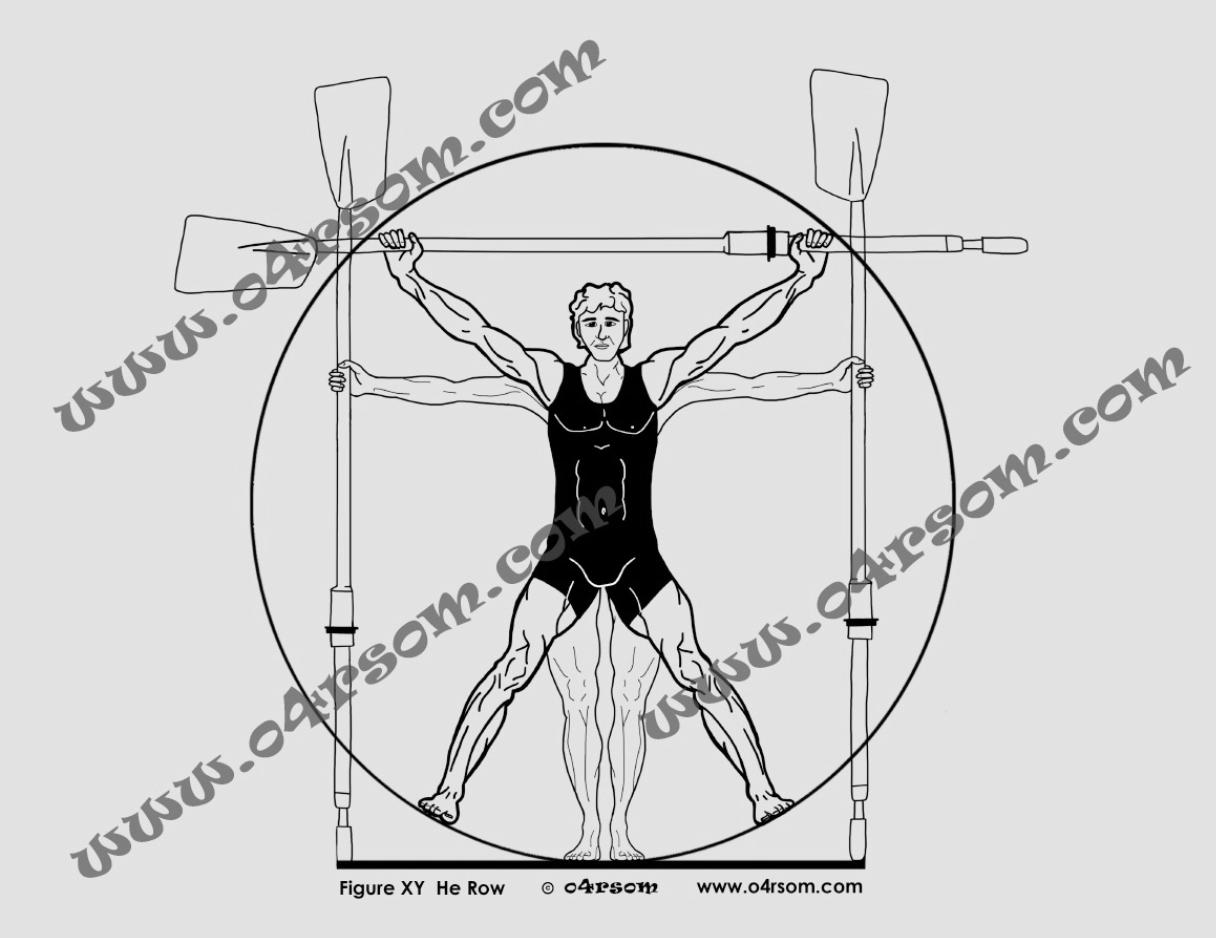
I’m exactly the same height as wingspan (think Archimedes’ picture of the man in a circle). And I used to row with Jenny whose wing span was 15 cm longer than her height - you can see why we had alignment issues in our pair and had to make compromises in our stroke.
You can check if your “wing span” i.e. fingertip to fingertip distance is the same (or more/or less) than your height.
Stand next to a wall put one finger tip on the floor and reach the other arm up to full extent to touch the wall above you. Leave the high finger touching the wall as you stand up… then put your back to the wall and see if the finger is level with the top of your head (or higher or lower).
The Archimedes image adjusted for oarsmen is courtesy of Tonia Williams who does artwork for oars folk.
Why I'm not finished yet seeking to improve my rowing technique.
Timestamps
There is no stroke I've ever taken which is perfect yet why do I keep trying?
My rowing started as a student in a bank tub, a tub pair and then a clinker eight. One of my first videos showed that I lunged at the catch - this fault has stayed with me ever since! I revert and then correct many times.
Why I'm not finished yet seeking to improve my rowing technique.
Timestamps
00:45 There is no stroke I've ever taken which is perfect yet why do I keep trying? My rowing started as a student in a bank tub, a tub pair and then a clinker eight. One of my first videos showed that I lunged at the catch - this fault has stayed with me ever since! I revert and then correct many times.
Taught me ways to separate each part of the stroke or exaggerate the movements - so I learned to separate different body parts moving.
Starting to scull I began to learn how to make the boat glide. I could see why people choose rowing because it felt so good. The learning journey is a series of steps - I had jumped ahead and then couldn't regain that feeling. I needed to go back and fill in the gaps in my learning so that I could consistently make the movements.
Single sculling taught me how to recruit more muscles - how each part contributes to the rowing stroke. Notably, my glutes were a gap in my learning. It also helped my mental endeavour - anything happening was caused by me and the resolution was also mine. I took on new challenges like steering and sweeping on both sides.
Sculling also taught me boat feel - how the boat responded to the water conditions and the weather. External stimuli taught me how to adjust the stroke to respond to these. Dissipating negative effects caused by externalities or taking advantage of positive influences. Small adjustments to how I was sculling was a good lesson.
The continuous learning journey is a series of steps forward and backwards. I came to understand the difference between rowing style and technique - viewing scullers from a distance, you can recognise individual people.
Now as a masters rower, aging adds another dimension. As my body changes I'm making different adaptations and changes e.g. strength training. And different challenges - learning to blend crews together from differing techniques. The pleasure of making a crew fire by everyone making small changes so we together make the boat go better is high. My perfect stroke today in this crew will be different from that in another crew lineup.
The journey is never only, the challenges continue. Enjoying the process of the journey rather than seeking a singular destination is why I love being a masters rower still working on finding the perfect stroke.
Want easy live streams like this? Instant broadcasts to Facebook, YouTube, LinkedIn. Faster Masters uses StreamYard: https://streamyard.com/pal/d/5694205242376192
Many coaches started doing rowing video analysis markup with a tool called Coaches Eye - sadly it was withdrawn September 2022 and so we have all been on the hunt for a replacement.
We have found some for you to consider.
This is free on the Apple Store. You can import your videos into it, run at slow speeds down to 1/8 speed, annotate, measure angles etc. Also offers In-App purchases for distributing video to athletes.
You can upload two videos side-by-side and compare them.
This is a tool which does physiological measurements for you - it scans your video of rowers and tells you angles between the limbs and the stroke length and sequencing. The process is called "telestration".
Clearly useful for tracking progress as your crews adapt to a particular style of rowing. Downsides, it's THEIR analysis, not yours and it is only numbers. The coach needs to first have a good idea of what numbers they want. The app is free at the moment as it's in beta.
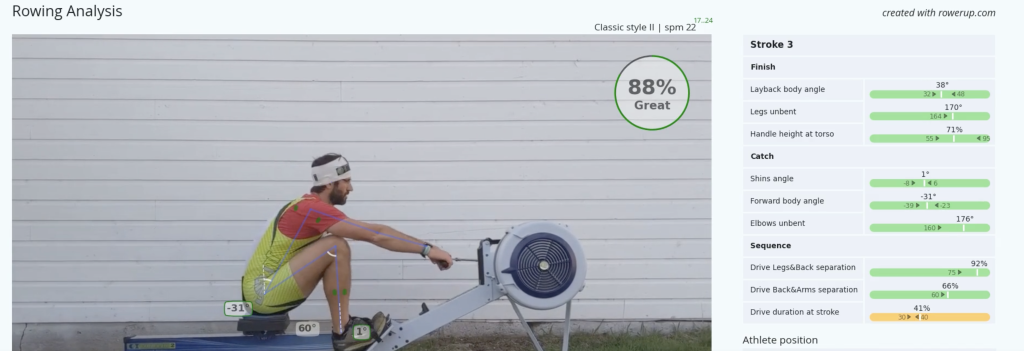
This is the closest alternative to Coaches Eye - annotate your video with lines, angles and comments. It also offers semi-automated angle tracking (like Rowerup). Most usefully it allows side by side comparison of two videos which you can synch e.g. to the catch of one stroke.
The app is free and the creator asks for optional Patreon subscription support.
This is an app and designed to offer simple annotation and most usefully "skeleton mapping" - a stick man drawing tool. So you can automatically see where the rower's limbs are and how they move. That saves a lot of time drawing lines! It has slow motion replay, and side by side options and also allows text messaging to your athletes from inside the app.
The coach version is only available in the Apple app Store for iPad users. The Athlete version is in the Google Play store as well. The coach version includes in-app purchases.
This article was first published in the Masters Rowing Magazine in May 2023.
Discover how to adjust your blade parallels when rowing in a mixed crew to get the oar arcs as similar as possible.
Timestamps
Set up the boat for a comfortable row - ideally with all the oars moving through the same angles. Know the dimensions of the athletes - how tall are you relative to your wingspan (fingertip to fingertip).
04:00 We do not have to be rigged identically in the boat. Start with the basics - ensure your set up in the boat is good. Start with getting the finishes parallel. Set up your back seat wheel to the same distance behind the face of the work. 58-62 cm is a normal range in sweep. In sculling, it's done by getting the gap between your handles the same at the finish. This assumes you are using oars / sculls which are the same length and inboard.
Meeting in the middle is worthwhile - tall people row a little shorter and shorter people row a little longer. Use video to assess how you are rowing - record this at firm pressure to get the best insight.
Want easy live streams like this? Instant broadcasts to Facebook, YouTube, LinkedIn. Faster Masters uses StreamYard: https://streamyard.com/pal/d/5694205242376192
Get better at extracting the oar without being splashy and frantic. And why your elbow position is of critical importance.
Timestamps
The goal is to get the oar out of the water in a smooth movement and as efficiently as possible. Start with the correct set up at the finish. Your handle end should be in line with the side of your rib cage.
Pause at the finish with the oar flat on the surface of the water. This helps you check the height of your handle and your outside hand should be brushing your shirt. The handle height is the same as when your oar is under the water a the end of the power phase. Check you are drawing your finish to the right position.
Outside hand drawing through with pressure and controlling the height of the handle; the inside hand is squaring and feathering. Outside hand pushes down to extract the oar from the water and then the inside hand turns the oar to feather it. Practice this slow motion or in fours/pairs.
Wide grip (inside hand down the loom) helps to teach you which hand controls the handle. By isolating your inside hand closer to the oarlock pivot, it makes it harder to control the handle height with that hand. Control each hand by altering the grip tightness on the handle - loosen the grip alternately to keep the focus (inside/outside).
If your elbow is lower than your wrist it's hard to push down on the handle with the outside hand. Progressively move your hands back to a normal grip starting from wide grip.
There's a tendency for may athletes to have too much control with the inside hand. You're also unlikely to be only feathering with the one hand.
Keep pressure through to the end of the stroke, holding your oar under the water 1 cm longer.
Work your inside hand at the very end of the power phase - the outside hand loses effective power at the end of the power phase because it's at an increasingly obtuse angle to the oar handle. Whereas the inside hand can stay at 90 degrees to the handle. Give an extra pull with the inside hand at the end of the stroke.
Stationary stability drill is a free video joining bonus in our Coach Mastermind Group as a joining bonus. Get yours here
And to your hand grip tightness while rowing. Ensure you aren't dominating with the wrong hand.
Further Resources
I saw this post online from a respected coach and we discussed it in the Coach Mastermind group discussion.
What do you see in the photo? Compare stroke and 7 seat athletes. Think about technique, posture, power creation, muscle recruitment, likely blade spoon position.
[DON'T scroll down until you've thought about your answer.]
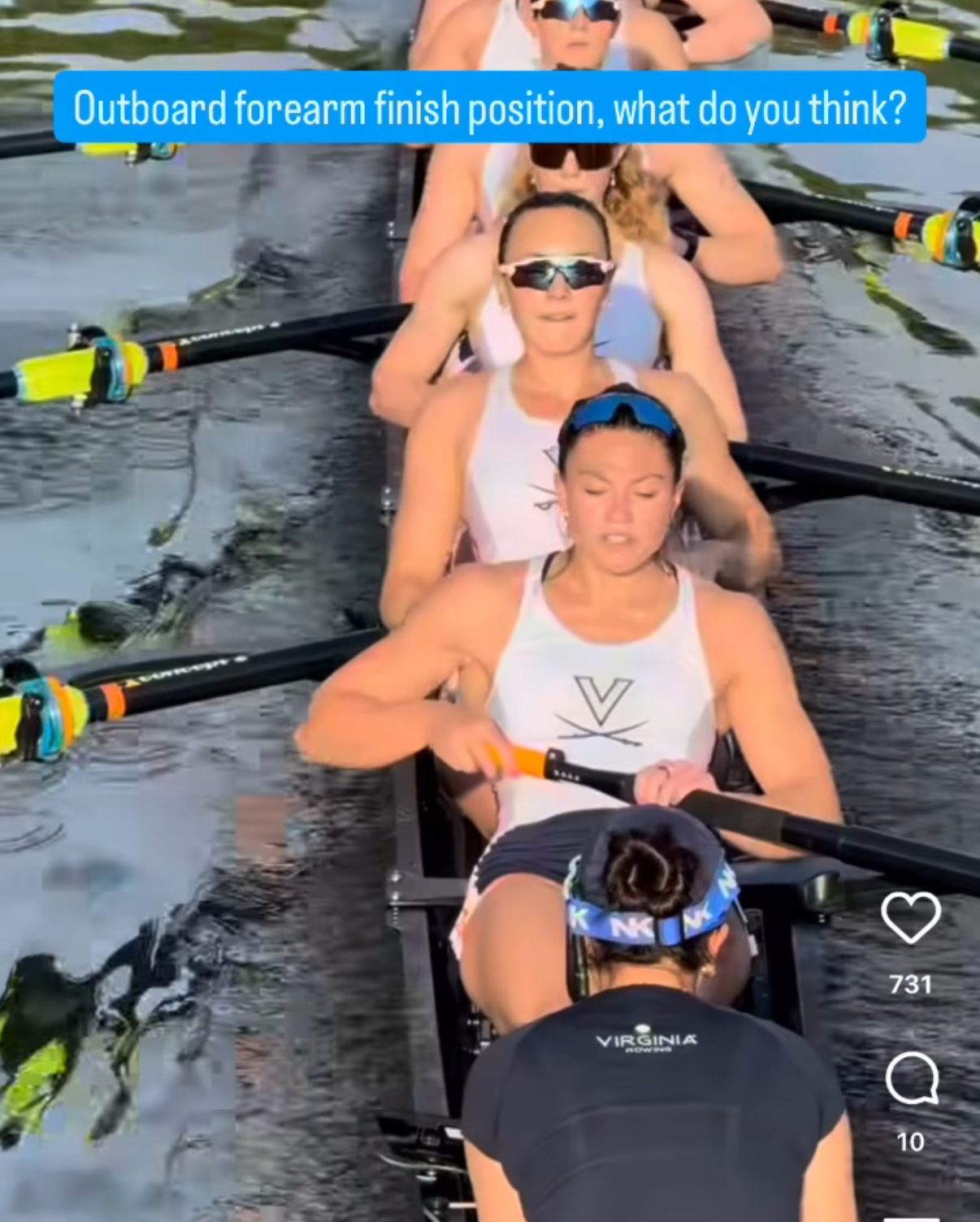
My views and what I can see (training your coach's eye to spot these differences is an important part of advancing your coaching practice).
I see the stroke has her right elbow pointing sideways out of the boat and her right hand rests on top of the oar handle with two fingers lightly holding the rubber grip and the wrist is flat; she leans slightly towards her rigger (shoulders aren't level) and her inside arm is feathering the oar and the elbow is lower than the oar shaft. There's a lot of tension in her left forearm.
The 7 seat has her left elbow pointing behind her towards the girl sitting behind, the wrist is flat; she also leans a little towards her rigger and her inside elbow is pointing a little out the side of the boat. We cannot see her right wrist or oar handle grip.
If stroke is controlling her oar handle height with her inside hand (I can see more tension compared to her outside hand) then she likely will be less skilful placing the oar at the catch. It's harder to control the push down on the oar handle if your elbow is below your wrist or the oar handle/shaft. Similarly trying to place the catch using the inside hand is less accurate (as your inside hand is closer to the oar shaft fulcrum).
If 7 has her outside elbow pointing behind her she's likely continuing the arm draw using her lats as well as bicep/tricep. She looks like she isn't feathering with her outside hand.
Both athletes may be able to get more power right at the end of the drive phase if they used their inside hand to pull the very last bit of the stroke. This is because as the oar handle comes around the arc, the outside arm becomes increasingly ineffective, while the inside arm can have a 90 degree angle to the handle which is efficient for pulling. Note this is a very small part of the power phase.
Could the boat go faster if these technical points were changed? How fast can athletes change their technique? When fatigued, how quickly will athletes revert to "poor" technique? Have you got time to fix these things before a big regatta? Is this a coaching style you want to encourage? How much crew symmetry do you desire in your crews?
All of this is in service to identifying inconsistencies in your crew and for you to coach them towards identical positions while activating the same muscles to make their rowing stroke power.
Masters rowing is about rowing with adaptations.
Timestamps:
00:45 Grant Faulkner quote: The speed the clock moves forwards and the things it takes away. Masters learn to enjoy age and the things we have to adjust for our rowing.
Nobody told me it was going to be like this!
Strength and Mobility are the main things you will notice first. Strength diminishes differently between men and women 50s versus 60s. Your 60s is a 'hold steady' decade. Read article. Use the Facebook group to post questions and get answers from people who have the same issues.
Range of movement in joints is important - pelvic mobility in the hips to get into the rowing stroke positions. Flexibility is also key.
Programs page has FREE STUFF including How to test your functional movement and strengthening exercises. David Frost's webinar on Functional Strength and Movement is a deeper dive into exercises for body strengthening for daily life - essential for older women who find it hard to lift a boat. If athletes can't get into the right positions for rowing it's difficult to teach them.
Adjustments to take account of mobility issues. Adapting Rowing Rigging For Masters Physiology article Try to maintain your technique and range of motion as you age. Adjust rigging to accommodate physical limitations - some are easy, medium and hard - they take tools and more time to set up.
We can still always improve our technique as we age. Despite losing strength, masters rowers can always be more skilful at the catch, get the blade in without slip, get a full leg drive, recruit extra muscles to add to power delivery. Technique has no regard for age - you can improve at all ages.
What is the next horizon for you? Most of us delay making changes - if you are losing strength, you should be shortening your oars (Volker Nolte's Rigging Webinar has charts for oar designs, Men and Women). Most masters row on oars which are too long for their strength and capability.
This webinar includes
Want easy live streams like this? Instant broadcasts to Facebook, YouTube, LinkedIn. Faster Masters uses StreamYard: https://streamyard.com/pal/d/5694205242376192
The three stages of masters rowing and a checklist of the skills learned in each stage. When learning to row you move up through experience and grades.
This is a summary checklist - you can get a more detailed one if you join the
Coach Mastermind Group - customise this to suit your waterway and local safety practices.
checklist
Now you know where you are, here's what to do about it. Faster Masters Rowing has resources built specifically for masters rowers at every stage - pick the ones that match where you are right now.
Focus on building safe, consistent habits before worrying about refinement. Your priority is confidence - in the boat, with other water users, and in your own body. Start here:
You've got the foundations - now it's time to get precise. This is the stage where technique pays off in real speed, and where most masters rowers spend the longest time. Go deeper with:
At this level the gains come from refinement, data and smart decision-making. You're also likely supporting others in your crew, so your coaching eye matters as much as your own rowing. Take it further with:
Watch our podcast episode on the ladder of learning — we walk through how rowers progress from beginner to advanced, what holds people back at each stage, and how to know when you're ready to move on. It's a practical listen whether you're coaching yourself or others.
Join the Faster Masters Rowing newsletter for regular technique advice, training ideas and insights designed specifically for masters rowers. Thousands of rowers aged 40+ read it every week.
Sign up free →The free checklist you've just downloaded is a summary. The full Rowing Skills Checklist — available from the Coach Mastermind Group — breaks every stage down in detail. It's US$10 and worth every cent.
Get the full checklist →Meet Jonathan Drake who teaches rowing using Alexander Technique methods.
01:00 Jonathan is an expert in rowing, Tai Chi and the Alexander Technique. His awareness of his co-ordination issues comes from being an Alexander teacher. Insights into how adults learn. His book is Rowing from the inside out: The art of indoor rowing with on the water in mind.
What is it like to scull on the water while you're learning to row indoors?
Understand how rowing is "in your head" and how to connect this to what your body does. Ingrained movement habits are hard to change especially as you get older. Move more lightly, freely and less movements creating tension.
Pulling your neck forwards and downwards creates tension in the rowing stroke. Feel how the dynamic opposition of one part of the body connects or separates from another part. Using your body changes through the rowing stroke. In the power phase the spine lengthens and changes at the finish before lengthening again on the recovery. The perspective is novel - indoor and outdoor rowing combined with Alexander Technique and Tai Chi. Learn from the inside rather than copying someone else from the outside.
10:00 There's a sequence in the feet - pushing off the balls of your feet causes calves to tighten and then after your heels are down and the stroke finishes, people lift the balls of their feet again. That's why gym rowers strap in their feet tightly. The basic dynamic is through the feet - the inside of your heels means you access the whole of your foot arch, this gives you the power you need to perform rowing while sitting dynamically.
It gives you more awareness of when you're using more effort than necessary. Engage in the journey yourself because you cannot teach what you do not know. You can get results without all the effort.
Encourage your athletes not to strap in your feet from the beginning. How to hold the handle without gripping (creates tight wrists and shoulders). When you understand about how to control the blades in the water - feather into your fingers - you can use your fingers on the indoor rower in the same way.
The key to coordination is the relationship between the neck, the head and the back. If your neck stiffens it creates spinal compression and tension. Our habits feel comfortable. Come to a state of quiet to help the body to organise itself. Learn to do less in order to achieve more. At the start of the drive the connection comes from the feet, then moves into the legs / hips / back and into the arms. As the recovery begins the pelvis takes the energy into the arms and body.
Ed Coode, rowed for Great Britain in Athens 2004 - he was taught AT.
20:00 The book is very clear on how you teach. When Jonathan is on the rowing machine he views each stroke as a potentially new experience. Use them as an opportunity to be constantly refining and improving your movement patterns. It's never too late to make improvements. The book has links to video clips on YouTube to show what to do.
Contact Jonathan [email protected] www.everydayfitness.co.uk
Want easy live streams like this? Instant broadcasts to Facebook, YouTube, LinkedIn. Faster Masters uses StreamYard: https://streamyard.com/pal/d/5694205242376192
Why the blade pathway from crossover to catch is so different between the left and right hands. If you aren't going straight, three things to check.
01:00 What generally causes difficulties?
Beginner errors are straightforward to work out if these are affecting you.
Look from your stern to the horizon and line up your stern with a fixed point (house, power pole, tree) and watch the wake off your stern. You can see if the vee of the wake is symmetrical.
04:30 Blade extraction - are the blades coming out at the same time and are you pressing down symmetrically? If one blade drags that affects the boat course.
05:30 Blade crossover - from extraction to handle crossover it's important the boat is level. The rig is left higher than the right - your handle heights have to reflect the difference in oarlock height. Ensure your hands are "nested" close together.
08:00 Blade catch - the handles have to be symmetrical around a similar arc from the oarlock so the tips of the blades are the same distance from the side of the boat.
The right hand has to move a greater distance from crossover to the catch than the left hand. It's probably 2 cm greater distance. Practice the fine motor skills to make subtle adjustments to the handles using pontoon floats on a single scull. Your arms have to go out to the same distance at the catch (not the same handle height). Listen to the sound of the oars going into the water - you can hear if one oar goes in before the other.
Want easy live streams like this? Instant broadcasts to Facebook, YouTube, LinkedIn. Faster Masters uses StreamYard: https://streamyard.com/pal/d/5694205242376192
Join our community and get our exclusive Faster Masters Rowing Magazine, packed with tips, techniques, and inspiring stories. Includes four new articles monthly.