Support this show with a donation
https://fastermastersrowing.com/register/podcast-supporter/
03:00 This past week - Learn to row classes; Peer to Peer Coaching Clinics and new masters at Knowlton Rowing Club
08:00 Gardening and rowing - over use injuries.
12:00 Troubleshooting body sequencing. Video first so you know what you're doing
13:00 The recovery - know the sequence you want. Arms - body - slide.
Feeling unstable when putting the blades in the water.
Setting the body angle - twice or once?
Moving up the slide "like an accordion"
17:00 The power phase - the sequence is legs - back - arms.
Only use each body part once per stroke.
Drills to emphasise the sequence - Legs only rowing; legs and backs; legs back and arms. Then blend them together.
24:00 Legs only drill. Blades on the water reinforces the horizontal power - level handles.
Mark the blade shaft 40 cms up from where the blade joins the shaft. Use white tape and use this as a marker to ensure the blade isn't too deep.
29:00 Blade depth while stationary - check it.
The slope of the oars to the water matters and is affected by boat depth in the water.
40:00 Finish at the xiphoid process - demonstrates the oarlocks are set at the correct height.
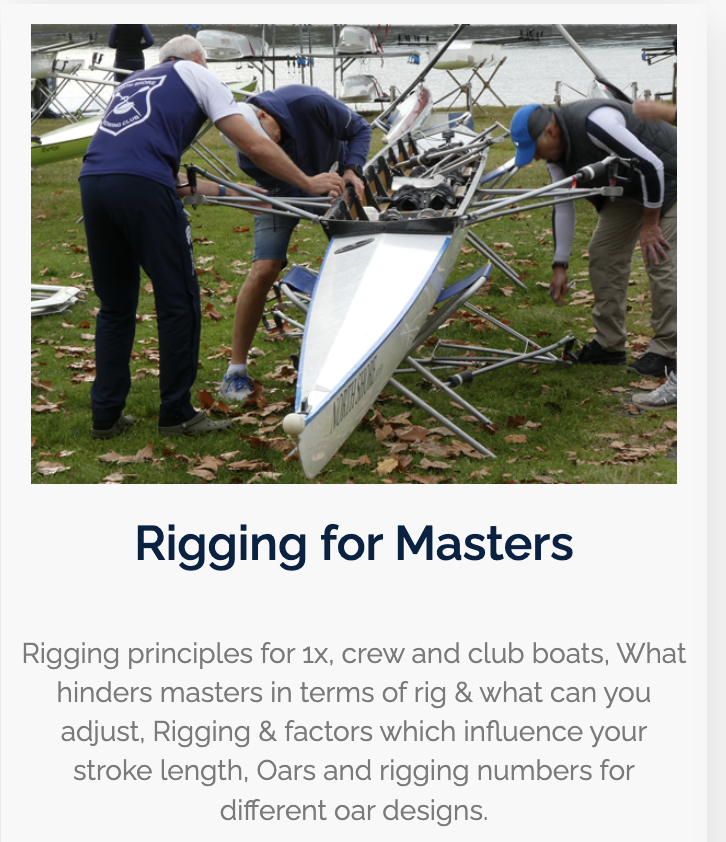
Masters rowers fundamentally are no different from any other age group. However, regular competitors know that your strength and flexibility changes as you age and so it is helpful to re-assess rigging and boat set up regularly for masters training groups. Knowing how to adapt rowing rigging for masters is explained here along with some common problems and how to fix them with rigging adjustments.
The goal of rowing and sculling boat rigging for masters is twofold:
Let’s start by reviewing the parts of a rowing boat which are capable of adjustment and the degree of difficulty involved in changing each.
My assessment of easy / moderate / hard is based on the amount of time, tools and skill needed to make a change. For example, a club who uses snap-lock spacers on the oarlocks will find it very easy to change the oarlock heights on the water.

Changing your slide position on the water is more challenging - but easy to do off the water with the boat on trestles. Adjusting the rigger pin takes tools, time and expertise and so is classified as hard.
Knowing what can be changed is a good starting point. Any change has to be made with reference to an “ideal” or preferred situation. Therefore rowing groups should all know some basic principles of rigging which can be adapted for taller or shorter people.
There are some fixed positions that rowers should be able to achieve
These give you clear points in the rowing stroke cycle to check against what your athletes actually do when they are rowing. Note that many will be able to get into these positions when the boat is stationary, check if they actually do it while rowing continuously.
Problem: not enough space between the handles at the sculling finish
Problem: Handles can go past the body at the sculling finish
Problem: Cannot get shins vertical at the catch
Problem: Cannot get back rocked forward with shoulders in front of hips on recovery
Problem: Cannot keep oars buried at the finish under the water
Problem: Tall athlete rowing with a shorter athlete
Problem: Big shoes in the boat and athletes with smaller feet
Most rigging fixes are a combination of recognising a problem and knowing what to try as a possible solution. As a rule, only make one change at a time, go rowing and see what the change is before making another change.
Would you like to publish this article in your club newsletter or website?
Join our Masters Rowing Advocates mailing list and we will send you one article a month. Sign up on our Advocacy page.
You can copy the text on this page. Or download the PDF
These observations are from my experience and there certainly are variations between different people but these are some trends.
Check each decade to see what you could be experiencing now and into the future for your own rowing practice.
If you are a former student athlete and you continue to train as you start your career, work, or family, you can maintain a high level of fitness close to that of your university years and even surpass that fitness. Provided that you are living a reasonable “athletic-lifestyle” your body has a great recovery capacity and you can certainly push your limits. Many single scullers reach their peak in their late 20s early 30s. In masters rowing, high-energy athletes in this age group often train 6 to 9 sessions per week including land and water workouts. If you are new to the sport 3 to 4 sessions per week will provide a good base for technique, for additional fitness you can include more land-based training.
You will often have limited time in this decade and have to weave your rowing in between your career and family demands. So the key here is making sure that you get adequate training to support the level of your goals and to put a priority on quality workouts versus quantity. Getting enough sleep and recovery is an important training factor not to be overlooked. Top masters in this age group are likely to train 5 to 7 sessions per week; newcomers should aim for 3 to 4 rowing sessions complemented with cross training until a good base is established.
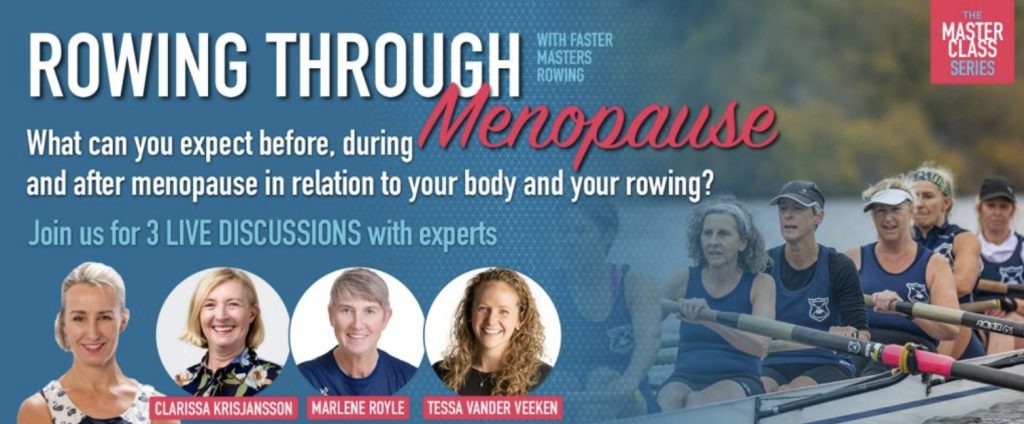
Take a look at the speakers and the detail of what you'll learn.
This is one of the most competitively-minded groups in masters rowing; especially among women. This is often a time when your career is well-developed, the children are a bit older allowing more personal time for pursuing rowing goals and motivation is very high. It can also be a time when many new masters join the sport because they now have some additional time to follow personal interests or have the opportunity to pursue athletic goals they had earlier in life but put on hold.
With your 50s come metabolic and hormonal changes in both men and women. Sleep patterns may be disrupted, unwanted weight gain can happen easily, so diet and sleep need to be watched carefully. If you are lacking sleep at night it is important to take short power naps before or after training so that your workout has quality. Recovery has to be monitored more closely and if you are feeling run down, boost your protein intake and take additional rest. Always err on the side of caution. The top competitors in this age group train 5 to 7 sessions per week. Newcomers must take care not to over do it, your body needs time to adapt to the training and doing too much too soon can cause over-use injuries or set backs. Your body must adapt on the cellular level and this takes time.
The body undergoes greater metabolic changes during the 50s decade and so your 60s can be a fairly stable decade provided you have no major or unfortunate health issues to deal with. Retirement offers more training time, at much as one can tolerate safely, and also allows for more recovery time. With each additional year of age, recovery becomes paramount to success. You may not be hitting personal best times compared to when you were 40 but you can certainly maintain a high level of competitiveness and fitness through this decade and keep your erg score pretty steady. Technical improvements become more and more critical as the ability to increase hours of training is limited for recovery reasons. It’s far better to get coaching and gain boat speed technically than trying to pile on extra training hours. Maintaining flexibility, proper recovery, and injury prevention must be closely attended. Top masters in this age group train 5 to 6 sessions per week. Novices may want to aim for 3 sessions and gradually build up as tolerated.
Seasoned rowers, in their 70s are some of the first humans to have been athletic most of their lives. This age group is no less competitive than any younger age group especially on the international masters level. Athletes have reported to me that when they turn 70 their body goes through another major change as it did in their 50s, primarily that the body’s response to exercise becomes more unpredictable.
Typical workouts now require much more recovery, two to three days compared to one day in years past but it can change from week to week. The main factor here is to continue your training but be flexible to adjust for your recovery needs. Some days you may need to simply go for a walk if it means the next day you can again have a quality workout. You may want to look at varying your weekly schedule to be one day on one day off or two training days followed by a rest day, or include active rest days between harder rows. Again, it is very individual and one has to be prepared to adjust as your body dictates. There is every reason to continue to get coaching to row better, to maintain flexibility and muscle mass, and to maximise your time on the water. It’s also a great way to get out in team boats and row for health, friendship, and well-being.
This age class is growing and I suspect it will only continue to grow in years to come. Already 70-year olds tell me that they can’t wait to move into the next age group. I repeat all the same points for the 70-year olds with an even great emphasis on recovery and injury prevention. Always err on the side of caution. Safety concerns should be paramount in conjunction with health and well-being.
I am sure this age group will expand.
Would you like to publish this article in your club newsletter or website?
Join our Masters Rowing Advocates mailing list and we will send you one article a month. Sign up on our Advocacy page.
You can copy the text on this page. Or download the PDF
Several listeners asked questions about oars and rigging for masters - specifically how long your sculling oars should be and what the ratio of outboard to inboard is ideal and whether that changes for different oar shapes,
We apologise for the poor audio in part of this podcast.
01:00 This Past Week - what we do to advocate for masters rowing.
Rowing Canada ethics course - legal issues, ethical issue and scenarios
Rules for rigging rowing boats
- Make yourself comfortable
- Centre yourself - at the catch hip on the pin centreline
- Height - keep your forearms above the handles
Sit in your boat and get someone to observe - if they aren't an experienced rower, just get them to take photos of you - from as low down as possible so you can examine in close up.
Sadly "it depends" is the only correct answer here. It's more important to see the person in the boat than to just follow rigging numbers. Customise to your flexibility and strength.
Sculling oar lengths for masters depend on your age and the type of oar you are using - see diagram below.
Rig for the "end of the race" - Ted van Dusen
What degrees of arc should we rig for?
Your priority is to get as many degrees of arc catch angle as you can.
In a September 2021 Rowing News magazine article Volker Nolte makes recommendations for masters "Rigging Numbers for Scullers"
The diagram below is from the article.

28:00 Hanging or arm bending in the initial part of the stroke?
Use each body part once per stroke - does arm bending affect your finish?
35:00 The Power Rectangle in rowing diagram. When oars are perpendicular what is the pattern of legs, back & arms - using the right sequence. Check using video.
37:00 Foot stretcher angle and height - rule of thumb 43-45 degrees on the foot stretcher. Shoe height is determined by your flexibility and height.
Ensure your shoes fit. Check heel to seat measurement on the erg.
44.00 Getting back on the water after a long break - using pontoons. Be gradual.
Try "no puddle" rowing and turns or backing down with some stationary drills to reacquaint yourself with the boat and oar handling skills.
47:00 Getting to the pin in club boats - should you compromise finish or catch?
Use the release position if you can't adjust them.
Buy your own oars if you can afford and use clams to adjust then to suit the boat you are in.
Ask your club committee or board to standardize boat set up.
51:00 Changing oar gearing is it OK to shorten or lengthen the inboard?
Are you trying to match other people in the crew? How does it affect your rating and load?
54:00 C2 Fatties (sculls) can you cut them down to 85cm?
57:00 Using the C2 Comp blade for lightweight women masters
1:02:00 Transferring sculling skills to a sweep boat
Consider rotation, inside arm and faster moving boats.
Which is better Layback or swing?
Experts explain the difference and how to pick which you need for your rowing and sculling.
03:50 This week in masters rowing we have worked on the March Faster Masters program specially on spine health for rowing. We are supporting the US Rowing Indoor championships CRASH-Bs
08:50 We guested on the Backpack show with Chris Brogan and Kerry Gogone.
Rebecca’s photo is of Orca’s Island by Tena Hall
Rowers sometimes tie themselves in knots by thinking too much about their technique. Try thinking for 10 strokes and not thinking for 10 strokes. There’s an elasticity in rowing without tensions. Drills are important to create new movement patterns.
21:00 Do your workout with the voice in your head. Be un-judgemental. It’s not good or bad - did I do it correctly?
28:00 The Hula dancer on the pendent boat at Craftsbury - did you row this boat?
Too much layback is common. What’s the purpose of layback?
Swing is using your body weight. Layback does not necessarily increase the length of your stroke. Ergs reward layback but not in the boat.
32:00 Pay attention to your lower back; don’t collapse it. Too far means you don’t have enough time to set your body angle.
Try feet out rowing for getting the pressure in the second half of the drive.
40:00 Caryn Davies interviewed on RowingChat.
https://rowing.chat/caryn-davies/
Marlene and Rebecca discuss
Staying mindful is all about keeping your brain focused on what you are doing in the present moment.
The concept of mindfulness lends itself to learning the rowing stroke. Thinking about what you are doing so that your movements are careful and controlled will help you to learn correct rowing technique and improve sculling faults and rowing errors.
05:00 Sacro-Iliac joint dysfunction - has anyone got this from rowing? It’s a sliding joint in the pelvic area. When it does not glide smoothly it is dysfunctional. Quadratus lumorum or QL is tight this gives back pain and is sometimes a sign of SI dysfunction. Flexing forward is harder like putting on your socks.
10:00 If you are prone to it how do you sit? Is it favouring one side or are you tight on one side of your back?
13:00 Returning after injury. If you were competitive a long time ago, we have learned a lot since 30 years ago about athletic bodies and masters older athletes. How long were you out of training? The rule of thumb for returning. Same amount of injury time is the time it takes to come back. You can never see do too much easy rowing training. Be careful you don’t lose your form
16:45 Off water training - mobility and stretching, strength training. Keep a training diary and count your minutes total per week training. Add 500 meters per session. Your body adapts at a cellular level. 10-15% more per week in minutes. Use the Faster Five as a template for learning and improving your rowing
21:00 Isometric work such as seated hold, contract muscles, hold and relax the calf muscles and glutes is helpful. You can reduce inflammation with Omega 3s in your diet and aspirin.
25:00 Mindful practice - perfect practice makes perfect. So many things can lower your stress and help you get better technically.
Drills for technical improvement and low intensity workouts
- row in circles
- slow motion rowing
- shadow rowing
- row in double and take turns to do 30 strokes each then 30 strokes together.
When you are really fatigued you cna get into a dysfunctional stroke patterns and you are best to stop before you get tired.
32:00 Dr Stacy Sims interview with Rebecca on RowingChat link is below. Marlene recommends tart cherry juice which also stimulates melatonin as a sleep aid.
https://rowing.chat/dr-stacy-sims-sporting-women-are-not-small-men/
What Stacy says about menopause and training at 39 minutes in.
Research in menopausal women - peri menopause where you get more oestrogen dominance is the 4 years prior affects your body composition where biggest changes happen.Many epigenetic changes happen. First reduce long slow distance work and emphasise heavy resistance training and increase higher intensity work and plyometrics. Glucose control and when lean mass development and recovery when they flatline or the ratios of each change, you need an alternative to stress. You have to challenge the body post menopause - the longer you go the slower you become. Use the stressors from exercise and specific nutrition dosing to get what oestrogen and progesterone hormones used to do for you.
ROAR. How to Match Your Food and Fitness to Your Unique Female Physiology for Optimum Performance, Great Health, and a Strong, Lean Body for Life
https://amzn.to/3dKQbSb Amazon affiliate link
Marlene and Rebecca discuss
Faster Masters Rowing announces the launch of the Faster Five.
Find out more at https://rowing.chat/sponsors/
Kanghua single for sale
The team at Kanghua has a single scull available for sale. It's an all carbon Spirit design for athletes weighing 60-65 kilogrammes. You can trial a Spirit single scull near your home club by contacting Eric Sims
https://rowing.chat/sponsors/
05:00 Interviewing and hiring a rowing coach. What to do and what not to do. You are looking for communication skills. Getting along with the group. Can they adapt their teaching style to the learning style of the athlete? What’s important to them as a coach - what do they get out of coaching?
09:00 Specify the goal of the programme - is it competition / fitness / recreational? What are the age range of athletes? Boat sizes - big or small. Write the advert for a rowing coach as specific as possible including qualifications needed
14:00 Interviewing a rowing coach. Get references. Invite them to a practice day. Watch how they interact with the athletes. Observe how they coach. Then ask scenario questions - how do they problem-solve this situation. In their reasoning check they have health and safety in mind and check they ask the right questions.
17:00 How would you select a crew? This is a great interview question to ask. Being a team player has a big influence on culture of the club. Remember unhappy members affect the club culture.
20:00 Coaching technique versus coaching people. They have to be effective communicators. Give the novices the best technical coach.
26:00 Have the crews give input into the selection - do a sample coaching weekend. Get feedback from your members. Use a survey which can be anonymous.
Read the article When Masters Can't Find A Rowing Coach
https://fastermastersrowing.com/when-masters-cant-find-a-rowing-coach/
29:00 Starting work with a virtual rowing coach. Several clubs are working with Faster Masters alongside having an in-person coach. It’s powerful to have a common goal for your group.
32:00 If your coach is not comfortable writing a program this can work well - buy the Faster Masters Rowing program and use it alongside your in person coach.
Rebecca and Marlene explain The Faster Five essentials for rowing
Technique, Bladework, Stroke Power, Racing and Fitness Assessment.
12:00 We launch the Faster Five. These are principles which are important to learn, how to practice and what to practice. Things to pay attention to and key reference points.
The Faster Five represents the Faster Masters Rowing philosophy of teaching and a structure for you to plug into when you are studying rowing and learning how to become the rower you want to be.
16:00 Faster Five - Technique . Reference points so you can practice on your own. It takes thousands of strokes to learn the correct technique. It takes 3 seasons to become a sculler and 2 seasons for a sweep rower to feel they can apply good power in both sweep and sculling.
19:30 Faster Five - Bladework. timing and co-ordination is important. When you hold something in your hand (the oar) your brain thinks it's part of your hand. This is why it takes a long time to learn. Reduce your wash and blade is a key part of the learning from the Faster Five. The timing, finesse and precision takes drill work, focus and concentration. Developing high speed co-ordination is key to becoming a skilled rower.
23:00 Faster Five - Stroke Power - this comes after the bladework which brings confidence to your rowing. Power requires you to trust the oars and use your body weight. Learning the sequencing, being explosive and being effective at moving the boat.
26:00 Faster Five - Racing - the principles of racing well. Mental and physical, starts, steering and race strategy. What works for you and your crew. Back up plans. Relevant for all rowers whether you race or not because you can test yourself and get progress markers.
30:00 Faster Five - Fitness Assessment. A battery of tests to gauge your quality of rowing including stroke power, VO2 max, anaerobic threshold. Comparing the results works on both an erg (watts) and on water (500m spit to watts). The relative comparison gives proportional fitness measures. This changes over time.
34:30 If you are injured and come back to rowing your test shows you the right level of intensity you can manage.
38:00 Where to get the Faster Five. Link is in the website footer
https://fastermastersrowing.com/courses/the-faster-five/
When you subscribe to ANY monthly recurring program on Faster Masters Rowing the Faster Five is included as a welcome gift.
When athletes stop doing our training program you lose a lot. You lose commitment, you lose engagement and you lose someone else coaching and doing the thinking for you.
When you stop doing our training program you lose fitness, you lose your edge and you don't stay engaged and showing up. When successful athletes stop doing the Faster Masters program 100% of the time they never maintain the results they had on the program. Success does not carry on without an ongoing, developing training program.
40:00 Faster Masters is more than just a training program. Faster Masters is not babysitting athletes. Depth of instruction and insight from masters specialists. The Faster Five took us months to complete and includes our years of coaching expertise.
Masters feel like "disregarded" athletes - we are on a mission to get the sport of rowing to appreciate masters athletes. What we can bring to them, the goals we have are important. We deserve respect. We are building a global family of athletes.

Rebecca and Marlene discuss conscious incompetence in the learning process,
Discuss Conscious incompetence on our Facebook page.
04:00 Conscious Incompetence in the boat. 4 development stages of learning as an adult - from unconscious incompetence through Conscious Incompetence and conscious competence to unconscious competence which is the goal.
09:30 It happens in your cerebellum - how you lean and the smooth co-ordinated movements of rowing depend on your brain to create new movement patterns.
15:00 Salt water versus fresh water 500m splits
17:50 Erg times compared to water times. Concept 2 times equate to a heavyweight mens 4-. RP3 and Rowperfect software equates these to water times. Generally it's hard to do so track them as two separate parallel times.
Marlene calculated WL1x water and erg times - she found a 15% difference with ergs faster.
24:00 Splashing in the boat -my 2x partner is getting me wet. Drills to do.
31:00 Rebecca explains why her boat is named Mental Floss
34:00 Ezz Eldin's question about what do you do to get up and go to training in the morning?
https://www.facebook.com/groups/595853370615544/permalink/1460715667462639/
Back after our holiday break, Marlene and Rebecca discuss this week's masters rowing news, We talk about Listener questions and the Fall Racing Season Program. Buy a question / answer https://fastermastersrowing.com/our-courses/
02:00 Ian Perkins asks I have recently been getting feedback that I’m opening my body early at the catch.
Check the muscle sequencing on the drive phase. Bring the handle with you as you initiate the drive. "Drive the knees away from the chest which is different from lifting the chest away from the knees."
06:00 The legs only rowing drill
10:00 Andres Carazo asks about Training for Head Races. What would be the best way to start the program should I wait til next Month to start, or should I just go ahead and start with the head race module mid-month?
15:00 Rowers versus Oarsmen article https://fastermastersrowing.com/oarsmen-versus-rowers/
Bend a Rowing movie by Daniel Pallotta. Watch the trailer https://vimeo.com/ondemand/bend
16:00 process-oriented athletes and goal oriented athletes. Has Covid thrown you off schedule?
19:00 get ANY race practice it will help you.
HOCR remote race announced https://www.hocr.org/remote-event-announcement/
22:00 Drills for the entry. practice sitting at the top of th slide and get comfortable there.
25:00 The "Catch" drill to help to bury the blade before initiating the drive.
Join our community and get our exclusive Faster Masters Rowing Magazine, packed with tips, techniques, and inspiring stories. Includes four new articles monthly.