When racing, it's important everyone knows what a call means. Whether it's 'sit up' or 'push' or 'sting and float'- there are depths of meaning behind that call.
I remember Mike Spraklen coaching my crew and in a debrief he asked what the coxswain called. She said what it was. Then he went round the circle of athletes asking each of us what those words meant to us. Every one of us gave a slightly different answer. A clear demonstration that we hadn't agreed what the call meant and what we did when we heard it.

In the anecdote below by Drew Ginn he explains that you have to set up the crew/boat to be ready to do the call as well as actually doing it. This shows the level of depth and clarity needed for really successful execution.
Set up the call first - everyone must have a common understanding. Then decide how to use that call. What purpose does it serve in your race plan? To answer this I copy below the words used by Australian legend Drew Ginn. He explains the race plan and how important it was that they got the race "set up" in the first half.
[Taken from his Facebook page.]
In 2006 the race plan was consistent with previous years in pairs and fours. This race was a good example of focusing on our process and staying with boat speed. First 250m set up and solid 2nd 250m and by focusing on length and breathing we established our rhythm early and held boat speed well.
Below were the focuses and reminders I would make sitting in the bow seat.
Once into the 2nd and 3rd 500ms the calls were simple and focused on front end, then back end of the stroke. And each call was made with this type of process: prep call, make the call and feedback on the call. This would be a few strokes before and after each call which was times with each 250m or 45sec.
In any boat having clarity is critical and in pairs its obvious that any inefficiencies and differences in mindset and application has a massive impact. Not straight away but 2 to 3min later the pair just gets heavy and you find out around 800m or so you lose speed and this is why so often pairs who can stay with the speed of the boat and be efficient stand out.
Sequence, length and power leads to rhythm and staying calm under pressure means the boat runs. I always loved the sensation of the Catches call at 500m and thinking 'slide my hips off the front and staying super long in the arms'.
Hips speed, handle speed is about athleticism and I often found you could keep boat speed up but not feel like it was working, verses moving with it and staying with it.
Always loved sitting behind guys like Duncan Free, James Tomkins, Mike McKay, Josh Dunkley Smith as they we great at leading the drive and being connected in the first foot. Which meant in the bow it was about supporting them but being in and on at the catch, and then just hang for as long as possible to let them work. And this was the trick. Accelerating through them to add value while not making it heavy.
The magic of a pair of synchronicity with a little syncopation.
Having a race plan which is customised to your skill and preferences is a thing of beauty. You know it WORKS for you and you can continually refine it.
Coach Sam Dutney leads the Erg Intensive training and has given this outline on how to build your plan.
For erg racing, Sam recommends aiming for an even split for each quarter of the race. This is because the relationship between watts (power) and split is not linear. It takes more energy to bring your split down one second per 500 the lower your splits. Therefore to keep your energy expenditure as constant as possible, even splits is the best strategy.
The purpose of a race plan is to set markers through the race, to help you plan strategies for each part of the race and to give you focus points to achieve this.
Breaking your race plan into "chunks" helps - it's easier to focus on a short term horizon. At a minimum four quarters is an easy breakdown. In a 1k race this is each 250 meters is one quarter. You need to have a goal for each quarter. If you prefer, you can do 8 or 10 chunks for smaller increments.
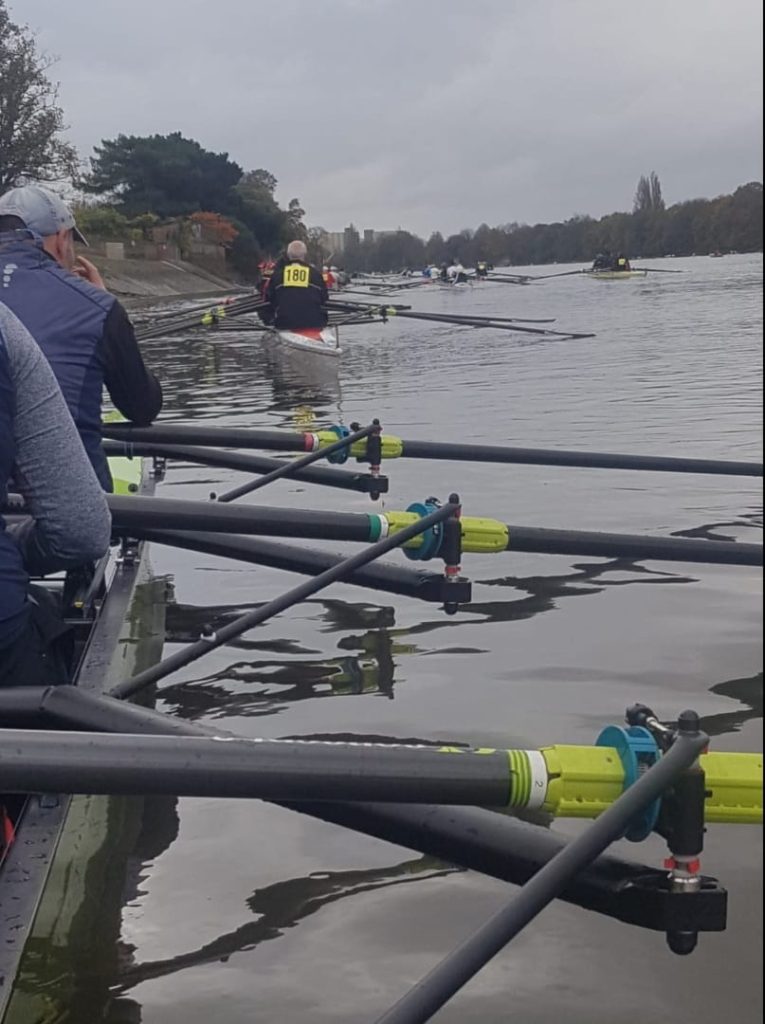
1st quarter - get yourself onto your target split as quickly as possible AFTER the first 10 strokes. Use these ten strokes to work your anaerobic reserves of energy - but they get depleted fast and so after 10 strokes, get onto your target. Focus on length and good body sequencing.
2nd quarter - Consolidate is your focus. The first challenge point in your race comes around 110 - 140 seconds after the start. This is where your energy system switches from anaerobic lactic to aerobic. It will hurt. But after you are past this point, nothing will hurt more than this in the rest of the race. You need to know how many strokes you take to cover 100 meters. Then this allows you to chunk into 100 meter sections. You may take 12 or 15 strokes to do 100 meters. Ensure your focus points DO get you through 100 meters each time so you can cover the distance.
3rd quarter - This is the 'gold medal' quarter. As you come into the third quarter at half way in the race you can make an assessment. How am I doing and can I sustain this pace? If you want, you can accelerate slightly to go faster - as long as you know you can continue at this new faster pace. In this quarter use most of your technical focus points. It may help to distract you from the pain with a focus on technique rather than a focus on effort / intensity.
4th quarter - If you are feeling good, can you accelerate as you come into this last part of the race? Maybe drop the split one point. Do this as a gradual step up in intensity, not a sudden shift. Don't start to sprint until 300 meters to go.
When deciding how much faster you want to go, here are some guidelines.
Changing your 500 meter split by 1 second (e.g. from 02:00 to 01:59) at 500 meters remaining in the race will make your tie 1 second faster at the finish. If you do the same change at 1000 meters remaining, you will drop your finish time by 2-3 seconds. And if you are in the last 200 meters of the race and you drop the split by 5 seconds you will still only take 1 second off your finishing time.
Practice one technical focus at a time. Do these in your tempo pieces during training. This will teach you how to do a range of focuses and you can use the to make improvements during your race. Think of these as being a "bag of tricks" and you need to choose the right trick for each situation.
Sam recommends your technique focus points work around the stroke cycle circle. So you need one for the catch/front end (e.g. engage the lats at the catch); follow this with one for the mid-drive (body swing hard), one for the finish (pull the handle up) and one on the recovery (keep your legs straight as you rock over). The benefit of this is that each technical point naturally leads to the next one in the stroke cycle.
When doing practice races, set your target split on the conservative side. The reason for this is that at the end you will know if you have more energy to give in future. But if you fail to hold the split in your practice trial race, you will find it hard to diagnose why you failed to hold your target split.
Remember, racing is 90% mental.
Race plans - overtaking and being overtaken.
00:30 Coach masterclass discussion zoom was about running masters learn to row classes. We learned the diversity of situation and how people problem-solve for their own clubs
02:30 Race plans Free ebook - the Ultimate Guide to Head Racing sign up to get your copy https://fastermastersrowing.ck.page/693a02e0a1
Goal of a race plan is to row the best race you can, technically the best you can as you fatigue through the race. What to focus on as you move through the stages of the race to retain good technique and efficiency. Don't question the competitive desire.
As the stages of the race progress how to maintain your technique is key. Be as consistent as possible and as aggressive as possible.
How much time will the race take? This affects stroke rate choices.
05:00 During your practice work out your most efficient stroke rate with good technique. A race lasting 4.5 to 5k meters is over 600 strokes. Marlene likes to think of this as 600 one-stroke races!
What calls do you include in the race plan? Set a common understanding of words you use.
It doesn't need to be complicated to be effective. What is the focus in this part of the race? You can focus on time or distance for your race plan. Include a plan for mishaps.
The race plan calls are about keeping your performance as consistent as possible through the race.
Slide control in the recovery - Rebecca's crew decided to experiment with how to get the best outcome from our calls. Did it work better with power called first and then slide control called second? Or the other way around? This showcased what was effective for this crew - the coxswain could spot when we needed to be refocused back onto the pattern of movement.
Experiment with what works in practice then discuss whether it should be part of the race plan.
11:30 Trials are important - try different strategies in your practice outings. What is your focus? Do you go out strong or conservatively?
The Faster Masters training workout programs include test workouts which help you to zoom in on what works for you and what you can do in a race.
12:50 Rowing boats take a long time to overtake each other - overtaking it is not a quick thing. You are unlikely to be able to overtake in just 10 strokes. You likely take 10 cm each stroke further than the other crew - overtaking one person in a crew may take 15 or 20 strokes.
Practice scenarios of overtaking on a straight versus a corner turn. Will you approach a turn differently if you are overtaking? Adjust to suit your physiology.
15:00 Distance per stroke is the core metric.
You can do this with more power through the water or by rating higher. More strokes per minute - your boat should move one boat length per stroke. This takes energy - you need to be able to row efficiently in this new mode (power or rate).
16:30 Once you start overtaking keep it going - don't drop back after you have finished overtaking. Maintain your length in the water and increased boat speed. Be as tough as nails and stay at it. So many races come down to narrow margins. Don't be comfortable just getting past a crew.
It's different from side by side races. In head races you can't know how fast other crews are going because they may not be near your boat.
If they are faster than you, you should make it hard for them to get past. Keep your stroke length, power and rhythm. Take the straightest possible line without impeding their advance - make them work hard for it. Play within the rules.
Rebecca was at HOCR and was getting yelled at by a faster crew calling for her crew to "yield". They didn't steer well and took a longer route, but Rebecca's crew kept pushing on and it took nearly a kilometer for them to overtake. Take your motivation from the fight with the other crew. It was a fun battle that got Rebecca's crew the best possible result that they could have got and trying to deny a good result for the other crew.
21:30 There may be situations where more than one boat is overtaking at the same time. Avoid getting penalised. You can judge if you are interfering with the other crew and so if you can get a better course than they do, that's your advantage.
Buy the Carlo Zezza Book - Winning Head Races
Learn from each event you do so that you can personalise your pre-race preparation.
01:00 Pre-race checklists - how to prepare before the regatta and how to improve through the season. Ritual of things to do to get ready for competition.
One day before, get everything you need together. Add elements of structure by packing and folding your clothes.
03:00 Do repairs to equipment / adjustments before you leave home.
At the regatta there are so many distractions and it's easy to make mistakes. Take enough food with you. Your normal food and additional snacks. At a new race course, know where the bathrooms are, where to get water, how long it will take to walk your boat to the boating dock.
05:00 Equipment checklist - car rack, boat, seat, riggers, oars, slings, electronics, bow marker numbers, tools, seat pad, spare fin / collar / oarlock, duct tape.
Clothing for whatever weather you might get - row suit, tights, pants, wind shirt, sweatshirt, socks. Also have an extra bag of clothes if you might get wet.
08:00 Copy the checklist for each regatta, copy it and update for each event. Nerves and excitement mean you can forget things. Have your GPS and road map, hotel room, entry confirmation, know how to get to the race course, a pop up tent to rest between races.
09:45 What to do immediately Where to put your boat, rig it, tie it down. Know who else is using the boat and knows where they are and the oars. Organise your "pad" and your trailer.
11:15 How to assess after the race.
Look at the entire 24 hour period before the event. Write down 10 things which went well for you. You nailed these! Sleep, eating, boat readiness. The warmup, the start etc. They can be subjective or objective.
Then look at 10 things which could be better for the next regatta. Note these and decide what needs to go on the checklist and what needs to go into your training programme for the next race. Consider the big picture. Then reflect on this at the end of the season.
15:00 Ten things we wish we'd learned before going to race overseas. A new article on the Faster Masters blog.
16:00 Racing overseas with a time difference - plan for this ahead of time. This takes an adjustment. If you arrive and can race within 48 hours of arrival, that's will work fine. If you don't and it's longer than 48 hours you need 1 hour per day to adjust to the new timezone. Also consider altitude and its effect on you.
If your race time is significantly different from when you normally train, try to schedule practices at the time of your race. Learn how to manage your meals and your body.
When to take risks with your race plan - what types of risk to choose and when to use them.
Support this show with a donation.
01:00 This Past Week - what we do to advocate for masters rowing. Marlene has been teaching beginners
08:00 Race Plans - these are included free in our subscription training programs. Check the Performance module for 1k and 5k template race plans.
09:00 Mentality for racing - it's individual.
It's process based mentality and NOT results based.
11:30 Racing is 90% mental Know yourself and make a plan to calm yourself. A race is an opportunity to express yourself.
12:45 Your brain will tell you to protect yourself. It will try to keep you safe. In between your thoughts, talk to yourself. Make your mistakes in practice and in trials.
15:30 Racing is often intuitive - build your experience to improve this. 19:00 The four quarters and what to do strategically in each
23:00 Mary Whipple took a risk to let the boat "breathe" Bring the focus back to the boat - not us.
29:00 Taking an extra push after pulling level with another crew. Put them away if you can
34:00 Pull a trick out of the bag for each situation you face.
Perfect races rarely happen.
Marlene Royle
Be prepared to respond to every situation that arises.
Join our community and get our exclusive Faster Masters Rowing Magazine, packed with tips, techniques, and inspiring stories. Includes four new articles monthly.