Continuing our series about the rowing and sculling stroke and what each phase should look and feel like plus drills on how to coach yourself to improve.
02:30 This Past Week - what we do to advocate for masters rowing.
Organising groups of different skills
Crew racing lineups article.
09:00 Jess Di Carlo reviews book of the month Socrates the Rower. Rowing as stress relief.
See more rowing books on our blog.
Building power as you move into racing.
Technique for the drive:
Get the blade into the water.
Mechanics - move the boat past the blades and not pushing the blades through the water.
Focus on lower body - legs, hips and push on the footstretchers.
Maximise stronger muscle groups and use them first.
Pressure on the handle and footstretcher are the same.
Read and watch the full video series on the rowing stroke cycle - 6 episodes from catch to finish.
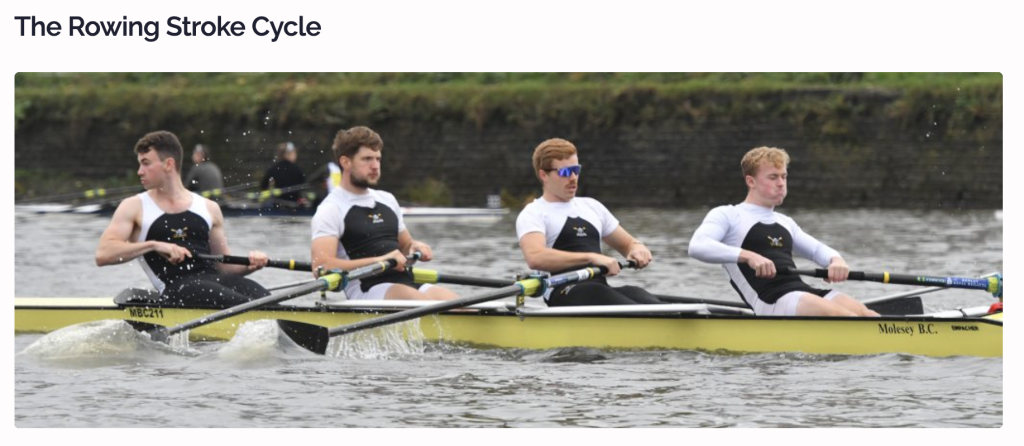
Get feedback by checking your oar shaft. Look at it.
Is it changing blade depth? this shortens the time in the water.
Wash happens if you don't extract the blade at the right time.
Slip is if you don't have purchase on the water at the start of the drive.
Purchase at the catch is sometimes called grip on the water.
22:00 Practice rowing feathered on the drive to find the correct height of your handles.
Identify a visual reference point to check you have the correct height.
Initiate the drive with the legs and hips and later bring in the body swing.
Pressure on the foot stretcher - the whole food goes flat on the footstretcher - this is the moment to bring the body swing in.
25:50 Swing through the perpendicular point of the oar handles.
As you do this you start to bend your elbows.
The blade is moving to the pin at this point.
Continue to hold pressure so the blade doesn't tear the water.
If you lose the pressure that hurts the release.
30:00 Practice the drive - legs only rowing.
Add resistance with a bungee.
A good way to get more proprioception into your joints.
34:00 Push a refrigerator
Activate the glutes - this supports the lower back
Activate the lats - this gives a solid shoulder girdle
Together these solidify the torso for the drive.
36:30 Drill - finish all three at the same time - legs, back and arms.
Exaggeration drill - do for 10 strokes
This teaches how you can adjust your movements.
38:15 The result is shown in your puddles
They should be tight dark circles.
39:30 An exercise for swing and rhythm.
Learn to trust your blade. Get your head out of the boat and stop looking down.
Put the blade in the water and look up at the sky. Add your head mass to the leverage.
43:00 The boat is stable when the oars are in the water.
What is the difference between the stroke finish and the release? Are these just different words for the same thing?
01:00 This Past Week - what we do to advocate for masters rowing.Faster Masters 1k racing programs are published for May/June or September peaks
What is the difference between the release and the finish?
Bio-mechanists say the release is when the blade exits the water.
The finish is a position of your legs/body/arms when the power phase of the stroke is complete
The release is the action of pressing the oar out of the water.
- extract with your hand pressing down on the oar handle - you must have weight over the handle
- simultaneously directing your weight into the oarlock so you exit cleanly.
11:00 Press your palm downwards using only your forearm.
This is tricky because the boat is moving fast at this point.
There is a tendency to rush it - keep it continuous is your goal
Exit quietly - listen to the oarlocks
Check your collar doesn't pull away from the oarlock /gate.
Read and watch the full video series on the rowing stroke cycle - 6 episodes from catch to finish.
16:15 The Open Oarlocks drill - helps teach you to keep pressure on the oarlocks.
Test different release points - 1, 2 or 3 cm away from your body
Look at your puddles - tight swirls in a circle. This is what you want.
Timing off your foot pressure will tell you when to release.
This is where you transition to weight back on your feet.
How you sit on your seat is important.
Check you aren't too far back.
Maintain the handle speed and sequence.
30:00 Separate the arms away from the body rock forwards - the swing.
You should feel your shoulders behind the hips.
It's hard to get a good rhythm without this movement executed well.
33:30 How much rock over should you do?
Shift your weight to the front of your seat
Let the hands lead the body rock - when fully straight your arms pull your body forward.
Actively think hips move towards the bow.
39:00 Train yourself to listen and feel the boat.
To get our monthly articles for inclusion in your club newsletter sign up here.
Pausing at the finish technique - Faster Masters Rowing Radio - the podcast for masters rowers. Tips, advice and discussion from Marlene Royle and Rebecca Caroe.
It's become fashionable for crews to pause at the finish of the stroke with handles close to the body - more in sweep than sculling. Why do this? Is it effective?
Support this show with a donation
01:30 This Past Week - what we do to advocate for masters rowing.
HOCR results and congratulations to our winners
10:00 Ask Me Anything - Marlene and Rebecca answer your questions. Doing 2 races in one day.
How much time do you have in between races?
Dry clothes, eat immediately, hydrate and fuel.
Rest if you can.
Zone out in your car and listen to music or read. Set an alarm.
Plan any changes to your race plan for race #2
Take a snack in the boat in a plastic bag.
I don't coach this but it's not necessarily wrong.
Look at the athletes and crew you have - what works for them?
Drew Ginn had a quicker recovery and high skills for catch timing when he started doing the paused finish.
20:30 Focus on the follow through position. Finish the cycle at arms/body away.
Be aware of a 1x versus a crew boat and can you all do this technique?
28:00 Simultaneous versus sequential drive.
Try both and video yourself before deciding.
Get the drive time to 0.8 seconds.
There is a lot of room to do legs, back and arms
Stay effective - don't reach too far or lay back too much
Racing starts - you may want simultaneous for more power.
33:00 Opening the knees at the catch.
Is this flexibility, structural in your hip socket and femur?
Look at your foot stretcher and heel to top of seat measurement - match your erg.
Angle of the foot stretcher
Take a nerf ball or water bottle or buy an elastic and hold between your legs as you row as a reminder.
Glute medius may need muscle strengthening
Check the shoe position width in the boat compared to the erg.
I notice I keep digging my oar when pulling in. And we for some reason tend to lean towards port, which is what I row Seat 4 or 6. Is it just my rigging I need to adjust?
Overall, our bodies need to lean ever so slightly to our side of the boat, our outside elbows should stay up, and we should have a very very minimal tap down that actually is a down and away motion of the hands out of the finish that gets the blade out and away from the puddle we create and want to leave behind at the finish.
From Capital Rowing Club - focus on the finish position
https://www.capitalrowing.org/crcwp/week-2-focus-on-the-finish-position/
To get a feel for this and ideally accomplish it, we’ll be incorporating the pick drill, outside arm only rowing, pauses, and cut the cake into our practices.
From Row Science - a list of common rowing faults causes and fixes
Seeing what you are trying to do may help as well. So here are videos to watch. You should also get a video of yourself rowing (just 3 strokes) taken from the side (90 degrees square off from you) - ask your coach to film on your cellphone so you can watch it after practice. If you choose, get a video analysis for a detailed assessment and personalised recommendations.
Neil Bergenroth learn to row playlist - Neil is a very experienced coach and this series of videos is great.
US Rowing also has a good video showing a lot of different pause drills
Faster Masters Rowing Radio - the podcast for masters rowers. Tips, advice and discussion from Marlene Royle and Rebecca Caroe.
Support this show with a donation
https://fastermastersrowing.com/podcast
02:00 This Past Week we launched our Advocacy page - if you want masters rowing articles to go in your club newsletter sign up here
https://fastermastersrowing.com/advocacy
04:00 Rowing Tales call for articles. If you
07:00 Figuring out club integration
- self organising masters and welcoming new members
Welcome lesson includes orientation, boats, oars, racks, carrying boats. How fit are they, co-ordination, allocate to a training group.
13:30 Integrating different technique styles in sweep
- look at the body and stroke lengths. Agree as a crew what to focus on
- set the finish position first - where you adjust to. Measure on the deck 58-60-62 cm behind the pin
- timing the finish first using pause drills. Check the correct hand is doing the right job - squaring, tapping down
- agree a reference point when to square the blade
20:00 In the crew half are tall and half medium height would it make sense to put them bow 4 and stern 4?
- how to spot shoulder lifting.
Watch the shoulders rising at the catch.
Handles also rise up.
Blades going deep at the start of the drive.
Legs - look for knees moving away from the chest or the chest lifting off the knees
24:30 Use the big muscles first
You can only use each muscle group once in a stroke.
26:00 How to correct shoulder lifting
You could be holding tension in the trapezius muscles in the shoulders.
Make a connection between the legs and handle. Hold the lats strong.
27:40 How to teach the legs only rowing drill.
Start with the blade feathered - mime the movement and keep torso still.
Start at the finish and move up the slide to full compression (feathered) in stages.
Move rhythmically doing this feathered.
Then add in the squared blade and keep the body doing the same thing (square blades)
Train the legs to work on their own.
30:00 Norm Graf's image of holding the grapefruit. Try to hold the angle a little longer.
31:30 How to know when to swing?
It depends on keeping the pressure on the blade. Consistent pressure is key.
34:00 Put you hands under your arm and pull your shoulder blades down. You can feel the lats engage.
See more resources - scroll down
nHow to Get Your Blades Off the Water - Faster Masters Rowing Radio - the podcast for masters rowers.
Support this show with a donation.
Timestamps
03:00 This past week. As coaches we develop too - we change our understanding over time.
Most rowers who keep their oars on the water during the recovery do it because the boat is not set and balanced.
What causes imbalance?
There's a long list of possible reasons including:
13:00 What blade skills do you need to have to get your blades off the water?
You must be committed and intentional to get your oar blades off the water. It doesn't just "happen".
Trying to get your oars off the water after the finish won't work. You can ONLY to do it as you take the oars out of the water.
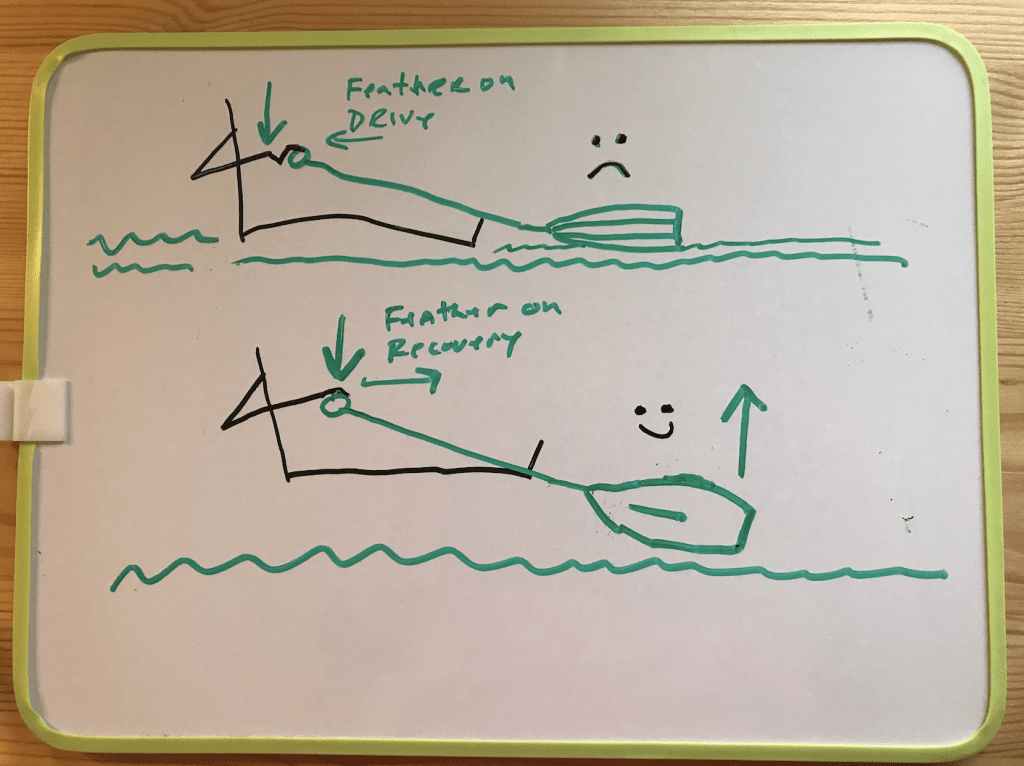
The way to do it is this: On the drive phase, as your hands come close to your body - you tap down on the handle and get the oar blade spoon out of the water. The depth of downward pressure on the handle determines the blade spoon height above the water's surface.
Press lower to get greater height above the water.
Press less to let your oar be closer to the water on the recovery. Mostly, if your oars touch the water on the recovery it slows down the boat and the reason you are touching the water is that you have not pressed downwards sufficiently at the extraction point.
19:00 Get the set / balance on the follow through after taking the oars out of the water.
By the time the oars are perpendicular, your boat should be set level.
Teach how to feather first
https://fastermastersrowing.com/how-to-feather-correctly/
Teach how to feel the weight of the oar in your hand
Tapping drills and progressions to different body positions
Delayed feather drill
Set a high standard for drills
27:00 Do these drills slowly - this is key. Many athletes feather too quickly and lose connection to the boat.
31:00 Consistency - in a crew build up to more people rowing as you practice getting your blades off the water.
Look at your blades to see what they are doing compared to what you THINK you are doing.
35:00 Practice concentration.
38:00 An easy reference point - if your wrist bends you are too late tapping down. Pressure in the water helps the blade to come out of the water.
40:00 When you perfect the release, the boat speed goes up.
Several listeners asked questions about oars and rigging for masters - specifically how long your sculling oars should be and what the ratio of outboard to inboard is ideal and whether that changes for different oar shapes,
We apologise for the poor audio in part of this podcast.
01:00 This Past Week - what we do to advocate for masters rowing.
Rowing Canada ethics course - legal issues, ethical issue and scenarios
Rules for rigging rowing boats
- Make yourself comfortable
- Centre yourself - at the catch hip on the pin centreline
- Height - keep your forearms above the handles
Sit in your boat and get someone to observe - if they aren't an experienced rower, just get them to take photos of you - from as low down as possible so you can examine in close up.
Sadly "it depends" is the only correct answer here. It's more important to see the person in the boat than to just follow rigging numbers. Customise to your flexibility and strength.
Sculling oar lengths for masters depend on your age and the type of oar you are using - see diagram below.
Rig for the "end of the race" - Ted van Dusen
What degrees of arc should we rig for?
Your priority is to get as many degrees of arc catch angle as you can.
In a September 2021 Rowing News magazine article Volker Nolte makes recommendations for masters "Rigging Numbers for Scullers"
The diagram below is from the article.

28:00 Hanging or arm bending in the initial part of the stroke?
Use each body part once per stroke - does arm bending affect your finish?
35:00 The Power Rectangle in rowing diagram. When oars are perpendicular what is the pattern of legs, back & arms - using the right sequence. Check using video.
37:00 Foot stretcher angle and height - rule of thumb 43-45 degrees on the foot stretcher. Shoe height is determined by your flexibility and height.
Ensure your shoes fit. Check heel to seat measurement on the erg.
44.00 Getting back on the water after a long break - using pontoons. Be gradual.
Try "no puddle" rowing and turns or backing down with some stationary drills to reacquaint yourself with the boat and oar handling skills.
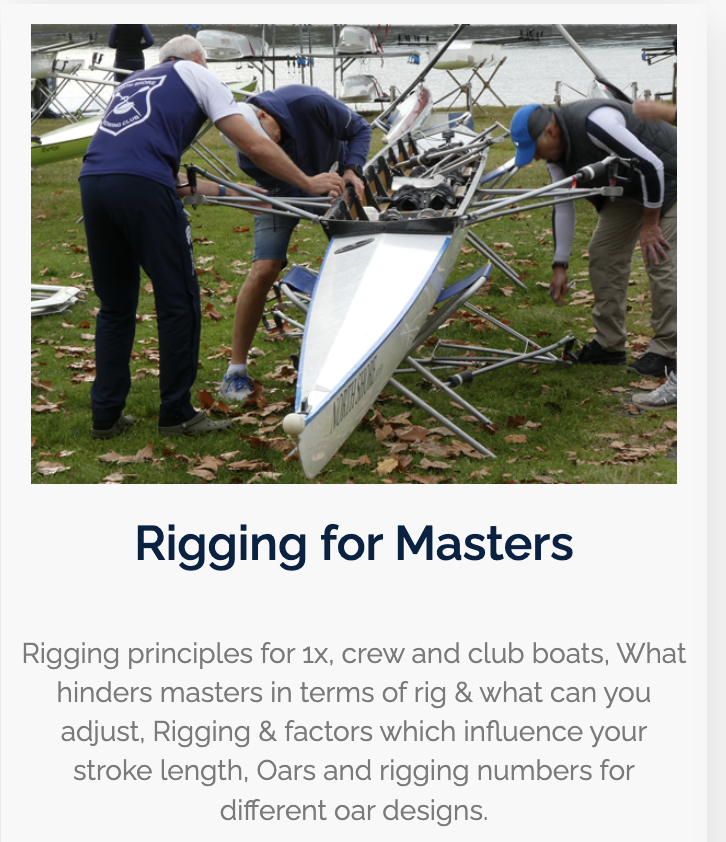
47:00 Getting to the pin in club boats - should you compromise finish or catch?
Use the release position if you can't adjust them.
Buy your own oars if you can afford and use clams to adjust then to suit the boat you are in.
Ask your club committee or board to standardize boat set up.
51:00 Changing oar gearing is it OK to shorten or lengthen the inboard?
Are you trying to match other people in the crew? How does it affect your rating and load?
54:00 C2 Fatties (sculls) can you cut them down to 85cm?
57:00 Using the C2 Comp blade for lightweight women masters
1:02:00 Transferring sculling skills to a sweep boat
Consider rotation, inside arm and faster moving boats.
Faster Masters Rowing Radio - the podcast for masters rowers. Tips, advice and discussion from Marlene Royle and Rebecca Caroe.
01:00 This Past Week. Marlene was on the Rowing Podcast round table hosted by Tara Morgan and Rachel Freedman.
Rebecca presented the Domestic Rowing Committee in New Zealand with a report on progress with masters rowing
https://www.facebook.com/groups/256708472122650/permalink/466938324432996/?__cft__[0]=AZXntUTchZA-vISQD5q246pWgof25fK9uIuOXlw4G2a_nbf2qaldXp_jWGKEWmew3vtGzg19zQR1l4pMiBRrrJOSnyP81fMDW6pFbWHL4RaEktOn_ar85DLmNEXZsxPUW5gpaZ-yiECmB8xnti1GKDP6yNJ-5UkP5K0bDcgoi-qFCEGmCxaOn8hFwfS5KuIMkxs&__tn__=%2CO%2CP-R
13:00 Functional Movement Assessment Webinar date and link to get tickets
https://bit.ly/FunctionalMovementRowing
17:00 Ways to focus on bow steering without your sculling going to pot. Rebecca advises focus on one job at a time. Row or steer - don't try to do both at once.
Do you look around every 10 strokes - no I don't and here's why.
33:00 Tidal waters are hard to steer because objects move around.
40:00 Preparing for the finish or release
- this is a critical instant. When the entry and release timings are imprecise you have issues. We don't want the boat to know when the blade goes in and out.
42:00 Start to prepare at crossover when sculling or the blade is perpendicular to the boat in sweep. The boat is increasing speed. Focus on keeping pressure on the blade until the release.
Exercise - crossover elbow bend. Apply work into the blade pressure out to the tip. Instead of pulling into the body, this prevents the blade slipping in the last third of the drive.
46:00 As the boat speed goes up the release goes closer to your knees. Quote from Dick Dreisiggaker
50:00 Focus the work into the pin. The first two thirds of the stroke is bow side of the pin. At square off the blade is stern side of the pin. You have to make the transition to maintain it. Use your elbows to maintain the pressure on the tip.
Getting fit while learning to row and scull is challenging because learning how to handle the oars is more difficult than most people think.
Until you have good bladework skills you will likely find it hard to grow aerobic fitness from your on-water exercise. Do not get frustrated because we have recommendations. Firstly, you need to get used to being in a rowing boat - this will improve your rowing musculature and improve things like your ability to sit tall, rock from the pelvis and grow callouses on your hands. You need these before you can become rowing fit.
But you can get fit by rowing - we explain how in our podcast episode below.
Faster Masters Rowing Radio - the podcast for masters rowers. Tips, advice and discussion from Marlene Royle and Rebecca Caroe.
04:16 This Past Week - things we do to advocate for and advance masters rowing around the world. The CRASH-Bs had many athletes from Faster Masters racing.
Wayne Lysobey's book is Long Live Open Water https://amzn.to/30OY2rX
He wrote a poem for Marlene
There once was a man who did row
But when older he found he did slow
So he then did decide
He’d go fast on the slide
Either that or he’d get him a tow
08:00 the foot straps for rowers whose feet don't fit into big shoes.
There will be a masters Oxford and Cambridge boat race in Auckland on April 11th
11:00 Marlene refurbished her "guest boat" with a new footstretcher and shoes.
14:00 Video what's inside a Faster Masters Rowing subscription program
16:00 Our Favorite drills for Sweep 8s
Marlene likes rowing in 4s with the oarlocks open - it teaches how to keep weight into the oarlock.
Rebecca likes rowing with inside hand on the backstay20:00 One drill that we each love to do in the single & in an 8+
Our Favorite drills for Sculling 1x
Marlene likes open fingers on the recovery
Rebecca likes the quarter slide push drill
26:00 Ways to maintain fitness when you are learning to row the single
How to get fit in the single scull if you are a beginner.
Do combination workouts - it's hard to get up to pressure when you are learning and you may get tired but you won't get a hard cardio workout. Do hard sessions on the indoor rower.
Run to the club and try to get as many good strokes on the water as you can. Then stop.
Aim to start on the water rowing at the same quality as you came off from the previous outing.
Perfect practice makes perfect.
31:00 Use drills in single scull. These help you embed movement patterns.
Practice alternate strokes firm pressure and easy pressure. Learn how to build pressure in the stroke.
Take breaks - a rest is good as it frees up your mind as well as your body.
36:00 Try shadow rowing on the erg.
Join our community and get our exclusive Faster Masters Rowing Magazine, packed with tips, techniques, and inspiring stories. Includes four new articles monthly.