Ted Pytlar joins Marlene and Rebecca to talk about his club masters group and their experience of rowing, racing and training | Faster Masters Rowing Radio - the podcast for masters rowers. Tips, advice and discussion from Marlene Royle and Rebecca Caroe.
04:00 This Past week Rowing News Magazine published Marlene's article on Periodisation of Technique.
08:00 Merijn Soeters new Book of rowing photography
10. 30 Our podcast name - we emailed a question to all newsletter subscribers
11:30 Ted Pytlar's background in rowing
13:30 Moving to the single scull - the ultimate boat. The club mix of boats has changed as the interest in rowing singles has changed.
16:00 Delaware River is rocky and can get shallow so we lose skegs often
17:00 Training Goals - focus on head race preparation. We organise ourselves as a group of 4 we know where the rocks are. After hurricanes we re-survey the river
22:00 after hurricanes we get high flow and use peripheral vision to steer and avoid landmarks.
23:00 We have a LTR annual program with a waiting list. 16 people limit.
We don't have enough coaches and 10 sessions is not enough and so we added a plus plan to integrate them into experienced boats.
26:00 We have a plan to beef up the masters program structure with regular outings
Customise a track for each person's flexibility.
28:00 the board has a LTR co-ordinator and organised coaching roster.
Scullers have a skills test for 1x use and also a masters program co-ordinator with input from members. We bring in a professional coach a couple of times a month
31:00 Swapping from sweep to sculling
I didn't realise the importance of stability at the catch and release in 1x in order to get the rest of the stroke to work well.
Subtle mistakes you can make on port /starboard can really mess you up. It took a while to figure them out.
Loose hands is critical in sculling.
33:50 you have to be at a certain point in your rowing journey to realise or hear certain things. As you get better you realise what the coach meant.
35:00 Try to get an understanding of the complete stroke. Mine is 4 pages long.
A picture in your head
37:30 Some adapt technique which is a coping measure because they are afraid of tipping over
39:30 The swirling vortex behind the blade isn't needed - just bury them deeper. Differences of opinion between people happen in rowing - it's good to know them all.
45.00 Rowing movie - Heart of Champions review by Rebecca
https://www.amazon.com/Heart-Champions-Michael-Shannon/dp/B09LRZR2F1?ref_=nav_signin&
Who are you becoming? the importance of contemplating this question - become the athlete you want to row with.
03:00 This past week Rebecca was at the South Island Masters Regatta.
05:00 There is a need for handicaps in masters rowing to make the races work better. What do you think are the benefits?
08:00 Who are the athletes you want to row with? Can you row with them?
Why do more experienced athletes warmup square blades?
Different attributes of an athlete - Trainers, Racers, Technicians.
What is it they do that I would like to also do?
12:00 Attributes of rowers you admire and aspire to be like - positive attributes
14:00 Open minded on the water gives and asks for feedback.
Use the same language that the rowers use for a discussion about feedback.
17:00 How's it going? is a good way to ask for feedback during a training session.
19:00 Advance a common understanding in your crew and group. A common language.
Mike Spraklen asked us what does "stride" mean to you?
21:00 Can we give confidence to other people in our crew as we discuss the outing?
Ask the question carefully. What words to use when you give feedback?
You sit behind me - uniquely positioned to see my technique. Can you remind me when you see me doing something wrong or right in the boat?
Ask opinions - helps people to feel they are being heard. "What are you personally working on?"
25:00 Start the positive behaviours yourself. Begin before you get on the water - where are you going? What to do today? Did I do what I set out to do? Quality score points out of 10 for rowing practice, acquisition of skill.
27:00 Openness in rowing - is this challenging for masters compared to youth rowers? Our practice ebbs and flows through the year with more intensity. Small moments of joy in what you are doing. Smiles and grins after the row.
32:00 Why do we row? Where do we get enjoyment? Process goals - lead the change yourself that you seek in others.
What is the ideal athlete for your club group? It's incumbent on rowing leaders to be inclusive of returning rowers (who rowed as youth) and those who learn as adults.
When you are in the groove and the boat is in stealth mode, you dial into your mission and rise to the challenge. Whether in practice or on the race course if you are "on" thoughts of failure get no airtime.
However, there will be days when you feel like toast. Athletes need enough rest and at times your scale may be tipped towards the side of fatigue. However, if your performance is starting to drag and the doldrums don't seem to be going away, you may be pushing the "more is better" principle too far and be risking burnout.
Asking yourself these 20 questions can determine if you need to build more rest and down time in your plan.
Answer each one True or False:
Each true answer equals one point; each false equals zero points.
If you scored between one and three you are not at risk for burnout; between four and seven you are entering the trouble zone so take some time off; between eight and 14 you really need a vacation from training and competition; 15 or higher you are seriously burned out and should sit down with your coach and evaluate your rowing future.
Taking a breather can turn the Thank Goodness it is Friday mentality, counting the minutes of practice, into the Thank Goodness it is Monday mentality and get you revved up for the next season.
Would you like to publish this article in your club newsletter or website?
Join our Masters Rowing Advocates mailing list and we will send you one article a month. Sign up on our Advocacy page.
You can copy the text on this page. Or download the PDF.
Stepping back to reflect on your rowing of this year will make clear how to better your performance for next year. Your inner voice is probably already whispering hints to you but get it down in writing anyway.
Get out your log book for an annual review; it will give you the information you need. To start your annual review, set aside a big chunk of time in a place where you like to hang out.
Read through your entire journal for the year. Jot down notes about thoughts or events that stand out as you are reading. Make a list of your disappointments or commitments you did not keep. Reflect on what comes to mind reviewing the negative or down points. Then list your accomplishments and high points of training and racing that went very well. Reflect on what comes to mind reviewing your accomplishments. Finally, summarize your year in one word.
Questions to prompt your ideas are: What went well? What didn’t go so well? Why didn’t I achieve my goals? What big things did I learn?
My favorite questions are: What should I start doing? What should I keep doing? What should I stop doing?
This helps you recognize the good habits that are productive, habits that are interfering with your progress, and the habits you need to change to make progress. Think about the word you chose to sum up your rowing year and why you chose it. What’s going to make next year awesome?
Write down 10 action steps that will get you there, for example: Drink more water, learn to steer a single straight on a buoyed course, improve my posture when sitting at my desk, arrive 15 minutes early for every practice, or hire a coach / trainer.
Now go and enjoy the new rowing year.
Would you like to publish this article in your club newsletter or website?
Join our Masters Rowing Advocates mailing list and we will send you one article a month. Sign up on our Advocacy page.
You can copy the text on this page. Or download the PDF.
As the age-groups roll by, your ability to simply rack up more miles on the river is not an option. Workout time is at a premium. Post-exercise recovery is a force to be reckoned with. So to keep getting faster with your schedule and available energy what’s an aging rower to do?
If your physical training stays on par, you will likely gain more boat speed by investing an hour in your technique versus two more hours at the gym. After all, technique improvement has no age limit. If you can pick up another meter per second by not missing water that is going to be evident when chasing down your mates next season. Incorporate technique work into your training on the water every practice so there is no need to increase your training volume - simply put more attention to your form.
Protection of your joint and spine is the best resilience against injury. This means power through posture, a neutral spine favors leverage. Hinge at the hip to set body angle versus flexing through your back. Use your core. Activated glutes give you suspension during the drive and prevent collapse in the lumbar spine. Engaged lats stabilize your mid-back and shoulder blades to help sustain your swing and protect your ribs.
Your goal is to stick to the correct sequencing of the stroke without compensation regardless of your range of motion. Maximize your stroke length through a stable body position and your rigging. Avoid extreme body positions. Perfect your bladework: entry, release, feather, square and be conscious of preserving momentum and speed and run on the recovery. Strive to keep your motions as smooth as possible and always row to your potential.
Would you like to publish this article in your club newsletter or website?
Join our Masters Rowing Advocates mailing list and we will send you one article a month. Sign up on our Advocacy page.
You can copy the text on this page. Or download the PDF.
Rebecca has a great rowing hack for situations when you need a coxswain but a suitably small person is not available.
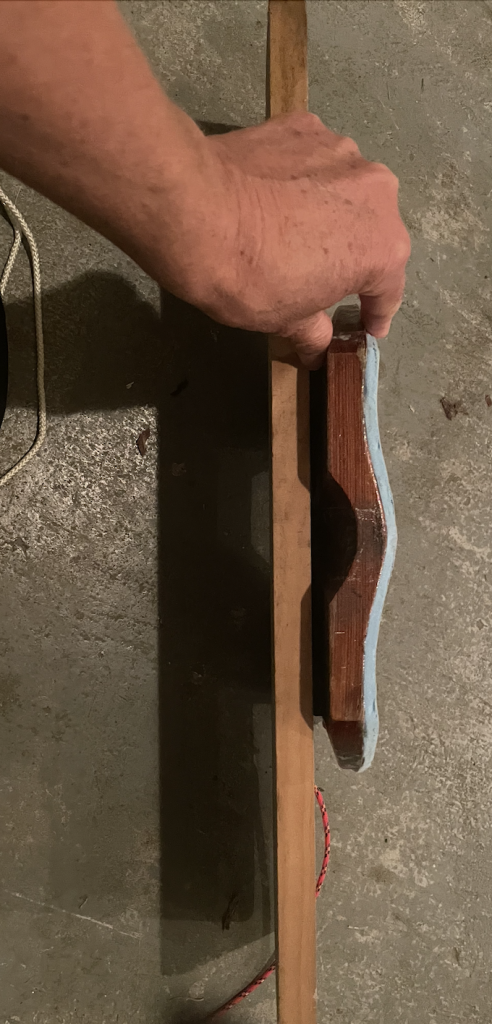
Her club designed a "plank seat" for the coxswain.
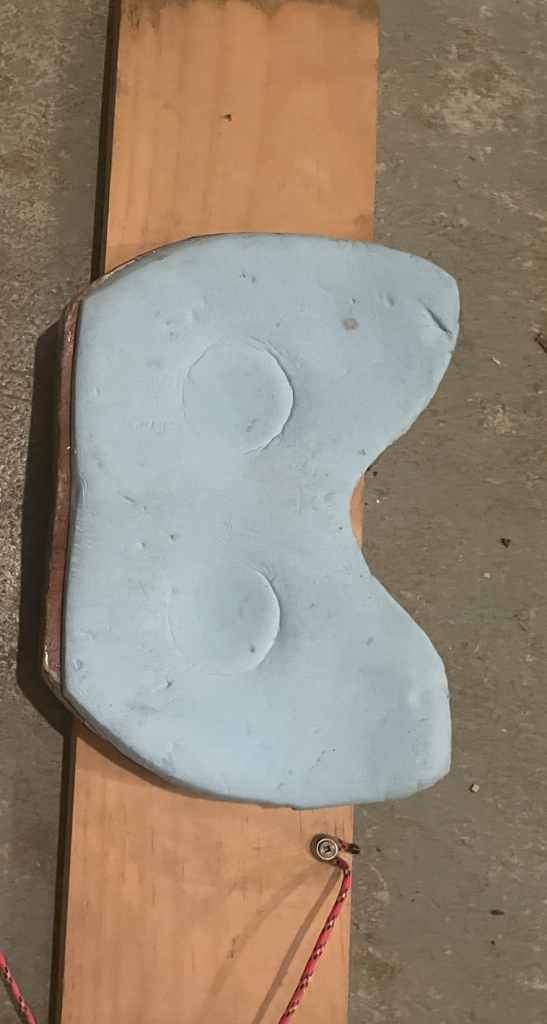
We took a plank of wood and found an old sculling seat top (we removed the undercarriage). The one we chose happened to have light blue foam seat pad glued to it - but you don't need that. It's just extra comfort.
The plank is around 20 cm wider than the width of the boat where the cox sits - so there's no chance it will slip down.
Screw the seat to the middle. And we also added a pink lanyard with a clip on the end. This loops over the steering wires as a safety feature in case the plank falls into the water during the outing - it won't float away.
Faster Masters Rowing Program for clubs is written by experienced coach, Marlene Royle. She specializes in coaching rowing to adults from 27 to 80 plus years and has a track record of racing success.
Masters need special programs because our age range is diverse, our physical abilities are varying and overall rowing must be a fun journey that we want to engage with.
And so Rebecca Caroe and Marlene Royle founded the Faster Masters Rowing business to serve this global audience.
For club boards running a masters group can be challenging because masters don't conform to the model for youth and scholastic rowing training and racing. The Faster Masters Program allows a club group to self-organize around a program and educational articles which is renewed each month.
The beauty of the Faster Masters program is that it is flexible. It allows the occasional rower to participate as well as the mad-keen trainer who wants multiple workouts per week.
The online program comes in 6 modules - each participant can download and print the month's lessons for individual study. Erg and water training is at the heart of Faster Masters. Seven days a week workouts are available - with a recommendation that participants do 3 core sessions - all the others are optional. The program has a clear focus on building up to an event or regatta and switches from 1k racing in the summer through head racing in the fall and erg events over winter.
Land training is provided with a suite of exercises which can be done in a home gym using light weights or kettle bells and some simple ancillary equipment like elastic bands. Building core strength and muscle strengthening is important for ageing well and all of the exercises come with video demonstrations for clarity.
For students of the sport a monthly technique article and frequent video demonstrations allow self-guided improvements to bladework, body positions in the boat and an understanding of how to finesse the rowing/sculling boat movement. These are also built into the workouts.
Lastly articles on Rowing lifestyle - how to age well and Performance mindset and psychology complete the monthly modules.
Club groups get a further benefit of a monthly coaching zoom call with Rebecca or Marlene to run through questions, seek guidance on program interpretation and video analysis.
How do you work with your coach and how do they work with you?
What boundaries are there to the relationship?
How to give and receive negative feedback
01:00 This Past Week - what we do to advocate for masters rowing.
US Rowing Masters Conference
https://2022usrowingmastersconference.sched.com/
05:00 Ageing Well Webinar
https://fastermastersrowing.com/courses/ageing-well-for-rowing/
08:00 Athlete Coach Relationships
How do they work with you and you with them?
Goals of your program - fitness, technique, camp ....
Develop trust and respect
Understand communication - what would they like to get from the session or what to learn
10:15 Life stage and coach relationships
At high school they tell and you do.
Competitive teams - team culture, standards of behaviour and quality training matter
Masters are different our choices are more varies.
12:30 Igor Grinko coach to USSA, USA and China noticed the differences in athlete coach relationships.
15:00 What boundaries are there to the relationships?
private time
Communication - how, when, text / email / call / Face to face
Days off from the team
Scheduling crews - deadlines
Timelines for practice. Time to arrive and time on the water OTW
18:00 Preparing for the session - brief the coach ahead of time.
What is the approach - do you coach the whole boat or individually?
22:00 Use video to give individual feedback privately
23:00 How to give and receive feedback
Ask at the beginning what are you currently working on?
At the end one good point and one point to work on. Plus video of good sculling.
26:45 Separate their identity from the rowing skills - feedback is not criticism
28:00 Receiving feedback - coach-ability is a great skill to have. Try to do what the coach says.
Some coaches relay on athlete intuition to solve problems. Others explain the "how" relative to a reference point.
31:00 Give coach feedback afterwards for the crew.
35:00 If you want coaching, come close to the coach boat.
02:30 This Past Week - what we do to advocate for masters rowing. The March programs are ready including a focus on the pelvis and how to use it in rowing and sculling. Hip and pelvic mobility exercises.
08:00 Sponsor this week by the Rowing Directory including new listings for Glide Boat, The Flying Boatman, Shell Covers Australia, Adirondack Rowing and Trophy Oars
https://rowing.chat/retailer/
09:45 The Recreationals at Trafford Rowing Club - Susie Loates is the Vice Captain responsible for the group.
11:30 A recreational rower is anyone who does not want to commit to the full training plan of the racing squads. Members are parents, professionals with busy jobs and shift workers.
13:00 We seek a good technical row in sculling boats.
15:00 The Group uses Fitclub.me to book boats with up to 19 sessions available per week. We are welcome and a recognised part of the club.
16:30 How are sessions broken down - is a technical point or a workout set?
We arrange to out out 4-5 times a week.
Anyone can coach and we are encouraged to help other rowers.
Treated as an equal rower from day one.
19:30 The explore series of races. Uses stable 4x. These are 300 meter dashes races.
23:00 Advice for starting a recreational group.
Approach your committee or club leadership. You want a fair time on the water and a fair allocation of boats and equipment. Seen as the equal t racing squads.
25:30 Has the group got a leader? Susie has a rough plan for the group.
Membership fees are £25 per month for everyone in the club.
How is rowing going for you? What's it like elsewhere in the world? Learn more from our survey report. If you would like the anonymised raw data, get in touch.
Most masters have been rowing over 10 years and started rowing either at school/university or began over age 40.
The average spend on rowing per year is between US$500 to $2,000 with a significant group spending $4,000 or more each year.
There is some alignment between training effectiveness and rowing budget, those who invest the least get the worst results. Masters who train between 2-4 days a week report results between mixed, OK and good results in the past year.
Training frequency on land and water is consistent from summer to winter.
55% of masters follow a training programme. 39% do not plan their training.
Nearly 40% of masters row a single, 25% use the erg and many do crew boats as well. Weights, body conditioning, yoga, gym and cross training are the most popular land training choices.
Download the State of Masters Rowing 2022 report.
The most shocking finding is that half of all masters rowers either do not get coached or get coaching once a month or less.
Going on camp is popular with most choosing to go to improve technique or for race preparation. 60% of respondents plan on going to camp during 2022.
The pandemic affected rowing clubs postiviely and negatively - 30% reported a growth in members and 22% lost members compared to pre-pandemic yeas. Learn to row classes continue to be popular with most clubs running between 1-3 courses a year and 40% of clubs had more students.
Student drop-out after learning to row is reported at between 50-70%.
Racing was badly affected by Covid with over 70% doing three or fewer races in 2021 and 2/3 reporting they raced less than in previous years. 50% of masters race 5 times a year normally.
The majority of masters use data to analyse their rowing at least some of the time - only 25% report not collecting rowing data. Race results get more attention than training data by the very keen but 30% of masters don't analyse race or training data (clearly some collect data and don't analyse it). Over a quarter report uncertainty understanding what the data shows and 6% have technical issues interpreting rowing data.
We asked respondents for the personal and club challenges - the biggest challenges for clubs are recruiting new members, fundraising, coaching and equipment. A strong second tier of answers include 'getting people to row with', finding time to row and getting support from the organization.
For personal challenges Coaching, injuries and age-related issues lead the responses. It is interesting that the detailed responses frequently reference learning rowing and sculling technique as a personal issue.
Covid has of course created challenges as well from weight gain, restrictions in the number of people allowed to row at one time and training frequency. Many people referenced training in singles as a change as a positive result of Covid.
Join our community and get our exclusive Faster Masters Rowing Magazine, packed with tips, techniques, and inspiring stories. Includes four new articles monthly.