Marlene and Rebecca discuss
- Synching schedules. It's the hardest thing for a masters group to figure out.
- Injuries outside training
Anything that prevents you doing a full training load. And so a strained muscle, a stiff lower back or a hand blister can be part of you failing to complete a training session successfully.
Clearly there are scales and grades of injury - a blister is not the same as a broken leg!
Masters do not get injured more than younger athletes, but we are more likely to be adversely affected for longer and to take longer to return to full training.
Take injuries seriously - training on an injury usually makes it worse, not better.
05:00 This past week - Marlene is a nordic ski coach; she guested on The Science of rowing podcast and will be studying coastal rowing coaching at the Rowing Canada Aviron conference with Guin Batten.
Rebecca has been reviewing the novice masters status in New Zealand and seeking a rule of racing change. You get the behaviours your tolerate in your club.
15:00 Ways to align your crew schedule. Review your lineups, the number of people in your group and seek regular days.
Cliques in clubs can rip clubs apart. Good leadership is essential.
22:00 No wasted water time. This is something we value a lot.
23:30 Marlene has seen a huge increase in injuries from our athletes. when you get injured you have to heal the injury, rehabilitate it and then progress back to training.
These are non-rowing injuries and were caused by carelessness on land. Your body is fragile. It doesn't take much to derail your training.
Accidental injuries when you are in a fatigued state your tissue is fatigued.
26:50 The further you lean away from your body to pick up your boat it puts you at risk of injury. This is relate to poor judgement.
Be mindful of how you move your body.
34:00 The United Nations list of
Craftsbury Common is one of these heritage sites - the Trouble with Harry movie was filmed there.
35:00 Mike asks are there any good videos that can explain all the basics to a never/never rower - someone who has never sculled before?
Rebecca uses these two videos in slow motion for her beginner class. There's no commentary so you can overlay your own interpretation.
https://www.youtube.com/watch?v=882yriTw1VA
https://www.youtube.com/watch?v=gQMaxr-gxp0
Marlene and Rebecca discuss
- Mapping out a good erg program
- Feedback on caring for elders
Through winter the weather affects our rowing. Some are iced in and others just have windy and bad weather days.
We all need to use the erg and water interchangeably - in this episode Marlene and Rebecca discuss how they map out a good erg program.
Start with knowing your spring goal -
Your program needs to reflect these different goals.
Winter is good for building underlying fitness through a base preparation program which maintains your physical form.
Customise your program by doing the Faster Five Fitness Assessment - then you will be working within your personal capability ad know that your training is in the correct zone to improve your physique to achieve your chosen goal.
Timestamps to the show
01:00 The rowing seasons are changing. Winter rowing beckons
05:00 Masterclass Transitioning to Winter. Sign up here
https://fastermastersrowingwinter.eventbrite.co.nz
07:00 US Rowing Conference. Wednesday December 9th 2020 the Training day. Marlene is talking on Training for Life at 12.45 EST. See the full schedule.
https://rowcon2020.sched.com/
Speakers include Stephen Seiler who was on a previous RowingChat episode
https://rowing.chat/power-in-rowing-symposium-stephen-seiler/
09:30 Update on the National Masters Strategy New Zealand - we are creating a model framework. If you want to copy the model, contact Rebecca Caroe
15:00 Caring for Elders was last week's topic. Feedback from a listener. Training is a great outlet for your stress cortisol levels.
18:00 Short intervals on the erg or a power workout are time-efficient which suits carers.
21:00 Mapping a good erg program. Faster Masters programs for December 2020 include 2 separate programs. Base preparation for 1k (next summer) and Base preparation for 5k with a spring peak. if you are planning the Tideway Head Races or the Heineken Regatta or CRASH-B erg races.
Every workout has a land and water instruction including stroke rates.
Faster Five fitness assessment helps you to individualise your program.
25:00 Understand the purpose of the workout. Priority sessions.
Adapting workouts for the erg - 2 points lower in rate.
28:00 Check the resistance and the drag factor of 80-90 on Concept2. Marlene recommends erring on the light side for resistance.
30:00 Riggers on the rack don't line up - how to rack your 1x when some boats have forward wings and others have back mounted wing riggers.
32:00 Marlene's nightmare of having to use a ladder to rack her single scull on the top rack.
Rebecca and Marlene discuss
- US Rowing Conference
- Training while caring for kids and elders
- Upcoming Masterclass Transitioning to Winter Rowing
02:00 Family Quads at the Bennett Shield Regatta

04.30 inter squad fun races - with nickels and quarters as prizes
07:45 Transitioning to Winter training masterclass - sign up
09:00 US Rowing conference Wednesday December 9th 2020 the Training day. Marlene is talking on Training for Life at 12.45 EST. See the full schedule.
https://rowcon2020.sched.com/
17.oo Training while caring for kids or elders
19:30 Rowers can be very generous - they give their all. Take care of yourself first. Boundaries are needed - scheduling is a problem. Be as consistent as you can.
Reduce cortisol levels by training regularly. Choose from erg / walk / stretch / row on water.
22:00 Don't give up on structure. Commit to 30 minutes a day.
Resources in a past episode we covered
https://rowing.chat/rowing-training-while-raising-kids/
What can you delegate? Cleaning, gardening, shopping?
24:00 Use the travel circuit suggestions which we covered in this episode.
https://youtu.be/oivuKUmpkrU?t=906
Set up a nice home rowing gym
https://fastermastersrowing.com/the-perfect-home-rowing-gym/
Dionne is "super-Mom" she trains around her kids naps and their sport sessions.
28:00 Run with the kids to school and then you run home alone.
30:00 Protect and defend your time. The beautiful word called "NO".
Find some regular training partners who can sub in for you at the last minute if something comes up.
35:00 Erg Studio at home - make it a nice place to be.
Being the best rower you can be involves having good flexibility and mobility in your body.
As we age, our flexibility typically reduces. Understand your personal range of movement and how each part of your body is used in the rowing stroke.
Our 10 exercise functional movement assessment for masters rowers will show you where you can improve and how it affects your rowing and sculling.
Marlene and Rebecca host Faster Masters Rowing Radio where having a rowing coach only makes you better, following a program gives you a true pathway to becoming a confident sculler who is respected by your peers. Become the athlete you want to row with.
- difference between exercising and training
- functional movement screening for masters
05:00 Early warning that November 24 there will be a podcast about Transitioning to Winter Training - ONLY newsletter subscribers will be able to watch this episode. Please subscribe to get the link emailed to you.
These 10 drills allow you to test your own body and its ability to move in a way compatible with rowing and sculling.
Use these exercises to identify your physical limitations
https://www.row2k.com/features/5323/Functional-Movement-Screening-for-Masters-Rowers/
11:30 Podcast feedback - You Cannot Coach Yourself - Marlene declares that Faster Masters are very aware of the "reality for many masters" with regard to coaching, availability of club support and video assessment.
One of the reasons we set up Faster Masters is dealing with the reality of masters training alone - it is very common. This is why masters like to come to camps because they can network with others.
We recommend you ask your club coach if you can buy a private lesson.
17:00 Coach rowing alongside you is very similar to what you get from a remote coaching video feedback. I'm surprised more people don't take advantage of video review services. They give great insight.
23:00 Tanya from Australia gives her feedback on the Faster Masters programme. Marlene reminds us that Faster Masters programs are designed to prevent under-training and over-training. Both damage your performance.
27:00 Exercising versus training. Keeping things "interesting" and setting challenges in the program is key. Have one objective in mind. Your personal time trial, for example - it should be a performance element. Programs are DESIGNED to add stresses and recovery period. They train the different physiological systems which you are developing as you row.
33:00 Marlene follows Dr Steven Seiler in the low intensity and high volume approach to training.
Technique
Concentration
Focus
Use your training to improve your skill in these 3 areas. Rebeca recommends a drill to help you learn how to improve your skills.
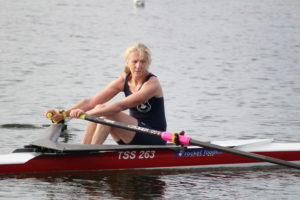
We got this email from a customer who is returning to rowing. Her experience and our advice may help you.
Hi Marlene and Rebecca
Can you give me any tips on how to get started with the programme and how to build myself up from pottering around on the river to actual training? I’m 62 next week, was a successful heavyweight senior rower in the 1980s but always very inflexible and prone to back injuries. I taught myself how to scull a single in 1977 but only raced for the first time in August 2018. I won my first two races but the third regatta in mid June 2019 was a disaster, I felt really weak, lost by miles, and haven’t raced since.
I signed up to Faster Masters at the end of May 2020, full of good resolutions even though I wasn’t very fit. I gradually started back sculling in and built up my mileage so I am doing 10k to 11k in my single at what is probably Cat VI. When I have tried the faster rowing sessions I couldn’t get anywhere near the suggested stroke rates and found that very dispiriting. It’s very hard to track progress on our river because of the variable flow and wind conditions but my splits seem to be considerably higher than the times local women scullers my age achieved in a time trial I missed even though I have been sculling longer than any of them.
During lockdown I had no erg access and, even though I do now, I have eventually developed costochondritis every time I have used ergs for serious training since I returned to masters rowing in 2003 so I avoid them now. We can usually row here if the river isn’t in flood or it isn’t blowing a gale, as we don’t get frost or snow even though it isn’t very warm.
I live beside the boathouse and am retired so I have plenty of time and I thought I was going out five days a week but my husband reckons that it’s more like two or three days. I do reformer Pilates twice a week normally and am currently doing a video mat class as we have locked down again. I’ve started running once a week with a group and am actually enjoying it despite my asthma.
Maybe one of the documents set out how to build up to full race training from a low base, apologies if it does but I didn’t see it.
What all returning rowers have to learn is that you aren't that girl in the 1980s any more.
You (and we) all need to learn what our mature bodies can cope with and how long we take to recover from any exercise stress. And that includes recovering from coughs and colds and other ailments too.
The three core sessions are marked on the programme with an asterisk.
Buy a heart rate monitor to wear in the boat and note when your HR rises because that's a sign you are getting tired.
Do the land training on non-water rowing days so you improve your strength and flexibility.
Do a daily waking Heart Rate Variability test as this will tell you how "recovered" you are from the prior day's training. There's an app called HRV4Training which you can use. [more information here from their blog https://www.hrv4training.com/blog ]
This will help you work out how much training to do as you mention running and pilates and your mat class as additional training sessions. That's at least 6 sessions a week although the pilates may not be aerobic, it still gives you a workout.
Build up the program based on how your body copes with the training load. If you start by doing 50% of the volume of each rowing water session and only do the 3 core sessions a week. Do that for 2 weeks.
Then add about 500m more each outing until you are comfortable and your HRV recovery scores are confirming that your fitness and recovery is tracking positively. Be confident that holding steady and not adding 500m more distance is fine. This is your body adapting to training again. And you can step back down if you are tired and only want to do a couple of kms on the water. Use it to practice technique - lots of stationary roll ups or pause rowing drills.
Use the erg and water interchangeably - so if the weather isn't good, you can erg even if you don't like it much.
Note how energised you feel before the workout. What training you did. How tired (scores out of 5 or 10) you feel afterwards. That will help you with subjective gauge of your body and your mental approach to each workout. It is not a bad thing to cut a workout short if you are tired or it's not going well.
Be patient and kind to yourself!
And best wishes, let us know how you go after the first 4 weeks.
Rebecca and Marlene
Rebecca and Marlene explain The Faster Five essentials for rowing
Technique, Bladework, Stroke Power, Racing and Fitness Assessment.
12:00 We launch the Faster Five. These are principles which are important to learn, how to practice and what to practice. Things to pay attention to and key reference points.
The Faster Five represents the Faster Masters Rowing philosophy of teaching and a structure for you to plug into when you are studying rowing and learning how to become the rower you want to be.
16:00 Faster Five - Technique . Reference points so you can practice on your own. It takes thousands of strokes to learn the correct technique. It takes 3 seasons to become a sculler and 2 seasons for a sweep rower to feel they can apply good power in both sweep and sculling.
19:30 Faster Five - Bladework. timing and co-ordination is important. When you hold something in your hand (the oar) your brain thinks it's part of your hand. This is why it takes a long time to learn. Reduce your wash and blade is a key part of the learning from the Faster Five. The timing, finesse and precision takes drill work, focus and concentration. Developing high speed co-ordination is key to becoming a skilled rower.
23:00 Faster Five - Stroke Power - this comes after the bladework which brings confidence to your rowing. Power requires you to trust the oars and use your body weight. Learning the sequencing, being explosive and being effective at moving the boat.
26:00 Faster Five - Racing - the principles of racing well. Mental and physical, starts, steering and race strategy. What works for you and your crew. Back up plans. Relevant for all rowers whether you race or not because you can test yourself and get progress markers.
30:00 Faster Five - Fitness Assessment. A battery of tests to gauge your quality of rowing including stroke power, VO2 max, anaerobic threshold. Comparing the results works on both an erg (watts) and on water (500m spit to watts). The relative comparison gives proportional fitness measures. This changes over time.
34:30 If you are injured and come back to rowing your test shows you the right level of intensity you can manage.
38:00 Where to get the Faster Five. Link is in the website footer
https://fastermastersrowing.com/courses/the-faster-five/
When you subscribe to ANY monthly recurring program on Faster Masters Rowing the Faster Five is included as a welcome gift.
When athletes stop doing our training program you lose a lot. You lose commitment, you lose engagement and you lose someone else coaching and doing the thinking for you.
When you stop doing our training program you lose fitness, you lose your edge and you don't stay engaged and showing up. When successful athletes stop doing the Faster Masters program 100% of the time they never maintain the results they had on the program. Success does not carry on without an ongoing, developing training program.
40:00 Faster Masters is more than just a training program. Faster Masters is not babysitting athletes. Depth of instruction and insight from masters specialists. The Faster Five took us months to complete and includes our years of coaching expertise.
Masters feel like "disregarded" athletes - we are on a mission to get the sport of rowing to appreciate masters athletes. What we can bring to them, the goals we have are important. We deserve respect. We are building a global family of athletes.
Is this really a complicated subject - surely you just breathe when you want to?
Well no actually that is not best for rowing performance.
We chose a big topic for this week's podcast. Breathing.
Few of us re-learn how to inhale and exhale. Most just let it happen naturally when rowing. But we may be getting it badly wrong.
This week's podcast and the Faster Masters paid membership subscriptions both address breathing in rowing.
The easy answer to "when to breathe" is to inhale on exertion and exhale on the recovery. That works for most sports, but in rowing your diaphragm is constricted when you are at the catch and you won't get a full breath in. So we have to do it differently.
When you work harder and get tired, you can end up feeling very short of breath indeed.
Yes it really does - because you could be compromising your ability to train effectively. Getting rid of carbon dioxide is important because any build-up in your body will cause you to bind up.
The Faster Masters podcast for 1 September
In the paid membership subscription is a detailed article about Rhythmic Breathing. Marlene describes exactly where in the stroke you should breathe, how to use breathing to improve your rowing and what to do if you run out of air before your muscles become exhausted.
05:00 Would you race for fun? What is the appeal of racing and rowing?
11:30 The Goddess Coach
18:00 Socializing at the rowing club. We started the club and agree that NOT chatting in the boat is important. But when you are training at Category VI you should be able to talk while rowing.
22:00 Does it matter if training groups don't overlap and meet at the club. Every Tuesday night we have picnic dinners on the grass.
25:00 Macons. Because the surface area is smaller you get more slip in the stroke. They won't do te work for you. You have to enter and release very precisely.
28:00 Rowing technique changed with cleaver blades and rig changed too. Open water rowers may prefer macons
33:00 Breathing in the rowing stroke. Mark Novak suggests you inhale on exertion and exhale on the recovery. He's the physical therapist for the US national team. Focus your breathing on land. The main purpose of breathing is to blow out carbon dioxide. That will bind you up if it accumulates. Make breathing part of your rhythm.
39:30 Breathing can calm you down before the start of a race - Rebecca explains nose breathing.
Warming up for your training session can be enhanced with nose breathing.
47:00 Virtual regattas - are they appealing to you? Especially if they are on the erg.
53:00 Racing is about YOU - Your performance. Did you come away satisfied with your performance afterwards?
Marlene and Rebecca discussed
Timestamps
03:00 Rethinking the Olympics - what’s the purpose of it? Striving to achieve the highest potential you can.
Dame Katherine Grainger on rethinking the Olympics
https://open.spotify.com/episode/1VG3FAbAVWZsUIYKqBbFFn?si=efZQWup1TNa2sc8iRY1sLQ
07:50 The Economist asks if electronic sports should be included in the Olympics
https://www.economist.com/leaders/2020/06/27/why-the-next-olympics-should-include-fortnite
16:15 Volker Nolte on the Olympics
https://rowing.chat/volker-nolte/
21:00 Sculling to lose weight. Obviously this year it is not possible for sweep masters teams to get on the water. So I have taken up sculling, is three times a week sufficient for weight loss?
How many times a week were you sweep rowing? Number of calories you need for weight maintenance how to calculate for your body weight.
26:00 July’s Faster Masters program - technique module backing into the catch drill which builds on the erg suspension drill from last month. Performance module is Quick Boat Set Up for shared boats and the Bonus is a rigging challenge.
34:00 Elizabeth Bugert asked Does anyone know if you can connect a Garmin watch and Speedcoach on the same HR strap? If yes, which straps would you recommend?
Garmin Vivofit https://amzn.to/3i2wLKe
Garmin Foreunner 935 https://amzn.to/3idgYZc
NK Speed coach https://amzn.to/2Cz8efp
Garmin HRM Dual https://amzn.to/2CCyuWd
Wahoo https://amzn.to/38d84X7
Polar H10 https://amzn.to/2VAtGHR
Coxmate GPS https://www.coxmate.com.au/product/coxmate-gps-2/?v=8e3eb2c69a18
43:00 Katherine Gross started a discussion on the Masters Rowing International Facebook Group
What fun/creative/meaningful/random/perfect/legendary name did you give your shell?
Winter rowing training is hard. The weather is unfavourable to motivation and many of us can only train indoors.
But as committed Faster Masters, we are not discouraged. We know that by setting a training goal for winter rowing, we will be able to track our progress and overcome short term challenges.
So what should your winter rowing goal be?
Rowing fitness is built through endurance and so one easy goal to set yourself is to become fitter. Taking the Faster Five fitness assessment will give you a clear measure of where you stand. Marlene and Rebecca recommend testing yourself once a month. And so if your winter begins in November and runs through to March - you can have 5 tests completed which should chart your progress. The Faster Five Rowing fitness assessment includes your long distance fitness, your absolute strength and two more tests. Overall you need to know these fitness test results so that you can train optimally in the correct training zones.
When you design your program (or if you buy the Faster Masters program), you will have multiple goals - some are short term and others may be a big race regatta event like the London Head of the River, Head of the Yarra or the Head of the Charles. All your training is focused on the big goal - but the smaller goals as transition points towards that big moment.
Questions to ask yourself or with your crew
1:13 Faster Masters Rowing training program elements for this month.
4.45 Are erg sprints a good winter goal?
7:30 Goal of winter training programs.
Faster Masters Rowing Episode 7: The Role of Testing & Trials in Rowing
https://fastermastersrowing.com/courses/faster-masters-episode-7/
10:09 What gives you the biggest boost for next year's head racing?
15:00 Work travel and how to keep training alongside social obligations of a corporate career
Home Exercises by Raf Wyatt
https://www.rowperfect.co.uk/home-exercises-need-to-train-at-home-heres-how/
22:20 Training adjustments
Returning to rowing, starting rowing as an older athlete. Can you row aged 20 or aged 90? How to coach masters athletes.
https://fastermastersrowing.com/courses/faster-masters-returning-to-rowing-coaching-masters/
27:45 Using the ski - erg in training for rowing
32:30 How to stay motivated during 1x training
42:00 Fitkick boat shoes promo
https://amzn.to/33mBhdQ
Hi, my last head race of the season is behind me and I think I’ve identified some areas that I need to work on. The last race was a lot of fun even if only finishing in the middle of the pack and I think I put into it as much as I could as far as effort.
I know I have lost muscle mass and strength over the years and I am wondering if it is feasible to increase strength by focusing on particular erg and rowing exercises over the winter? My erg is a C2 model A with no computer but I can row all year around (except when it is stormy outside). I live in a rural area and I know I wouldn’t consistently drive into town to lift weights if i joined a gym. Any suggestions?
Well done on your season. I think that you definitely want to include strength and flexibility work over the winter especially for hips. There is a strength program included in the Faster Masters program subscription. If you have some kettlebells or dumbbells and elastic bands you can do most of the exercises at home if you prefer not to join a gym. It's fine to join a gym if you would like but we design the exercises so they can be done easily at home.
Adding a bungee workout once per week when you are on the water is a good way for specific strength too. You could include it on a Cat VI rowing day. Good training, Marlene
Join our community and get our exclusive Faster Masters Rowing Magazine, packed with tips, techniques, and inspiring stories. Includes four new articles monthly.