Being the best rower you can be involves having good flexibility and mobility in your body.
As we age, our flexibility typically reduces. Understand your personal range of movement and how each part of your body is used in the rowing stroke.
Our 10 exercise functional movement assessment for masters rowers will show you where you can improve and how it affects your rowing and sculling.
Marlene and Rebecca host Faster Masters Rowing Radio where having a rowing coach only makes you better, following a program gives you a true pathway to becoming a confident sculler who is respected by your peers. Become the athlete you want to row with.
- difference between exercising and training
- functional movement screening for masters
05:00 Early warning that November 24 there will be a podcast about Transitioning to Winter Training - ONLY newsletter subscribers will be able to watch this episode. Please subscribe to get the link emailed to you.
These 10 drills allow you to test your own body and its ability to move in a way compatible with rowing and sculling.
Use these exercises to identify your physical limitations
https://www.row2k.com/features/5323/Functional-Movement-Screening-for-Masters-Rowers/
11:30 Podcast feedback - You Cannot Coach Yourself - Marlene declares that Faster Masters are very aware of the "reality for many masters" with regard to coaching, availability of club support and video assessment.
One of the reasons we set up Faster Masters is dealing with the reality of masters training alone - it is very common. This is why masters like to come to camps because they can network with others.
We recommend you ask your club coach if you can buy a private lesson.
17:00 Coach rowing alongside you is very similar to what you get from a remote coaching video feedback. I'm surprised more people don't take advantage of video review services. They give great insight.
23:00 Tanya from Australia gives her feedback on the Faster Masters programme. Marlene reminds us that Faster Masters programs are designed to prevent under-training and over-training. Both damage your performance.
27:00 Exercising versus training. Keeping things "interesting" and setting challenges in the program is key. Have one objective in mind. Your personal time trial, for example - it should be a performance element. Programs are DESIGNED to add stresses and recovery period. They train the different physiological systems which you are developing as you row.
33:00 Marlene follows Dr Steven Seiler in the low intensity and high volume approach to training.
Technique
Concentration
Focus
Use your training to improve your skill in these 3 areas. Rebeca recommends a drill to help you learn how to improve your skills.
n
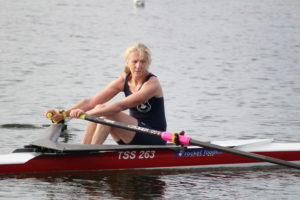
We got this email from a customer who is returning to rowing. Her experience and our advice may help you. [Published with consent.]
Hi Marlene and Rebecca
Can you give me any tips on how to get started with the programme and how to build myself up from pottering around on the river to actual training? I’m 62 next week, was a successful heavyweight senior rower in the 1980s but always very inflexible and prone to back injuries. I taught myself how to scull a single in 1977 but only raced for the first time in August 2018. I won my first two races but the third regatta in mid June 2019 was a disaster, I felt really weak, lost by miles, and haven’t raced since.
I signed up to Faster Masters at the end of May 2020, full of good resolutions even though I wasn’t very fit. I gradually started back sculling in and built up my mileage so I am doing 10k to 11k in my single at what is probably Cat VI. When I have tried the faster rowing sessions I couldn’t get anywhere near the suggested stroke rates and found that very dispiriting. It’s very hard to track progress on our river because of the variable flow and wind conditions but my splits seem to be considerably higher than the times local women scullers my age achieved in a time trial I missed even though I have been sculling longer than any of them.
During lockdown I had no erg access and, even though I do now, I have eventually developed costochondritis every time I have used ergs for serious training since I returned to masters rowing in 2003 so I avoid them now. We can usually row here if the river isn’t in flood or it isn’t blowing a gale, as we don’t get frost or snow even though it isn’t very warm.
I live beside the boathouse and am retired so I have plenty of time and I thought I was going out five days a week but my husband reckons that it’s more like two or three days. I do reformer Pilates twice a week normally and am currently doing a video mat class as we have locked down again. I’ve started running once a week with a group and am actually enjoying it despite my asthma.
Maybe one of the documents set out how to build up to full race training from a low base, apologies if it does but I didn’t see it.
What all returning rowers have to learn is that you aren't that girl in the 1980s any more.
You (and we) all need to learn what our mature bodies can cope with and how long we take to recover from any exercise stress. And that includes recovering from coughs and colds and other ailments too.
The three core sessions are marked on the programme with an asterisk.
Buy a heart rate monitor to wear in the boat and note when your HR rises because that's a sign you are getting tired.
Do the land training on non-water rowing days so you improve your strength and flexibility.
Do a daily waking Heart Rate Variability test as this will tell you how "recovered" you are from the prior day's training. There's an app called HRV4Training which you can use. [more information here from their blog https://www.hrv4training.com/blog ]
This will help you work out how much training to do as you mention running and pilates and your mat class as additional training sessions. That's at least 6 sessions a week although the pilates may not be aerobic, it still gives you a workout.
Build up the program based on how your body copes with the training load. If you start by doing 50% of the volume of each rowing water session and only do the 3 core sessions a week. Do that for 2 weeks.
Then add about 500m more each outing until you are comfortable and your HRV recovery scores are confirming that your fitness and recovery is tracking positively. Be confident that holding steady and not adding 500m more distance is fine. This is your body adapting to training again. And you can step back down if you are tired and only want to do a couple of kms on the water. Use it to practice technique - lots of stationary roll ups or pause rowing drills.
Use the erg and water interchangeably - so if the weather isn't good, you can erg even if you don't like it much.
Note how energised you feel before the workout. What training you did. How tired (scores out of 5 or 10) you feel afterwards. That will help you with subjective gauge of your body and your mental approach to each workout. It is not a bad thing to cut a workout short if you are tired or it's not going well.
Be patient and kind to yourself!
And best wishes, let us know how you go after the first 4 weeks.
Rebecca and Marlene
Rebecca and Marlene explain The Faster Five essentials for rowing
Technique, Bladework, Stroke Power, Racing and Fitness Assessment.
12:00 We launch the Faster Five. These are principles which are important to learn, how to practice and what to practice. Things to pay attention to and key reference points.
The Faster Five represents the Faster Masters Rowing philosophy of teaching and a structure for you to plug into when you are studying rowing and learning how to become the rower you want to be.
16:00 Faster Five - Technique . Reference points so you can practice on your own. It takes thousands of strokes to learn the correct technique. It takes 3 seasons to become a sculler and 2 seasons for a sweep rower to feel they can apply good power in both sweep and sculling.
19:30 Faster Five - Bladework. timing and co-ordination is important. When you hold something in your hand (the oar) your brain thinks it's part of your hand. This is why it takes a long time to learn. Reduce your wash and blade is a key part of the learning from the Faster Five. The timing, finesse and precision takes drill work, focus and concentration. Developing high speed co-ordination is key to becoming a skilled rower.
23:00 Faster Five - Stroke Power - this comes after the bladework which brings confidence to your rowing. Power requires you to trust the oars and use your body weight. Learning the sequencing, being explosive and being effective at moving the boat.
26:00 Faster Five - Racing - the principles of racing well. Mental and physical, starts, steering and race strategy. What works for you and your crew. Back up plans. Relevant for all rowers whether you race or not because you can test yourself and get progress markers.
30:00 Faster Five - Fitness Assessment. A battery of tests to gauge your quality of rowing including stroke power, VO2 max, anaerobic threshold. Comparing the results works on both an erg (watts) and on water (500m spit to watts). The relative comparison gives proportional fitness measures. This changes over time.
34:30 If you are injured and come back to rowing your test shows you the right level of intensity you can manage.
38:00 Where to get the Faster Five. Link is in the website footer
https://fastermastersrowing.com/courses/the-faster-five/
When you subscribe to ANY monthly recurring program on Faster Masters Rowing the Faster Five is included as a welcome gift.
When athletes stop doing our training program you lose a lot. You lose commitment, you lose engagement and you lose someone else coaching and doing the thinking for you.
When you stop doing our training program you lose fitness, you lose your edge and you don't stay engaged and showing up. When successful athletes stop doing the Faster Masters program 100% of the time they never maintain the results they had on the program. Success does not carry on without an ongoing, developing training program.
40:00 Faster Masters is more than just a training program. Faster Masters is not babysitting athletes. Depth of instruction and insight from masters specialists. The Faster Five took us months to complete and includes our years of coaching expertise.
Masters feel like "disregarded" athletes - we are on a mission to get the sport of rowing to appreciate masters athletes. What we can bring to them, the goals we have are important. We deserve respect. We are building a global family of athletes.
n
Is this really a complicated subject - surely you just breathe when you want to?
Well no actually that is not best for rowing performance.
We chose a big topic for this week's podcast. Breathing.
Few of us re-learn how to inhale and exhale. Most just let it happen naturally when rowing. But we may be getting it badly wrong.
This week's podcast and the Faster Masters paid membership subscriptions both address breathing in rowing.
The easy answer to "when to breathe" is to inhale on exertion and exhale on the recovery. That works for most sports, but in rowing your diaphragm is constricted when you are at the catch and you won't get a full breath in. So we have to do it differently.
When you work harder and get tired, you can end up feeling very short of breath indeed.
Yes it really does - because you could be compromising your ability to train effectively. Getting rid of carbon dioxide is important because any build-up in your body will cause you to bind up.
The Faster Masters podcast for 1 September
In the paid membership subscription is a detailed article about Rhythmic Breathing. Marlene describes exactly where in the stroke you should breathe, how to use breathing to improve your rowing and what to do if you run out of air before your muscles become exhausted.
05:00 Would you race for fun? What is the appeal of racing and rowing?
11:30 The Goddess Coach
18:00 Socializing at the rowing club. We started the club and agree that NOT chatting in the boat is important. But when you are training at Category VI you should be able to talk while rowing.
22:00 Does it matter if training groups don't overlap and meet at the club. Every Tuesday night we have picnic dinners on the grass.
25:00 Macons. Because the surface area is smaller you get more slip in the stroke. They won't do te work for you. You have to enter and release very precisely.
28:00 Rowing technique changed with cleaver blades and rig changed too. Open water rowers may prefer macons
33:00 Breathing in the rowing stroke. Mark Novak suggests you inhale on exertion and exhale on the recovery. He's the physical therapist for the US national team. Focus your breathing on land. The main purpose of breathing is to blow out carbon dioxide. That will bind you up if it accumulates. Make breathing part of your rhythm.
39:30 Breathing can calm you down before the start of a race - Rebecca explains nose breathing.
Warming up for your training session can be enhanced with nose breathing.
47:00 Virtual regattas - are they appealing to you? Especially if they are on the erg.
53:00 Racing is about YOU - Your performance. Did you come away satisfied with your performance afterwards?
n
Marlene and Rebecca discussed
Timestamps
03:00 Rethinking the Olympics - what’s the purpose of it? Striving to achieve the highest potential you can.
Dame Katherine Grainger on rethinking the Olympics
https://open.spotify.com/episode/1VG3FAbAVWZsUIYKqBbFFn?si=efZQWup1TNa2sc8iRY1sLQ
07:50 The Economist asks if electronic sports should be included in the Olympics
https://www.economist.com/leaders/2020/06/27/why-the-next-olympics-should-include-fortnite
16:15 Volker Nolte on the Olympics
https://rowing.chat/volker-nolte/
21:00 Sculling to lose weight. Obviously this year it is not possible for sweep masters teams to get on the water. So I have taken up sculling, is three times a week sufficient for weight loss?
How many times a week were you sweep rowing? Number of calories you need for weight maintenance how to calculate for your body weight.
26:00 July’s Faster Masters program - technique module backing into the catch drill which builds on the erg suspension drill from last month. Performance module is Quick Boat Set Up for shared boats and the Bonus is a rigging challenge.
34:00 Elizabeth Bugert asked Does anyone know if you can connect a Garmin watch and Speedcoach on the same HR strap? If yes, which straps would you recommend?
Garmin Vivofit https://amzn.to/3i2wLKe
Garmin Foreunner 935 https://amzn.to/3idgYZc
NK Speed coach https://amzn.to/2Cz8efp
Garmin HRM Dual https://amzn.to/2CCyuWd
Wahoo https://amzn.to/38d84X7
Polar H10 https://amzn.to/2VAtGHR
Coxmate GPS https://www.coxmate.com.au/product/coxmate-gps-2/?v=8e3eb2c69a18
43:00 Katherine Gross started a discussion on the Masters Rowing International Facebook Group
What fun/creative/meaningful/random/perfect/legendary name did you give your shell?
n
Winter rowing training is hard. The weather is unfavourable to motivation and many of us can only train indoors.
But as committed Faster Masters, we are not discouraged. We know that by setting a training goal for winter rowing, we will be able to track our progress and overcome short term challenges.
So what should your winter rowing goal be?
Rowing fitness is built through endurance and so one easy goal to set yourself is to become fitter. Taking the Faster Five fitness assessment will give you a clear measure of where you stand. Marlene and Rebecca recommend testing yourself once a month. And so if your winter begins in November and runs through to March - you can have 5 tests completed which should chart your progress. The Faster Five Rowing fitness assessment includes your long distance fitness, your absolute strength and two more tests. Overall you need to know these fitness test results so that you can train optimally in the correct training zones.
When you design your program (or if you buy the Faster Masters program), you will have multiple goals - some are short term and others may be a big race regatta event like the London Head of the River, Head of the Yarra or the Head of the Charles. All your training is focused on the big goal - but the smaller goals as transition points towards that big moment.
Questions to ask yourself or with your crew
1:13 Faster Masters Rowing training program elements for this month.
4.45 Are erg sprints a good winter goal?
7:30 Goal of winter training programs.
Faster Masters Rowing Episode 7: The Role of Testing & Trials in Rowing
https://fastermastersrowing.com/courses/faster-masters-episode-7/
10:09 What gives you the biggest boost for next year's head racing?
15:00 Work travel and how to keep training alongside social obligations of a corporate career
Home Exercises by Raf Wyatt
https://www.rowperfect.co.uk/home-exercises-need-to-train-at-home-heres-how/
22:20 Training adjustments
Returning to rowing, starting rowing as an older athlete. Can you row aged 20 or aged 90? How to coach masters athletes.
https://fastermastersrowing.com/courses/faster-masters-returning-to-rowing-coaching-masters/
27:45 Using the ski - erg in training for rowing
32:30 How to stay motivated during 1x training
42:00 Fitkick boat shoes promo
https://amzn.to/33mBhdQ
n
Hi, my last head race of the season is behind me and I think I’ve identified some areas that I need to work on. The last race was a lot of fun even if only finishing in the middle of the pack and I think I put into it as much as I could as far as effort.
I know I have lost muscle mass and strength over the years and I am wondering if it is feasible to increase strength by focusing on particular erg and rowing exercises over the winter? My erg is a C2 model A with no computer but I can row all year around (except when it is stormy outside). I live in a rural area and I know I wouldn’t consistently drive into town to lift weights if i joined a gym. Any suggestions?
Well done on your season. I think that you definitely want to include strength and flexibility work over the winter especially for hips. There is a strength program included in the Faster Masters program subscription. If you have some kettlebells or dumbbells and elastic bands you can do most of the exercises at home if you prefer not to join a gym. It's fine to join a gym if you would like but we design the exercises so they can be done easily at home.
Adding a bungee workout once per week when you are on the water is a good way for specific strength too. You could include it on a Cat VI rowing day. Good training, Marlene
It's the Head of the Charles 2019 - my bucket list rowing event. Months and months of training, and poof! Over in a flash.
Three days back and there’s still much to process. I didn’t update during the regatta because I wanted to absorb the experience–and I needed to sleep at night.
I did make this short video, the 7 Days Countdown to HOCR. I wanted to capture everything that leads up to a race, plus the results.
The first half of the trip went off with zero problems: Louisville to Laguardia Airport. Now that airport is a disaster. Poor signage, terrible food choices behind security, and one bathroom for 15+ gates?
My flight from Laguardia to Boston was cancelled. Not delayed. Cancelled, due to poor weather. The plane never left Boston. Luckily I saw “CANCELLED” flash on the screen before the gate attendant announced it. I rebooked on the app, getting the next flight out before it filled up, then scrambled to make sure my gate-checked luggage would be re-routed. Then I started wondering if the next flight would also be cancelled. How would I get to Boston before 9am? I started researching train and bus, just in case.
What a hot mess! Mom brain is real and I swear I’m losing it. In between this chaos, I temporarily lost my wallet. It happened when charging my phone. I guess my backpack wasn’t zipped all the way. When I put it on the counter, it flipped out over the sill. I didn’t see it, but neither did anyone else. 15 minutes of sheer panic once I realized it was gone. I could get to Boston–but how would I get home? How would I get money to eat? But I found it, the next plane did arrive (even if late) and I made it to Boston and my cousin Maggie’s about 9 p.m. Rode the bus with a youth team from Great Britain.
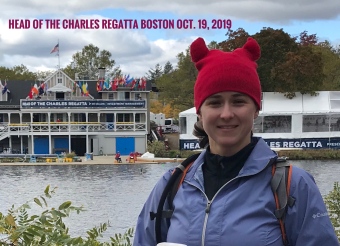
After a poor night’s sleep, I was excited to get to the racecourse. This time I rode a bus with Newport Aquatic Center youth. Their cox talked about heading to Vespoli, also my destination, so I followed them from the stop to the river. At that point, it was easy to figure out. Just follow all the other rower-type peoples heading for the water.
And holy bananas. Six docks? Streams of boats? Official merchandise? Yes! And I soon as I saw my friends from Florida, I teared up a little. For real, but out of joy. I’m here and this is happening!
Our practice row happened thanks to a sub from CRI, a lovely woman who was so encouraging and helpful. Thank you Sarah for stepping in so we could row!
Two doubles collided under Elliot and a men’s single flipped in front of Cambridge. And that was all in the first two minutes of our practice!
Conditions were windy and chilly, but not terrible. Hands tore up on the grips even with light hands. They happened to be my least favorite Concept2 grip, so I expected it. Overall, it felt like a solid row and it was nice to get the jitters out.
My Mom came to watch the races. We met up after practice, sipped some hot cider and walked around the venue scoping out the scene. It was nice to have her there to cheer us on and I got to wear my rowing nerd hat while explaining everything. “That’s HOCR headquarters, this is the last bridge, etc.”
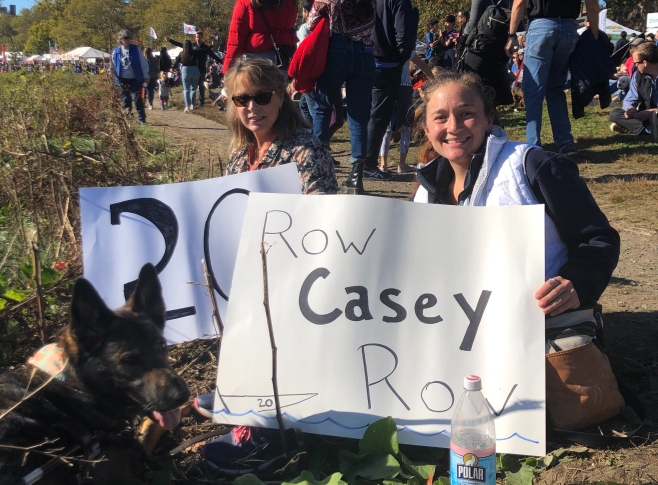
Mom and Maggie, with signs for our race! So sweet.
A beautiful, clear blue sky day. We never had the chance to row our 4+ line-up until race day.
We were hopeful for a top 11 finish. It seemed reasonable to me that we could be close to 11.
I am super proud of how well I did mentally. There were some moments of jitters. In the morning, at my cousin’s place, getting ready. Laying out the uniform. Seeing a fellow rower on the transit. Standing by the river watching the other boats coming down. Hands on. Some dry mouth while rowing up. Hearing the announcer calling boats onto the course.
But overall, I didn’t lose it like I have in the past. I felt focused. Excited. I let go of the unknown and welcomed the experience. I was happy to be there, in that boat, with four other ladies who I knew had my back. It will be what it will be.
My hands were a big concern. I had the worst hot spots on the right hand bandaged, but worried about their staying power. Sure enough, one slipped off on the way up. But it turned out the bigger problem was the outside palm of my left hand. I The rotation had rubbed a section raw it was doing me no favors. n the rush to leave, I’d left my tape behind. Luckily 2-seat, Caitlin, had some surgical tape. It stayed on the whole race and saved my hand, I swear.
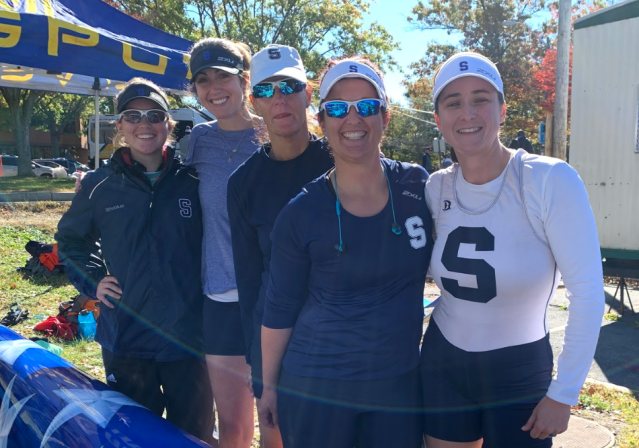
Our women’s masters 4+: Cox Sarah, 2-seat Caitlin, bow-Beverly, stroke- Holly, 3- me
The race happened so fast, what I have left are fleeting moments. I was so dialed in during the race I didn’t see the crowds on the sidelines, the banners on Elliot bridge, the enclosures, my family by Weeks. Here’s the rundown of what I remember:
Where do zombies like to row?
The Dead Sea!
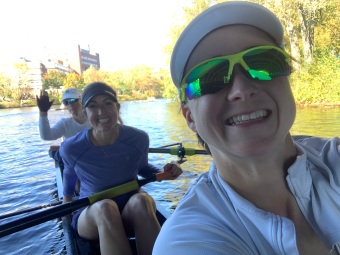
On our way to the start…taken during an Elliot Bridge traffic jam.
Panic! We’re going to hit! We’re under a bridge! Cox’n is yelling, and I’m screaming too, “POWER! POWER NOW!” and jamming it with everything I got, eyes glued not on stroke but the white bow surging forward and the sunglasses of their cox. I think stroke is yelling too, and we are standing on it—
Swoosh! Inches, they change course cutting to starboard and we cut to port. (Apparently, says our cox, the same thing was happening in her bow, which is why she was also yelling.)
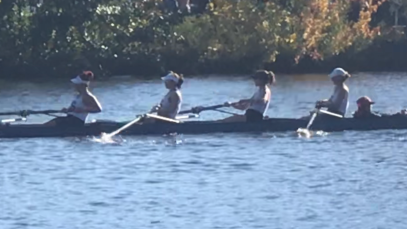
I was looking forward to row2k’s pictures to see how close this almost-collision was, but they posted nothing. Only one picture of our boat at all.
About fifty meters past the finish, we’re on the paddle when our cox’n says, “Hey, Texas, do you know Felicia?” Holly and I whipped our heads around, thinking about the same thing–”Oh my god, our cox’n did not just ‘Hey Felicia’ that boat”– but she quickly followed up with how she used to cox with some girl there and to say hi. Relief. Holly and I chuckled at that.
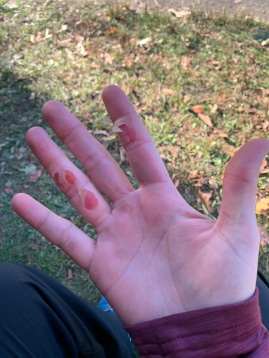
My right hand: as soon as we went on paddle and the race adrenaline wore off, I felt the damage. Light pressure on the right hand all the way back home. Strangers asked if I was in an alumni about because clearly I don’t row enough. I also turned down the offer of alcohol from the first aid station. Not a glutton for punishment.
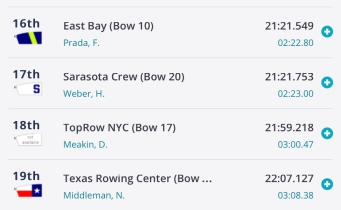
Someone looked up the results. I don’t think it was me, but maybe. We were all disappointed to find ourselves at 17. A general, “really?” The row felt decent for a composite 4+, maybe a little messy near the end, but it came back together. If boat 17 had yielded, we probably would’ve been 16, as it was a 0.2 second difference.
I hoped for a better end, but the goal was experience. That we nailed 100%. It was an awesome race. I enjoyed every second. I felt strong, I know I made a solid effort by how my muscles felt at the end, and I conquered those pesky inner demons. Triple win.
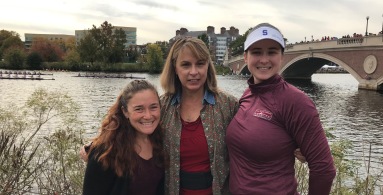
My Mom and cousin Maggie came to watch us race.
No rest for the weary. The Head of the Hooch is less than 10 days away and I’ve got three races including the single. I landed home Monday and
picked training back up on Tuesday.
It’ll be my second race ever in the 1x, the first being over six years ago. With the HOCR out of the way, there’s nothing to stop the mental wheels burning about the Women’s Master 1x, but I’ll save that for another time.
You may be wondering what is Faster Masters? Let me answer by telling you a story. Grab a comfy seat and a drink because this will take you 5 minutes to read.
Rebecca and Marlene are your coaches were both competitive younger rowers and (eventually) reached the end of their careers and wondered what to do next.
Marlene had won major titles in sculling and sweep rowing including a US National Championship, a Collegiate National Championship, and a Head of the Charles title. In 2000, she set two world records on the Concept2 Indoor Rower; Rebecca was a multiple Henley Womens medalist and Henley Royal Regatta finalist with a string of medals in UK head races, National Championships and a Boat Race win.
After deciding to quit, both were at a loss about what to do next. Was there a place in rowing for older athletes with a bit of coaching experience?
We noticed in every rowing club there is a committed group of older athletes who enjoy training together; they turn up regularly; they get given old boats to use and after training they huddle in the club room drinking tea and clearly having a good time chatting together.
Everyone ignores them.
Nobody knows or cares that they were once the youthful heroes of the club training all hours and winning medals. Once in a while a newcomer is added to the group – someone who moved to the area, a visitor from overseas or a beginner who is starting off in the sport. They quickly become embedded in the group and make friends.
The group gets no coach allocated to advance their skill; they do boat maintenance as they use older shells and oars cast aside by other training groups. And yet …… they have the same commitment and drive to succeed, to gain skill to move a shell with ease, becoming fit, strong and worthy competitors in rowing races.
Rebecca was asked by David Hudson and Andy Ripley to coach the masters group at Tideway Scullers School, her London UK club. This was a revelation. The group were the most attentive students, striving to effect technique changes, hungry for more drills and more insights to make their boat go fast. And as they trained with a common focus and a common purpose they got faster, stronger and that season they won medals, lots of them.
Marlene took a different path – becoming a coach and starting Royle Row training camps and coaching.
But before the internet, few of these masters could find each other and learn together or share experiences. They met occasionally at the Head of the Charles or the FISA Masters Regatta but dispersed afterwards back to their clubs. The group was global but isolated, motivated but un-focused, and unable to progress.
Mike Davenport, the author of the Nuts and Bolts Guide to Rigging and Jimmy Joy, host of the Joy of Sculling Conference were both guests on Rebecca’s RowingChat podcast. Behind the scenes, both gave invaluable advice on how to share coaching advice from a distance, how to bring groups together for a few days to progress rowing skills; how to write clear explanations allowing the reader to coach themselves.
And this motivated both Marlene and Rebecca to continue coaching and to start sharing their knowledge online. Rebecca started writing for an audience of Masters on the Rowperfect blog; Marlene penned articles for Rowing News and gained new club clients who bought her training programs.
The snowball started to roll.
Rebecca invited Marlene to be a guest on RowingChat in January 2016 and that episode became one of the most downloaded ever. They continued chatting offline and decided to launch an advisory self-coaching program called Faster Masters Gold. It is 8 detailed ebooks covering drills, technique adaptations as you age, developing stroke power and racing 1k. The globally popular Facebook group, Masters Rowing International was formed and it continues to grow (>6,000 members) as masters find a community with aligned interests ready to answer each others’ questions and share advice. (Do join and invite your rowing friends.)
These early successes encouraged Rebecca and Marlene to continue to discuss the challenges faced by masters athletes. We found ways to overcome the isolation; to demonstrate smart ways for more people to really enjoy rowing and to make strong progress towards goals - despite clubs who do not support and encourage masters.
Today, Faster Masters Rowing helps athletes with a framework for their training and an online community to support the trials of training, injury, setbacks and to celebrate progress towards success.

Join our community and get our exclusive Faster Masters Rowing Magazine, packed with tips, techniques, and inspiring stories. Includes four new articles monthly.
