Continuing our series about the rowing and sculling stroke and what each phase should look and feel like plus drills on how to coach yourself to improve.
02:30 This Past Week - what we do to advocate for masters rowing.
Organising groups of different skills
Crew racing lineups article.
09:00 Jess Di Carlo reviews book of the month Socrates the Rower. Rowing as stress relief.
See more rowing books on our blog.
Building power as you move into racing.
Technique for the drive:
Get the blade into the water.
Mechanics - move the boat past the blades and not pushing the blades through the water.
Focus on lower body - legs, hips and push on the footstretchers.
Maximise stronger muscle groups and use them first.
Pressure on the handle and footstretcher are the same.
Read and watch the full video series on the rowing stroke cycle - 6 episodes from catch to finish.
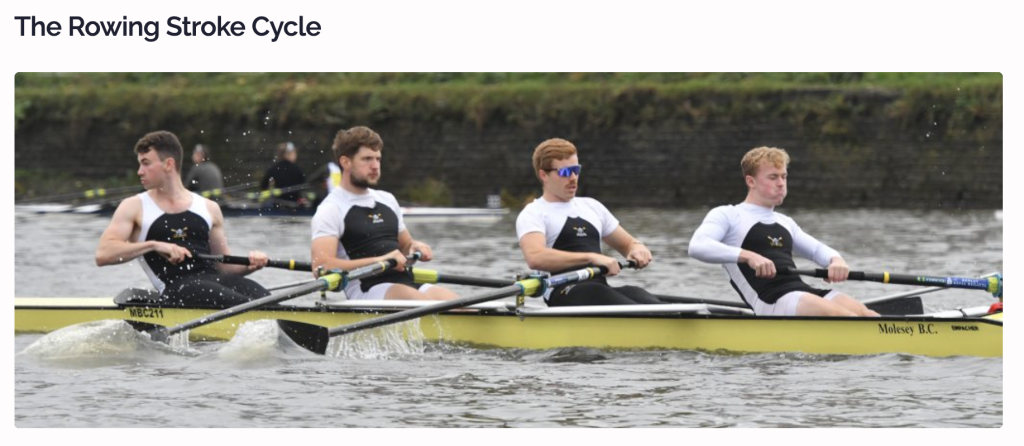
Get feedback by checking your oar shaft. Look at it.
Is it changing blade depth? this shortens the time in the water.
Wash happens if you don't extract the blade at the right time.
Slip is if you don't have purchase on the water at the start of the drive.
Purchase at the catch is sometimes called grip on the water.
22:00 Practice rowing feathered on the drive to find the correct height of your handles.
Identify a visual reference point to check you have the correct height.
Initiate the drive with the legs and hips and later bring in the body swing.
Pressure on the foot stretcher - the whole food goes flat on the footstretcher - this is the moment to bring the body swing in.
25:50 Swing through the perpendicular point of the oar handles.
As you do this you start to bend your elbows.
The blade is moving to the pin at this point.
Continue to hold pressure so the blade doesn't tear the water.
If you lose the pressure that hurts the release.
30:00 Practice the drive - legs only rowing.
Add resistance with a bungee.
A good way to get more proprioception into your joints.
34:00 Push a refrigerator
Activate the glutes - this supports the lower back
Activate the lats - this gives a solid shoulder girdle
Together these solidify the torso for the drive.
36:30 Drill - finish all three at the same time - legs, back and arms.
Exaggeration drill - do for 10 strokes
This teaches how you can adjust your movements.
38:15 The result is shown in your puddles
They should be tight dark circles.
39:30 An exercise for swing and rhythm.
Learn to trust your blade. Get your head out of the boat and stop looking down.
Put the blade in the water and look up at the sky. Add your head mass to the leverage.
43:00 The boat is stable when the oars are in the water.
We continue our series exploring all the parts of the rowing stroke.
04:00 This Past Week - what we do to advocate for masters rowing.
10:00 The coxing "plank" and the shoe straps
13:40 The recovery begins when the blade exits the water and continues until it returns into the water.
In practice, I teach it as the beginning of when the knees rise on the slide.
16:30 You've done the preparation for the catch already. Simplicity is key.
Let the wheels of the slide move and only your legs are changing position.
Feathered blades on the recovery and your wrists are bent
You need weight under the handles
Level out the back of your hand and forearm
In sweep use the outside hand to keep weight above the oar handle.
The square up can mess with the rhythm
The point at which you release. your knees - you don't need your body fully over until quarter slide. We prefer that your hands are past your knees and the body has shifted to rock forward.
Read and watch the full video series on the rowing stroke cycle - 6 episodes from catch to finish.
23:45 Release the knees gently. Bring the boat underneath you.
Get the arms out first - the handle leads the recovery.
Focus on the slide seat rolling past.
Be poised and relaxed.
Deactivate the muscles and remain poised without tension.
Strength training can teach you how to activate and release muscles.
34:00 The jelly legs exercise - Rebecca explains how to teach this and practice it yourself.
38:00 Slide in time with the boat. Feel the glide.
Give your muscles the rest so as to gather energy for the top of the slide.
Don't chicken out at the top of the slide. Recovery continues until the blade is in the water.
Continue to compress - you're slowing down. Stay on the arc around the pin especially in sweep.
41:00 Decrease your tension by 1 percent.
Practice this in your crew all rowing together - you can't get the feeling with only half of you rowing.
The Stroke Cycle - recovery
What is the difference between the stroke finish and the release? Are these just different words for the same thing?
01:00 This Past Week - what we do to advocate for masters rowing.Faster Masters 1k racing programs are published for May/June or September peaks
What is the difference between the release and the finish?
Bio-mechanists say the release is when the blade exits the water.
The finish is a position of your legs/body/arms when the power phase of the stroke is complete
The release is the action of pressing the oar out of the water.
- extract with your hand pressing down on the oar handle - you must have weight over the handle
- simultaneously directing your weight into the oarlock so you exit cleanly.
11:00 Press your palm downwards using only your forearm.
This is tricky because the boat is moving fast at this point.
There is a tendency to rush it - keep it continuous is your goal
Exit quietly - listen to the oarlocks
Check your collar doesn't pull away from the oarlock /gate.
Read and watch the full video series on the rowing stroke cycle - 6 episodes from catch to finish.
16:15 The Open Oarlocks drill - helps teach you to keep pressure on the oarlocks.
Test different release points - 1, 2 or 3 cm away from your body
Look at your puddles - tight swirls in a circle. This is what you want.
Timing off your foot pressure will tell you when to release.
This is where you transition to weight back on your feet.
How you sit on your seat is important.
Check you aren't too far back.
Maintain the handle speed and sequence.
30:00 Separate the arms away from the body rock forwards - the swing.
You should feel your shoulders behind the hips.
It's hard to get a good rhythm without this movement executed well.
33:30 How much rock over should you do?
Shift your weight to the front of your seat
Let the hands lead the body rock - when fully straight your arms pull your body forward.
Actively think hips move towards the bow.
39:00 Train yourself to listen and feel the boat.
To get our monthly articles for inclusion in your club newsletter sign up here.
Satisfaction gained from rowing often comes from measuring progress
02:00 This past week
06:00 British Rowing Plus magazine article by Rebecca Caroe Goals and Measuring Training for Masters
07:45 Marlene reads the article - process goals and measured achievement goals.
12:00 What will help you move towards your goal? Diary your testing every 6 weeks.
18:00 Resources and rowing measurement suggestions included in the article. Using an app or speed coach to record data Metres per stroke at rate 18 a measure of base paddling speed A 20 minute erg test for fitness Faster5 Fitness Assessment includes the details
20:45 Heart rate is not a good measure of training intensity Row set distances or set time. Marlene likes Stroke rate 22 for 20 or 30 minutes as a regular workout.
25:00 At what intensity do you row the 20 minute test? The best effort you can on the day - it is a test. However you can’t row 100% every stroke, you have to last the distance. How to find the ideal 500 meter split which you can maintain at “comfortably hard” for the full time. You can increase the split a little during the piece. You just feel that the test is an honest reading of your capacity on that day.
29:30 Tips on goals for non-racing masters.
Technical goals - how many strokes can you row with blades off the water? Endurance goals - distance before you need to take a break. Marlene is not a fan of talking in the boat for team boats. Testing breathing - can you breathe through your nose or your mouth? Steering tests- through the bridge without over-steering.
32:00 Rate of perceived exertion scale Small wins matter.
35:30 Fitness evaluations cause less anxiety over time. Have a routine of how you approach the tests. Make them regular, part of your practice.
37:00 Is it better to rate high with low pressure? It depends - rigging affects this, gearing and your physiology. Use the Rigging for Masters Webinar to find what’s right for you.
The Stroke Cycle - Balance and Stability PLUS Book of the Month with Jess di Carlo
Support this show with a donation
https://fastermastersrowing.com/podcast
01:00 This Past Week - what we do to advocate for masters rowing.
Ageing Well Webinar
British Rowing Plus article on goal setting
Club feedback on season goals
Jess Di Carlo reviews. Book of the Month - it's womens history month and Jess chose My Olympic Life by Anita DeFrantz
https://amzn.to/36pkjTE
The definition of balance is narrow. It's about the level or set of the boat.
Stability is a wider base of support using the whole system from oarlock to oarlock. Keep the riggers level when the oars are out of the water, keeping connection to the oarlock.
Within the hull keep pressure on your feet and back.
19:30 Watch for oarlocks staying on the button and the collar not coming away from the gate.
Read and watch the full video series on the rowing stroke cycle - 6 episodes from catch to finish.
21:00 Transitioning back onto the water.
Testing your stability and balance - an exercise.
Sit at the finish with blades buried. Press against the oarlock on one side - the boat tips.
Do Drills
In place - finish squared and buried. Tap out the release and put the oars back int he water.
Release and feather
Release, feather and hands away
Release, feather, hands away and body rock forward
All return to blades buried in the water after each attempt.
27:00 Weight in the hand is a key concept in rowing and sculling.
Demonstrated by Marlene
28:30 Open palm sculling drill
Enough weight ove the handle - how do you know when you have this?
Feel you sat up a little taller - your sternum rises as you rock forward.
How do you work with your coach and how do they work with you?
What boundaries are there to the relationship?
How to give and receive negative feedback
01:00 This Past Week - what we do to advocate for masters rowing.
US Rowing Masters Conference
https://2022usrowingmastersconference.sched.com/
05:00 Ageing Well Webinar
https://fastermastersrowing.com/courses/ageing-well-for-rowing/
08:00 Athlete Coach Relationships
How do they work with you and you with them?
Goals of your program - fitness, technique, camp ....
Develop trust and respect
Understand communication - what would they like to get from the session or what to learn
10:15 Life stage and coach relationships
At high school they tell and you do.
Competitive teams - team culture, standards of behaviour and quality training matter
Masters are different our choices are more varies.
12:30 Igor Grinko coach to USSA, USA and China noticed the differences in athlete coach relationships.
15:00 What boundaries are there to the relationships?
private time
Communication - how, when, text / email / call / Face to face
Days off from the team
Scheduling crews - deadlines
Timelines for practice. Time to arrive and time on the water OTW
18:00 Preparing for the session - brief the coach ahead of time.
What is the approach - do you coach the whole boat or individually?
22:00 Use video to give individual feedback privately
23:00 How to give and receive feedback
Ask at the beginning what are you currently working on?
At the end one good point and one point to work on. Plus video of good sculling.
26:45 Separate their identity from the rowing skills - feedback is not criticism
28:00 Receiving feedback - coach-ability is a great skill to have. Try to do what the coach says.
Some coaches relay on athlete intuition to solve problems. Others explain the "how" relative to a reference point.
31:00 Give coach feedback afterwards for the crew.
35:00 If you want coaching, come close to the coach boat.
02:30 This Past Week - what we do to advocate for masters rowing. The March programs are ready including a focus on the pelvis and how to use it in rowing and sculling. Hip and pelvic mobility exercises.
08:00 Sponsor this week by the Rowing Directory including new listings for Glide Boat, The Flying Boatman, Shell Covers Australia, Adirondack Rowing and Trophy Oars
https://rowing.chat/retailer/
09:45 The Recreationals at Trafford Rowing Club - Susie Loates is the Vice Captain responsible for the group.
11:30 A recreational rower is anyone who does not want to commit to the full training plan of the racing squads. Members are parents, professionals with busy jobs and shift workers.
13:00 We seek a good technical row in sculling boats.
15:00 The Group uses Fitclub.me to book boats with up to 19 sessions available per week. We are welcome and a recognised part of the club.
16:30 How are sessions broken down - is a technical point or a workout set?
We arrange to out out 4-5 times a week.
Anyone can coach and we are encouraged to help other rowers.
Treated as an equal rower from day one.
19:30 The explore series of races. Uses stable 4x. These are 300 meter dashes races.
23:00 Advice for starting a recreational group.
Approach your committee or club leadership. You want a fair time on the water and a fair allocation of boats and equipment. Seen as the equal t racing squads.
25:30 Has the group got a leader? Susie has a rough plan for the group.
Membership fees are £25 per month for everyone in the club.
How is rowing going for you? What's it like elsewhere in the world? Learn more from our survey report. If you would like the anonymised raw data, get in touch.
Most masters have been rowing over 10 years and started rowing either at school/university or began over age 40.
The average spend on rowing per year is between US$500 to $2,000 with a significant group spending $4,000 or more each year.
There is some alignment between training effectiveness and rowing budget, those who invest the least get the worst results. Masters who train between 2-4 days a week report results between mixed, OK and good results in the past year.
Training frequency on land and water is consistent from summer to winter.
55% of masters follow a training programme. 39% do not plan their training.
Nearly 40% of masters row a single, 25% use the erg and many do crew boats as well. Weights, body conditioning, yoga, gym and cross training are the most popular land training choices.
Download the State of Masters Rowing 2022 report.
The most shocking finding is that half of all masters rowers either do not get coached or get coaching once a month or less.
Going on camp is popular with most choosing to go to improve technique or for race preparation. 60% of respondents plan on going to camp during 2022.
The pandemic affected rowing clubs postiviely and negatively - 30% reported a growth in members and 22% lost members compared to pre-pandemic yeas. Learn to row classes continue to be popular with most clubs running between 1-3 courses a year and 40% of clubs had more students.
Student drop-out after learning to row is reported at between 50-70%.
Racing was badly affected by Covid with over 70% doing three or fewer races in 2021 and 2/3 reporting they raced less than in previous years. 50% of masters race 5 times a year normally.
The majority of masters use data to analyse their rowing at least some of the time - only 25% report not collecting rowing data. Race results get more attention than training data by the very keen but 30% of masters don't analyse race or training data (clearly some collect data and don't analyse it). Over a quarter report uncertainty understanding what the data shows and 6% have technical issues interpreting rowing data.
We asked respondents for the personal and club challenges - the biggest challenges for clubs are recruiting new members, fundraising, coaching and equipment. A strong second tier of answers include 'getting people to row with', finding time to row and getting support from the organization.
For personal challenges Coaching, injuries and age-related issues lead the responses. It is interesting that the detailed responses frequently reference learning rowing and sculling technique as a personal issue.
Covid has of course created challenges as well from weight gain, restrictions in the number of people allowed to row at one time and training frequency. Many people referenced training in singles as a change as a positive result of Covid.
This week's podcast is about maintaining your posture at the finish, particularly your back angle.
01:00 This Past Week - what we do to advocate for masters rowing. Learn to row course; US Rowing Masters Conference 2nd April 2022; Australian Masters Rowing Championships venue changed to Ballarat, Victoria.
06:00 - NEW feature - Book of the month with Jess Di Carlo
Perfect Balance by Aquil Abdullah.
"One man's personal struggle to be the best in a sport and to find meaning from efforts that repeatedly fall shy of their mark."
Aquil Abdullah
We have a list of rowing books which you may enjoy.
The challenge is sitting and maintaining awareness of your posture.
How to maintain spine position
The finish is at the end of the leg drive - the handle is close to the body and a slight layback of your body.
13:30 Pay attention to the lumbar spine
How to tell if you have swung your body back too far.
15:00 Protect your lower back in rowing.
Keep your chest high helps with neutral spine.
17:15 Feet connected to the foot stretcher helps keep your finish posture as well.
How to do a physical check of your finish position. You need help from someone outside your boat to find this out to give you guidance if you are maintaining that position as you row.
Set up your finish position so your oar handles brush your lower ribs at a specific point so you can tell if you've rocked back too far because your handle is not at that position.
Set up your oarlock height and your foot stretcher so you have a precise place you finish at on your ribs / shirt.
20:00 Compare video of yourself rowing (3 strokes low rate and firm pressure) to a good example of rowing / sculling. What am I aiming for? Compare to what I'm doing in the video.
Join our community and get our exclusive Faster Masters Rowing Magazine, packed with tips, techniques, and inspiring stories. Includes four new articles monthly.