Rowing is a sport that rewards discipline. Book of the Month | Faster Masters Rowing Radio - the podcast for masters rowers. Tips, advice and discussion from Marlene Royle and Jess DiCarlo.
01:00 This Past Week - what we do to advocate for masters rowing. 03:05 Jess discussed her book choice
Rowing Through the Barbed Wire Fence – Rima Karaliene.
What it was like rowing in the Eastern Bloc from 1960s. 13:30 Privileges came with the elite sport team membership in Soviet Union.
27:20 We discussed the concept of discipline being connected to a goal to help you make decisions and create good habits.
Book Mental Discipline: The pursuit of peak performance by Mike Livingston
29:00 Rule followers are one type of discipline follower.
30:00 The 80/20 type people mean you are highly likely to be successful. To get the benefits of what you are trying to accomplish with your goals. Regular practice of discipline improves your skills.
33.00 Knowing yourself helps - do you need a team or a training partner?
Over training happens to masters too | Faster Masters Rowing Radio - the podcast for masters rowers. Tips, advice and discussion from Marlene Royle and Rebecca Caroe.
01:00 This Past Week - what we do to advocate for masters rowing.
02:40 Block format racing allows more events and easier for boat sharing
05:00 squads for masters racing. Being ultra-flexible because things come up unpredictably.
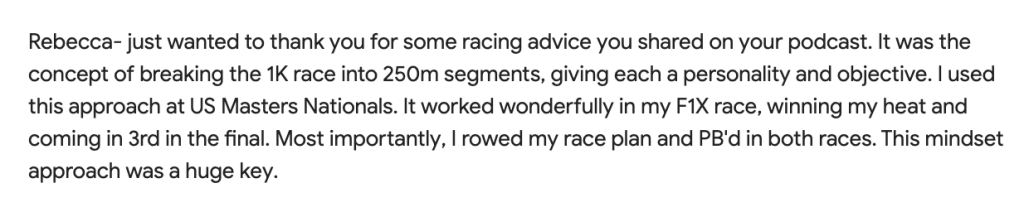
08:00 Testimonials from our customers
13:00 Henley on Todd - Alice Springs
18:00 Over training,. what is it? Over-stress when your system gets run down. Increasing training volume or intensity too fast. Insufficient recovery. If you do not rest your body creates a situation where it forces you to rest. -
Type 1 - muscular - it hurts.
Type 2- central nervous system- lack of balance, co-ordination low motivation.
21:15 When I got over-training. Be very careful. It was caused by too high training load. We have to push boundaries in a training program in order to get fitter.
25:00 Warning signs of over training
30:00 Using your down time profitably. Go down to base training only. Avoid hard AT or Interval work until your heart rate is back to normal. Do not be on your feet- row /cycle is better than jogging. Go out in the coach boat-watch and learn. Join them at the training sessions. Get a sports massage Nutrition HELPS - get protein and B vitamins in. A blood profile test shows deficiencies like B- 12 and iron Do Yoga. Do Pilates. Take a core class -sit ups, press ups, stretching and mobility work. When you start to feel better begin training again.
Rule is #days off = no of days to come back to full training. Be conservative - older athletes take longer to rebound.
40:00 Adaptation happens at the cellular level.
Good stress and bad stress - what they are and how to handle rowing stress | Faster Masters Rowing Radio - the podcast for masters rowing.
One thing to improve masters rowing - Rebecca is asking this question on LinkedIn.
02:00 This Past Week - Marlene met Tony, a faster master from Sherbrook, Canada.
04:00 Good stress / bad stress
A good stress helps you grow , challenges you. Something unfamiliar but which stimulates you to improve.
It pushes you in a positive direction.
Bad stress is too much of a challenge which causes breakdown.
Coach tells stroke "you are responsible for the outcome of this race". Putting athletes into situations which are way over their heads is inappropriate
10:45 Learning to push yourself into situations where you are vulnerable and uncertain is part of the rowing journey
12:30 Integrating new people into the club as an outing plan.
Good stresses - training with incremental goals. Raise the bar gradual.
A more challenging boat balance situation. It was clear we had gone too far so we switched boats.
24:30 When I push off the dock all the bad stresses stay on land. This is a skill. Learn to leave them behind.
28:30 In racing when starts are delayed can you do anything about it? How can you use the time profitably?
32:00 Why does Let it be work best as a stress mantra?
Percentage of people reporting reduced stress from the 3 mantras.
Daily things which impact you in the boat.
Irene's Question:
"Could you maybe talk about how to best behave in an eight to support steering? Some curves are so tight we need to dampen the power on the inside, but do we lean in a direction, do we adapt our stroke length or something? And what about in longer curves where we can continue rowing at full power on both sides but still want to support the cox - how do we best do that? Or do we let her do her thing and just row?"
Techniques for steering in an eight round a sharp corner.
Ted Pytlar joins Marlene and Rebecca to talk about his club masters group and their experience of rowing, racing and training | Faster Masters Rowing Radio - the podcast for masters rowers. Tips, advice and discussion from Marlene Royle and Rebecca Caroe.
04:00 This Past week Rowing News Magazine published Marlene's article on Periodisation of Technique.
08:00 Merijn Soeters new Book of rowing photography
10. 30 Our podcast name - we emailed a question to all newsletter subscribers
11:30 Ted Pytlar's background in rowing
13:30 Moving to the single scull - the ultimate boat. The club mix of boats has changed as the interest in rowing singles has changed.
16:00 Delaware River is rocky and can get shallow so we lose skegs often
17:00 Training Goals - focus on head race preparation. We organise ourselves as a group of 4 we know where the rocks are. After hurricanes we re-survey the river
22:00 after hurricanes we get high flow and use peripheral vision to steer and avoid landmarks.
23:00 We have a LTR annual program with a waiting list. 16 people limit.
We don't have enough coaches and 10 sessions is not enough and so we added a plus plan to integrate them into experienced boats.
26:00 We have a plan to beef up the masters program structure with regular outings
Customise a track for each person's flexibility.
28:00 the board has a LTR co-ordinator and organised coaching roster.
Scullers have a skills test for 1x use and also a masters program co-ordinator with input from members. We bring in a professional coach a couple of times a month
31:00 Swapping from sweep to sculling
I didn't realise the importance of stability at the catch and release in 1x in order to get the rest of the stroke to work well.
Subtle mistakes you can make on port /starboard can really mess you up. It took a while to figure them out.
Loose hands is critical in sculling.
33:50 you have to be at a certain point in your rowing journey to realise or hear certain things. As you get better you realise what the coach meant.
35:00 Try to get an understanding of the complete stroke. Mine is 4 pages long.
A picture in your head
37:30 Some adapt technique which is a coping measure because they are afraid of tipping over
39:30 The swirling vortex behind the blade isn't needed - just bury them deeper. Differences of opinion between people happen in rowing - it's good to know them all.
45.00 Rowing movie - Heart of Champions review by Rebecca
https://www.amazon.com/Heart-Champions-Michael-Shannon/dp/B09LRZR2F1?ref_=nav_signin&
Incorporating novices into your club is essential as part of keeping the membership from attrition.
Rebecca and Marlene discuss how to set up and teach a novice group and ways to incorporate them into your main club group after they finish a learn to row course.
01:15 This Past Week - what we do to advocate for masters rowing. Rebecca's rowing hack got published on row2k - the Coxing Plank. Marlene has been teaching new novices.
06:00 Beginners joining your group. Do you start in single sculls or team boats? The coach does a 1 on 1 session overview of the sport. Important to get in the boat in the first lesson.
Nobody ever asks how do I turn the boat around! First session - ensure they are comfortable, it's a stable boat, they can find where the water is with the oars.
14:00 Incorporating novices into your club - start them in a group together.
People learn at different speeds. - basic skills of stopping, backiing, turning and rowing. Do check how to structure your learn to row programme tuition in Volker Nolte's book, Masters Rowing. Wolfgang Fritzch wrote the chapter on novices. It's excellent. [affiliate link].
18:00 How we learn Just try it. We learn by discovery
People ask questions - it's best to let them do this and answer what they ask (it tells you a lot about how you teach and whether they have comprehended the information you shared). Incorporate drills to explain and clarify.
24:00 Tell people how to do things not just what change you want them to make.
Use drills to isolate part of the stroke and practice them slowly.
Remember if you talk to athletes while they are rowing they often don't listen. It may be better to talk when they have stoped rowing.
26:00 Jam sessions - mixing abilities in crews
Build this into your club season - mixed ability groups. The novices scale up and the experienced people scale down. It allows novices to experience acceleration in a boat. What does swing feel like? It's easy to improve rhythm and timing when you have been shown how to do it and felt the boat move.
30:00 Shadow rowing is useful especially for visual learners
31:00 Coaching groups of different speeds Individual attention for people of different abilities Give time to process the coaching advice. Position the launch (coach boat) so the slow people go first.
39:00 Feedback from a fitness athlete on the new fitness program.
When to take risks with your race plan - what types of risk to choose and when to use them.
Support this show with a donation.
01:00 This Past Week - what we do to advocate for masters rowing. Marlene has been teaching beginners
08:00 Race Plans - these are included free in our subscription training programs. Check the Performance module for 1k and 5k template race plans.
09:00 Mentality for racing - it's individual.
It's process based mentality and NOT results based.
11:30 Racing is 90% mental Know yourself and make a plan to calm yourself. A race is an opportunity to express yourself.
12:45 Your brain will tell you to protect yourself. It will try to keep you safe. In between your thoughts, talk to yourself. Make your mistakes in practice and in trials.
15:30 Racing is often intuitive - build your experience to improve this. 19:00 The four quarters and what to do strategically in each
23:00 Mary Whipple took a risk to let the boat "breathe" Bring the focus back to the boat - not us.
29:00 Taking an extra push after pulling level with another crew. Put them away if you can
34:00 Pull a trick out of the bag for each situation you face.
Perfect races rarely happen.
Marlene Royle
Be prepared to respond to every situation that arises.
Getting Tougher for your mental skills is important training in rowing. Marlene reviews James E. Loehr's classic book The New Toughness Training for Sports: Mental Emotional Physical Conditioning.
Buy from Amazon https://amzn.to/3yI3fnm [affiliate link]
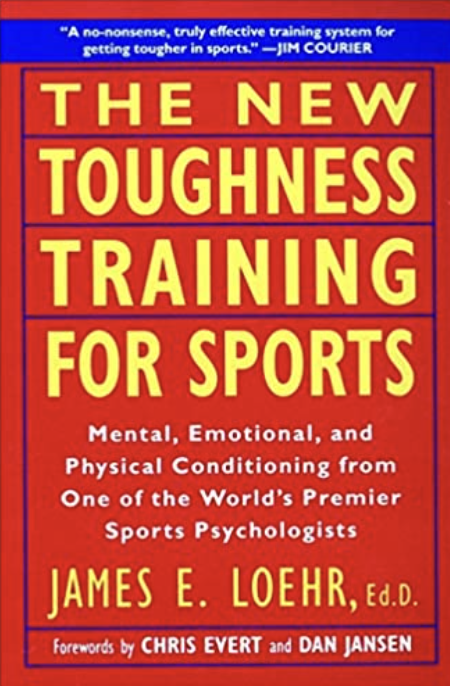
04:15 How tough are you? Have you ever thought to yourself, it’s never over until it’s over or never give up? Or said, I could have rowed faster if I had stayed concentrated in the second half of the race; I wasn’t thinking clearly. Building mental and emotional strength, an essential ingredient for success in rowing and sculling, is what James Loehr’s book; The New Toughness Training for Sports is all about. Loehr’s classic book covers issues related to recovery, understanding the language of emotion, signs of overtraining, the performer-self versus real-self, balancing stress and recovery, as well as the role of awareness in the mental toughening process. Loehr describes toughness training as “the art and science of understanding your ability to handle all kinds of stress-physical, mental, and emotional-so that you’ll be a more effective competitor.” It is a method of perfecting your sport skills while minimizing the risk of physical injuries and emotional setbacks that can result from overtraining. Loehr explains that a key element of toughness training is improving the routines used for recovery from stress during practices and between competitions to maximize an athlete’s potential so that the mind, body, and emotions will become more flexible, resilient, and strong.
06:00 Common words that we associate with toughness; cold, mean, insensitive, or heartless, are not those included in the definition of toughness here. Phrases such as responsive under pressure, resilient, and flexible rise to the surface.
Loehr describes four indicators of toughness.
09:10 There are many athletic situations when the way that you really feel isn’t the way that you know you need to feel to perform at your best level. The way that you really feel is referred to as your real-self and the way you need to feel to perform at peak is referred to as your performer-self. Positive and negative emotions are constantly intertwined in our daily feelings. Positive emotions relate to balance and health, negative ones typically point to unmet needs. Every feeling serves a purpose and you will become a better athlete when you can respond to negative messages in ways that are appropriate versus blocking them out. To perform consistently under pressures at a high level requires that you have enough food, rest, sleep, and water. You must develop the capacity to move from the real-self to the performer-self on demand, which calls for precise thinking and acting skills. You also must be fundamentally physically fit. If your tolerance for physical stress is low your battle may be lost before it begins.
12:30 Performer skills include disciplined thinking and imaging skills that keep your emotions focused. In addition, physical acting skills that help you act the way you want to feel to achieve your ideal performance state.
This is your body language. The way you move intensifying whatever emotion you are feeling. Lastly, you have to learn new emotional responses to old problems. Just as your muscles need time and stimulation to grow, so do your emotional responses. You need to practice putting yourself into situations that help you train your reactions.
14:30 For racing this is why doing time trials and scrimmage races can be critical to improving your performances; you have the opportunity to practice new reactions. You can use words and images to control your performance state.
Learn how to tell yourself to hang in there, that is tough but you are tougher, that you can do what you want to achieve. Avoid showing weakness on the outside and let yourself know that you are right where you want to be so you stay passionate and fight no matter the circumstances.
16:00
Balancing stress and recovery is a major focus of Loehr’s book. He writes,
“Stress is anything that causes energy to be expended; it occurs physically, mentally, and emotionally. Recovery is anything that causes energy to be recaptured; it occurs physically, mentally, and emotionally. Unfulfilled needs represent forms of stress. Fulfillment of needs is recovery. In order to fight great battles in competition, your energy deposits should be roughly equal to your energy withdrawals. Your goal should be to enter battle fully recovered whenever possible. Balancing stress and recovery is fundamental to becoming a tough competitor.”
James Loehr
Like balancing your checkbook, these factors need to be kept in line. For example, when you are going through difficult emotional times be sure to include some fun into your day. To get tougher you need to “jump into the fire and jump out before you get burned” taking risks in life and competition is a natural part of developing strength.
Talking or writing provides powerful relief for dealing with emotional pain or turmoil. Spend time talking with your coaches, friends, or family about your problems or keep a training journal to help sort out your thoughts.
19:35 Work hard but recover equally as hard. Sharpen your saw regularly.
Your recovery schedule should receive as much attention as your training plan does. Sleep ranks number one when it comes to recovery methods. Get eight to ten hours of sleep every night, go to bed and get up within 30 minutes of your normal sleep times, learn to take short naps of 15-20 minutes whenever you can, and track your amount of sleep.
Eat a healthy well-balanced diet with adequate amounts of water and nutritious food. Enjoy both passive and active rest activities. Active rest can include walking, yoga, flexibility exercises, or easy outdoor games. Passive rest activities do not involve body movement; examples are laughing, meditating, getting a massage, watching TV, having a whirlpool bath, or taking a nap.
On a final note, the application of stress is the stimulus for growth but recovery is when you grow.
26:06 How in 1986 in preparation for the world championships, C.B. Sands-Bohrer and Christ Ernst practiced various race scenarios; they went on the win the gold medal in the women’s lightweight double.
Blade depth on the drive | Faster Masters Rowing Radio.
Support this show with a donation if any of the information is helpful for your rowing.
02:30 What should your blade depth be?
Keep the top edge consistent, level and covered by the water at this height through the drive. Important for an effective drive. It affects the length of time the oar is in the water.
04:00 common errors with blade depth
The blade has floatation and will sit in the water at the correct height if you just leave it sitting there with no pressure. Add pressure to the blade does bury it a little more.
2. Lifting the hands too high causes deep blades.
Use the reference point for the handle “aim for where your knees were” Norm Graaf's advice.
3. Opening up the body too early on the drive sequence.
If the body lifts away from the knees this causes the blades to go too deep “rowing up over the barrel”.
4. The blade is not fully square when it goes into the water.
This causes it to dive deep. Is there enough height above the water to square on the recovery? A solution is to relax the handle. If you hold too tightly the water isn’t able to fix the blade depth and square placement.
09:30 Drills and skills to build blade power
1. Row in circles
Leave one blade flat on the water with the handle next to your body. Row with the opposite hand. Watch your blade as you row - make corrections to the depth. Check the waterline on the oar shaft - it should stay consistent until the oar comes out of the water.
2. Backing down drill
13:45 Backing down drill
Keep the blades in the same position as you row (don’t counter-feather). Build your confidence increasing the stroke length from arms only to full slide backing. You can see your blades as you back.
Practice the correct recovery sequence - arms / body / legs flow up the slide as your hands separate. Practice in sweep and sculling boats.
3. Half blade depth drill
16:30 Half blade depth drill
Row with your oars half way out of the water. Requires more control over the oar - finesse. You can’t row hard but allows you to practice the handle control. Practice full blade depth as well.
4. Bungee rowing drill
20:00 Put the elastic bungee to the stern of your foot stretchers. This slows down the boat on the recovery and gives you resistance feedback.
Try rowing one stroke with power and one light pressure easy alternating. Goal is to apply pressure to the handle keeping the blade at the correct depth.
4 sets of 8-10 strokes focusing on higher power.
5. Vary pressure through the stroke drill.
21:45 Change from quarter to half pressure (50%) at the release. Row 20 strokes with this focus.
Then go from 50% up to 75% pressure at the release. Maintain handles horizontal and drive length through the water. Lastly try 75% up to 100% full pressure.
6. The silent pyramid exercise
23:30 This helps build up to full pressure strokes; it also helps concentration. Start with 1 stroke with power and 1 stroke easy light pressure; then 2 on and 2 off; 3 on / off;
Up to 10 strokes with power and 10 strokes off easy - then work your way back down the pyramid, 9 - 8 - 7 down to 1 stroke.
26:00 Managing training with long Covid
The effects take a long time to recover after illness. A useful measurement is heart rate variability. Morning resting heart rate gives you a norm. If you are fatigued from training this will change - elevate.
Rule of thumb 5 beats above normal you should take it easy that day or do a light training to keep your heart rate low.
28:30 Heart rate variability - measures the amount of time between heart beats. This reacts to how much fatigue you have and indicates if your body is in a relaxed or stressed state. It indicates whether your sympathetic nervous system is over-active (fight or flight). In a relaxed state your parasympathetic nervous system is activated.
Measure using an app like HRV4Training it measures heart rate and asks questions about your lifestyle - sleep, training, injury. The factor is personal to you and indicates what’s normal for you.
Should we prioritise our rest more? How much is right for my training? Marlene and Rebecca run through some pointers for you to review.
01:00 This Past Week - what we do to advocate for masters rowing - who is the fund raising group in your club?
04:00 Corporate rowing if you’re interested in a discussion - get in touch.
05:00 Marlene’s rigging dock talk
07:00 book of the Month with Jess di Carlo is Olaf Tufte’s Skjerpins. This literally means “sharpening” or more prosaically “Get a grip - you can always get better”. It's in Norwegian and Jess used Kindle translate function to read it.
10:30 Olaf is strong on visualisation and spent 10 minutes working on the first stroke before the Beijing Olympic final.
15:00 Hiking with his family - he found himself in trouble and said 'get the breathing right and the head will follow'.
21:00 Start rowing slowly and rebuild the stroke from the basics after a set back.
Peaks require a rest and reset before another peak event. Recover - between your sessions each week - between each is a recovery period. Sleep is terrific for recovery as is nutrition and hydration. Glycogen in your muscles fuels muscle action - heavy legs
26:30 Doing 2 sessions a day versus 2 days between sessions. Hard and easy days take planning.
28:30 Rest and sleep means 7-9 hours per day asleep. When you sleep your hormones are active. Maintain weight, mental sharpness and dehydration. Interrupted sleep is a common issue for masters. Naps are a useful tool to use.
30:30 Other types of rest include sports massage, sauna, contrast showers (hot and cold) all help flush your system, Plan the rest days in a week's schedule Plan the rest weeks in an annual schedule. Cross training can be a rest and a change too,
33:00 Heart Rate Variability measures the fluctuation of what is happening between your heart beats. Compares the sympathetic and parasympathetic nervous systems. Different ways to track are available. Get age group comparison data and personal day to day changes in your analytics. High values mean you are more recovered.
35:00 Active Recovery is rest or sleeping an extra hour. Simple ways to test your recovery. Check your waking heart beat in the morning for 1 minute. If it’s 10 beats higher than normal don’t do hard work that day or take a rest day.
37:00 Rebecca used to track using the Daily Diary from Harry Mahon If it’s 5 beats higher than normal you could have a virus coming on. Err on the side of caution.
40:45 De-conditioning takes a long time. You have to stop training for a long time to get to lose your fitness. Two sessions a week are enough for fitness maintenance. Keep it low intensity. Two sessions a week are enough for maintenance at low intensity.
Who are you becoming? the importance of contemplating this question - become the athlete you want to row with.
03:00 This past week Rebecca was at the South Island Masters Regatta.
05:00 There is a need for handicaps in masters rowing to make the races work better. What do you think are the benefits?
08:00 Who are the athletes you want to row with? Can you row with them?
Why do more experienced athletes warmup square blades?
Different attributes of an athlete - Trainers, Racers, Technicians.
What is it they do that I would like to also do?
12:00 Attributes of rowers you admire and aspire to be like - positive attributes
14:00 Open minded on the water gives and asks for feedback.
Use the same language that the rowers use for a discussion about feedback.
17:00 How's it going? is a good way to ask for feedback during a training session.
19:00 Advance a common understanding in your crew and group. A common language.
Mike Spraklen asked us what does "stride" mean to you?
21:00 Can we give confidence to other people in our crew as we discuss the outing?
Ask the question carefully. What words to use when you give feedback?
You sit behind me - uniquely positioned to see my technique. Can you remind me when you see me doing something wrong or right in the boat?
Ask opinions - helps people to feel they are being heard. "What are you personally working on?"
25:00 Start the positive behaviours yourself. Begin before you get on the water - where are you going? What to do today? Did I do what I set out to do? Quality score points out of 10 for rowing practice, acquisition of skill.
27:00 Openness in rowing - is this challenging for masters compared to youth rowers? Our practice ebbs and flows through the year with more intensity. Small moments of joy in what you are doing. Smiles and grins after the row.
32:00 Why do we row? Where do we get enjoyment? Process goals - lead the change yourself that you seek in others.
What is the ideal athlete for your club group? It's incumbent on rowing leaders to be inclusive of returning rowers (who rowed as youth) and those who learn as adults.

Join our community and get our exclusive Faster Masters Rowing Magazine, packed with tips, techniques, and inspiring stories. Includes four new articles monthly.
