I got asked about rowing coach education available in Europe. Here are some suggestions for self education - which is a great place to start.
1 - Go to your local club and speak to the coaches there - ask if you can sit beside them and watch and learn from them
2 - Read - lots. Find books, articles. Listen to podcasts and videos. Listen to Faster Masters Rowing Radio weekly. Each time ask yourself
Why is that crew going faster than the other crew?
Then ask
What would I do to try to improve their rowing?
3 - Find a local club or school and volunteer to coach. Try out the things you learn in 2.
World Rowing has free online coaching resources which you can use to teach yourself
https://worldrowing.com/technical/coaching/
Also join the email list for CRI in Boston MA, USA - they have a one year coach education course which is highly regarded - the Institute for Rowing Leadership.
https://www.communityrowing.org/programs/coach-education/rowing-leadership
Faster Masters Rowing Radio - the podcast for masters rowers. Tips, advice and discussion from Marlene Royle and Rebecca Caroe.
Timestamps:
01:00 This Past Week - we launched the June training program.
Little and often is a good mantra. Regattas - every club should do a winter and summer regatta. Different types of regatta - boats are provided, racing for time, skills and drills, juniors and masters are good companion athletes.
13:00 Summer head races - Maine State Championships around 3 buoys for 5k. The "Killer Meter" a 1k race with a mass start. The CRI Classic is a preparation for HOCR. The Head of the Kevins - 3 series of races seeded by time Cambridge Winter League over 3 months with cumulative time.
- a service fee on race entries - bottle returns and tin cans - jumble sale / rummage sale / bake sale - junior disco - raffles - donated merchandise in kind and gift certificates
28:00 Run a learn to row for parents of juniors
30:00 Corporate rowing is a league possible?
37:00 Resources within the membership - who is already a member who could help you? Local library www.spacetoco.com allows you to list rooms for hire (a commercial Air BnB for club rooms) 47:00 Catchy things like "sponsor 10 strokes" Buy a row or buy 1 hour or 1 outing.
Getting a group of rowers into one boat is simple - making their individual techniques blend into a crew combination that can row in time is a longer process. Our podcast discusses 3 core drills to combine into a crew.
01:00 This Past Week - what you can learn from elite athletes. Intention and attention.
Good rhythm and flow and energy.
Does it "click?"
Is the recovery matched up?
Why do trials and tests? Do these have to be part of a masters rowing program?
Support this show with a donation
https://fastermastersrowing.com/podcast
01:00 This Past Week – what we do to advocate for masters rowing.
Marlene is coaching a camp – why go on camp? How to select a camp.
Situations where rowers don’t want to do a time trial.
But coaches want a measure of fitness.
– race in single sculls
10:30 Are you trying to boat the best possible crew?
What is your philosophy of training – how do you measure progress?
Have the strategy discussion. What do you want from your rowing? Why are you here?
These will guide your boat lineup choices and testing and trials.
14:30 The main tests you can do
22:00 If you don’t want to measure progress, don’t test.
25:00 Do not be afraid of trials.
Mahe Drysdale article “Why do rowers fear the erg?”
The Last Amateurs by Mark de Rond about the 2007 Oxford Cambridge boat race.
Economist article by Mark de Rond - Rhythm and Blues about his time researching the book and how it applies to business management.
This book tries to answer the eternal questions
– How do coaches pick crew lineups
– Why is this crew off-balance?
Seat racing – can you blend your crew to make it go faster than the sum of the parts?
You are competing with your squad to make the lineup but then once you are in the crew, you have to gel to make the boat go fast.
In our final instalment about the rowing and sculling stroke we will focus on holding the handle(s).
01:00 This Past Week - what we do to advocate for masters rowing.
12:00 Hand placement and grip. In our final instalment about the rowing and sculling stroke we will focus on holding the handle(s).
Establish your hands correctly or end up under or over-rotated.
Find the right place - sit at 3/4 slide and place the blade in the water square. Put your hand on the handle and ensure your wrist and hand back are flat.
Read and watch the full video series on the rowing stroke cycle - 6 episodes from catch to finish.
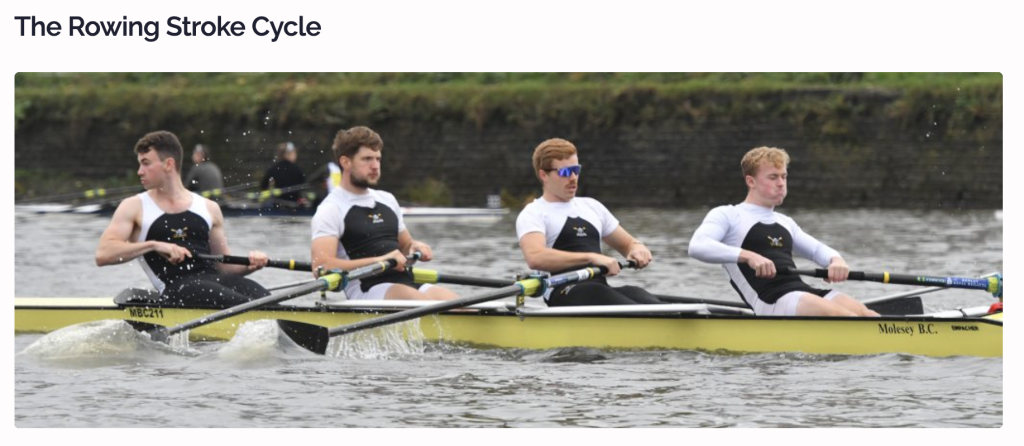
The top row of knuckles is on top of the handle - not in your palm, not in the tips of your fingers.
15:00 Learn to move the handle in your hand not your handle with your hand.
16:00 Open versus closed grip
19:00 You don't need to grip the handle - you guide it.
Water supports the blade in the water.
Oarlock supports the blade on the recovery
How tight to hold the handle?
21:00 How much pressure to put on the handle?
23:00 The sweep grip. How wide to hold the handle.
Inside versus outside hand roles.
Avoid wrist tendonitis by taking the load with your back / shoulder not your wrist.
27:00 Cranking your wrist with pressure stresses the carpal tunnel - the "Harley Davidson Method".
Use an elastic band as a guide for you hand if you move it around during the stroke or it drifts.
In sweep the grip effectiveness changes from outside hand to inside hand as you move from catch to finish.
Don't let you hand come off the handle as you get to the placement.
30:00 Drills for grip
34:30 Posture in rowing
The extremes are the gymnast and the couch potato.
Pick a mid point.
Work on your posture all the time. Not just in the boat.
In the car - adjust the rear view mirror; use the head rest so you sit with your ears over your hips; neutral spine is more resistant to injury.
38:00 During the drive phase you don't want pressure on your vertebrae you want it through your hips.
Keep low back supported
Make posture a habit in your daily life.
Further resources
Timing the catch, how it should feel, drills to improve the catch.
01:30 This Past Week - what we do to advocate for masters rowing. When procedures for communication don't work out through an organisation.
Lake Safety committee - many users of the water.
09:00 The placement of the oar at the catch.
Get pressure on the blade is key to moving the boat well.
You are moving while placing. The entry is the final action of the recovery - your wheels are still turning. It's important not to stop - this causes missed water.
Minimise missed water equals minimising slip.
As the blade enters it's traveling in the same direction as the boat.
Get fully buried before putting pressure on the handle.
Read and watch the full video series on the rowing stroke cycle - 6 episodes from catch to finish.
11:30 Visualise what you want at the catch.
Describe it in words. This helps you understand.
The difference between where the bottom edge of the oar touches the water and where the blade buries is missed water.
14:00 Hands lead the recovery
The handle moves further than the seat.
15:45 Checklist for good blade placement
24:00 Advanced tip to minimise slip
Have soft hands to let the water do its work
As it is buried, maintain distance between the thumbs until you feel pressure on the blade.
27:00 Thumbs along the handle drill
Don't chicken out - keepp the motion going
30:00 Row at 3/4 slide to work on the entry.
Make your corrections here because you are on the move
Backsplash is an exaggeration drill
When timing is good the splash is small
A small v-shaped splash front and back of the blade is desirable.
36:00 Row circles with one oar or in a pair. Create a controlled environment for learning.
Continuing our series about the rowing and sculling stroke and what each phase should look and feel like plus drills on how to coach yourself to improve.
02:30 This Past Week - what we do to advocate for masters rowing.
Organising groups of different skills
Crew racing lineups article.
09:00 Jess Di Carlo reviews book of the month Socrates the Rower. Rowing as stress relief.
See more rowing books on our blog.
Building power as you move into racing.
Technique for the drive:
Get the blade into the water.
Mechanics - move the boat past the blades and not pushing the blades through the water.
Focus on lower body - legs, hips and push on the footstretchers.
Maximise stronger muscle groups and use them first.
Pressure on the handle and footstretcher are the same.
Read and watch the full video series on the rowing stroke cycle - 6 episodes from catch to finish.
Get feedback by checking your oar shaft. Look at it.
Is it changing blade depth? this shortens the time in the water.
Wash happens if you don't extract the blade at the right time.
Slip is if you don't have purchase on the water at the start of the drive.
Purchase at the catch is sometimes called grip on the water.
22:00 Practice rowing feathered on the drive to find the correct height of your handles.
Identify a visual reference point to check you have the correct height.
Initiate the drive with the legs and hips and later bring in the body swing.
Pressure on the foot stretcher - the whole food goes flat on the footstretcher - this is the moment to bring the body swing in.
25:50 Swing through the perpendicular point of the oar handles.
As you do this you start to bend your elbows.
The blade is moving to the pin at this point.
Continue to hold pressure so the blade doesn't tear the water.
If you lose the pressure that hurts the release.
30:00 Practice the drive - legs only rowing.
Add resistance with a bungee.
A good way to get more proprioception into your joints.
34:00 Push a refrigerator
Activate the glutes - this supports the lower back
Activate the lats - this gives a solid shoulder girdle
Together these solidify the torso for the drive.
36:30 Drill - finish all three at the same time - legs, back and arms.
Exaggeration drill - do for 10 strokes
This teaches how you can adjust your movements.
38:15 The result is shown in your puddles
They should be tight dark circles.
39:30 An exercise for swing and rhythm.
Learn to trust your blade. Get your head out of the boat and stop looking down.
Put the blade in the water and look up at the sky. Add your head mass to the leverage.
43:00 The boat is stable when the oars are in the water.
We continue our series exploring all the parts of the rowing stroke.
04:00 This Past Week - what we do to advocate for masters rowing.
10:00 The coxing "plank" and the shoe straps
13:40 The recovery begins when the blade exits the water and continues until it returns into the water.
In practice, I teach it as the beginning of when the knees rise on the slide.
16:30 You've done the preparation for the catch already. Simplicity is key.
Let the wheels of the slide move and only your legs are changing position.
Feathered blades on the recovery and your wrists are bent
You need weight under the handles
Level out the back of your hand and forearm
In sweep use the outside hand to keep weight above the oar handle.
The square up can mess with the rhythm
The point at which you release. your knees - you don't need your body fully over until quarter slide. We prefer that your hands are past your knees and the body has shifted to rock forward.
Read and watch the full video series on the rowing stroke cycle - 6 episodes from catch to finish.
23:45 Release the knees gently. Bring the boat underneath you.
Get the arms out first - the handle leads the recovery.
Focus on the slide seat rolling past.
Be poised and relaxed.
Deactivate the muscles and remain poised without tension.
Strength training can teach you how to activate and release muscles.
34:00 The jelly legs exercise - Rebecca explains how to teach this and practice it yourself.
38:00 Slide in time with the boat. Feel the glide.
Give your muscles the rest so as to gather energy for the top of the slide.
Don't chicken out at the top of the slide. Recovery continues until the blade is in the water.
Continue to compress - you're slowing down. Stay on the arc around the pin especially in sweep.
41:00 Decrease your tension by 1 percent.
Practice this in your crew all rowing together - you can't get the feeling with only half of you rowing.
The Stroke Cycle - recovery
What is the difference between the stroke finish and the release? Are these just different words for the same thing?
01:00 This Past Week - what we do to advocate for masters rowing.Faster Masters 1k racing programs are published for May/June or September peaks
What is the difference between the release and the finish?
Bio-mechanists say the release is when the blade exits the water.
The finish is a position of your legs/body/arms when the power phase of the stroke is complete
The release is the action of pressing the oar out of the water.
- extract with your hand pressing down on the oar handle - you must have weight over the handle
- simultaneously directing your weight into the oarlock so you exit cleanly.
11:00 Press your palm downwards using only your forearm.
This is tricky because the boat is moving fast at this point.
There is a tendency to rush it - keep it continuous is your goal
Exit quietly - listen to the oarlocks
Check your collar doesn't pull away from the oarlock /gate.
Read and watch the full video series on the rowing stroke cycle - 6 episodes from catch to finish.
16:15 The Open Oarlocks drill - helps teach you to keep pressure on the oarlocks.
Test different release points - 1, 2 or 3 cm away from your body
Look at your puddles - tight swirls in a circle. This is what you want.
Timing off your foot pressure will tell you when to release.
This is where you transition to weight back on your feet.
How you sit on your seat is important.
Check you aren't too far back.
Maintain the handle speed and sequence.
30:00 Separate the arms away from the body rock forwards - the swing.
You should feel your shoulders behind the hips.
It's hard to get a good rhythm without this movement executed well.
33:30 How much rock over should you do?
Shift your weight to the front of your seat
Let the hands lead the body rock - when fully straight your arms pull your body forward.
Actively think hips move towards the bow.
39:00 Train yourself to listen and feel the boat.
To get our monthly articles for inclusion in your club newsletter sign up here.
Satisfaction gained from rowing often comes from measuring progress
02:00 This past week
06:00 British Rowing Plus magazine article by Rebecca Caroe Goals and Measuring Training for Masters
07:45 Marlene reads the article - process goals and measured achievement goals.
12:00 What will help you move towards your goal? Diary your testing every 6 weeks.
18:00 Resources and rowing measurement suggestions included in the article. Using an app or speed coach to record data Metres per stroke at rate 18 a measure of base paddling speed A 20 minute erg test for fitness Faster5 Fitness Assessment includes the details
20:45 Heart rate is not a good measure of training intensity Row set distances or set time. Marlene likes Stroke rate 22 for 20 or 30 minutes as a regular workout.
25:00 At what intensity do you row the 20 minute test? The best effort you can on the day - it is a test. However you can’t row 100% every stroke, you have to last the distance. How to find the ideal 500 meter split which you can maintain at “comfortably hard” for the full time. You can increase the split a little during the piece. You just feel that the test is an honest reading of your capacity on that day.
29:30 Tips on goals for non-racing masters.
Technical goals - how many strokes can you row with blades off the water? Endurance goals - distance before you need to take a break. Marlene is not a fan of talking in the boat for team boats. Testing breathing - can you breathe through your nose or your mouth? Steering tests- through the bridge without over-steering.
32:00 Rate of perceived exertion scale Small wins matter.
35:30 Fitness evaluations cause less anxiety over time. Have a routine of how you approach the tests. Make them regular, part of your practice.
37:00 Is it better to rate high with low pressure? It depends - rigging affects this, gearing and your physiology. Use the Rigging for Masters Webinar to find what’s right for you.

Join our community and get our exclusive Faster Masters Rowing Magazine, packed with tips, techniques, and inspiring stories. Includes four new articles monthly.
