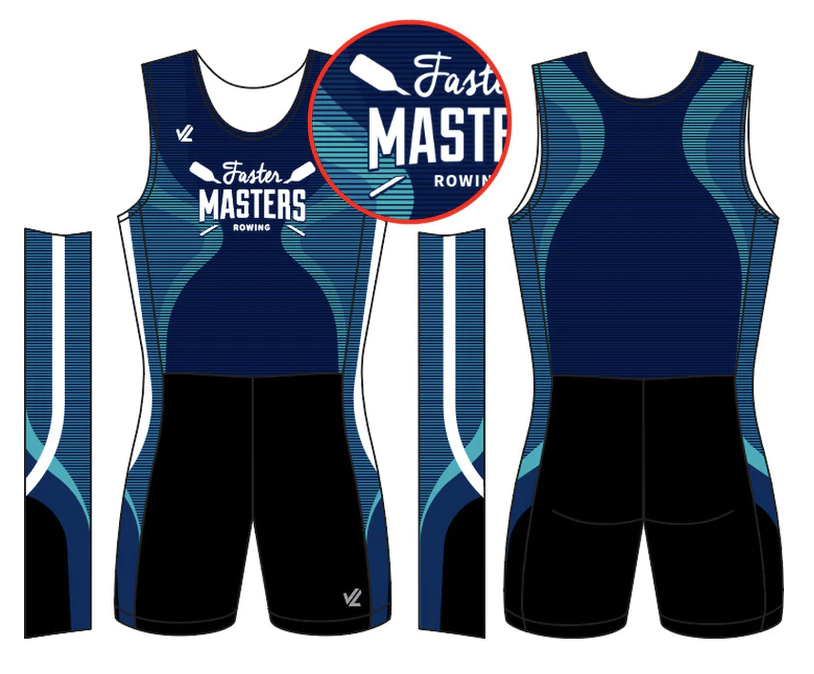
See all the 2022 range of rowing gear from Faster Masters
Why sell clothing?
Rebecca explains
We wanted to create a "talking object" for our community. When you are out and about in the rowing world, you may not know that someone is also a Faster Masters Rowing community member and so by wearing clothing with our brand on it, you can easily spot others who might enjoy connecting with you. They will already know that you are a like-minded athlete who is on a journey of technical improvement and learning how to age well and still keep rowing.
Faster Masters Rowing are advocates for masters within the sport - we lobby federations to take their masters members more seriously, to provide the services which masters need, to bring the older athlete to the foreground in rowing. We are the backbone of the sport, we volunteer, we coach, we pay our dues and we deserve to be acknowledged and recognized as valued community members.
Live in the R.O.W. [rest of the world]?
Worry not, use these shipping forwarding services to send your parcel from a USA address to your home. For the Rest of The World, use either US or EU store. BUT JL recommend using a mail forwarding service like HopShopGo (Australia) or YouShop (NZ) 6 US options. They don’t ship to every country.
Rebecca has a great rowing hack for situations when you need a coxswain but a suitably small person is not available.
Her club designed a "plank seat" for the coxswain.
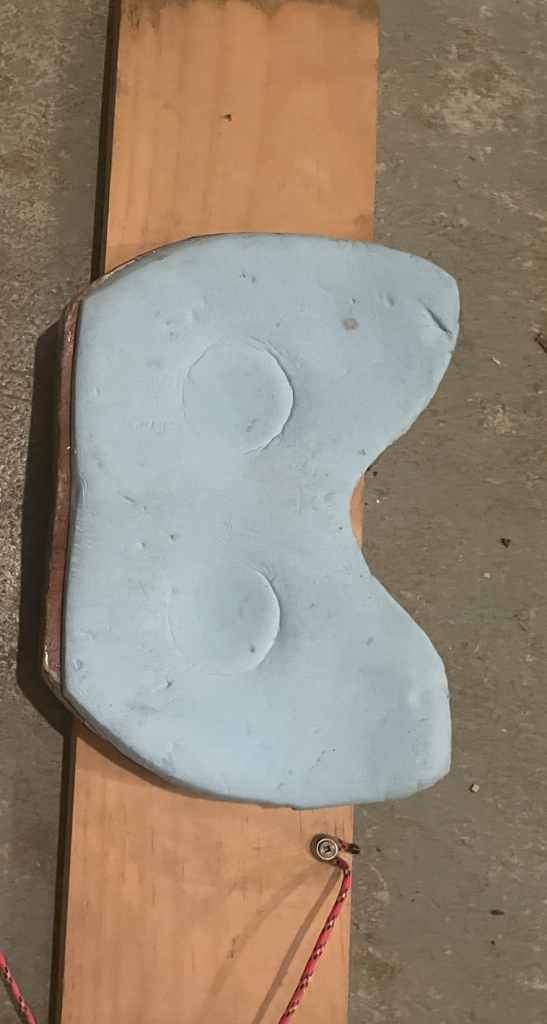
View of plank with sculling seat screwed on top
How to build a cox's plank seat
We took a plank of wood and found an old sculling seat top (we removed the undercarriage). The one we chose happened to have light blue foam seat pad glued to it - but you don't need that. It's just extra comfort.
The plank is around 20 cm wider than the width of the boat where the cox sits - so there's no chance it will slip down.
Screw the seat to the middle. And we also added a pink lanyard with a clip on the end. This loops over the steering wires as a safety feature in case the plank falls into the water during the outing - it won't float away.
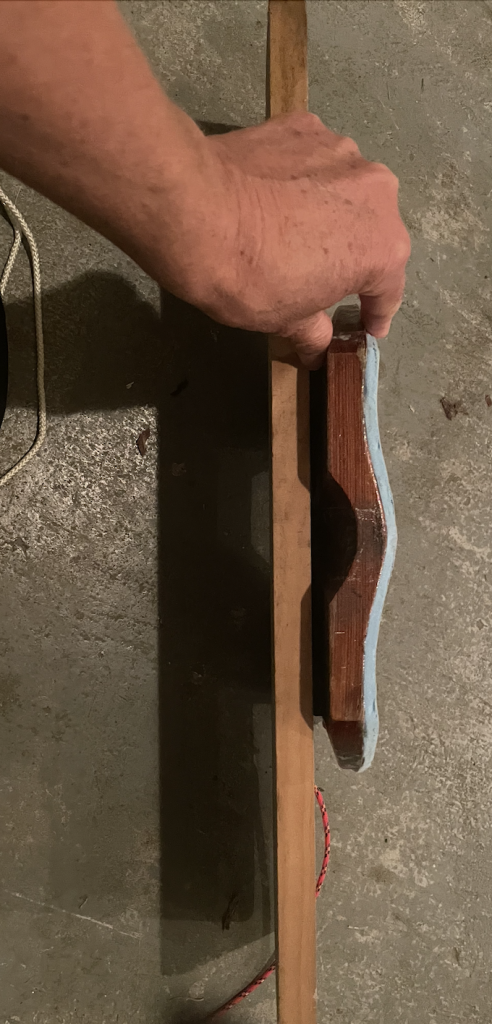
Side view of the cox seat showing depth of the plank and the seat top.
As a club board member or committee you want to keep your members in touch with what's going on around the club.
Often it's hard to think about what to write - so much is repetition - wash the boats, remember to switch off the lights, the social event dates, regatta calendar. You are likely seeking something new to put into your rowing club newsletter.
Use Faster Masters Articles
We write detailed articles on a range of topics suitable for masters rowers of all ages.
You can use these (copy paste share) for your own club newsletter or social media pages. We only ask that you mention we wrote them - that's all! Sing 'em, yodel 'em, strum to 'em - just tell the folks we wrote them.
The first article is published here, ready for you to swipe. It's a downloadable pdf. If your newsletter is printed this is the best thing to use - or you can just take the text and copy it into your newsletter software.
We also have articles published on a range of websites Row2k, British Rowing, RowingCrazy. If you're a rowing business - we can write for you too.
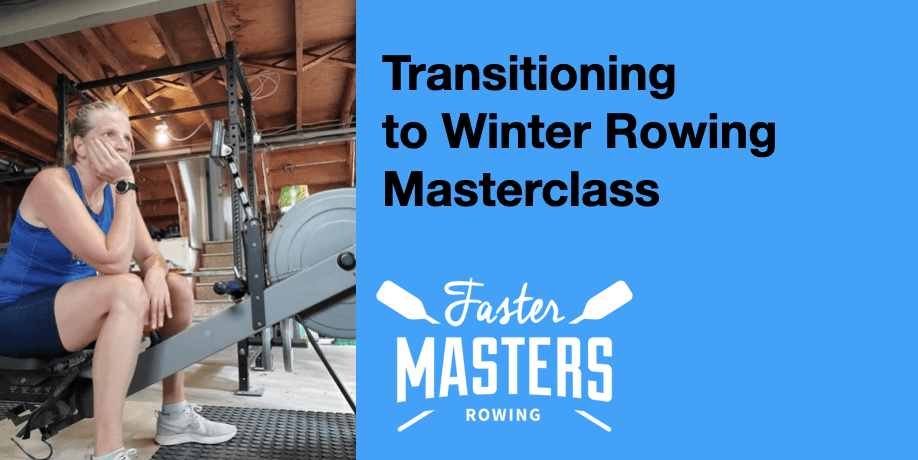
Join Marlene and Rebecca on November 24 for our exclusive masterclass.
Marlene Royle and Rebecca Caroe lead a dive deep into winter training.
how to avoid injury
ways to stay focused and motivated
technical improvements
reviewing your past season
setting new goals
changing modalities
After listening you will
Know what YOU have to change in your training practice
Understand how to measure progress
Have 5 strategies to keep motivated
It will be recorded and the link shared afterwards if you cannot join us live.
Reserve your FREE ticket
This event is not public, you can only see the masterclass by reserving a ticket OR if you are already subscribed to our newsletter, we will share the link with subscribers.
Hi I am unsure about membership. I already have your 3 month 1k training program. I am considering the heads program but unsure how having these two programs may be different from an individual membership. Am currently in Victoria Australia with doubts about any competition before Christmas. If there is it is likely to be heads racing in singles, not my preferred boat so a lot of time on the water is needed to get comfortable in the boat
I can see.the challenge here. Due to uncertainty in the rowing race calendar for masters rowers, it is hard for folks to prepare and to plan ahead.
The difference between 12 week program and a subscription
Faster Masters Rowing sells stand-alone programs which prepare you for 1k racing or Head racing in 12 weeks. These are designed for individuals or crews who have a single focus within a 3 month time horizon.
The 12 week 1k programme is a stand-alone on-water ONLY training plan. The 12 week Head Racing programme is similar, just focused on a different event length.
The subscription has more than just an on-water program - it includes land training, performance, technique, rowing lifestyle and a bonus
Their commitment to rowing is ongoing and that one event is just one of several points of focus during a single year
When you buy the individual membership you will get a monthly water training programme, a land training plan, PLUS 4 additional modules including technique, performance, rowing lifestyle and a bonus. When we write the water training programmes we include BOTH 1k and Head Racing plans so that you can use the one which is most relevant and suitable for your individual situation.
When you buy a subscription we include BOTH 1k and Head race training plans. You get both of them in any of our subscription plans - this means you can switch to the one most suitable for your race calendar at any time.
How we design Faster Masters Rowing training plans
When Marlene and Rebecca first conceived the business Faster Masters Rowing, we studied the rowing regatta calendar for masters rowers around the world.
What we found surprised us.
Our assumption that the seasons would be directly opposites in the Northern hemisphere and the Southern hemisphere was completely wrong. We thought that winter time in the south (April to October) would be head racing season and that the 1k side by side races would be in the southern summer. But that's not the case.
Australia has 1k races in April and May; New Zealand has 1k races in April and September; United States has 1k races in August; UK has 1k races in June and July. It is very concentrated.
And the long distance head races are similar.
Our solution
Every month we write an on-water training programme. For the months leading up to these regatta dates, we give subscribers 2 training programmes. One for 1k and one for head racing. You choose the one best suited to your timeline of regatta events.
Testimonial for 1k Racing Program on Faster Masters Rowing
Thanks to Jennifer who writes
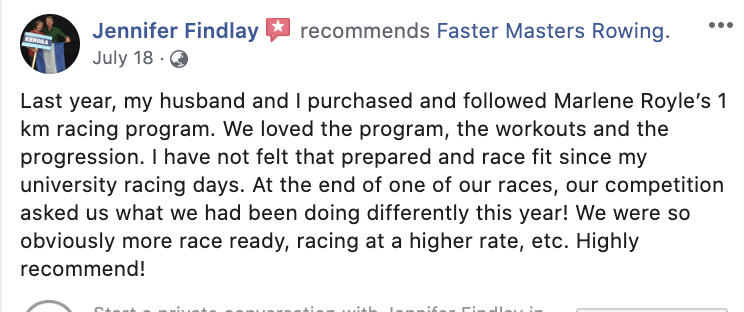
Last year, my husband and I purchased and followed Marlene Royle's 1km racing program. We loved the program, the workouts and the progression.
I have not felt that prepared and race fit since my university racing days. At the end of one of our races, our competition asked us what we had been doing differently this year! We were so obviously more race ready, racing at a higher rate, etc.
Highly recommend!
She purchased the Faster Masters Rowing 1k Racing Program.
Rowing books range from novels to technical advice. We list popular and classic books which you can read. Become a student of rowing by reading rowing books. Let us know if we've missed your favourite.
Here are the items that fit in well in a home gym suitable for rowing training.
Make the room pleasant - add posters on the wall or your favorite music collection so that you really want to be in the room. Working out alone is a challenge so a nice view or good photos of past sporting success can help get you into the right frame of mind. One of Rebecca's acquaintances has his complete vinyl collection in the home gym - he listens to what he wants and the family doesn't get bothered by his music choices!
We want to support you while rowing clubs are closed.
Marlene has written home rowing training programs for you to stay fit while we cannot get on the water.
Training at home during virus lockdown
There are 2 options - the free "lite" version which gives you a choice of workouts at varying intensities. You can train 4,5, 6 or 8 times a week and it suggests a workout type for each day.
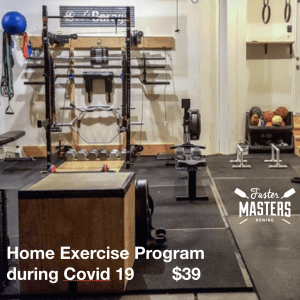
The Full Program version is one month of training on a repeating cycle, land training (strength and conditioning) with additional bonuses such as how to calculate cross training back to rowing equivalents.
A home workout program for rowers FREE Home Exercise Lite Program. In this program are A list of workouts for you to choose; Includes explanation of each and intensity goals; Suggested workout intensity per day; Training 4, 5, 6 or 8 times a week; FREE.
Home Exercise Full Program. In this program are 4 weeks of a training program; Training 3, 4, 5 or 6 times a week; 4 weeks of land training (strength and conditioning); Fitness evaluation series of tests ; An article explaining how to calculate cross-training times back into rowing equivalents; The perfect home training gym checklist; Erg category pace guidelines; Strength training guidelines; Training program guidelines; $39
Thinking through how my fall head season went while training on the Faster Masters Rowing program.
Got a “new-to-me” Fluidesign for my birthday-anniversary-Christmas-Valentines-Day-next-five-years. Now I race again!
I went to my second-ever Masters Nationals. Won my first gold! Composited a whole bunch of boats, met a bunch of people, had lots of fast races.
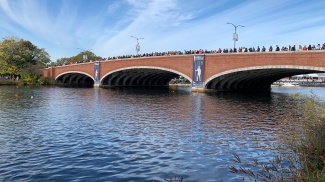
Rowed in my first Head of the Charles.
Medaled in 2 of 3 races at the Hooch and raced my 1x for the first time.
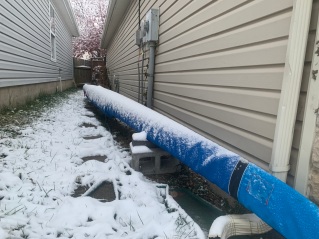
Already had our first snow, and well before Thanksgiving.
Now I’m taking some “me” time and reflecting back on my head season. I used the Faster Masters program for my Head of the Charles and Head of the Hooch prep.
I wish I could say, “Look, ma, I WON ALL THESE RACES,” but I didn’t. But my objective wasn’t necessarily LET’S GO WIN ALL THESE RACES. (Not that it wouldn’t have been nice to win everything…duh, it would have.)
Of the four individual events I competed in since starting the program, I aimed to win two of them. I was 1st and 2nd in those events. Breaking it down:
Goal #1: Race at Head of the Charles. Achieved. Women’s 4+, 17th of 22. I wished it was higher, but our boat felt like we had a solid race. Physical conditioning was solid.
Goal #2: Win Women’s Open 4x at Head of the Hooch. Defending champs. We were 2nd.
Goal #3: Win Women’s Masters 8+ under 50 Head of the Hooch. The boat was defending champs, but it was my first time participating in it. We won.
Goal #4: Race in Women’s Masters 21-42 1x at Head of the Hooch. Gain race experience, work on my pesky nerves problem. Finish middle of the pack. Goal Achieved.
Framed this way, I achieve what I set out to do. I survived, I won some races and definitely gained experience.
So how did the Faster Masters program work for me?
I raced three 5ks over the weekend one other time, back in my 20’s (35 now, ha-ha, so long ago, right?) and I remember it being a miserable experience. Dying in the final race, sore all over, and not enjoying the ride. This year my physical conditioning was way better. Three races were no problem and that’s despite nursing the end of a head cold.
Seeing as how I did the program for the two months leading up to that regatta, I’d say it’s a good sign it establishes a solid base. And I felt strong and capable at HOCR.
I liked being able to compare my progress over the weeks in each month. When you’re training alone, you compete against what you did before. That aspect worked well for me.
I’ve struggled with balancing how much anaerobic training to do; in that regard, I also liked the plan (especially October) and I saw improvement in that area.
I liked the land training workout, but my strength base was at a level that I needed more intensity and variety. So I did the planned land work 2x a week mixed with my current strength routines 2x a week until I had to taper. At that point, I followed the program’s land training to the letter.
The only thing for me I felt I was missing was more meters. I’m not talented enough to do 15k in 60 minutes at a low rate. So I started swapping a 60-minute row with a high meter day, usually 18k, sometimes 21k. But when you read Marlene’s head race advice, she does talk about needing those long meter sessions for aerobic training. It’s just that wasn’t apparent in the training plan.
Overall, I am satisfied with how it worked. Even now that I’m in “off-season,” I’m still feeling really fit and crushing my cross-training work. Except swimming, but that has some different issues.
I want to note that Marlene and Rebecca know the November burnt-out is true for so many of us masters. It made me happy to see that there’s a “recovery” training plan for November. Full disclosure: I haven’t really done it. I looked at it and did two of the workouts. But I just can’t face an erg yet. Those two workouts were because of schedule necessity.
A mental and physical clean break I think is so important to do at least once a year. Especially for me, who spends the majority of my training on that seat and not on the water, I need to step away and let it collect some dust. Right now I’m doing lots of cross-training, experimenting, and having fun. I’ll be jumping back on the horse Turkey Day and kickstarting training again with the Holiday Challenge.
Got a program already? Get our monthly magazine
Join our community and get our exclusive Faster Masters Rowing Magazine, packed with tips, techniques, and inspiring stories. Includes four new articles monthly.
PLUS get the Rowing Fundamentals bundle (US$279 value).