Faster Masters Rowing Radio - the podcast for masters rowers. Tips, advice and discussion from Marlene Royle and Rebecca Caroe. - Focus on leg drive - Testing what to test and how
03:00 This Past Week - we are surveying our newsletter subscribers. Check your email for the link.
Rowing Leg Drive
11:00 The leg drive - strongest muscles. Common sequential flaws - your legs are stronger than your back. Horizontal leg drive compared to a body lift which is vertical. 14:45 Be patient with the leg drive. Put the blade in the water correctly. Lack of stability causes some people to rush the leg drive and blade placement. 16:30 Novices - learn the leg drive first. RowingChat Caryn Davies interview talks about the drive. Pressure on the blade, footstretcher and handles should al be the same. https://rowing.chat/caryn-davies/ 19:30 Shooting the slide, missing water and shoulder lifting are all explained by tactile feedback of these 3 pressures (blade, footstretcher and handles). 21:00 Row with half the crew sitting easy or with a bungee.
30:00 What to test and how.
Testing can be equipment, physiology, fitness and boat speed. First decide what you want to learn about. Then pick a protocol - how you will test. 32:00 How Concept2 tests oar designs. Fixed protocol - always the same. 33:30 Testing on the water - use the sane markers all the time. 38:30 Sub-maximal testing on the erg - you don't need to taper before testing.
n
What should you expect from your rowing as you age?
These observations are from my experience and there certainly are variations between different people but these are some trends.
Check each decade to see what you could be experiencing now and into the future for your own rowing practice.
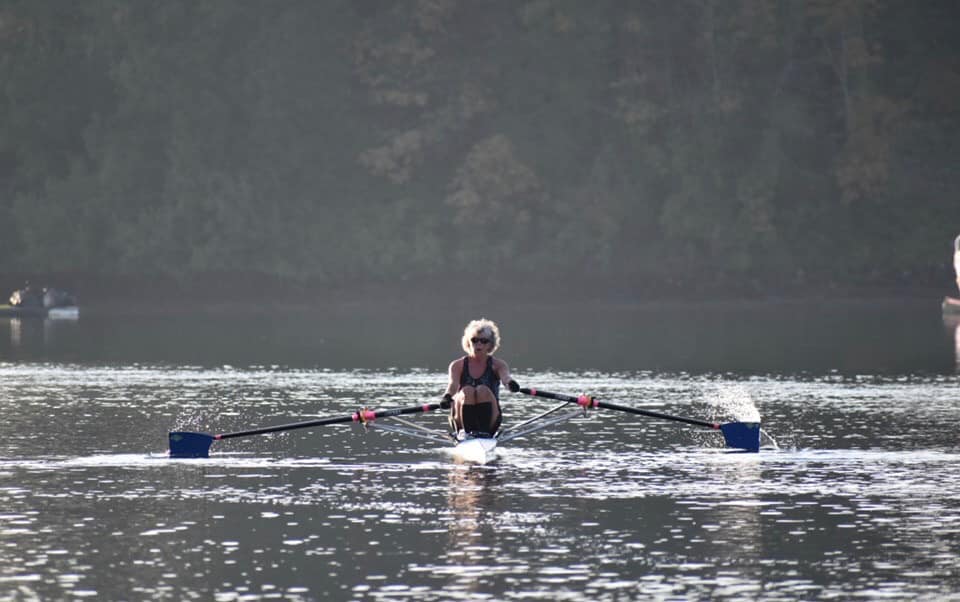
Louise Gardener 1x Gorge Narrows RC in her single scull
20s and 30s
If you are a former student athlete and you continue to train as you start your career, work, or family, you can maintain a high level of fitness close to that of your university years and even surpass that fitness. Provided that you are living a reasonable “athletic-lifestyle” your body has a great recovery capacity and you can certainly push your limits. Many single scullers reach their peak in their late 20s early 30s. In masters rowing, high-energy athletes in this age group often train 6 to 9 sessions per week including land and water workouts. If you are new to the sport 3 to 4 sessions per week will provide a good base for technique, for additional fitness you can include more land-based training.
40s
You will often have limited time in this decade and have to weave your rowing in between your career and family demands. So the key here is making sure that you get adequate training to support the level of your goals and to put a priority on quality workouts versus quantity. Getting enough sleep and recovery is an important training factor not to be overlooked. Top masters in this age group are likely to train 5 to 7 sessions per week; newcomers should aim for 3 to 4 rowing sessions complemented with cross training until a good base is established.
This is one of the most competitively-minded groups in masters rowing; especially among women. This is often a time when your career is well-developed, the children are a bit older allowing more personal time for pursuing rowing goals and motivation is very high. It can also be a time when many new masters join the sport because they now have some additional time to follow personal interests or have the opportunity to pursue athletic goals they had earlier in life but put on hold.
With your 50s come metabolic and hormonal changes in both men and women. Sleep patterns may be disrupted, unwanted weight gain can happen easily, so diet and sleep need to be watched carefully. If you are lacking sleep at night it is important to take short power naps before or after training so that your workout has quality. Recovery has to be monitored more closely and if you are feeling run down, boost your protein intake and take additional rest. Always err on the side of caution. The top competitors in this age group train 5 to 7 sessions per week. Newcomers must take care not to over do it, your body needs time to adapt to the training and doing too much too soon can cause over-use injuries or set backs. Your body must adapt on the cellular level and this takes time.
60s
The body undergoes greater metabolic changes during the 50s decade and so your 60s can be a fairly stable decade provided you have no major or unfortunate health issues to deal with. Retirement offers more training time, at much as one can tolerate safely, and also allows for more recovery time. With each additional year of age, recovery becomes paramount to success. You may not be hitting personal best times compared to when you were 40 but you can certainly maintain a high level of competitiveness and fitness through this decade and keep your erg score pretty steady. Technical improvements become more and more critical as the ability to increase hours of training is limited for recovery reasons. It’s far better to get coaching and gain boat speed technically than trying to pile on extra training hours. Maintaining flexibility, proper recovery, and injury prevention must be closely attended. Top masters in this age group train 5 to 6 sessions per week. Novices may want to aim for 3 sessions and gradually build up as tolerated.
70s
Seasoned rowers, in their 70s are some of the first humans to have been athletic most of their lives. This age group is no less competitive than any younger age group especially on the international masters level. Athletes have reported to me that when they turn 70 their body goes through another major change as it did in their 50s, primarily that the body’s response to exercise becomes more unpredictable.
Typical workouts now require much more recovery, two to three days compared to one day in years past but it can change from week to week. The main factor here is to continue your training but be flexible to adjust for your recovery needs. Some days you may need to simply go for a walk if it means the next day you can again have a quality workout. You may want to look at varying your weekly schedule to be one day on one day off or two training days followed by a rest day, or include active rest days between harder rows. Again, it is very individual and one has to be prepared to adjust as your body dictates. There is every reason to continue to get coaching to row better, to maintain flexibility and muscle mass, and to maximise your time on the water. It’s also a great way to get out in team boats and row for health, friendship, and well-being.
80s and 90s
This age class is growing and I suspect it will only continue to grow in years to come. Already 70-year olds tell me that they can’t wait to move into the next age group. I repeat all the same points for the 70-year olds with an even great emphasis on recovery and injury prevention. Always err on the side of caution. Safety concerns should be paramount in conjunction with health and well-being.
Creating rowing training groups which encompass athletes of different speeds and skill levels is a big challenge for a rowing coach.
You may find different ways of doing this from setting crews comprising faster and slower athletes so the average boat speed is similar, to setting off your slowest crews first and allowing the faster ones to overtake them. Doing pieces for time not distance is another easy way to keep crews closer together.
You can do the first piece, with crews starting level, then start the second piece based on who was in front at the end. This could be as a staggered start or a time handicap from a level start.
When an athlete does not stick with the group this makes it challenging - having acceptable behaviours in the group and the coach needs to reinforce these with the group for this to work.
Timestamps to the show
04:30 This Past Week - Things we have done to advocate for masters rowing
Rebecca has launched expressions of interest for the peer-to-peer coaching clinics.
Marlene led the Functional Movement Assessment webinar/
08:40 Faster 5 Stroke power - Getting the most meters per stroke out of your boat. Strength training is important for masters in order to stimulate muscle recruitment. Hormone changes in men and women affect your muscles.
Important for developing a good rhythm contrast between drive and recovery. Easier learned with a more experienced rower.
13:30 Finding and creating appropriate training groups as a coach or organiser.
A group of single scullers - treat it as a pod that works together. Keep the group together relative to boat speed. The coach has to be strict to make people follow directions.
What to do if someone is disruptive or chooses not to join in with the group.
To get coaching stay rowing near the coach.
Three crews of different speeds and one coach - we had the 500m rule where you had to stop rowing if you got further away from the coach. We used the stationery stability drill to kill time until the others catch up.
22:00 Alternatives to a speed coach for rating. Ways to monitor your rating without using electronics.
Luka Spik says it's important to row without devices because it helps you focus on feel and rhythm.
28:00 Randall foils discussion about how they increase the load on the athlete.
What is the issue you are trying to solve using the foils? Is it keeping the drive horizontal - is it better to learn to scull properly and not use a device?
35:00 Death of a coach - how it affects you. Honouring their memory. Larry Gluckman died this week.
n
Rowers need to have strong fingers to control the oars. Our expert coaches, Marlene and Rebecca, explain
exercises to improve finger and forearm strength
how to build aerobic base while training for the CrashBs
Exercises for fingers and forearm strength
We got this question
Could you recommend some exercises to improve finger and forearm strength? My fingers and forearms often tire from trying to feather correctly without using my wrists,
4 rowing hand strength options
First it pays to check you have got the basics correct in your equipment and the technique you use to turn the oar (feathering and squaring).
The back of the hand and wrist should not drop below the oar handle
Handle grip size - get the correct size for your hands. Most sculling oars come in 3 sizes - small, medium and large. The correct size is one where you wrap your fingers around the scull handle and your thumb can overlap with the tip of your finger - not quite to the first knuckle. This is just a guide. some people prefer larger or smaller handles. Sweep handles do not always offer size variations.
Initiate the turning movement with your fingers and wrists. Starting the rotation and getting the movement started is what takes the most strength. You don't need to turn the full 90 degrees as you square and feather using your fingers or your wrist. If you get the rotation to 45 degrees, the oar will continue to turn under gravity and drop onto the flat of the collar. Try to find the minimum amount of turning momentum you can give with your fingers / wrist and then relax your grip and let the oar finish rotating without assistance. For sweep, the inside hand does the turning and you can use the same technique to move the rotation to 45 degrees as above.
Make sure the back of your hand and wrist never falls beneath the level of the handle. Because you need downward pressure on the handle to help roll the oar. See picture below
Check your boat set-up. Are you able to achieve the correct static positions at the finish? These are legs straight, back leaning backwards 5 degrees, with blades buried under the water your thumbs should be on your lower ribs / bra strap area, your wrists flat, elbows at 90 degrees to the oar shaft. If you cannot achieve this position - seek advice on adjustments you can make to seat height, oarlock height and shoe height.
4 Exercises for finger and forearm strength in rowing
Curling the fingers and knuckles exercise. [Watch the video for this.] Your extensor muscles aren't strong. Flexor muscles are 4-6 times stronger. They are meant to grip and so get worked more than extensors. This helps strengthen the extensors.
Elastic band for strengthening the intrinsic muscles in your hand.
Wrist strength - take a small weight in your hand. It's important to stabilise your forearm. Hold your wrist over the end of a table and flex up and down and side to side.
String on a dowel rod - roll it up and down with a 2-3 lb weight on the end. Use both hands for this.
Timestamps to the video
19:00 If you have osteoarthritis - don't push yourself into inflammation and swelling with your rowing practice. Don't use your thumb to apply internal pressure on the oarlock either if you have osteoarthritis. 20:00 How tight should you hold the handles? As if you're holding a kitten, puppy or a small bird - Firmly enough so the animal doesn't struggle, not so tight that you crush it.. 23:00 If your forearms wake you up at night feeling restless. You should stretch them. Do the "Karate Chop" drill on the recovery and Open Palm Sculling drill. 26:00 Trigger finger syndrome can be developed from rowing. The anular ligaments get pulled and swelling happens in the tendons.
28:00 How to train for both speed and endurance simultaneously. If you are doing CRASH-Bs erg race in March and enter the 30 minute and the 500m sprint event. Follow the Faster Masters Rowing training plan first and foremost - pick the 1k racing plan. If you have extra time include a 40 minute low intensity row or aerobic cross training session. 32:30 Keep the group together - over the holidays stay in touch with your crew mates and become accountability partners. Community matters in masters rowing.
Rebecca and Marlene explain The Faster Five essentials for rowing
Technique, Bladework, Stroke Power, Racing and Fitness Assessment.
Timestamps to the show
12:00 We launch the Faster Five. These are principles which are important to learn, how to practice and what to practice. Things to pay attention to and key reference points.
The Faster Five represents the Faster Masters Rowing philosophy of teaching and a structure for you to plug into when you are studying rowing and learning how to become the rower you want to be.
16:00 Faster Five - Technique . Reference points so you can practice on your own. It takes thousands of strokes to learn the correct technique. It takes 3 seasons to become a sculler and 2 seasons for a sweep rower to feel they can apply good power in both sweep and sculling.
19:30 Faster Five - Bladework. timing and co-ordination is important. When you hold something in your hand (the oar) your brain thinks it's part of your hand. This is why it takes a long time to learn. Reduce your wash and blade is a key part of the learning from the Faster Five. The timing, finesse and precision takes drill work, focus and concentration. Developing high speed co-ordination is key to becoming a skilled rower.
23:00 Faster Five - Stroke Power - this comes after the bladework which brings confidence to your rowing. Power requires you to trust the oars and use your body weight. Learning the sequencing, being explosive and being effective at moving the boat.
26:00 Faster Five - Racing - the principles of racing well. Mental and physical, starts, steering and race strategy. What works for you and your crew. Back up plans. Relevant for all rowers whether you race or not because you can test yourself and get progress markers.
30:00 Faster Five - Fitness Assessment. A battery of tests to gauge your quality of rowing including stroke power, VO2 max, anaerobic threshold. Comparing the results works on both an erg (watts) and on water (500m spit to watts). The relative comparison gives proportional fitness measures. This changes over time.
34:30 If you are injured and come back to rowing your test shows you the right level of intensity you can manage.
38:00 Where to get the Faster Five. Link is in the website footer https://fastermastersrowing.com/courses/the-faster-five/
When you subscribe to ANY monthly recurring program on Faster Masters Rowing the Faster Five is included as a welcome gift.
When athletes stop doing our training program you lose a lot. You lose commitment, you lose engagement and you lose someone else coaching and doing the thinking for you.
When you stop doing our training program you lose fitness, you lose your edge and you don't stay engaged and showing up. When successful athletes stop doing the Faster Masters program 100% of the time they never maintain the results they had on the program. Success does not carry on without an ongoing, developing training program.
40:00 Faster Masters is more than just a training program. Faster Masters is not babysitting athletes. Depth of instruction and insight from masters specialists. The Faster Five took us months to complete and includes our years of coaching expertise.
Masters feel like "disregarded" athletes - we are on a mission to get the sport of rowing to appreciate masters athletes. What we can bring to them, the goals we have are important. We deserve respect. We are building a global family of athletes.
n
Rhythm is talked about as an almost mystical achievement in rowing circles - some call it “swing” and it’s often described as the reason you lost a race or had a bad outing. “We lost our rhythm”.
Today we will demystify rhythm, explain what it is and how you can learn to row with rhythm and be confident about getting the crew boat rhythm back if you lose it.
What is Rhythm in rowing?
Rhythm according to Marlene Royle is a sense of ease, the flow experience. Your oars going in and out of the water on time, you feel relaxed and you move through the transition from power phase to recovery phase without hesitation.
That sounds lovely, but why is it so important?
The number one reason rhythm is important is due to your body weight sliding up and down the boat hull. As the hull surges forward, your body is moving in the opposite direction towards the stern. If the two movements are out of sync, then the sense of rhythm is lost, the boat feels heavy to row and it goes a lot slower. Your body mass is moving in the wrong direction and actively slowing the boat.
Teaching rhythm is challenging because it’s best learned by sitting behind someone more experienced who knows how to row with rhythm so you can copy them.
The benefits of rhythm include an ability to keep going when wake or winds hit the boat and threaten to disrupt you, when you are alongside another crew, your crew doesn’t start to follow their stroke rate (seriously, this happens!) and lastly, you move in time with the hull through the surge in power and with lightness on the seat through the recovery.
Before you can learn rhythm there are 4 critical parts of the stroke cycle where you must have confident bladework and know how to produce stroke power.
The crossover of your hands in sculling is a key reference because it’s where you complete the stroke cycle (in sweep it’s getting weight back onto your feet on the recovery).
Being able to follow the person in front accurately
During the acceleration phase of the stroke, you must be able to increase the boat speed
And being able to manage the transition from the power phase to the recovery phase smoothly
Remember you are decelerating the boat three quarters of the time during the rowing stroke at low rate (because your oars are out of the water). The amount of time spent during the drive phase does not change much regardless of rating but your time on the recovery does change a lot when rowing at low rates. And so being skillful at managing the recovery is critical to rhythm.
Teaching rhythm
Rhythm in rowing is the contrast between the drive and the recovery.
There are 4 principles to rhythm
Keep your handles in motion, especially around the back turn of the finish
Try not to make abrupt changes
Be accurate with bladework
Without stopping your handles, take more time than you think you should around the back turn of the finish
Remember Rebecca says, everyone has rhythm even complete beginners.
As you row, try changing rhythm and see if you like the change.
Drills for you to try
Row a half pressure catch and a three quarter pressure finish - this exaggerates the acceleration through the drive and can help you create a stronger rhythm.
Learn how to use the body swing mid-stroke. This has to be trained and can be learned with a simple sequence of 10 strokes at each of these stages:. Body swing only (straight arms); body and arms; half slide; full slide normal rowing. Try to keep your back swinging when you move from body swing only to adding the arms.
Try to blend legs, back and arms and end the stroke with all 3 parts together. Then after you have made a strong second half of the drive phase, move smoothly to the recovery and notice the contrast. That’s rhythm.
Masters Rowing Advocates
Would you like to publish this article in your club newsletter or website?
Join our Masters Rowing Advocates mailing list and we will send you one article a month. Sign up on our Advocacy page.
Marlene Royle and Rebecca Caroe discuss drills as part of rowing practice for masters rowers.
Timestamps
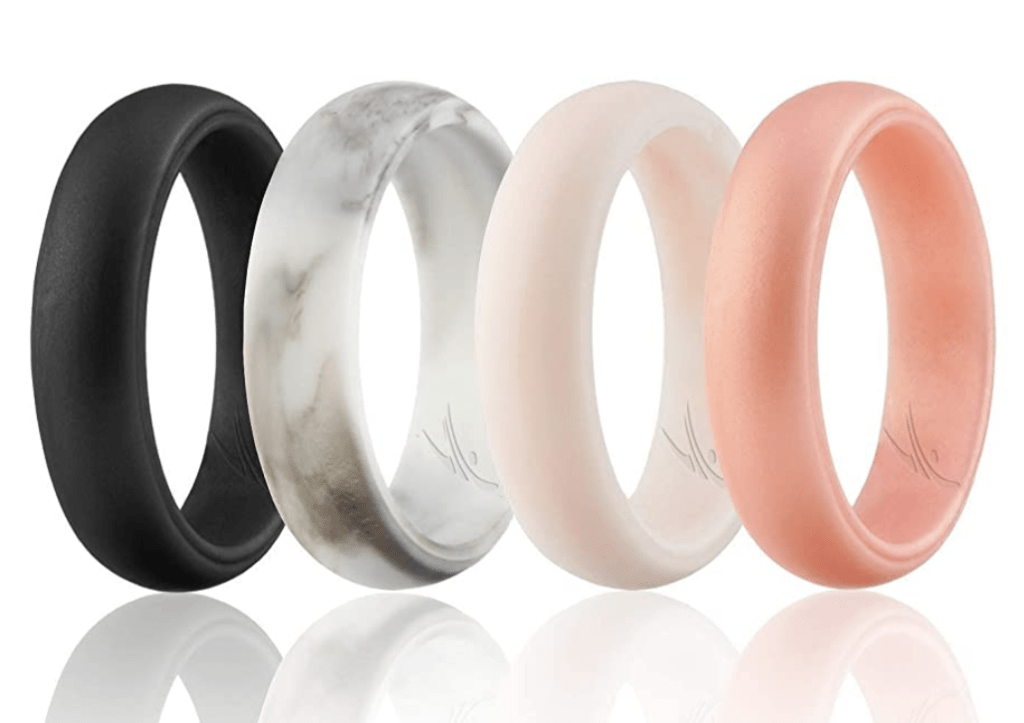
03:00 Silicone wedding ring
Silicone wedding rings
Men https://amzn.to/2V5tIqH
Women https://amzn.to/2YjEbRp
06:50 Carol Daley’s question I’d like to hear Marlene Royle, Rowing Coach discuss a little more in depth about inboard and its relationship to rigging.
Goal of rigging is to have a longer stroke / time in the water.
Effective stroke length incorporates physiological comfort.
16:00 changes in rigging should not create pain or aches 2-3 days after you make the change.
The role of drills for learning rowing technique
What is the role of drills?
To perfect an element of the stroke cycle
To develop coordination by isolating a movement
To focus the attention of the athlete on learning a new motion
To provide technical challenge
How to use drills
To correct a flawed sequence
To blend a new element into the stroke cycle
To help a crew develop symmetrical patterns and sequences at various rates
To solidify technique at race pace
When to do drills in a practice
When attention and physical power are high, prior to fatigue i.e as part of warm up or at start of session
Incorporating drills into a technical session, give examples 4’ Cat VI 1’ drills, short sets of 5 stroke of a drill then back to regular rowing
During a rest period
22:00 New to the 1x tip is get a good posture in the boat - get a correct placement and correct extraction of the oars. Get your own oars allows for customisation of rigging.
27:00 When to incorporate drills into your practice. The role of drills. Drills for crews are about blending timing and rhythm. Early in the session your attention is at a peak.
31:00 The push and pull drill.
Sponsors
Help Rowing Retailers Recover – We are building a giant sale page with a product from as many rowing businesses as we can. Send us your favourite product web link and we’ll get permission to add it to the page. #RowingSale
Blake Gourlay book - the Movement of Rowing
https://rowing.chat/sponsor/blake-gourlay-book/
GPS Speed orders
https://rowing.chat/sponsor/gps-speed-orders/
n
Marlene Royle and Rebecca Caroe answer your rowing questions. [Ask Me Anything].
Help Rowing Retailers Recover
We are building a giant sale page with a product from as many rowing businesses as we can. Send us your favourite product web link and we'll get permission to add it to the page. #RowingSale
Timestamps
03:16 AMA and please comment. 05:30 Should you vary racing starts by weather or boat type? Your start is 2% of your race in a 1k. So it's not very important in the big picture. Practice your starts square blade to check you are being effective and have clean transitions. 10:30 The Danish Women 4x in 1996 start sequence. Our job is to follow the stroke 15:24 The best race Marlene ever had in Aiken, South Carolina in a single. "I remember thinking tap out a fraction earlier for the first 20 strokes. Keep the wheel spinning." 17:20 If you have a peak race, go back 24 hours and identify what you did to set you up for that performance. You need to learn how to turn on / off your stimulation depending on what type of racer you are. 20:50 The concept of work through the pin. The arc of the handle and where the blade is set in the water. The time the blade as adequate force on it during the stroke cycle. For your rigging - draw a line through your 2 pins and set your footstretcher so when you're at full compression the centre line of your hip are at least level with the line. Or slightly to the stern. You can work on the catch angle later. 30:30 What is VO2 and why do you need to row slow and fast to train it? Create the metabolic conditions in your muscle cells with training. Increase capillary density in your muscle cells. When racing for masters you race multiple times a day. The person with the best recovery ability will win more races on the last day. 37:15 Will a blade move bow-ward over the course of the drive from the catch to the release? Yes just as the blade is entering and getting loaded up. 41:00 Rowing in salt water you are slower is this resistance training? 43:00 Rebecca's Stuck at Home Rowing Club t-shirt arrived. Thanks to @SquareBladesRowing https://squareblades.com/ 45:00 Sculling tip for 1x if you are new to the single scull after lockdown - pausing at the finish drill. Check your handle heights and spoons are on the water. Also check your elbow position. 50:00 We can help rowing businesses recover from lockdown. Send us your favourite product's URL so we can build the giant #RowingSale page 53:00 For rowing in rough water should you stay long or shorten the slide - which works best? 56:00 Messages from listerners in Sweden, Oregon, Australia, Scotland 58:30 How do you stay light on the seat and remind yourself to do it? Use your glutes. The Drive Suspension Drill is part of the June 2020 technique lesson in the Faster Masters Rowing subscription programs https://fastermastersrowing.com/our-courses/
n
One of my boat mates texted about her on-water training that morning and said, “What’s it, like, 17 days now?”
“16. Get it right,” I answered.
My little reminder.
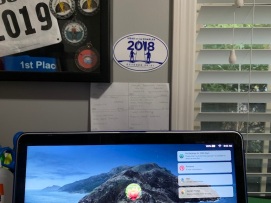
It’s getting real. I bought this sticker at last year’s Head of the Hooch, when I decided going to the Charles was the goal for 2019. HOCR seemed far away and beyond reach when I taped over my work desk at eye level. It’s been reminding me for eleven months of the objective. Now HOCR is 12 days away.
All this training is coming to a head.
Training Plan Update
This week started on the tail end of a head cold. I had to take it a little easier the first two days. Tuesday’s workout was the epitome of starting the workout feeling crappy and ending channeling a rowing diva. That’s how I knew I’d recovered enough to attack it 100%.
New workouts from Faster Masters for the month! The theme is getting accustomed to speed. Feel the burn. Embrace it. Push through it.
I loved the anaerobic work, which is saying something since usually I struggle. I’ve had this weird dichotomy of being decent at laying down low-rate steady state meters, decent at high-rate sprint work, but sucking at the “middle.” All that AT work seems to finally be showing some results.
My favorite workout had the training note to “pretend you are practicing passing” during one of the burn sections. A lovely visual for the press and shift back to base.
My notes were sprinkled with positivity from Tuesday on. “Powerful.” “Press harder next time.” “Feeling awesome.” All good words to have as the countdown plows through the teens.
For the recovery work, I watched YouTube videos from prior Head of the Charles. This may not have been the smartest choice because as the coxes made moves and the vocal tension swelled, the rate crept up. Whoops.
Still, a fun way to pass the time and “visualize” while getting in precious meters.
Strength training maxed out this week. I finished the build with a 1-rep strength test on Thursday. My shoulder press remains as miserably weak as ever, but the deadlift and squat improved since last assessment three months ago.
Now land training goes on taper. The rowing workouts will follow.
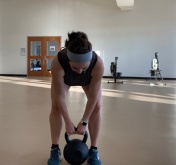
Kettlebell deadlifts.
I can’t believe I’m throwing around “taper.” That makes it even more real.
One rowing friend shared a Head of the Charles memory, calling the regatta “Charlesmas.” Merry Charlesmas everyone!
A tiny vacation in training
I executed only five training sessions this week. I mentioned last week having scheduled travel over the weekend. Our wedding anniversary is Monday after HOCR. Usually we go camping, but I’ll be in Boston. We can’t go the weekend after because the Head of the Hooch is two weekends later, so I’ll be training some more.
Whoa! A cave!
So here’s our camping weekend! Mammoth Cave National Park, one of our Kentucky bucket list items. The river running through the park is too low to safely row with our current drought. The boat stayed home, so I banged out an erg and land session Friday before we left and took two days “off.” With our hiking and chasing a toddler, it was an active rest period.
I know some hardcore people will probably ding me for taking a “vacation” right before such a big event. Taper’s coming right? Maybe this vacation is a small step towards the taper.
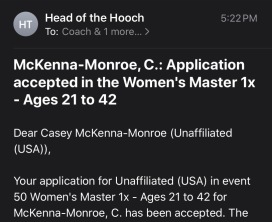
Head of the Hooch
The deadline crept up on me. I’m in an Open Women 4x and a Masters Women 8+, but had nothing on Sunday. I didn’t actively seek anything out, nor did it help that the Open 4x was moved to Saturday. By the time I realized I had two days to deadline, I couldn’t find anyone looking for a rower to fill a seat. Sunday’s schedule isn’t conducive to a lot of racing anyway with two hours of singles.
After consulting with three people, dredging up my courage, I did this.
First race in the new boat. Right now most of my mental focus is on succeeding at the Head of the Charles, but I’ll be real nervous about this one after October 18.
What’s up this week?
I’m a little concerned the head cold turned into a sinus infection. It seemed okay until our trip this weekend. I’ll be jumping on top of that as I don’t need antibiotics or breathing trouble during the HOCR.
I have another week of pushing the rowing, while strength training is now about maintenance. I’m looking forward to challenging the sessions to see some gains from the first week of the new workout.
You may be wondering what is Faster Masters? Let me answer by telling you a story. Grab a comfy seat and a drink because this will take you 5 minutes to read.
Rebecca and Marlene are your coaches were both competitive younger rowers and (eventually) reached the end of their careers and wondered what to do next.
Marlene had won major titles in sculling and sweep rowing including a US National Championship, a Collegiate National Championship, and a Head of the Charles title. In 2000, she set two world records on the Concept2 Indoor Rower; Rebecca was a multiple Henley Womens medalist and Henley Royal Regatta finalist with a string of medals in UK head races, National Championships and a Boat Race win.
After deciding to quit, both were at a loss about what to do next. Was there a place in rowing for older athletes with a bit of coaching experience?
The enthusiastic older athlete
We noticed in every rowing club there is a committed group of older athletes who enjoy training together; they turn up regularly; they get given old boats to use and after training they huddle in the club room drinking tea and clearly having a good time chatting together.
Everyone ignores them.
Nobody knows or cares that they were once the youthful heroes of the club training all hours and winning medals. Once in a while a newcomer is added to the group – someone who moved to the area, a visitor from overseas or a beginner who is starting off in the sport. They quickly become embedded in the group and make friends.
The group gets no coach allocated to advance their skill; they do boat maintenance as they use older shells and oars cast aside by other training groups. And yet …… they have the same commitment and drive to succeed, to gain skill to move a shell with ease, becoming fit, strong and worthy competitors in rowing races.
Rebecca was asked by David Hudson and Andy Ripley to coach the masters group at Tideway Scullers School, her London UK club. This was a revelation. The group were the most attentive students, striving to effect technique changes, hungry for more drills and more insights to make their boat go fast. And as they trained with a common focus and a common purpose they got faster, stronger and that season they won medals, lots of them.
Marlene took a different path – becoming a coach and starting Royle Row training camps and coaching.
They both realised that in clubs around the world there are people who are hungry for coaching; for a focus for this workout and a gauge to measure progress towards a goal.
But before the internet, few of these masters could find each other and learn together or share experiences. They met occasionally at the Head of the Charles or the FISA Masters Regatta but dispersed afterwards back to their clubs. The group was global but isolated, motivated but un-focused, and unable to progress.
Mike Davenport, the author of the Nuts and Bolts Guide to Rigging and Jimmy Joy, host of the Joy of Sculling Conference were both guests on Rebecca’s RowingChat podcast. Behind the scenes, both gave invaluable advice on how to share coaching advice from a distance, how to bring groups together for a few days to progress rowing skills; how to write clear explanations allowing the reader to coach themselves.
And this motivated both Marlene and Rebecca to continue coaching and to start sharing their knowledge online. Rebecca started writing for an audience of Masters on the Rowperfect blog; Marlene penned articles for Rowing News and gained new club clients who bought her training programs.
The snowball started to roll.
The final chapter begins
Rebecca invited Marlene to be a guest on RowingChat in January 2016 and that episode became one of the most downloaded ever. They continued chatting offline and decided to launch an advisory self-coaching program called Faster Masters Gold. It is 8 detailed ebooks covering drills, technique adaptations as you age, developing stroke power and racing 1k. The globally popular Facebook group, Masters Rowing International was formed and it continues to grow (>6,000 members) as masters find a community with aligned interests ready to answer each others’ questions and share advice. (Do join and invite your rowing friends.)
The time for Faster Masters Rowing had come
These early successes encouraged Rebecca and Marlene to continue to discuss the challenges faced by masters athletes. We found ways to overcome the isolation; to demonstrate smart ways for more people to really enjoy rowing and to make strong progress towards goals - despite clubs who do not support and encourage masters.
Today, Faster Masters Rowing helps athletes with a framework for their training and an online community to support the trials of training, injury, setbacks and to celebrate progress towards success.
Got a program already? Get our monthly magazine
Join our community and get our exclusive Faster Masters Rowing Magazine, packed with tips, techniques, and inspiring stories. Includes four new articles monthly.
PLUS get the Rowing Fundamentals bundle (US$279 value).