Should you row differently in a headwind and a tailwind? Why and what and how?
01:00 This Past Week - what we do to advocate for masters rowing.
07:00 Lifeproof phone cases - demonstration of how to use them in a rowing boat.
Browse LifeProof phone cases [affiliate link]
Waterproof phone cases damage and drop-proof for mobile phones
08:30 Belt clip attaches to a boat tie on the rigger
10:00 Handlebar attachment - a small tube stays on your boat.
12:00 Arm strap - 3 different lengths of velcro
Headwinds slow down your power phase.
Expect a more 1:1 ratio.
Be patient, control what you do - don't allow the wind to rush you.
Maintain your length in the water.
Adjust stroke rate so it feels good. You aren't "rowing in mud".
18:30 Changes to make for headwind rowing
22:00 If you have chop and rough water which often comes with a head wind.
Rowing in peaks and troughs of waves.
Keep handles low so you clear the wave caps.
Article - rowing in rough water
Tailwinds push you along.
It can feel like the power has got away from you and you've missed the catch.
Less load on your blades.
27:00 Changes to make for tailwind rowing.
Practice before any race event - don't make first-time changes on the day.
1 cm adjustment on the button.
Move footstretcher one notch for Tailwind - towards the stern.
Clams can be kept on your oars and used / adjusted on the water.
The wind can change too during an event!
37:00 Experiment in smaller regattas with these changes.
Stepping into a single is one of the more difficult tasks a newbie sculler encounters. Entering your shell from a dock should be done as gracefully as the strokes you take once you are on the water.
To get out, push your handles sternward, butt the handles together again, scoot up the slide, take your feet out of the shoes, put one foot back, stand up on the water’s side leg, and step out onto the dock.
If you are saying to yourself, “that sounds pretty tricky,” start a land program to improve your coordination, balance, and flexibility to squat.
Would you like to publish this article in your club newsletter or website?
Join our Masters Rowing Advocates mailing list and we will send you one article a month. Sign up on our Advocacy page.
You can copy the text on this page. Or download the PDF.
We continue our series exploring all the parts of the rowing stroke.
04:00 This Past Week - what we do to advocate for masters rowing.
10:00 The coxing "plank" and the shoe straps
13:40 The recovery begins when the blade exits the water and continues until it returns into the water.
In practice, I teach it as the beginning of when the knees rise on the slide.
16:30 You've done the preparation for the catch already. Simplicity is key.
Let the wheels of the slide move and only your legs are changing position.
Feathered blades on the recovery and your wrists are bent
You need weight under the handles
Level out the back of your hand and forearm
In sweep use the outside hand to keep weight above the oar handle.
The square up can mess with the rhythm
The point at which you release. your knees - you don't need your body fully over until quarter slide. We prefer that your hands are past your knees and the body has shifted to rock forward.
Read and watch the full video series on the rowing stroke cycle - 6 episodes from catch to finish.
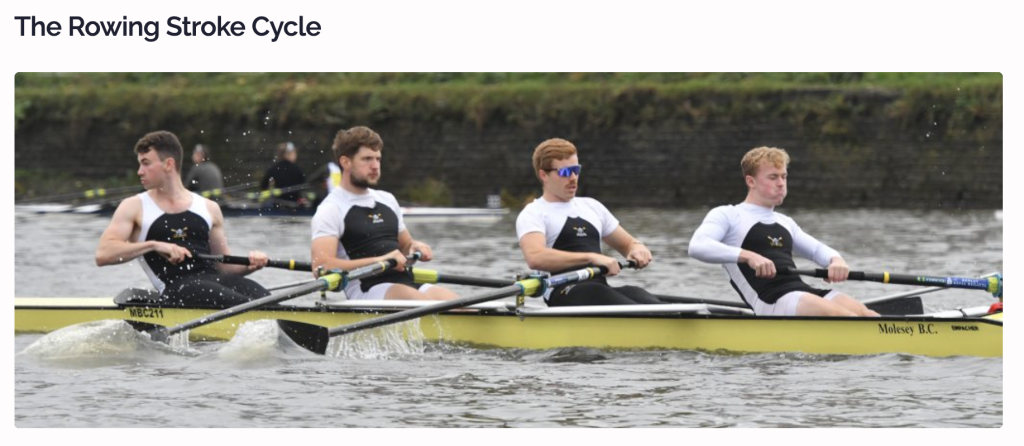
23:45 Release the knees gently. Bring the boat underneath you.
Get the arms out first - the handle leads the recovery.
Focus on the slide seat rolling past.
Be poised and relaxed.
Deactivate the muscles and remain poised without tension.
Strength training can teach you how to activate and release muscles.
34:00 The jelly legs exercise - Rebecca explains how to teach this and practice it yourself.
38:00 Slide in time with the boat. Feel the glide.
Give your muscles the rest so as to gather energy for the top of the slide.
Don't chicken out at the top of the slide. Recovery continues until the blade is in the water.
Continue to compress - you're slowing down. Stay on the arc around the pin especially in sweep.
41:00 Decrease your tension by 1 percent.
Practice this in your crew all rowing together - you can't get the feeling with only half of you rowing.
The Stroke Cycle - recovery
The Stroke Cycle - Balance and Stability PLUS Book of the Month with Jess di Carlo
Support this show with a donation
https://fastermastersrowing.com/podcast
01:00 This Past Week - what we do to advocate for masters rowing.
Ageing Well Webinar
British Rowing Plus article on goal setting
Club feedback on season goals
Jess Di Carlo reviews. Book of the Month - it's womens history month and Jess chose My Olympic Life by Anita DeFrantz
https://amzn.to/36pkjTE
The definition of balance is narrow. It's about the level or set of the boat.
Stability is a wider base of support using the whole system from oarlock to oarlock. Keep the riggers level when the oars are out of the water, keeping connection to the oarlock.
Within the hull keep pressure on your feet and back.
19:30 Watch for oarlocks staying on the button and the collar not coming away from the gate.
Read and watch the full video series on the rowing stroke cycle - 6 episodes from catch to finish.
21:00 Transitioning back onto the water.
Testing your stability and balance - an exercise.
Sit at the finish with blades buried. Press against the oarlock on one side - the boat tips.
Do Drills
In place - finish squared and buried. Tap out the release and put the oars back int he water.
Release and feather
Release, feather and hands away
Release, feather, hands away and body rock forward
All return to blades buried in the water after each attempt.
27:00 Weight in the hand is a key concept in rowing and sculling.
Demonstrated by Marlene
28:30 Open palm sculling drill
Enough weight ove the handle - how do you know when you have this?
Feel you sat up a little taller - your sternum rises as you rock forward.
This week's podcast is about maintaining your posture at the finish, particularly your back angle.
01:00 This Past Week - what we do to advocate for masters rowing. Learn to row course; US Rowing Masters Conference 2nd April 2022; Australian Masters Rowing Championships venue changed to Ballarat, Victoria.
06:00 - NEW feature - Book of the month with Jess Di Carlo
Perfect Balance by Aquil Abdullah.
"One man's personal struggle to be the best in a sport and to find meaning from efforts that repeatedly fall shy of their mark."
Aquil Abdullah
We have a list of rowing books which you may enjoy.
The challenge is sitting and maintaining awareness of your posture.
How to maintain spine position
The finish is at the end of the leg drive - the handle is close to the body and a slight layback of your body.
13:30 Pay attention to the lumbar spine
How to tell if you have swung your body back too far.
15:00 Protect your lower back in rowing.
Keep your chest high helps with neutral spine.
17:15 Feet connected to the foot stretcher helps keep your finish posture as well.
How to do a physical check of your finish position. You need help from someone outside your boat to find this out to give you guidance if you are maintaining that position as you row.
Set up your finish position so your oar handles brush your lower ribs at a specific point so you can tell if you've rocked back too far because your handle is not at that position.
Set up your oarlock height and your foot stretcher so you have a precise place you finish at on your ribs / shirt.
20:00 Compare video of yourself rowing (3 strokes low rate and firm pressure) to a good example of rowing / sculling. What am I aiming for? Compare to what I'm doing in the video.
Motivation is tough in winter, especially if we can only train on the indoor rowing machine.
Support this show with a donation https://fastermastersrowing.com/podcast
01:00 This Past Week - what we do to advocate for masters rowing.
Marlene's article in Rowing News Magazine e-news - Self improvement 101
05:45 Masters Rowing Survey This will take 10 minutes max. It's a global survey on the state of masters rowing and is multiple choice, mostly.
Make your erg work up into a series of mini challenges
Alternate exercises on the erg
20:00 Staying on track during the holidays. Plan to train.
Keep the intensity up 2-3 times per week. Shorter workouts
Go to the party but plan to train the next day. Don't worry about going off track. Have fun.
Be measured if you choose
Future Plans | Faster Masters Rowing Radio
Faster Masters future
- What we've done so far
- What we'd like to do in future
- Your ideas
Support this show with a donation
https://fastermastersrowing.com/podcast
Timestamps
01:00 It's the holidays in USA so Rebecca is hosting solo today.
02.30 US Virtual Rowing convention - Masters Monday will feature Marlene and Rebecca talking on a Vision for the future of Masters Rowing. This link is to the schedule
https://usrowcon2021.sched.com/
- what can you do inside a rowing tank with a group of beginners?
Sweep or sculling
Use the mirrors
Drills for technique
Recommend you stay square blades for beginners. -
Teach the timing points - watch the outside elbow (sweep) both elbows (Sculling) watch the slide.
How to Film the athletes in a rowing tank so they can learn whether they're following accurately.
90 degree square off and 45 degree angle shots - advantages
Roll through the line of athletes and which to focus on and for how many strokes.
we'd like you to be a part of our planning
- What we've done so far - Training programs; webinars (one off)
11:45 Rowers who don't want to race. Would you like a Faster Masters program which suits your goals (technique and skill rather than fitness workouts)?
12:40 What we'd like to do in future - new webinar topics. What would you like to learn?
- Your ideas - A program setting up your rigging, footstretchers and oarlock heights
- Menopause and Rowing
- Nutrition - how our needs change as we age and what we can do about it. Aging well.
13:300 Concierge service - book a 20 minute free meeting with us to answer your rowing questions.
https://fastermastersrowing.com/concierge
Marlene and Rebecca tackle the topic of rhythm in rowing.
- What is rhythm? How to get it, how to lose it and get it back.
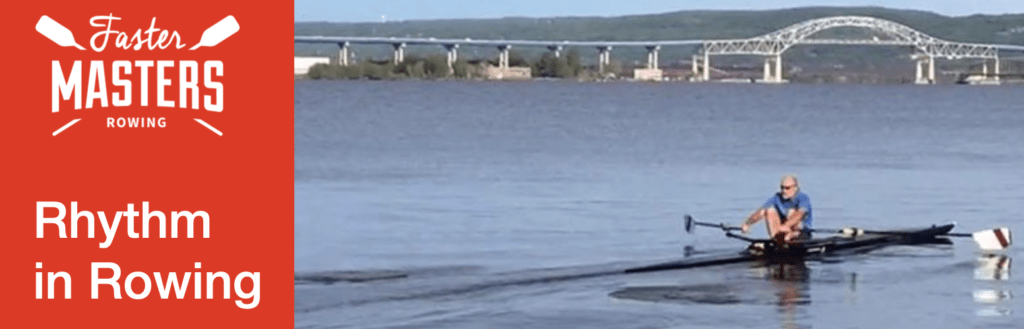
How to get rhythm, learn it and be confident.
04:00 Jonathan Tyson's wife asks we were reviewing stroke and talking about left hand over/ahead of right to allow for the oar handles to pass over one another. She asked why don’t we design / rig so that the oar handles are separated, meaning both hands could stay at the same level during recovery and drive?
10:00 For the 1k racing 12 week programme sold on Faster Masters Rowing, how are the sessions described - is there a 500m split time and stroke rate target, with the split times set based on your ultimate target speed?--Australian listener.
12:45 James Dundon from 612endurance sculling club in Minneapolis, MN reported coordinating a small boats race at a variety of lakes in town every Saturday this summer. Racers are split into four waves. We make it competitive by having the wave winner move up a wave and last place moves down a wave. 3 x 1k pieces
16:00 Rhythm - how do you describe the rowing rhythm? It's hard to achieve rhythm if you cannot trust the oar to use your body weight
20:00 Teaching rhythm to athletes - keep your handles in motion. Try the drill of half pressure catch and 3/4 pressure finish. Trust the oar and load it up in order to trust it.
26:00 Sarah Powell seeks solutions for mounting oars on walls [Munsen Rings]
34:15 Jeanette Brimble asks about timing the exit and start of the recovery transition. Your goal is to release without interrupting the rhythm. Check you are feathering outside the water not in the water. End of the leg drive equals the release timing. Feel the release timing from foot pressure in your shoes.
42:00 Funny boat names
Faster Masters Rowing Radio - the podcast for masters rowers. Tips, advice and discussion from Marlene Royle and Rebecca Caroe.
https://fastermastersrowing.com/register/podcast-supporter/
03:00 This past week. Regattas in New Zealand changing dates for Masters Champioships
06:00 What's in the September Faster Masters program? 3 separate training plans 1k, 5k and HOCR
11:00 Questions and answers
Balance is critical - ensure you lift the sides of the boat first so you have identified the balance point.
Your hands do not need to be directly opposite each other on the sides of the boat.
Also you can hold the boat above your head or on your shoulder and use your free hand to add more control by holding the rigger or the gate - this helps when gusts of wind come.
You can choose to carry at the shoulder or waist.
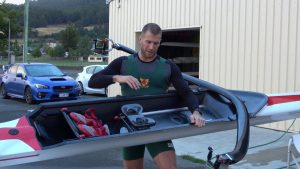
The man in the picture is controlling the boat on his thigh before pivoting the boat above his head.
Check the geography you have to navigate in and out of the boathouse. Do you have to go around corners? How wide is your boat bay - do you need to put the riggers vertical to fit in and not hit another boat?
Rebecca likes to carry her single on her head and use her right hand to pick up the oars and carry them at the same time. It helps her to carry the oars with the shaft along her forearm or wedged against the side of her torso - to balance and control them. To put down the oars, lower the handles to the ground, then use your foot to cup under the shafts - let go with your hand - and gently lower your foot to the ground.
14:00 Racing 17 km and how to adjust 5km program?
Compare your race rate.
Number of sessions a week and choose your core sessions.
Do a 5k time trial on the water. Average split for Cat V intensity is likely 2-3 seconds per 500m slower for a longer race.
23:00 What is a dynamic recovery?
Rowing News has an article by Volker Nolte called Swing or Co-ordination of forces.
Advantageous to approach the change of direction with pressure on the feet. Co-ordinating forces so the foot stretcher is loaded.
29:00 Can drills have a negative effect if used with inexperienced rowers?
32:00 Different styles of rowing - should we be adaptable?
Coaches use different routes to accomplish change. Important to listen to what others say. How you row effectively depends on your body.
36:00 The Sequential versus the Simultaneous power phase in rowing. Leg and back drive phase.
In this episode of Faster Masters Rowing Radio we dig deep into issues you have keeping your boat straight and steering successfully.
The team covers steering using pressure on the oars and steering using a wire "toeing".
Support this show with a donation
https://fastermastersrowing.com/register/podcast-supporter/
03:00 This Past Week - we have been watching a LOT of Olympic sports.
06:30 Listener survey results
Why are you going off course? What's happening, why and how to fix it.
Steer off a point on the bank / horizon align with the your stern of the boat.
Equipment - is the fin straight?
To find out if it's the fin causing the issue - take a few big strokes and stop rowing with oars off the water and let the boat run.... watch to see if it glides straight or goes off in one direction.
16:00 How to correct your steering.
Leverage at the catch for pressure steering.
Is your rudder and fin straight?
Is there tension on the wires
Have a steering shoe that fits
23:00 Steering straight off stake boat with a crosswind
29:00 Steering with an integral rudder and fin. And a canard fin / skeg reduces yaw.
31:00 The club annual steering course with theory and exam - appoint a foreperson for each boat.
Head Racing book by Carlos Zezza has great advice on steering head races
https://amzn.to/3C4QBi4
35:00 How to help those who cannot turn around easily? Divide the jobs so one steers and one looks around and a third does the calls.
Plan your practices so new steers people learn how to steer - half crew rowing; boats side by side; leap frogging;
44:00 Feathering with wet handles - how to do this; essential skills for successfully handling wet scull grips. You feel like you're not in control when they are wet. Loose grip is key.
Join our community and get our exclusive Faster Masters Rowing Magazine, packed with tips, techniques, and inspiring stories. Includes four new articles monthly.